
When starting a fitness journey, few supplements generate as much discussion as creatine. Among the various forms available, creatine monohydrate and creatine hydrochloride (HCl) are two of the most commonly debated. Marketing claims often position creatine HCl as superior due to its enhanced solubility and absorption rate. But for beginners, does this difference actually translate into better results? The answer isn’t as straightforward as supplement labels suggest. This article examines the science behind both forms, evaluates whether absorption rate is a decisive factor, and provides practical guidance for those just beginning their supplementation routine.
Understanding Creatine: Why It Matters
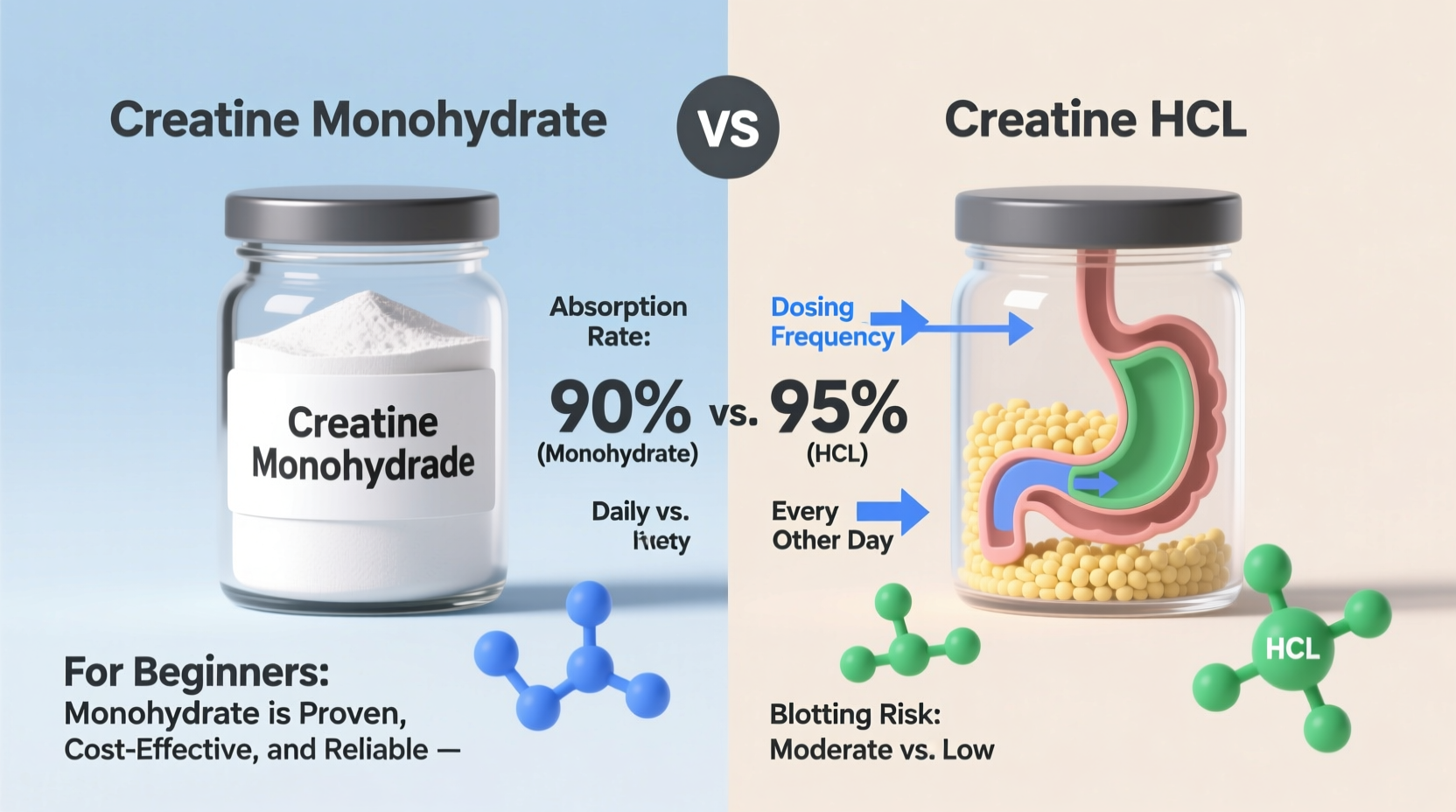
Creatine is a naturally occurring compound found primarily in muscle cells. It plays a critical role in energy production during short bursts of high-intensity activity—like weightlifting, sprinting, or jumping. When you supplement with creatine, you increase your body’s stores of phosphocreatine, which helps regenerate ATP (adenosine triphosphate), the primary energy currency of cells. This leads to improved strength, power output, and training volume over time.
Decades of research support creatine as one of the most effective and safest ergogenic aids available. However, not all creatine supplements are created equal—at least on paper. The two most prominent forms are:
- Creatine Monohydrate: The original and most studied form, typically sold as a fine white powder.
- Creatine HCl: A newer variation where creatine is bound to hydrochloric acid, marketed for higher solubility and lower required dosage.
While both deliver creatine to the muscles, they differ in chemical structure, cost, and how they’re absorbed. The central debate revolves around whether these differences matter—especially for someone new to resistance training and supplementation.
Absorption Rate: What It Means and Why It’s Overhyped
The idea behind creatine HCl centers on absorption. Proponents claim it dissolves more readily in water and is absorbed faster in the digestive tract, leading to less bloating, no loading phase, and greater bioavailability at lower doses. On the surface, this sounds promising. But what does the evidence say?
It's true that creatine HCl has higher solubility—about 10 times more soluble than monohydrate in water. However, solubility doesn't automatically equate to better absorption or efficacy. The human gut is highly efficient at absorbing creatine monohydrate when taken consistently, even if some remains undissolved in liquid. Once ingested, creatine enters the bloodstream and is transported to muscle tissue via the creatine transporter (CRT). This process is saturation-limited, meaning there’s a maximum amount your body can absorb per dose regardless of formulation.
“Absorption isn’t the bottleneck with creatine—it’s uptake into muscle tissue and saturation over time. Monohydrate achieves full saturation reliably and affordably.” — Dr. Stuart Phillips, Professor of Kinesiology, McMaster University
In practice, the minor differences in solubility don’t significantly impact overall muscle creatine levels when dosed appropriately. For beginners, whose muscles are often creatine-deficient (especially if they don’t eat much meat), even standard doses of monohydrate lead to substantial gains in performance and lean mass within weeks.
Comparing Creatine Monohydrate and HCl: A Practical Breakdown
| Feature | Creatine Monohydrate | Creatine HCl |
|---|---|---|
| Scientific Support | Over 1,000 studies; gold standard | Limited human trials; mostly anecdotal |
| Dosage | 3–5g daily (or 20g/day for 5–7 days loading) | 1.5–2g daily (no loading needed, per marketing) |
| Solubility | Moderate; may leave residue | High; dissolves easily in water |
| Bioavailability | High when taken regularly | Theoretically high, but unproven long-term advantage |
| Cost per Month | $5–$10 | $20–$40 |
| Side Effects | Rare; mild bloating possible | Less bloating reported anecdotally |
| Muscle Saturation Time | ~28 days with maintenance dosing | No significant evidence of faster saturation |
As the table shows, creatine monohydrate wins decisively on cost and scientific backing. While creatine HCl offers convenience in solubility and slightly smaller doses, these advantages don’t translate into measurable performance benefits for most users—particularly beginners who aren’t yet pushing physiological limits.
Real-World Example: Two Beginners, Two Forms
Consider two individuals starting their first serious strength training program:
- Jamal chooses creatine monohydrate after reading research summaries online. He pays $8 for a 3-month supply and takes 5g daily with his post-workout shake.
- Taylor opts for creatine HCl based on influencer recommendations. They pay $35 for a bottle and take 1.5g per day, attracted by the “no bloat” promise.
After six weeks, both report increased lifting capacity, faster recovery, and visible fullness in their muscles. Neither experiences significant side effects. Blood tests (hypothetically conducted) show similar increases in intramuscular creatine stores. Despite different products and price points, the outcomes are nearly identical.
This scenario reflects what clinical trials consistently show: once creatine stores are saturated, performance improvements depend on training stimulus and consistency—not the form of creatine used.
What Beginners Should Prioritize Over Form
For someone new to supplementation, focusing on the minutiae of creatine chemistry can distract from more impactful factors. Instead, consider the following priorities:
- Consistency: Taking creatine daily matters far more than which type you use. Skipping days undermines saturation.
- Dosing Timing: While timing isn’t critical, pairing creatine with a meal containing carbohydrates and protein may enhance uptake slightly.
- Hydration: Creatine pulls water into muscle cells. Drinking enough water prevents cramps and supports performance.
- Training Quality: No supplement replaces progressive overload, proper technique, and recovery.
- Budget Sustainability: Spending four times more on a marginally different product isn’t cost-effective long-term.
Step-by-Step Guide to Starting Creatine as a Beginner
Starting creatine doesn’t need to be complicated. Follow this simple, science-based plan:
- Choose Your Form: Start with micronized creatine monohydrate. Look for third-party tested brands (e.g., Creapure®).
- Select Dosage Strategy:
- Loading Phase (Optional): 20g per day (split into 4 doses) for 5–7 days.
- Maintenance Only: 3–5g per day indefinitely.
- Pick a Daily Routine: Take your dose at the same time each day—post-workout is ideal, but any consistent time works.
- Stay Hydrated: Aim for at least 2.5–3 liters of water daily, especially in warm climates or during intense training.
- Track Progress: After 3–4 weeks, assess changes in strength, endurance, and muscle appearance.
- Reassess at 8 Weeks: If results are positive, continue. If not, evaluate other factors like sleep, diet, and training intensity before changing supplements.
This approach ensures optimal results without unnecessary complexity. Switching to HCl later is always an option if gastrointestinal issues persist—but for most, monohydrate works just fine.
Frequently Asked Questions
Does creatine HCl really work faster than monohydrate?
There is no strong evidence that creatine HCl increases muscle creatine levels faster than monohydrate. Both forms require consistent intake over several days to saturate muscles. Claims of faster action are largely theoretical and not supported by comparative human studies.
Can I build muscle without creatine as a beginner?
Absolutely. Creatine enhances performance and recovery but isn’t essential. Many natural lifters build impressive physiques without supplementation. However, creatine provides a reliable edge in strength and volume, making progress slightly faster and more consistent—especially in the first year of training.
Is creatine safe for long-term use?
Yes. Long-term studies (up to 5 years) show no adverse effects in healthy individuals. Regular liver and kidney function remain normal. Those with pre-existing renal conditions should consult a physician before use, but for most people, creatine is one of the safest supplements available.
Expert Insight: What the Research Community Says
“The obsession with ‘better’ forms of creatine is largely driven by marketing. Monohydrate remains unbeaten in terms of efficacy, safety, and value. Until HCl demonstrates clear superiority in head-to-head trials, there’s no reason to switch.” — Dr. Eric Rawson, PhD, ACSM-CEP, creatine researcher at King’s College London
Experts consistently emphasize that innovation in sports nutrition should be driven by data, not hype. While creatine HCl may offer marginal comfort improvements (like reduced bloating for sensitive individuals), it hasn’t proven to outperform monohydrate in muscle growth, strength gains, or cognitive benefits.
Final Recommendation for Beginners
If you're just starting out, save your money and skip the premium-priced creatine HCl. Creatine monohydrate is effective, well-researched, and affordable. The slight differences in absorption rate do not justify the significant cost increase—especially when your body responds robustly to standard dosing.
Instead of chasing marginal gains through expensive formulations, focus on fundamentals: consistent training, adequate protein intake, quality sleep, and daily creatine supplementation. These factors will determine your success far more than the salt attached to the creatine molecule.
That said, if you’ve tried monohydrate and experienced persistent stomach upset or simply prefer the convenience of a smaller dose, trying HCl is reasonable. Just recognize it’s a lifestyle choice, not a performance necessity.




 浙公网安备
33010002000092号
浙公网安备
33010002000092号 浙B2-20120091-4
Comments
No comments yet. Why don't you start the discussion?