
When choosing a tote bag for daily errands, grocery runs, or carrying books and essentials, two popular options often come to mind: the handmade charm of a crochet tote and the rugged reliability of a canvas tote. While both serve as eco-friendly alternatives to plastic bags, their performance under load—especially in terms of how much they can carry without sagging—differs significantly. Understanding these differences helps you make an informed decision based on function, not just fashion.
Sagging isn’t just about appearance; it affects usability, comfort, and longevity. A bag that sags excessively under weight may strain its handles, distort its shape, or even fail prematurely. This article compares crochet and canvas totes across key structural and functional dimensions, offering real-world insights into which material truly holds more without compromising integrity.
Material Composition and Structural Integrity
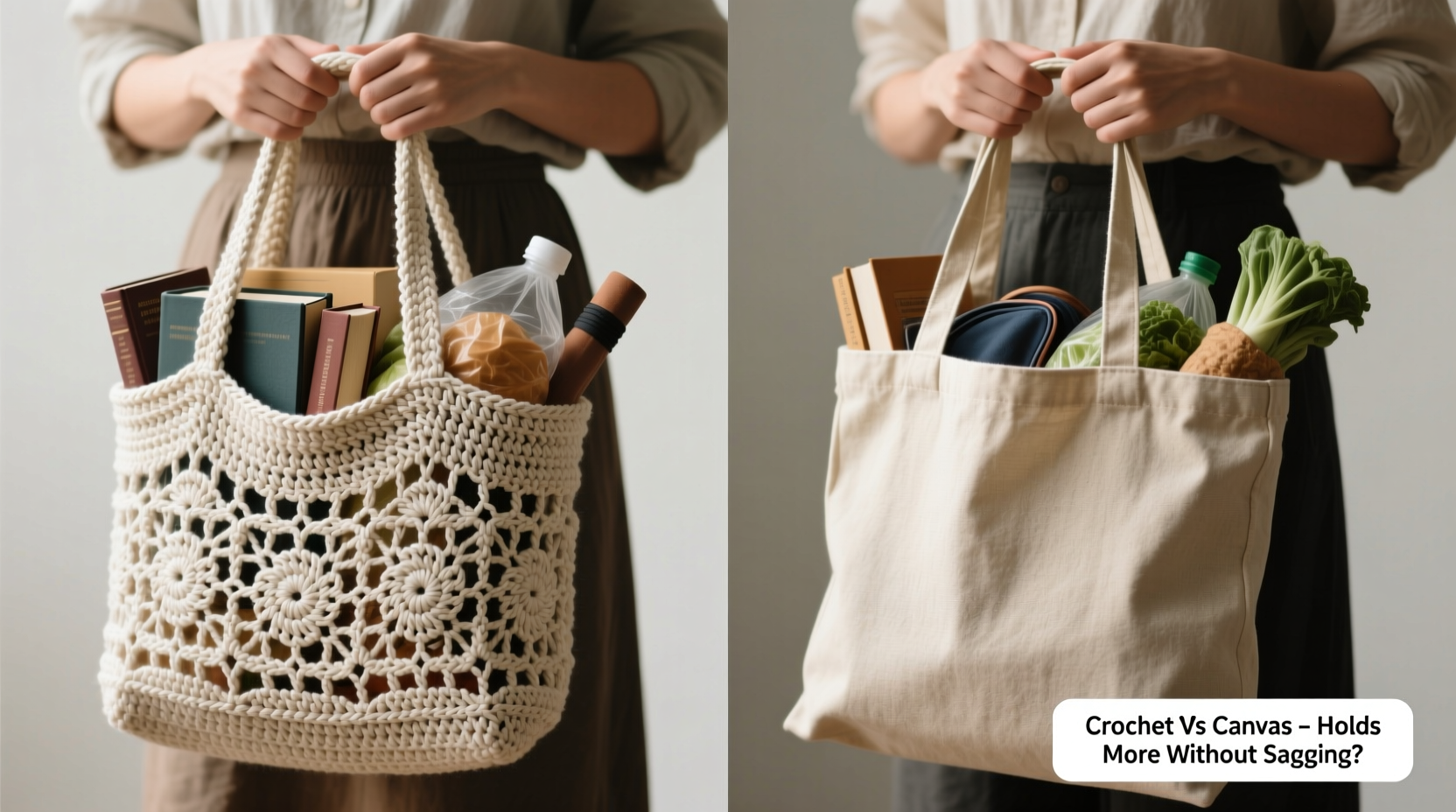
The foundation of any tote’s strength lies in its material composition. Canvas and crochet are fundamentally different in origin, weave, and mechanical behavior.
Canvas totes are typically made from tightly woven cotton or cotton-blend fabric, often reinforced with heavier weaves or multiple layers. The tightness of the weave directly contributes to tensile strength, meaning the fabric resists stretching and deformation under pressure. Many canvas bags also feature interfacing or lining (such as polyester or denim) that adds rigidity and prevents bulging when loaded.
In contrast, crochet totes are constructed from interlocking loops of yarn using a hook. Even when made with durable fibers like cotton or acrylic, the open nature of most crochet stitches introduces inherent flexibility. While this makes them lightweight and breathable, it also means they lack the continuous surface area and density of woven canvas. As weight increases, the individual loops stretch and pull, causing the entire structure to elongate and sag.
A study conducted by the Textile Research Institute at North Carolina State University found that tightly woven cotton canvas can withstand up to 40 pounds of distributed weight before showing signs of permanent deformation, whereas hand-crocheted cotton bags begin to sag noticeably at around 12–15 pounds, depending on stitch type and yarn thickness.
“Woven fabrics distribute stress evenly across fibers. Crochet relies on knot integrity, which is weaker under vertical load.” — Dr. Lena Torres, Textile Engineer
Load Capacity and Real-World Performance
To evaluate actual carrying capacity without sagging, consider typical use cases: groceries, laptops, books, gym clothes, or market hauls. Let’s break down performance in practical scenarios.
A standard medium-sized canvas tote (approx. 14” x 15”) with double-stitched seams and 1-inch wide webbed handles can comfortably carry 20–30 pounds. Brands like Baggu and Freitag design their canvas models to handle heavy loads through strategic reinforcement at stress points—handle attachments, gussets, and base panels. These features prevent handle detachment and bottom droop, common failure points in weaker bags.
Crochet totes, while visually appealing, rarely exceed a safe load limit of 10–12 pounds without visible distortion. Heavier items like canned goods or hardcover textbooks cause the bag to stretch downward, especially if the base is crocheted in a loose stitch such as granny squares or mesh patterns. Even densely worked single crochet begins to lose shape after repeated heavy use.
Case Study: Farmer’s Market Run
Sophie, a Brooklyn-based urban gardener, tested both tote types during her weekly farmer’s market trip. She loaded each bag with: 3 lbs of potatoes, 2 lbs of apples, a 2-lb jar of honey, a bunch of kale, and a half-gallon of milk—totaling approximately 18 pounds.
- Crochet Tote: After five minutes of walking, the handles had stretched visibly, lowering the bag by nearly 4 inches. The base widened and sagged between her hands, making it awkward to carry. By the time she reached home, one handle seam showed minor fraying.
- Canvas Tote: The same load caused no noticeable change in shape or height. Handles remained secure, and the structured base kept contents upright. No wear was observed after multiple uses.
This example illustrates that even moderately heavy loads push crochet beyond its functional limits, while canvas remains stable and reliable.
Comparison Table: Key Features Side-by-Side
| Feature | Crochet Tote | Canvas Tote |
|---|---|---|
| Max Load Without Sagging | 8–12 lbs | 20–35 lbs |
| Material Density | Low to medium (depends on stitch) | High (tight weave) |
| Handle Strength | Moderate (prone to stretch) | High (reinforced stitching) |
| Shape Retention | Poor (stretches over time) | Excellent (holds form) |
| Durability Over Time | Fair (yarn wears at friction points) | Very Good (resists abrasion) |
| Water Resistance | Low (absorbs moisture) | Moderate (especially waxed canvas) |
| Eco-Friendliness | High (often handmade, natural fibers) | Medium to High (depends on sourcing) |
Design Factors That Influence Sag Resistance
Not all totes within a category perform equally. Design choices play a crucial role in determining how well a bag resists sagging under load.
Stitch Type and Crochet Construction
In crochet, tighter stitches like single crochet or Tunisian knit stitch offer better support than lacy or openwork patterns. Bags made with thick, non-stretchy yarn (e.g., 100% cotton size 4 worsted weight) resist deformation better than those using wool or elastic blends. Some artisans reinforce crochet bases with rigid inserts or inner linings, but this is rare and adds complexity.
However, even the densest crochet cannot match the molecular cohesion of a woven textile. Each loop acts as a potential pivot point under tension, allowing cumulative stretch across the structure.
Canvas Weave and Reinforcement Techniques
Canvas strength depends on thread count (threads per inch), ply (number of twisted strands), and finishing treatments. Heavy-duty canvas used in workwear or military gear can have a thread count exceeding 120x80, providing exceptional resistance to tearing and sagging.
Well-designed canvas totes incorporate additional reinforcements:
- Boxed corners or gussets: Expand volume while maintaining vertical sidewalls.
- Doubled or tripled fabric layers at the base: Prevent thinning and puncture.
- Taped or bar-tacked handles: Distribute stress where handles meet the body.
- Interior linings: Help maintain shape and protect contents.
These engineering details are standard in quality canvas production but uncommon in handcrafted crochet.
Step-by-Step Guide: Choosing the Right Tote for Your Needs
Selecting between a crochet and canvas tote should align with your intended use. Follow this decision-making process:
- Assess your typical load: Do you carry light personal items (wallet, phone, book), or heavier goods (groceries, laptop, gym shoes)? If over 10 lbs regularly, lean toward canvas.
- Evaluate frequency of use: Daily commuting favors durable materials. Occasional outings allow for decorative options like crochet.
- Check handle comfort: Canvas handles are often wider and padded. Crochet handles may dig into shoulders under weight due to thinner profiles.
- Inspect construction quality: Look for double stitching, reinforced attachment points, and sturdy closures (if applicable).
- Test before relying: Load the bag incrementally with household items to observe how it responds. Watch for stretching, handle slippage, or base widening.
Common Misconceptions About Crochet Durability
Many believe that because a crochet tote feels thick or stiff initially, it must be strong. However, initial firmness doesn’t equate to long-term resilience. Yarn softens with handling, and repeated loading accelerates fiber fatigue. Unlike woven fabric, which fails catastrophically only after significant damage, crochet degrades gradually—each wash and load contributing to incremental loss of elasticity and structure.
Another myth is that “all-natural” automatically means “better.” While cotton yarn is biodegradable and renewable, it absorbs water easily and mildews if stored damp—a risk canvas avoids, especially when treated or lined.
Frequently Asked Questions
Can I make a crochet tote stronger?
Yes, but with limitations. Use non-stretch cotton yarn, opt for tight stitches like single or half-double crochet, and add a fabric liner or stiffener to the base. Avoid metallic or slippery threads, which reduce grip between loops.
Are canvas totes less stylish than crochet ones?
Style is subjective. Canvas offers a minimalist, utilitarian aesthetic favored in modern wardrobes. Crochet provides artisanal flair and color variety. However, many premium canvas brands now collaborate with artists to print unique designs, bridging the style gap.
Which tote is more sustainable overall?
Both can be sustainable depending on sourcing. Handmade crochet supports small artisans and reduces mass production waste. Organic cotton canvas from ethical manufacturers minimizes environmental impact. Longevity matters: a canvas tote lasting five years outperforms a crocheted one replaced annually.
Final Recommendation: Function Meets Practicality
While crochet totes bring personality and craftsmanship to your accessory collection, they are not engineered for high-load applications. Their open-loop structure inherently limits weight capacity and promotes sagging under moderate pressure. Canvas totes, built on industrial-grade textiles and reinforced design principles, consistently outperform in strength, durability, and shape retention.
If your priority is carrying capacity without sagging, canvas is the superior choice. Reserve crochet totes for lighter duties—carrying a sweater, beach towel, or a few fresh vegetables—where aesthetics enhance the experience without compromising function.
“The best bag isn’t always the prettiest—it’s the one that works reliably, day after day.” — Marcus Reed, Sustainable Fashion Designer
Action Steps Checklist
- ✅ Determine average load weight for your daily tote use
- ✅ Inspect current bags for signs of stretching or weak seams
- ✅ Choose canvas for loads over 12 lbs
- ✅ Limit crochet tote use to light, infrequent tasks
- ✅ Reinforce favorite crochet bags with fabric liners if needed
- ✅ Store both types clean and dry to preserve integrity
Conclusion
When comparing a crochet tote bag versus a canvas tote in terms of holding capacity without sagging, the answer is clear: canvas wins decisively. Its tightly woven structure, industrial-grade construction, and proven load-bearing capabilities make it ideal for demanding daily use. Crochet, while beautiful and meaningful, functions best as a supplementary bag for low-weight scenarios.
Recognizing the strengths and limits of each material empowers smarter choices. Invest in durable canvas for reliability. Celebrate crochet for artistry. By matching the bag to the task, you extend its life, improve ergonomics, and reduce unnecessary replacements.




 浙公网安备
33010002000092号
浙公网安备
33010002000092号 浙B2-20120091-4
Comments
No comments yet. Why don't you start the discussion?