
Fall brings crisp mornings, cool evenings, and the constant search for that perfect balance between style and warmth. Among the most popular staples in seasonal wardrobes are hoodies—comfortable, casual, and effortlessly stylish. But a growing trend has sparked debate: cropped hoodies versus full-length styles. While cropped hoodies dominate fashion feeds with their trendy silhouette, many wearers question whether they truly perform as well as their longer counterparts when temperatures drop. The central question isn’t just about aesthetics—it’s about thermal efficiency. So, which one actually keeps you warmer during the unpredictable chill of autumn?
The answer isn't as simple as \"longer = warmer.\" It involves understanding heat retention, fabric distribution, fit, and how your body loses heat. By examining both styles through the lens of thermodynamics, material science, and real-life use, we can make an informed decision on what works best when staying warm is the priority.
How Your Body Loses Heat in Cool Weather
To evaluate the warmth of any garment, it's essential to understand how the human body regulates temperature. When ambient temperatures fall below body temperature (approximately 98.6°F or 37°C), heat begins to escape through convection, radiation, conduction, and evaporation. The torso—especially the core area including the abdomen, lower back, and kidneys—is a primary zone for heat loss. Exposing even a small portion of this region can significantly reduce overall thermal comfort.
In cooler conditions, maintaining a sealed thermal layer around the midsection is crucial. Gaps at the waist, such as those created by cropped tops, allow cold air to enter and warm air to escape—a phenomenon known as the \"chimney effect.\" This disrupts the insulating microclimate formed between your skin and clothing, leading to faster cooling. Full-length hoodies, by covering more of the torso, naturally minimize these gaps and help retain core warmth more effectively.
“Even a two-inch gap at the waist can increase convective heat loss by up to 15% in windy conditions.” — Dr. Lena Torres, Bioclimatic Apparel Researcher, University of Vermont
Design Differences: Cropped vs Full-Length Hoodies
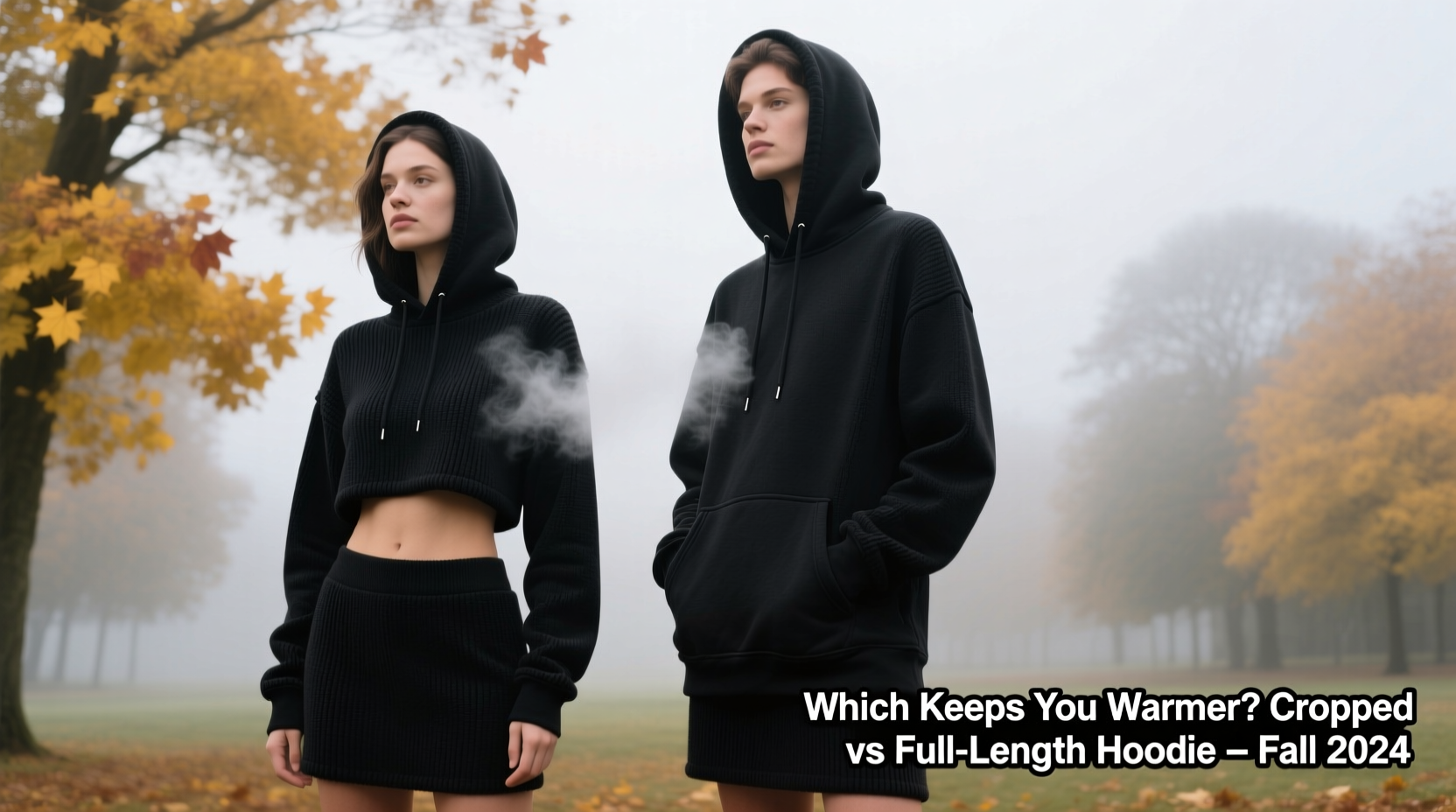
Cropped hoodies typically end above the hip line, often sitting just below the ribcage or at the natural waist. They’re designed for fashion-forward layering, especially over high-waisted jeans or leggings. Their appeal lies in proportion enhancement and a youthful, athletic aesthetic. However, their shortened length inherently sacrifices coverage.
Full-length hoodies, on the other hand, extend past the waist and often reach the upper thigh. This added length ensures consistent coverage of the lower back and upper hips—areas particularly vulnerable to drafts. Many full-length styles also feature ribbed cuffs and hemlines that create a tighter seal against wind infiltration.
While both styles may be made from similar materials—such as cotton blends, fleece, or French terry—the effectiveness of those materials depends heavily on how completely they envelop the body. A thick cropped hoodie might feel cozy at first, but if it leaves the lower back exposed while sitting in a chilly car or walking into the wind, its practical warmth diminishes rapidly.
Material and Insulation: Do Fabric Choices Level the Playing Field?
It’s tempting to assume that upgrading fabric quality can compensate for shorter length. After all, some cropped hoodies are made from heavyweight fleece or thermal-lined cotton. But material alone cannot overcome structural exposure.
Thermal resistance, measured in clo units (where 1 clo ≈ the insulation needed to maintain comfort at room temperature), depends not only on fabric thickness but also on coverage and fit. A cropped hoodie with a 0.8 clo rating might offer excellent shoulder and chest insulation, but without waist coverage, the overall system efficiency drops. In contrast, a slightly lighter full-length hoodie with a 0.7 clo rating but complete torso coverage can outperform it in real-world conditions due to fewer thermal leaks.
Additionally, full-length hoodies are more likely to be designed as outerwear, meaning they often include features like double-lined hoods, brushed interiors, and reinforced stitching—all contributing to better wind resistance and heat retention. Cropped versions, frequently intended as mid-layers or fashion pieces, may lack these functional upgrades.
Comparison Table: Key Features Affecting Warmth
| Feature | Cropped Hoodie | Full-Length Hoodie |
|---|---|---|
| Torso Coverage | Limited (ends at waist) | Extended (covers hips) |
| Wind Protection at Waist | Poor (exposed gap) | Good (sealed hem) |
| Common Use Case | Fashion layering, indoor wear | Outdoor activity, commuting |
| Insulation Efficiency (Real-World) | Moderate to low | High |
| Layering Compatibility | Excellent (pairs with high-waisted bottoms) | Good (may bunch under coats) |
| Typical Material Weight | Light to medium | Medium to heavy |
Real-World Performance: A Mini Case Study
Sophia, a college student in Portland, Oregon, tested both styles during a typical fall week with average highs of 62°F (17°C) and lows near 45°F (7°C). On Monday and Tuesday, she wore a cropped hoodie with high-waisted jeans. She reported feeling comfortable indoors but noted persistent chills in her lower back while biking to class, especially when the wind picked up. By mid-morning, she often reached for a jacket even though her upper body felt warm.
On Wednesday and Thursday, she switched to a full-length hoodie of similar material (80% cotton, 20% polyester fleece). Despite no additional layers, she found herself needing her jacket less frequently. “I didn’t realize how much heat I was losing at my waist until I wore the longer one,” she said. “The difference wasn’t huge, but it was constant—like a draft I couldn’t escape.”
Her experience highlights a key insight: localized exposure can undermine overall comfort, even if the rest of the garment is warm. While the cropped hoodie looked great in photos, its functional shortcomings became apparent in active, outdoor settings.
When a Cropped Hoodie Might Still Work
This isn’t to say cropped hoodies have no place in fall wardrobes. They excel in specific scenarios where warmth is secondary to style or mobility:
- Indoor environments: In heated classrooms, offices, or cafes, a cropped hoodie provides comfort without overheating.
- Layered outfits: Worn under a long coat or over a thermal turtleneck tucked into high-waisted pants, a cropped hoodie adds mid-layer insulation without bulk.
- Active wear: During brisk walks or errands, the shorter cut allows greater freedom of movement and reduces bunching at the hips.
The key is strategic pairing. A cropped hoodie alone won’t match the warmth of a full-length version, but integrated into a layered system, it can contribute meaningfully to thermal regulation.
Step-by-Step Guide: Maximizing Warmth with Either Style
- Assess your environment: Will you be mostly indoors or facing wind and variable temps outdoors?
- Choose base layers wisely: Wear a thermal or merino wool top underneath to trap heat close to the skin.
- Seal the gaps: If wearing a cropped hoodie, pair it with high-waisted, insulated bottoms to minimize waist exposure.
- Add a shell layer: Top either hoodie with a wind-resistant jacket or trench coat for added protection.
- Monitor airflow: Pay attention to drafts at the wrists, neck, and waist—tight cuffs and drawstrings help block them.
- Adjust dynamically: Carry a lightweight packable jacket to add or remove layers as conditions change.
Expert Insight: What Designers and Scientists Say
Apparel engineers emphasize that effective cold-weather clothing functions as a system—not just individual pieces. “Coverage matters as much as fabric,” says Marcus Lin, product developer at a sustainable activewear brand. “A well-designed full-length hoodie creates a continuous barrier. Fashion trends like cropping can compromise that, unless compensated with smart layering.”
He notes that many performance hoodies now integrate ergonomic patterning—such as curved hems or extended backs—to protect the lower back without sacrificing mobility. These design innovations blur the line between function and fashion, offering warmth without looking bulky.
“Length is leverage when fighting cold. Every inch of coverage counts—especially over the kidneys and lumbar spine.” — Dr. Anika Patel, Sports Medicine Physician
Frequently Asked Questions
Can I make a cropped hoodie warmer without changing my outfit?
Yes. Tuck a lightweight thermal undershirt into high-waisted pants to cover the exposed midriff. You can also use adhesive heating patches on your lower back for temporary relief in very cold conditions.
Are oversized cropped hoodies warmer than fitted ones?
Not necessarily. While oversized fits can trap more air (which acts as insulation), they often ride up during movement, increasing exposure. A loose fit without secure hemming may create more airflow, counteracting any thermal benefit.
Does hoodie thickness matter more than length?
Thickness contributes, but length generally has a greater impact on overall warmth. A thin, full-length hoodie will typically keep you warmer than a thick cropped one because it maintains a sealed thermal zone around the core.
Checklist: Choosing the Right Hoodie for Fall Warmth
- ✅ Prioritize full torso coverage for outdoor use
- ✅ Look for snug hems and cuffs to prevent drafts
- ✅ Choose mid-to-heavyweight fabrics (e.g., 300 GSM+ fleece)
- ✅ Consider double-lined or thermal-backed options
- ✅ Pair cropped styles with high-waisted, insulated bottoms
- ✅ Layer under a windproof outer shell when needed
- ✅ Test mobility and coverage while seated or bending
Final Verdict: Which Keeps You Warmer?
When the goal is pure warmth during fall, the full-length hoodie is the clear winner. Its extended cut provides uninterrupted insulation across the core, reducing heat loss and enhancing comfort in windy or fluctuating conditions. While cropped hoodies offer undeniable style and versatility, they are inherently limited by their lack of coverage—especially around the lower back and waist, where even brief exposure can trigger discomfort.
That said, fashion and function aren’t mutually exclusive. With thoughtful layering and context-aware choices, cropped hoodies can still play a role in a balanced fall wardrobe. For early autumn days with mild temperatures and minimal wind, they’re perfectly suitable. But when the mercury drops and the breeze picks up, reach for the full-length option. It’s not just about looking put together—it’s about staying genuinely warm.




 浙公网安备
33010002000092号
浙公网安备
33010002000092号 浙B2-20120091-4
Comments
No comments yet. Why don't you start the discussion?