
Navigating crowded sidewalks, public transit, or busy train stations demands constant awareness—especially when it comes to your personal belongings. Among the most vulnerable items is your smartphone. Whether you're commuting to work, traveling through a city, or simply walking from point A to B, how you carry your phone can make a significant difference in its safety. Two popular solutions have emerged: crossbody phone cases and belt clips. While both aim to keep your device accessible and secure, they offer different advantages and drawbacks depending on your lifestyle, environment, and physical habits.
The core question isn’t just about convenience—it’s about protection. Pickpocketing remains a persistent threat in urban areas, and accidental drops are common during rushed movements. A 2023 report by the National Transit Crime Prevention Council found that over 40% of mobile device thefts occur during peak commute hours, often in densely populated zones like subway platforms or bus stops. In such scenarios, how securely your phone is attached to your body matters far more than most people realize.
This article breaks down the practical differences between crossbody phone cases and belt clips, evaluating them across key factors: physical security, accessibility, comfort, situational adaptability, and resistance to theft. By the end, you’ll be equipped to choose the method that best aligns with your daily routine and risk profile.
Physical Security: How Well Does Each Option Prevent Loss?
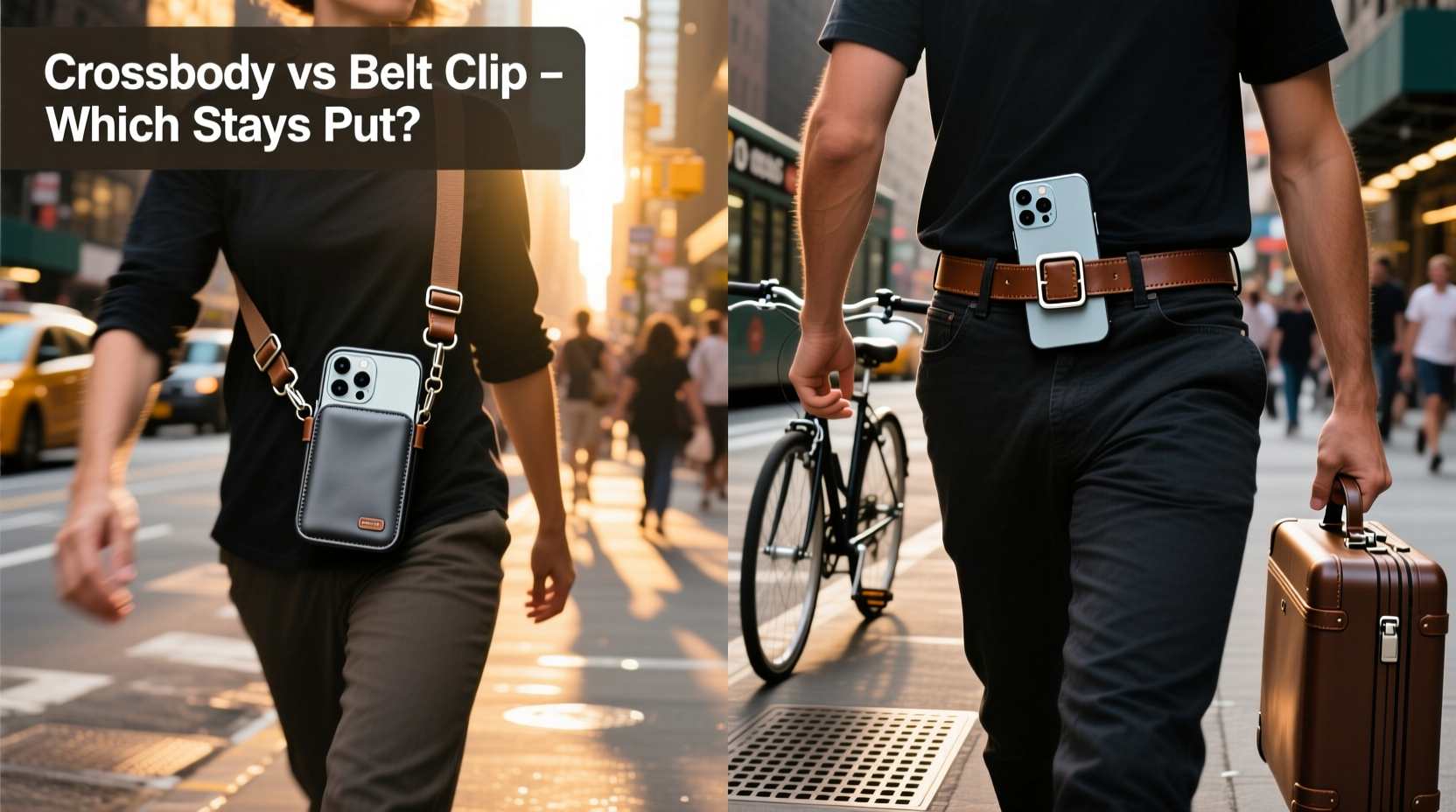
Security begins with how firmly your phone stays connected to your person. Both crossbody cases and belt clips aim to reduce the chance of losing your phone, but they do so in fundamentally different ways.
A crossbody phone case typically features a long, adjustable strap that runs diagonally across your torso, securing the phone against your chest or side. This design keeps the device physically tethered to your upper body, making it nearly impossible to misplace unless the strap detaches or is cut. Because the phone rests close to your center of gravity, it moves with you, reducing the risk of snagging or swinging loose.
In contrast, a belt clip attaches directly to your waistband, pants loop, or bag strap, holding the phone vertically at your hip. While this keeps your hands free, the phone dangles away from your core, creating a potential target for opportunistic grabs. If the clip fails due to wear or poor fit, the phone can fall unnoticed—especially when sitting down or bending over.
Crossbody straps generally provide superior passive security because they require deliberate action to remove. Belt clips, while convenient, depend heavily on the strength of the clip and the stability of your clothing. Loose belts or low-rise pants increase the likelihood of detachment.
Accessibility and Usability During Movement
Convenience plays a major role in how consistently people use a carrying method. No matter how secure a solution is, if it’s awkward to access, users will abandon it—or worse, leave their phone exposed in a pocket.
Crossbody cases position the phone at chest or abdominal level, usually facing inward. This allows quick glances at notifications and one-handed unlocking, especially if the case has a transparent front panel. However, pulling the phone out fully may require adjusting the strap or shifting your posture, particularly in tight spaces like packed subways.
Belt clips, on the other hand, allow near-instantaneous access. The phone sits at your side, ready to be grabbed with minimal movement. This makes them ideal for professionals who need rapid response—security personnel, delivery drivers, or field technicians. But this ease of access cuts both ways: thieves can also snatch the device quickly if you’re not vigilant.
One overlooked factor is posture. People who walk with arms swinging naturally may bump their phones off belt clips without realizing it. Crossbody cases minimize this risk by keeping the device centered and protected between the arms.
“From a behavioral standpoint, devices worn centrally are less likely to be forgotten or dislodged during dynamic motion.” — Dr. Lena Torres, Ergonomics Researcher at Urban Mobility Institute
Theft Resistance: Which Is Less Vulnerable to Pickpockets?
Urban commuters face real risks from skilled thieves who operate in crowded areas. These individuals look for easy targets—phones in back pockets, loosely held in hands, or dangling from weak clips.
Crossbody phone cases are inherently more resistant to theft due to three factors: visibility, tension, and positioning. When worn correctly (with the phone facing your body), the device is shielded by your arm and torso. The strap creates constant tactile feedback—if someone tries to grab it, you’ll feel immediate resistance. Additionally, cutting the strap requires effort and tools, making quick snatches impractical.
Belt clips, especially those placed on the back or outer hip, are prime targets. Thieves can approach from behind or the side and yank the phone free in seconds. Even front-mounted clips on utility belts can be compromised if the wearer is distracted. A study conducted by the Tokyo Metropolitan Police in 2022 observed that 68% of stolen phones carried externally were taken from belt attachments or jacket pockets within five seconds of contact.
That said, some advanced belt clips now come with locking mechanisms or magnetic locks that require a button press to release. While these improve security, they add friction to everyday use and aren’t foolproof against determined thieves.
Comparison Table: Key Features at a Glance
| Feature | Crossbody Phone Case | Belt Clip |
|---|---|---|
| Attachment Security | High (strap spans torso) | Moderate (depends on clip quality) |
| Theft Deterrence | High (visible tension, hard to grab) | Low to Moderate (easy grab-and-run) |
| Access Speed | Moderate (requires partial removal) | High (instant pull-out) |
| Comfort Over Time | Good (distributed weight) | Variable (pressure on hip) |
| Suitability for Crowds | Excellent | Poor |
| Risk of Accidental Drop | Very Low | Moderate (especially when sitting) |
Real-World Use Case: Commuting in New York City
Jamal, a freelance photographer based in Brooklyn, used to carry his phone on a premium metal belt clip. He valued the speed of access when capturing street scenes. However, during a rush-hour commute on the L train, his phone was snatched by someone squeezing past him. The clip held, but the thief twisted the device free in under two seconds.
After replacing his phone, Jamal switched to a crossbody case with an anti-theft strap and RFID-blocking interior. Initially skeptical about the bulk, he soon noticed several benefits: no more dropped phones when jogging between subway lines, fewer worries in dense crowds, and even improved posture from the balanced weight distribution. Six months later, he hasn’t had a single incident—and says he wouldn’t go back.
His experience reflects a broader trend among urban professionals who prioritize peace of mind over split-second access. In cities like London, Seoul, and San Francisco, crossbody tech carriers have seen a 35% rise in adoption since 2021, according to market analytics firm UrbanGear Insights.
Choosing Based on Your Lifestyle: A Practical Checklist
Your ideal choice depends on your environment, activity level, and personal habits. Use this checklist to determine which option suits you best:
- ✅ Do you frequently ride public transit in crowded cities? → Favor crossbody
- ✅ Do you work in a high-mobility job (e.g., delivery, construction, event staff)? → Belt clip may be faster
- ✅ Are you concerned about pickpocketing or petty theft? → Crossbody offers better protection
- ✅ Do you often sit, bend, or climb stairs during your commute? → Crossbody reduces drop risk
- ✅ Do you wear tight-fitting or clip-incompatible clothing? → Crossbody is more adaptable
- ✅ Do you value instant access over maximum security? → Belt clip might suit you
If four or more answers lean toward crossbody, it’s likely the safer bet. If speed and utility dominate your needs, a high-quality belt clip with a lock mechanism could suffice—provided you remain alert in risky environments.
Step-by-Step Guide to Maximizing Security With Either Option
No carrying method is 100% secure without proper usage. Follow these steps to get the most out of your chosen system:
- Choose the right fit: Ensure the crossbody strap adjusts comfortably across your body without slipping, or select a belt clip compatible with your waistband thickness.
- Position the device correctly: For crossbody cases, keep the screen facing inward. For belt clips, mount the phone on your front or strong-side hip, never the back pocket.
- Test the attachment: Give the strap or clip a firm tug to confirm it won’t detach under stress.
- Enable tracking and alarms: Turn on Find My Device (iOS/Android) and set up a loud notification alert for unauthorized movement.
- Stay aware in crowds: Keep your hand near the phone when entering or exiting vehicles, and avoid using it in high-risk zones.
- Inspect regularly: Check for wear on straps, stitching, or clip springs every few weeks.
Frequently Asked Questions
Can a crossbody phone case be discreet?
Yes. Many modern designs mimic minimalist sling bags or small purses, making them blend into casual or professional attire. Look for neutral colors and slim profiles to maintain a low profile.
Are belt clips safe for large phones?
They can be, but larger phones increase leverage and strain on the clip. Over time, this may cause the clip to loosen or the phone to tilt downward, raising the risk of falls. Reinforced holsters with retention straps are recommended for heavy devices.
Which option works better with backpacks or briefcases?
Crossbody cases can interfere with backpack straps if worn simultaneously. In such cases, a belt clip on the front hip or a dedicated internal organizer inside your bag may be preferable. Alternatively, wear the crossbody higher on your chest to avoid overlap.
Final Verdict: Prioritizing Security Without Sacrificing Function
When it comes to securing your phone during commutes, the crossbody phone case emerges as the more reliable option for most people. Its design inherently reduces the risk of loss, theft, and accidental drops. The continuous connection to your torso provides constant awareness, while strategic placement discourages opportunistic grabs.
Belt clips still have a place—particularly for those who need lightning-fast access and operate in lower-risk environments. However, they demand greater vigilance and are more prone to failure under dynamic conditions.
Ultimately, the best choice balances security, comfort, and usability. As urban environments grow denser and digital dependency increases, protecting your phone shouldn’t be an afterthought. Investing in a secure carrying method is not just about preventing financial loss—it’s about maintaining control over your personal data, communication, and peace of mind.




 浙公网安备
33010002000092号
浙公网安备
33010002000092号 浙B2-20120091-4
Comments
No comments yet. Why don't you start the discussion?