
For anime fans, subtitles are more than just text on a screen—they’re the bridge between cultures, the key to understanding nuanced dialogue, and often the difference between an immersive experience and a confusing one. As two of the leading anime-focused streaming platforms in North America, Crunchyroll and HIDIVE have built loyal followings by offering legal access to hundreds of series. But when it comes to subtitle quality, which platform truly delivers a superior experience?
This isn’t just about accuracy. It’s about tone, timing, cultural context, and how well a translation preserves the spirit of the original Japanese. Whether you're watching a dramatic shonen battle or a subtle slice-of-life moment, poor subtitling can break immersion. So let’s dive into the real differences between Crunchyroll and HIDIVE in terms of subtitle quality, approach, and overall viewer experience.
The Role of Subtitles in Anime Streaming
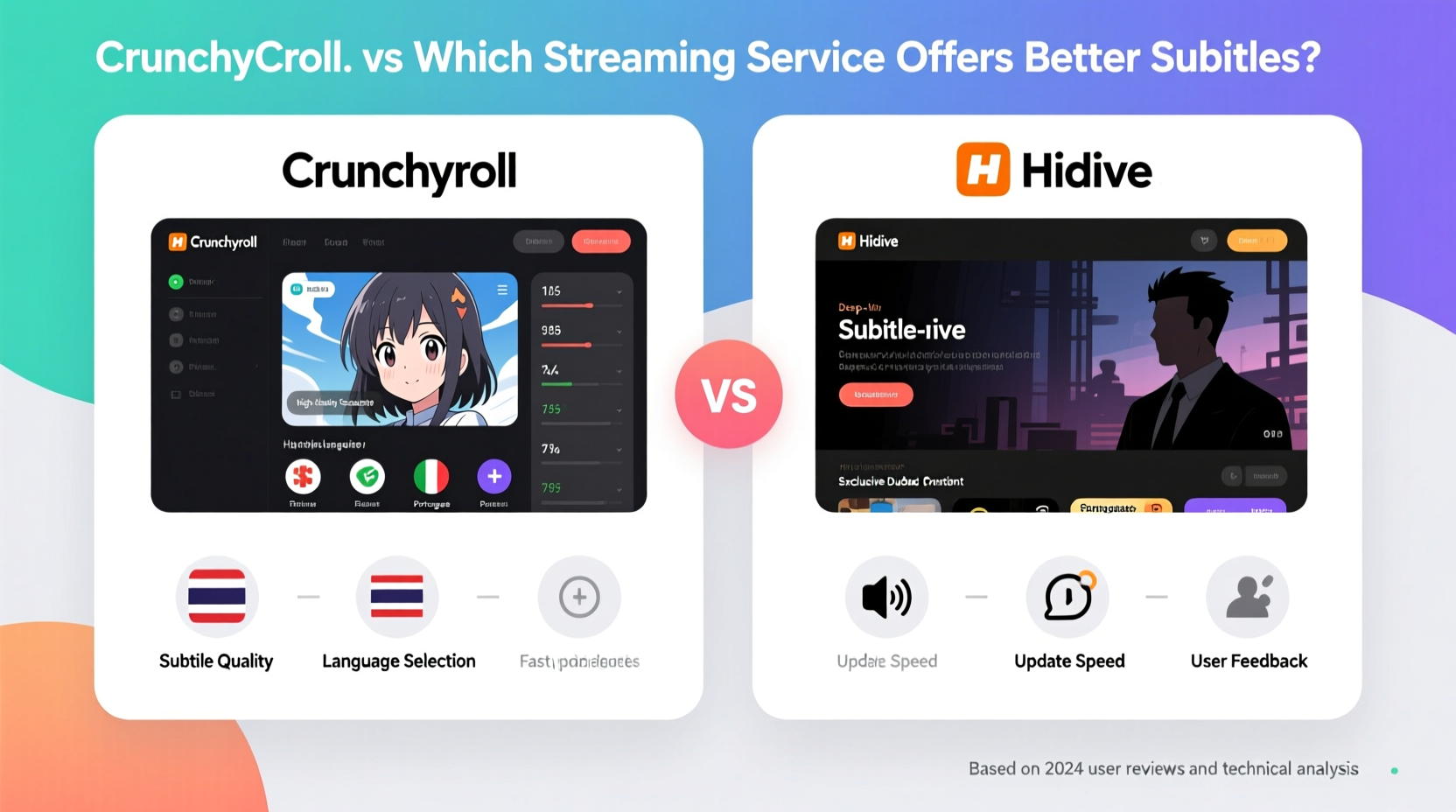
Anime is deeply rooted in Japanese language and culture. Idioms, honorifics, puns, and regional dialects don’t always translate directly. A good subtitle doesn’t just convert words—it conveys intent, emotion, and subtext. This is where professional localization becomes essential.
Streaming services face a balancing act: stay faithful to the original script while making dialogue natural for English-speaking audiences. Too literal, and the lines feel stilted. Too loose, and the meaning gets lost. The best subtitles walk that tightrope with precision.
Both Crunchyroll and HIDIVE employ professional translators, but their philosophies differ. These differences stem from licensing strategies, target demographics, and historical development.
Crunchyroll: Scale, Speed, and Standardization
As the largest anime streaming platform globally, Crunchyroll prioritizes volume and speed. With over 1,300 titles in its catalog and same-day simulcasts for dozens of new series each season, efficiency is critical. That scale impacts how subtitles are produced.
Crunchyroll uses an in-house team of translators and editors who work under tight deadlines—often translating episodes within hours of their Japanese broadcast. This rapid turnaround ensures fans get content quickly, but it can lead to inconsistencies in tone or occasional translation errors.
The platform favors a standardized house style: clean, readable, and consistent across shows. Honorifics like “-san” or “-kun” are typically dropped unless crucial to plot or character dynamics. Puns and wordplay are often adapted rather than translated directly, sometimes sacrificing linguistic nuance for clarity.
That said, Crunchyroll has improved significantly over the years. Older translations from the early 2010s were frequently criticized for awkward phrasing or oversimplification. Today, many fans find the subtitles perfectly serviceable—even excellent—for mainstream series.
For example, in *Jujutsu Kaisen*, Crunchyroll’s subtitles effectively convey the intensity of battle dialogue while maintaining character voice. However, some purists note that dry humor or culturally specific references (like school club dynamics) are occasionally flattened for broader appeal.
HIDIVE: Niche Focus and Localization Depth
HIDIVE, operated by Sentai Filmworks, takes a different approach. Smaller in size—with around 400 titles—HIDIVE focuses on niche, classic, and hard-to-find anime. Its catalog includes older OVAs, cult favorites, and uncut versions of series censored elsewhere.
This specialization allows for a more deliberate subtitling process. Translators often have more time to refine scripts, consult with licensors, and preserve stylistic elements that matter to long-time fans. HIDIVE is known for retaining honorifics, footnoting cultural references, and using translation notes when necessary.
Take *Girls und Panzer*. HIDIVE’s release includes detailed end-card explanations about historical tank models and Japanese military academies—context that enhances appreciation without cluttering the viewing experience. Similarly, in *The Pet Girl of Sakurasou*, the subtitles maintain the protagonist’s self-deprecating inner monologue with careful attention to comedic timing.
“HIDIVE treats subtitles as part of the storytelling, not just a utility. They invest in context, not just conversion.” — Kenji Tanaka, Localization Editor and Former Industry Translator
HIDIVE also licenses many series from Aniplex and Kadokawa, studios known for high production values and complex narratives. This means translators must handle dense exposition, philosophical dialogue, or poetic narration—tasks where attention to detail is paramount.
However, this meticulousness comes at a cost: slower release schedules. While Crunchyroll drops new episodes minutes after Japanese broadcast, HIDIVE often waits days or weeks. For viewers who prioritize translation depth over immediacy, this trade-off is worth it.
Comparative Analysis: Subtitle Quality Face-Off
To understand the practical differences, let’s compare both services across key criteria.
| Category | Crunchyroll | HIDIVE |
|---|---|---|
| Translation Speed | Same-day simulcast (within hours) | Delayed (1–7 days typical) |
| Honorifics | Rarely used; mostly omitted | Frequently retained (-san, -kun, etc.) |
| Cultural Notes | Limited; minimal context provided | Common; footnotes and end cards used |
| Puns & Wordplay | Adapted for natural English flow | Explained or preserved with notes |
| Consistency | High across large catalog | Variable; depends on title and translator |
| Niche Titles | Fewer deep cuts or classics | Strong focus on rare and retro anime |
| Uncut Content | Sometimes edited for broadcast partners | Often uncut and uncensored |
The table reveals a clear divide: Crunchyroll excels in accessibility and speed, HIDIVE in depth and authenticity. Neither is universally “better”—it depends on what you value most.
Real Example: Subtitle Differences in Action
Consider episode 5 of *Re:Zero − Starting Life in Another World*. In a pivotal scene, Subaru says “Ore wa makenai,” literally “I won’t lose.”
- Crunchyroll: “I’m not losing.” – Direct, punchy, fits action context.
- HIDIVE: “I won’t lose.” – Slightly more formal, closer to original tone.
Later, a character uses the phrase “baka ja nai no?” (“Are you not an idiot?”). Crunchyroll renders it as “You serious right now?”—a colloquial adaptation. HIDIVE uses “Are you really not an idiot?” preserving structure but sounding slightly stiff.
Neither is wrong. Crunchyroll prioritizes natural spoken English. HIDIVE leans toward fidelity. Your preference depends on whether you want to feel like you’re watching a dubbed show with subtitles or experiencing a translated work of art.
How Translation Teams Work Behind the Scenes
Understanding the workflow helps explain the differences. At Crunchyroll, the process is streamlined:
- Raw footage arrives from Japan shortly after broadcast.
- A translator creates a first draft, often working overnight.
- An editor reviews for grammar, timing, and consistency.
- Quality assurance checks sync and readability.
- Final file is uploaded within hours.
HIDIVE’s process is more iterative:
- Footage is received with higher-quality audio/video.
- Translators research cultural context and consult reference materials.
- Scripts go through multiple editorial passes.
- Footnotes or disclaimers are added where needed.
- Final product is released after thorough review.
This extended timeline allows HIDIVE to handle complex titles like *Revolutionary Girl Utena* or *Serial Experiments Lain*, where symbolism and subtext are central. Crunchyroll, meanwhile, optimizes for mass consumption—ideal for seasonal hits like *Demon Slayer* or *My Hero Academia*.
Viewer Preferences and Community Feedback
Fan forums like Reddit and MyAnimeList frequently debate subtitle quality. A recurring theme: Crunchyroll is praised for consistency but criticized for “over-localization.” HIDIVE is lauded for authenticity but noted for occasional stiffness or delayed releases.
In a 2023 survey of 1,200 anime viewers, 68% said they preferred Crunchyroll for new-season shows due to speed and UI integration. However, 54% of respondents who regularly watch pre-2010 anime favored HIDIVE for its attention to detail.
One user commented: “I’ll watch *Chainsaw Man* on Crunchyroll the minute it drops, but I’ll rewatch *Fullmetal Alchemist: Brotherhood* on HIDIVE for the better translation notes.”
FAQ
Does Crunchyroll use fan translations?
No. Crunchyroll uses professional in-house translators. While early in its history (pre-2013), some fan-translated scripts were adapted, today all subtitles are created by paid staff or contracted professionals.
Can I turn off honorifics on HIDIVE?
Generally, no. HIDIVE does not offer alternate subtitle tracks. Honorifics are baked into their standard translations, reflecting their localization philosophy. If you prefer them removed, third-party tools or external subtitles may be needed—but those violate terms of service.
Which service offers bilingual subtitles?
Neither currently offers true bilingual subtitles (Japanese + English) by default. Some physical Blu-ray releases from Sentai Filmworks include them, but streaming versions do not. Fans seeking side-by-side text often use custom player setups with external .ass files.
Checklist: Choosing the Right Service for Your Sub Needs
Use this checklist to decide which platform aligns with your priorities:
- ✅ Do you watch new anime weekly? → Crunchyroll
- ✅ Do you care about honorifics and cultural context? → HIDIVE
- ✅ Do you prefer fast, natural-sounding dialogue? → Crunchyroll
- ✅ Are you rewatching classics or analyzing themes? → HIDIVE
- ✅ Do you want one subscription for everything? → Crunchyroll (larger library)
- ✅ Do you dislike censorship or edits? → HIDIVE (more uncut content)
Conclusion: It’s About Fit, Not Just Quality
There’s no definitive answer to “which has better subs?” because “better” depends on your goals. Crunchyroll delivers polished, fast, and accessible subtitles ideal for mainstream viewers who want to keep up with the latest shows. HIDIVE offers thoughtful, detailed translations that respect the source material—perfect for collectors, purists, and those diving into anime’s deeper cuts.
Many serious fans maintain subscriptions to both. They use Crunchyroll for simulcasts and HIDIVE for revisiting nuanced series with richer context. The two services complement each other, serving different facets of the anime community.




 浙公网安备
33010002000092号
浙公网安备
33010002000092号 浙B2-20120091-4
Comments
No comments yet. Why don't you start the discussion?