
Choosing lighting for a nursery goes far beyond aesthetics—it’s about safety, emotional resonance, developmental appropriateness, and lasting meaning. Many parents gravitate toward illuminated lettering as a soft, ambient focal point above the crib or changing table. Yet a quiet but consequential decision awaits: invest in a custom engraved name light, or opt for affordable, mass-produced string letters? The difference isn’t just price—it’s permanence versus flexibility, craftsmanship versus convenience, identity versus decoration. This comparison cuts through marketing hype to examine real-world performance, regulatory compliance, emotional impact, and hidden lifetime costs.
What Defines Each Option—Beyond the Surface
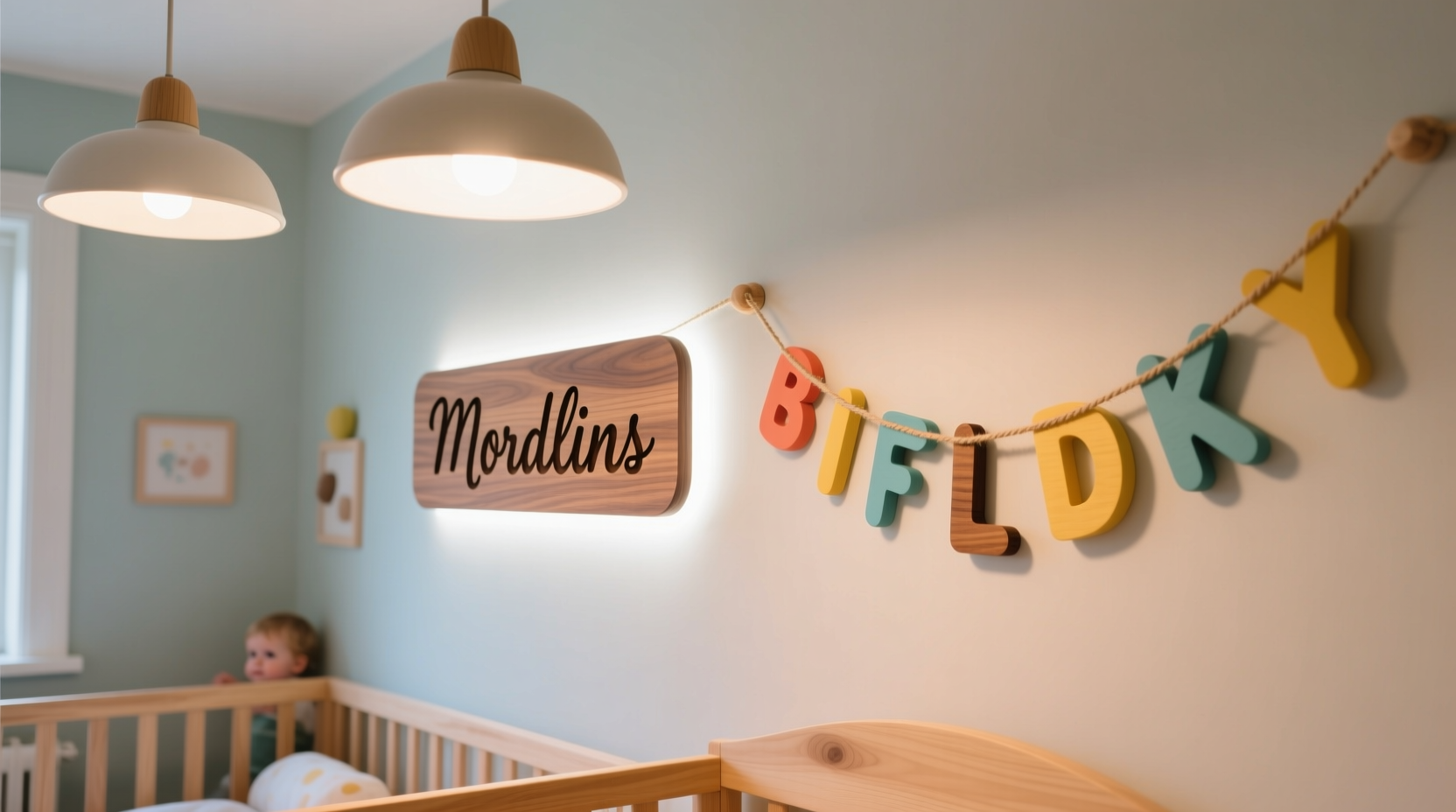
Custom engraved name lights are precision-crafted fixtures—typically made from solid wood (walnut, maple, birch), acrylic, or powder-coated metal—designed around a child’s full name. Each letter is individually cut, sanded, and engraved with subtle depth; LED strips are embedded behind the letters, diffusing warm, glare-free light (usually 2700K–3000K) through the material. Wiring is fully concealed, and units often include dimmers, timers, and UL-listed power supplies. They’re built for wall mounting, not temporary taping—and priced accordingly ($180–$450).
Generic string letters, by contrast, are lightweight, plug-in or battery-operated plastic or thin metal letters sold in sets (A–Z). Most use exposed, low-voltage LEDs strung along flexible wires or housed in hollow plastic shells. They’re marketed for dorm rooms, parties, and photo backdrops—not infant environments. While some brands claim “nursery-safe,” few meet stringent ASTM F963 or CPSC requirements for children under three. Prices range from $12 to $45 per set.
The divergence begins here: one treats the nursery as a sacred, long-term space where objects carry narrative weight; the other treats it as a transitional stage requiring disposable decor.
Safety & Regulatory Compliance: Where Standards Matter Most
Infants spend up to 16 hours a day sleeping—often within arm’s reach of wall-mounted decor. That proximity demands rigorous safety evaluation. Custom engraved name lights designed for nurseries undergo third-party electrical testing (UL 153 or UL 1310), feature flame-retardant materials, and maintain minimum clearance distances from bedding. Their low-heat LEDs operate at under 35°C surface temperature—well below the 60°C threshold that can ignite fabrics or cause burns on accidental contact.
Generic string letters rarely carry UL certification. A 2023 CPSC incident report documented 17 cases of overheating in non-certified nursery string lights between 2021–2023—including two instances where plastic housings warped and emitted acrid smoke near cribs. Battery-operated versions pose additional risks: loose coin-cell batteries (common in AA/AAA-powered units) are a leading cause of pediatric ingestion injuries, with over 2,800 ER visits annually (American Academy of Pediatrics, 2022).
| Feature | Custom Engraved Name Light | Generic String Letters |
|---|---|---|
| Electrical Certification | UL 153 or UL 1310 listed (standard) | Rarely certified; most lack listing |
| Surface Temperature (max) | 32–35°C (safe for prolonged proximity) | 48–62°C (risk of fabric ignition, skin discomfort) |
| Battery Access | None (hardwired or sealed USB-C) | Frequent—exposed compartments, easy for infants to open |
| Mounting Security | Sturdy D-ring or French cleat system (holds >50 lbs) | Adhesive tape or flimsy hooks (fails after 3–6 months) |
| Flame Resistance | ASTM E84 Class A rating (standard for wood/acrylic) | Typically untested; many plastics melt at <100°C |
Emotional Resonance & Developmental Impact
A child’s name is among their first linguistic anchors. Research in early childhood development shows that visual exposure to one’s own name supports pre-literacy skills—including letter recognition, phonemic awareness, and self-concept formation (Neuman & Dickinson, 2019). But not all name displays serve this function equally.
Custom engraved name lights project soft, even illumination that draws attention without overstimulation. The consistent glow becomes part of the bedtime ritual—calming, predictable, and deeply personal. Parents report children pointing to their name light as early as 8 months, naming letters by 18 months, and tracing engraved grooves with fingers during quiet time. The tactile dimension (especially in wood or frosted acrylic) adds sensory richness absent in flat plastic.
Generic string letters, however, suffer from inconsistent spacing, uneven brightness, and distracting flicker (particularly in cheaper battery models). Letters may be misaligned, oversized, or stylistically mismatched—undermining letter-form recognition. Worse, many sets omit essential characters (e.g., no ñ, ü, or ā), making them unusable for bilingual families or names with diacritical marks. One parent in Portland shared how her daughter’s name “Sofía” appeared as “Sofia” on a string set—erasing cultural nuance before her first birthday.
“Lighting isn’t neutral in a nursery—it’s part of the child’s earliest language environment. A well-designed name light doesn’t just spell a name; it affirms identity, invites interaction, and supports cognitive scaffolding.” — Dr. Lena Torres, Early Childhood Literacy Specialist, Erikson Institute
Total Cost of Ownership: Looking Past the Price Tag
At first glance, a $25 string letter set seems like prudent budgeting. But consider the full lifecycle:
- Replacement frequency: Adhesive fails within 4 months on painted drywall; plastic yellows or cracks by month 6; batteries deplete every 4–8 weeks (costing $12–$20/year in replacements alone).
- Compatibility costs: Needing separate dimmers, timers, or smart plugs adds $25–$45. Mounting hardware (like heavy-duty Command Strips rated for heat) costs another $8–$12.
- Opportunity cost: Time spent repositioning, troubleshooting flickering, replacing batteries, or hiding wires detracts from caregiving moments.
A quality custom name light, meanwhile, operates maintenance-free for 5+ years. Its LEDs last 30,000–50,000 hours (≈10–15 years at 8 hrs/day). No batteries. No flicker. No adhesive residue on walls. And because it’s built to last beyond infancy, many families repurpose it in the child’s big-kid room, classroom, or college dorm—extending functional life to 12+ years.
When amortized, the custom light costs roughly $0.04–$0.07 per day over 10 years. The string set averages $0.18–$0.32 per day when factoring replacement, batteries, and labor.
Real-World Decision Framework: A Step-by-Step Guide
Choosing wisely requires aligning values with practical constraints. Follow this objective sequence:
- Assess your nursery’s primary purpose: Is this space intended for long-term use (e.g., staying in the same home for 5+ years), or is it transitional (rental, upcoming move)? If long-term, prioritize investment-grade pieces.
- Verify safety infrastructure: Does your outlet have GFCI protection? Is the wall stud-aligned where you plan to mount? If not, custom lights’ secure mounting becomes non-negotiable—and string letters’ adhesive reliance becomes unsafe.
- Map usage patterns: Will the light stay on overnight? Used only for feedings? If yes, dimmability and zero-flicker performance matter more than decorative flair.
- Evaluate naming complexity: Does the name include special characters, hyphens, or multiple words (e.g., “Eliana-Rose”)? Generic sets rarely accommodate these. Custom makers adjust kerning, sizing, and layout fluidly.
- Calculate true budget: Add 20% to your initial decor budget for unexpected costs (outlet extenders, professional mounting, battery packs). If that adjusted budget exceeds $150, the custom option likely delivers better value.
Mini Case Study: The Chen Family’s Two-Nursery Journey
When Mei and David Chen welcomed their first child, Leo, they chose budget-friendly string letters. Within three months, the adhesive failed twice—leaving sticky residue on their rental’s eggshell-paint walls. By month five, the “O” flickered erratically, startling Leo during night feeds. They replaced it twice before giving up and unplugging it entirely.
For their second child, Amara, they invested in a maple engraved name light with integrated dimmer and USB-C power. It mounted securely in 12 minutes using included hardware. The warm, even glow became part of Amara’s sleep cue—she’d gaze upward and smile before drifting off. At 14 months, she began tapping each letter while saying “A-M-A-R-A.” When they moved apartments at 2.5 years, they removed it cleanly, packed it safely, and remounted it in Amara’s new room—no repurchasing, no wall repair.
“With Leo, we bought convenience. With Amara, we bought continuity,” Mei reflected. “The light didn’t just spell her name—it held space for her to grow into it.”
FAQ
Can I personalize generic string letters with paint or decals?
No—most plastic housings resist adhesion, and paint solvents can degrade LED wiring insulation. Decals peel near heat sources, creating fire hazards. Modifying uncertified electronics voids any minimal warranty and increases failure risk.
Do custom name lights work with smart home systems?
Yes—many premium makers offer optional Wi-Fi or Bluetooth modules compatible with Apple HomeKit, Google Home, and Alexa. These allow voice-controlled dimming, scheduling, and integration with motion sensors (e.g., brightening automatically during nighttime diaper changes).
What if my child’s name changes later (e.g., adoption, marriage, gender transition)?
Reputable custom makers offer engraving updates for 40–60% of original cost—replacing only the affected letters. Some provide lifetime engraving refreshes at cost of materials. Generic sets would require full replacement—and likely won’t match the original aesthetic.
Conclusion
Nurseries are not staging areas for future living—they’re the first architecture of belonging. Every object placed within them whispers something to the child about who they are, what they’re worth, and how carefully they’re held in the world. A custom engraved name light does more than cast light; it casts intention. It says: *Your name matters enough to be carved with care. Your presence here is permanent, even as you grow. This space was made for you—not for trend, not for season, but for you.*
Generic string letters aren’t inherently wrong—but they reflect a different priority: speed over significance, economy over endurance, decoration over devotion. There’s wisdom in discernment. Choose the option that aligns not with your current budget alone, but with the legacy you wish to illuminate.




 浙公网安备
33010002000092号
浙公网安备
33010002000092号 浙B2-20120091-4
Comments
No comments yet. Why don't you start the discussion?