
When shopping for a moissanite engagement ring, one of the most debated topics among buyers is the significance of color grading—specifically, whether the difference between D color and F color moissanite is truly visible. While both fall within the “colorless” range on the gemological scale, subtle distinctions exist that can influence sparkle, brilliance, and overall aesthetic appeal under certain conditions. Understanding these nuances helps ensure your choice aligns with both budget and visual expectations.
Understanding Moissanite Color Grading
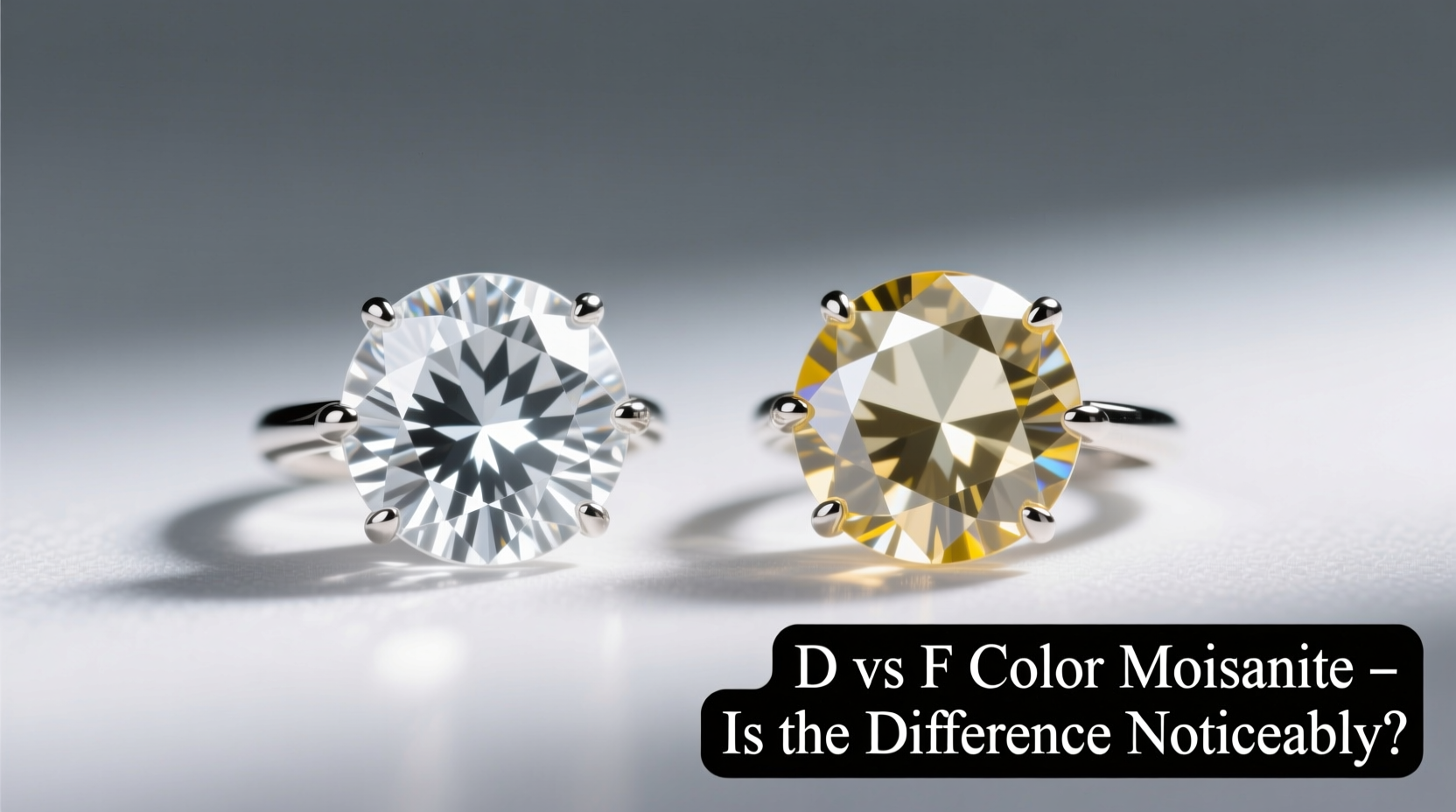
Moissanite is graded using a color scale similar to diamonds, ranging from D (completely colorless) to K (noticeably tinted). The highest grades—D, E, and F—are classified as colorless, meaning they should show no discernible hue when viewed face-up in controlled lighting. However, because moissanite is lab-created and often exhibits slight variations due to manufacturing processes, even stones labeled D or F may display faint undertones under intense scrutiny.
Unlike natural diamonds, where D-color stones are exceptionally rare and expensive, D-color moissanite is more accessible but still commands a premium over lower-graded options. F-color moissanite sits just below at the edge of the colorless category, potentially showing the faintest hint of warmth in specific environments—though typically imperceptible to the untrained eye.
“Even within the colorless range, lighting conditions and setting metals play a critical role in how much body color becomes apparent.” — Dr. Lena Torres, Gemologist & Lab-Grown Diamond Specialist
Visual Differences: Under What Conditions Do They Appear?
In standard daylight or indoor lighting, the difference between D and F color moissanite is rarely noticeable. Most people cannot distinguish between the two unless the stones are placed side by side on a white background under magnification. However, there are several factors that can amplify subtle color differences:
- Lighting Type: Cool white LED lights tend to highlight any warm undertones in F-color stones, while natural sunlight provides a more balanced view.
- Ring Setting Metal: White gold or platinum settings enhance the perception of colorlessness, whereas yellow or rose gold can mask slight warmth in F-color moissanite.
- Stone Size: Larger carats (over 2 carats) may make faint tints slightly more detectable due to increased light dispersion.
- Fluorescence: Some moissanites exhibit blue fluorescence under UV light, which can neutralize warmth in F-color stones in certain outdoor conditions.
Comparison Table: D vs F Color Moissanite
| Feature | D Color Moissanite | F Color Moissanite |
|---|---|---|
| Color Grade | Completely colorless | Nearly colorless; faint warmth possible |
| Visibility of Tint | None under normal conditions | Rarely visible; only in ideal comparison settings |
| Best Metal Pairings | White gold, platinum, palladium | All metals; warmth masked in yellow/rose gold |
| Price Premium | Higher (5–15% above F) | More budget-friendly |
| Brilliance Impact | Slightly crisper under cool lighting | Negligible difference in fire/scintillation |
Real-World Example: Choosing Between D and F for an Engagement Ring
Sophia was searching for a 1.5-carat round brilliant moissanite for her engagement ring. She initially leaned toward D color, believing it would offer superior clarity and brilliance. After viewing both D and F stones from reputable vendors like Charles & Colvard and Harrods Lab-Grown, she noticed no difference when worn on her hand indoors. However, during a visit to a jewelry studio with professional-grade daylight lamps, she detected a very faint yellowish flash in the F-color stone when tilted at extreme angles—something absent in the D-color sample.
Despite this, her jeweler advised that the difference wouldn’t be apparent in daily life, especially since she planned to set the stone in a six-prong platinum mount. Ultimately, Sophia chose the F-color moissanite, saving $120 without compromising perceived beauty. Her decision was reinforced after wearing the ring for three months—no friends or family members commented on any discoloration, even under direct sunlight.
Step-by-Step Guide: How to Evaluate D vs F Color Moissanite
- Source Reputable Vendors: Purchase from certified suppliers who disclose grading reports (e.g., GCAL, IGI).
- Request Side-by-Side Photos: Ask for images of D and F stones under daylight and incandescent lighting.
- Observe Face-Up Appearance: Focus on how the stone looks when mounted—not loose on a white card.
- Test Against White Background: Place the stone on plain paper and examine for any yellow or gray cast.
- Simulate Wear Conditions: Hold the stone near your fingertip to mimic skin tone interaction.
- Compare in Different Lights: Check under sunlight, office lighting, and evening bulbs.
- Evaluate Cost-Benefit: Determine if the price gap justifies the marginal gain in color purity.
Expert Insight: Why Perceived Difference Often Outweighs Actual Difference
The human eye struggles to perceive minute chromatic shifts in small objects, especially those designed to refract light intensely like moissanite. According to optical studies conducted by the American Gem Society, the average observer cannot reliably differentiate between D, E, and F color grades unless samples are directly compared under laboratory conditions.
“The emotional value of ‘perfect’ color often outweighs its visual impact. Many buyers feel more confident choosing D color—even if the benefit is psychological rather than optical.” — Mark Rinaldi, AGS Accredited Appraiser
This insight suggests that while D color may represent technical superiority, F color delivers nearly identical performance in real-world contexts. For practical purposes, especially in everyday wear, the distinction fades into irrelevance.
Frequently Asked Questions
Is F color moissanite visibly yellow?
No, F color moissanite is not visibly yellow under normal circumstances. Any warmth is extremely subtle and usually only detectable under controlled comparison with higher-grade stones. In most settings and lighting, it appears completely colorless.
Does the cut affect how color shows in moissanite?
Yes. Excellent cuts maximize light return and minimize the visibility of body color. A well-cut F-color stone can outperform a poorly cut D-color moissanite in terms of brightness and perceived whiteness due to superior scintillation and symmetry.
Should I pay extra for D color moissanite?
Only if you prioritize absolute top-tier grading and plan to compare your stone directly with others frequently. For most wearers, the aesthetic payoff does not justify the added cost. F color offers exceptional value with indistinguishable appearance in typical use cases.
Final Recommendation: Prioritize Cut and Setting Over Marginal Color Gains
While D color moissanite represents the pinnacle of color purity, the difference between it and F color is so minimal that it rarely affects the stone’s beauty once set in a ring. Factors such as cut quality, symmetry, clarity, and metal choice have a far greater impact on overall brilliance and visual appeal.
For those balancing aesthetics with budget, F color moissanite presents a smart compromise—delivering a virtually indistinguishable look at a lower price point. Unless you're pairing the stone with a high-clarity diamond accent or require certification-grade perfection, there's little functional reason to upgrade to D.




 浙公网安备
33010002000092号
浙公网安备
33010002000092号 浙B2-20120091-4
Comments
No comments yet. Why don't you start the discussion?