
When it comes to protecting yourself on the road, few tools offer as much peace of mind as a dash cam. These compact devices continuously record your drive, capturing critical footage in the event of an accident or dispute. But as technology advances, a growing question arises: Is a dual-channel dash cam—recording both front and rear—necessary, or is a front-only model sufficient for insurance purposes?
The answer isn't always straightforward. While front-only dash cams are more affordable and easier to install, rear coverage adds a layer of protection that can be decisive when proving fault in a claim. Insurance companies rely heavily on video evidence, and having a complete picture of what happened before, during, and after a collision can make all the difference.
This article breaks down the key differences between single and dual-channel systems, evaluates their impact on insurance outcomes, and provides actionable guidance to help you decide whether rear coverage is worth the investment.
Why Dash Cam Footage Matters in Insurance Claims
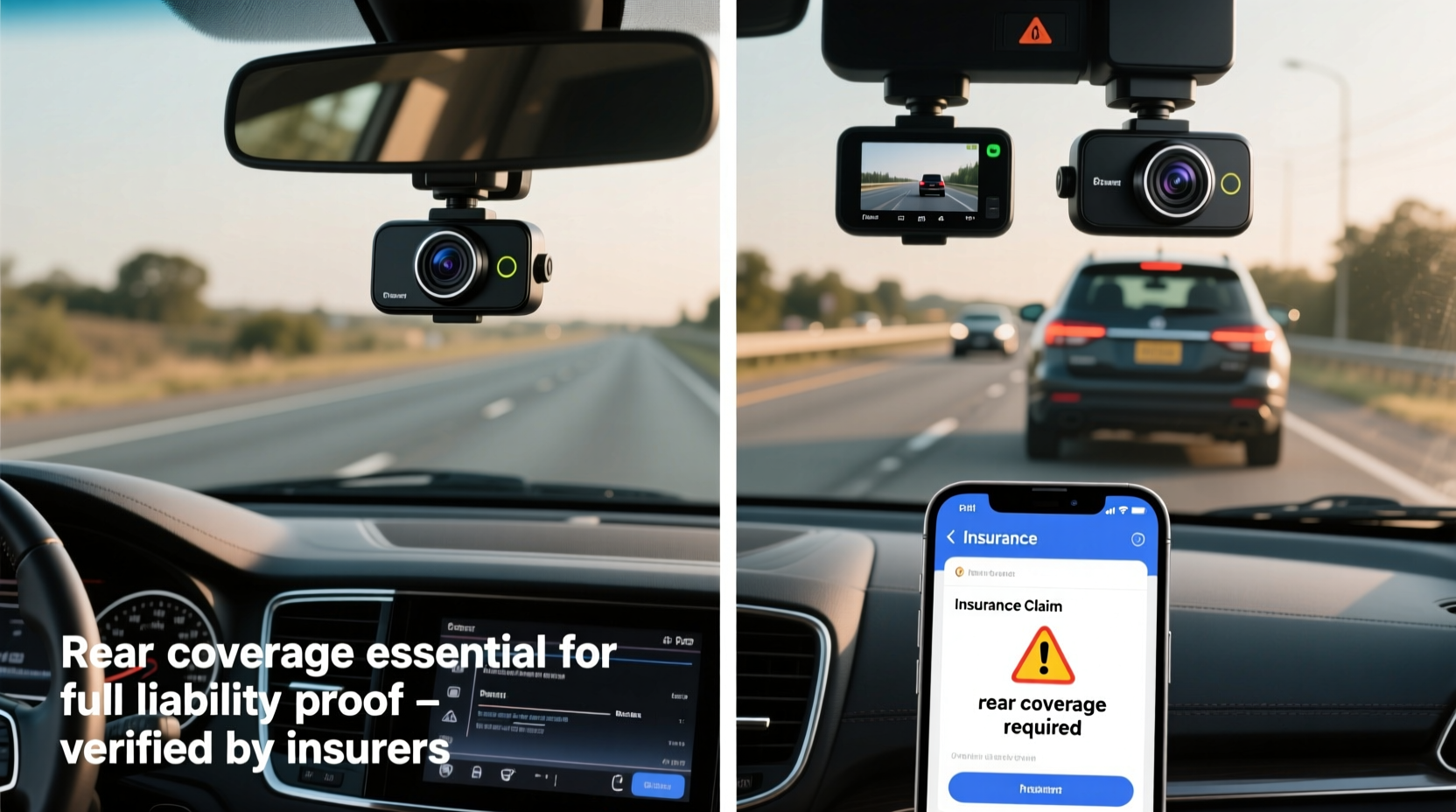
In the aftermath of a car accident, determining fault is often contentious. Drivers may give conflicting accounts, witnesses might not be available, and traffic camera footage could be limited or nonexistent. This is where dash cam recordings become invaluable.
Insurance adjusters increasingly accept dash cam footage as credible evidence. According to the Insurance Institute for Highway Safety (IIHS), video documentation reduces claim processing time by up to 40% and helps prevent fraudulent claims. Clear footage showing who had the right of way, whether a light was red, or if a vehicle changed lanes unsafely can decisively support your case.
However, most collisions don’t happen in isolation. Rear-end crashes, for example, account for nearly 30% of all reported accidents in urban areas. In these cases, a front-only camera captures only half the story—what’s happening ahead—but says nothing about what’s behind you.
“Video evidence from both ends of the vehicle removes ambiguity. It’s one of the most reliable ways to establish timeline and responsibility.” — David Lin, Claims Supervisor at Nationwide Auto Division
Front-Only vs. Front and Rear: A Practical Comparison
To understand which system suits your needs, consider how each performs across key criteria.
| Feature | Front-Only Dash Cam | Front and Rear Dash Cam |
|---|---|---|
| Cost | $60–$150 | $120–$300+ |
| Installation Complexity | Simple (plug-and-play) | Moderate to complex (requires wiring through trunk) |
| Field of View | Forward-facing only | Front + rear coverage (180°+ total) |
| Evidence Scope | Limited to events in front of the vehicle | Captures rear impacts, tailgating, reversing incidents |
| Storage Usage | Lower (one video stream) | Higher (dual streams require larger SD cards) |
| Insurance Claim Support | Strong for front collisions | Comprehensive for multi-angle incidents |
While front-only models excel in simplicity and affordability, they leave a blind spot at the rear. Dual-channel systems eliminate this gap but come with higher costs and installation effort. For drivers who frequently park in crowded lots, reverse often, or commute in heavy traffic, rear coverage significantly enhances evidentiary value.
Real-World Scenarios: When Rear Coverage Makes the Difference
A theoretical comparison only goes so far. Real-life situations reveal the true importance of rear recording capability.
Mini Case Study: The Parking Lot Dispute
Sarah, a delivery driver in Chicago, parked her SUV in a mall lot during lunch. Upon returning, she found a dent on her rear bumper but no note left behind. Her front-only dash cam was off while parked. Without evidence, her insurance denied the claim, citing lack of proof.
Months later, she upgraded to a dual-channel system with 24-hour parking mode. One evening, while parked at a gas station, another vehicle backed into her car and drove off. The rear camera captured the entire incident, including the license plate. She filed a claim with timestamped footage, and her insurer successfully recovered damages from the other party’s insurance.
This example illustrates a common vulnerability: damage occurring when the vehicle is stationary. Front cameras typically power down when the engine stops unless equipped with special wiring. Rear cameras with continuous monitoring provide crucial protection in such scenarios.
Another Common Scenario: Being Rear-Ended at a Stoplight
Imagine you’re stopped at a red light. A distracted driver fails to brake and hits you from behind. Your front camera shows your car was stationary, but it doesn’t capture the moment of impact from the rear. Without rear footage, the other driver could falsely claim you reversed into them.
A dual-channel system records both perspectives: your vehicle at a full stop and the approaching car making contact. This unambiguous evidence prevents disputes and accelerates claim resolution.
“In over 70% of rear-end claims we review, the at-fault party denies responsibility. Video from the rear camera ends the debate instantly.” — Linda Cho, Senior Adjuster at State Farm
Step-by-Step Guide: Choosing the Right Dash Cam Setup for Insurance Protection
Selecting the right dash cam involves more than just comparing specs. Follow this step-by-step process to ensure your device supports your insurance needs.
- Assess Your Driving Environment
Do you mostly drive on highways, city streets, or residential areas? Urban drivers face higher risks of fender benders and parking damage, making rear coverage more valuable. - Evaluate Parking Habits
If you regularly leave your car unattended in public spaces, rear coverage with parking mode becomes essential to document hit-and-runs or vandalism. - Determine Budget and Installation Tolerance
Front-only models are cheaper and easier to set up. If you're not comfortable running wires through your car’s interior, a plug-and-play unit may be preferable. - Check Storage and Power Options
Dual cameras generate twice the data. Use a high-capacity U3-rated microSD card (64GB or higher). Also, consider hardwiring for parking mode to avoid battery drain. - Verify Insurance Policy Requirements
Some insurers offer discounts for dash cam users. Ask if they prefer certain features like timestamp accuracy, loop recording, or dual-channel capability.
Expert Checklist: Must-Have Features for Insurance-Ready Dash Cams
Not all dash cams are created equal. To maximize effectiveness in insurance claims, ensure your device includes the following:
- ✅ High-resolution front recording (at least 1080p, ideally 1440p or 4K)
- ✅ Rear camera with night vision (for low-light clarity)
- ✅ Loop recording with G-sensor (automatically saves clips during impact)
- ✅ Time-stamped footage (critical for establishing sequence of events)
- ✅ Parking mode with motion or impact detection
- ✅ Reliable storage management (auto-overwrite, corruption protection)
- ✅ GPS logging (provides speed and route verification)
Devices lacking any of these features may fail to deliver usable evidence when needed most. For instance, a blurry rear image or missing timestamp can lead insurers to question authenticity.
Frequently Asked Questions
Do insurance companies accept dash cam footage?
Yes, most major insurers accept dash cam video as supporting evidence. However, they require clear, unedited footage with accurate timestamps. Avoid editing clips or enhancing contrast, as this may invalidate their use.
Can a front-only dash cam protect me in a rear-end collision?
Possibly, but not conclusively. A front camera might show your brake lights activating or your car coming to a stop, but it cannot prove the other vehicle struck you from behind. This leaves room for false liability claims against you.
Is rear dash cam footage admissible in court?
Yes, provided the recording is authentic, continuous, and properly stored. Courts recognize dash cam videos as objective evidence, especially when combined with metadata like time, date, and GPS coordinates.
Conclusion: Is Rear Coverage Essential?
The short answer: for comprehensive insurance protection, yes—rear coverage is essential. While front-only dash cams serve a purpose and can resolve many forward-facing incidents, they leave you exposed to risks from behind. Given that rear-end collisions are among the most common types of accidents, and parking lot damage is widespread, omitting rear coverage means accepting a significant blind spot.
Think of a dual-channel system not as a luxury, but as a complete safety net. It ensures that no matter where an incident occurs, you have verifiable proof. Over time, this can save thousands in disputed claims, premium hikes, or out-of-pocket repairs.
If budget or installation complexity is a concern, start with a front-only model—but plan to upgrade. Alternatively, look for kits that allow modular expansion, letting you add a rear camera later without replacing the entire system.




 浙公网安备
33010002000092号
浙公网安备
33010002000092号 浙B2-20120091-4
Comments
No comments yet. Why don't you start the discussion?