
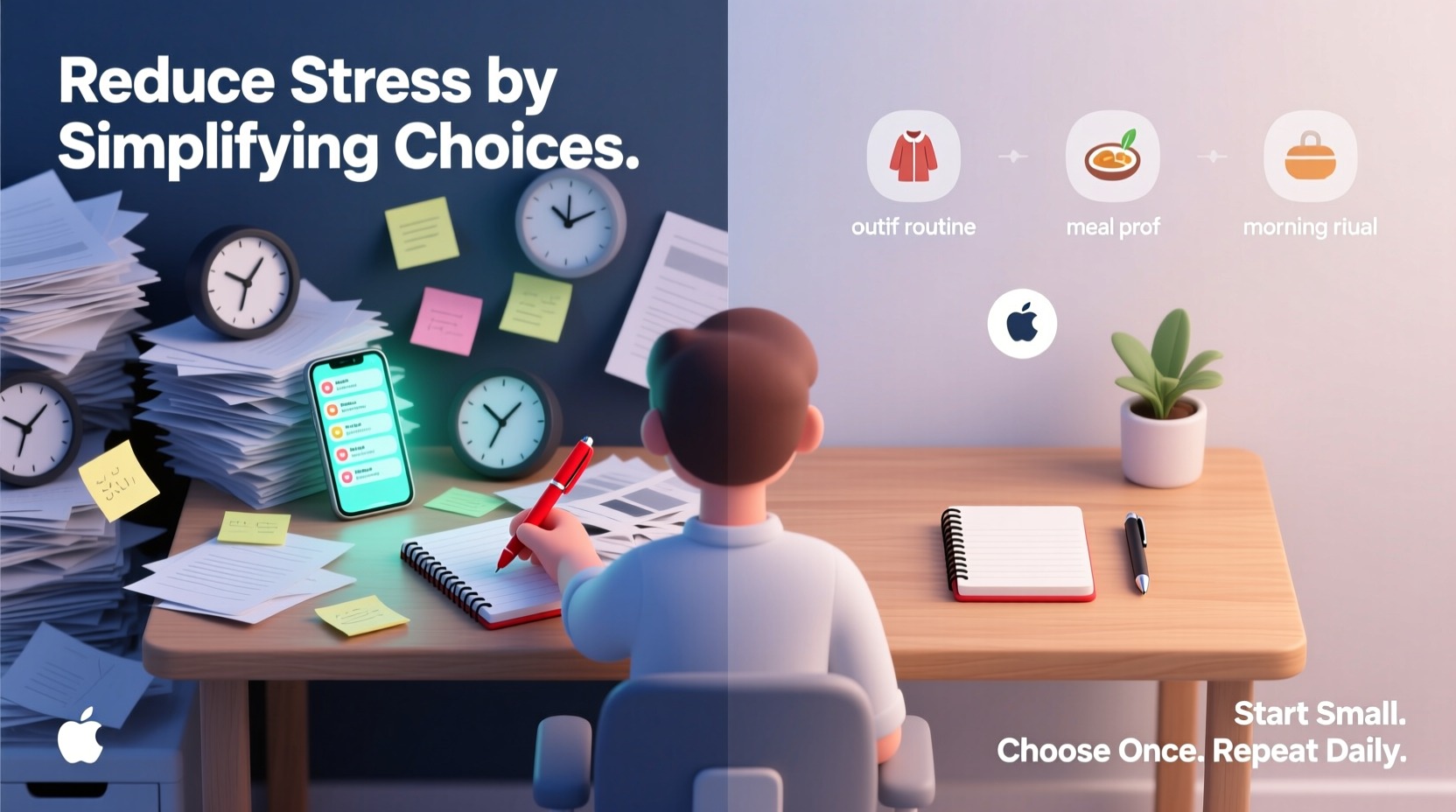
Every day, the average adult makes about 35,000 decisions. From what to wear and eat, to which emails to respond to first, our brains are constantly processing options. While many of these choices seem trivial, their cumulative effect can lead to a phenomenon known as decision fatigue—a state of mental exhaustion that impairs judgment, increases impulsivity, and drains emotional resilience. As demands on time and attention grow, learning how to reduce unnecessary cognitive load isn't just helpful; it's essential for maintaining clarity, productivity, and well-being.
Decision fatigue doesn’t announce itself with obvious symptoms like physical tiredness. Instead, it creeps in subtly: you might find yourself snapping at a colleague after a long meeting, skipping a workout despite good intentions, or reaching for junk food when you’d planned to eat healthy. These aren’t signs of weakness—they’re signals that your brain is overwhelmed by too many small choices throughout the day. The solution lies not in making fewer decisions overall, but in redesigning your environment and habits so that only the most important decisions require active thought.
The Science Behind Decision Fatigue
Psychological research has shown that willpower and decision-making operate like a finite mental resource. Each choice depletes a small amount of cognitive energy, especially when trade-offs are involved. This concept was famously illustrated in a 2011 study published in the *Proceedings of the National Academy of Sciences*, where researchers analyzed judicial parole decisions over several months. They found that judges were significantly more likely to grant parole early in the morning or right after lunch breaks—times when their mental energy was highest. Later in the day, as decision fatigue set in, approvals dropped sharply, even for similar cases.
This demonstrates a key insight: decision fatigue doesn’t just affect personal habits—it impacts professional judgment, relationships, and long-term outcomes. When we're mentally drained, we tend to either avoid decisions altogether (procrastination) or default to the easiest option, regardless of whether it’s the best one.
“Decision fatigue can lead to poorer self-control, increased risk-taking, and reduced empathy—all because the brain seeks shortcuts under pressure.” — Dr. Roy F. Baumeister, social psychologist and expert on willpower
The prefrontal cortex, responsible for executive function and rational thinking, becomes less effective as the day progresses if not managed properly. Overloading this system leads to diminished performance across all areas of life, from financial planning to emotional regulation.
How Daily Routines Contribute to Cognitive Drain
Modern life is filled with low-stakes but frequent decisions: Should I check my phone? Reply to this message now or later? What should I have for dinner? While individually insignificant, these micro-decisions accumulate rapidly. Consider the morning routine alone:
- What clothes should I wear?
- Should I hit snooze or get up immediately?
- Do I have time for breakfast?
- Which route should I take to work?
- Should I listen to music, a podcast, or silence during my commute?
Each of these requires evaluation, even if done subconsciously. Multiply this across dozens of such moments every day, and it’s easy to see how decision fatigue builds up—especially when major decisions are also expected at work or home.
Strategies to Minimize Decision Load
The goal isn’t to eliminate decision-making but to reserve high-quality cognitive effort for meaningful choices while automating the rest. Here are proven methods to streamline your day:
1. Establish Fixed Routines
Create structured routines for recurring activities like waking up, eating, working, and winding down. Consistency reduces uncertainty and eliminates repeated deliberation. For example, having a standard weekday breakfast removes the need to decide what to eat each morning.
2. Limit Options Intentionally
Barry Schwartz’s book *The Paradox of Choice* argues that more options don’t lead to greater satisfaction—they increase anxiety and regret. Apply this by curating your wardrobe (e.g., adopting a capsule collection), using meal templates, or setting default responses for common tasks.
3. Batch Similar Decisions
Group related decisions together to prevent scattered thinking. Schedule weekly planning sessions to map out meals, outfits, and priorities. This way, instead of deciding what to cook every night, you choose all dinners once a week.
4. Use Predefined Rules
Implement “if-then” rules to automate behavior. Examples include:
- If it takes less than two minutes, do it now.
- If an email doesn’t require action within 24 hours, schedule it.
- If I feel tempted to buy something non-essential, wait 24 hours.
5. Delegate or Eliminate Low-Impact Choices
Outsource decisions when possible. Let a partner pick the restaurant sometimes. Use grocery delivery with saved lists. Cancel subscriptions you rarely use. Every eliminated option frees up mental bandwidth.
“I wear basically the same thing every day—not because I don’t care about fashion, but because I want to make my life simpler and concentrate on things that matter.” — Mark Zuckerberg, Facebook co-founder
Case Study: A Week Without Morning Decisions
Sarah, a project manager at a tech startup, struggled with afternoon burnout and inconsistent productivity. She often skipped workouts, made impulsive lunch choices, and delayed important client follow-ups until late in the day. After tracking her habits, she realized she spent the first hour each morning making over a dozen small decisions—from checking notifications to choosing an outfit—before even leaving the house.
She implemented a simplified morning protocol:
- Laid out clothes the night before based on her calendar.
- Prepared overnight oats with three rotating flavor combinations.
- Turned off non-urgent notifications until 10 a.m.
- Committed to a 7-minute mobility routine immediately upon waking.
Within two weeks, Sarah reported improved focus during meetings, better dietary choices, and increased motivation to exercise. By reducing early-day decision load, she preserved mental energy for strategic work and creative problem-solving later in the day. Her team noticed a shift in her responsiveness and confidence during high-pressure discussions.
Practical Checklist: Reducing Daily Decision Fatigue
Action Plan: Simplify Your Daily Choices
- Choose 3 go-to outfits for workdays and rotate them weekly.
- Plan meals every Sunday using a repeating template (e.g., Meatless Monday, Taco Tuesday).
- Set up automatic bill payments and savings transfers.
- Designate specific times to check email and messages (e.g., 10 a.m., 1 p.m., 4 p.m.).
- Use app blockers to limit social media access during work hours.
- Keep a running list of quick dinner ideas on the fridge.
- Automate grocery orders with a preset list.
- Define clear criteria for saying “yes” or “no” to new commitments.
- Batch administrative tasks into one weekly 30-minute session.
- Practice the “one-touch rule” for paper and digital files—handle once, then file or discard.
When to Make Decisions—and When Not To
Timing matters. Research shows that self-regulatory strength fluctuates throughout the day. Making critical decisions when your mind is fresh leads to better outcomes. Use the following table to optimize decision timing:
| Time of Day | Mental State | Best For | Avoid |
|---|---|---|---|
| Morning (first 90 min) | Highest willpower, peak focus | Strategic planning, tough conversations, creative work | Checking news/social media, reactive tasks |
| Midday (11 a.m.–1 p.m.) | Moderate energy, post-meal dip approaching | Meetings, collaborative work, reviewing data | Major purchases, emotionally charged discussions |
| Afternoon (2–4 p.m.) | Declining focus, higher impulsivity | Routine tasks, organizing, light admin | Important decisions, negotiations, starting new projects |
| Evening (after 7 p.m.) | Low cognitive reserves, emotional sensitivity | Relaxation, reflection, light reading | Financial decisions, conflict resolution, screen-heavy multitasking |
Aligning your decision-making with natural energy cycles helps protect against poor judgment caused by fatigue. If a choice can wait until tomorrow morning, it often should.
Frequently Asked Questions
Is decision fatigue the same as being tired?
No. While physical fatigue affects your body, decision fatigue specifically impairs your ability to make sound judgments. You can be physically rested but mentally depleted from constant small choices. Symptoms include indecisiveness, irritability, procrastination, and impulsive behavior—even after a full night’s sleep.
Can technology help reduce decision fatigue?
Yes, when used intentionally. Tools like calendar blocking, automated reminders, habit-tracking apps, and smart home systems can minimize repetitive decisions. However, excessive notifications, endless scrolling, and constant alerts worsen the problem by increasing distraction and micro-choice frequency. The key is to design your tech environment to support—not sabotage—mental clarity.
How do successful people manage decision fatigue?
Many high performers minimize trivial choices. Barack Obama wore only gray or blue suits to reduce wardrobe decisions. Steve Jobs famously wore the same black turtleneck daily. CEOs often delegate scheduling, travel planning, and household logistics. Their strategy isn’t laziness—it’s focus. By conserving mental energy for leadership and innovation, they maintain consistency under pressure.
Building Sustainable Habits to Preserve Mental Energy
The most effective way to combat decision fatigue is to build systems, not rely on willpower. Willpower fades; routines endure. Start small: pick one area of daily life—like meals or mornings—and introduce structure. Once that becomes automatic, move to the next. Over time, these changes compound, freeing up significant cognitive space.
Consider implementing a “decision audit” once a month. Reflect on:
- Which decisions felt draining this month?
- Where did I make rushed or regrettable choices?
- What could be automated, delegated, or eliminated?
This reflective practice turns awareness into action, helping you continuously refine your decision architecture.
Conclusion: Reclaim Your Focus and Reduce Stress
Decision fatigue is invisible but pervasive, eroding your effectiveness one small choice at a time. But by understanding its mechanisms and applying intentional simplification, you can reclaim mental clarity and emotional balance. It’s not about doing more—it’s about thinking smarter. Streamline your routines, protect your peak focus hours, and eliminate clutter—both physical and cognitive.
Start today. Pick one repetitive decision—your morning coffee order, your work attire, your evening unwind ritual—and fix it. Make it automatic. Then watch how that small change ripples through your day, reducing stress and boosting confidence. Simplicity isn’t minimalism for aesthetics; it’s strategy for sustainable performance.




 浙公网安备
33010002000092号
浙公网安备
33010002000092号 浙B2-20120091-4
Comments
No comments yet. Why don't you start the discussion?