
Every day, we make hundreds of decisions—what to wear, what to eat, which route to take to work. Most pass unnoticed. But for some, even trivial choices trigger a spiral of second-guessing, mental fatigue, and inaction. This is decision paralysis: the inability to act due to an overwhelming fear of making the wrong choice. It’s not indecisiveness; it’s a cognitive bottleneck caused by overanalysis, perfectionism, and information overload. The good news? It’s fixable. With deliberate strategies, you can reclaim your clarity and confidence in everyday decisions.
The Hidden Cost of Overthinking Small Choices
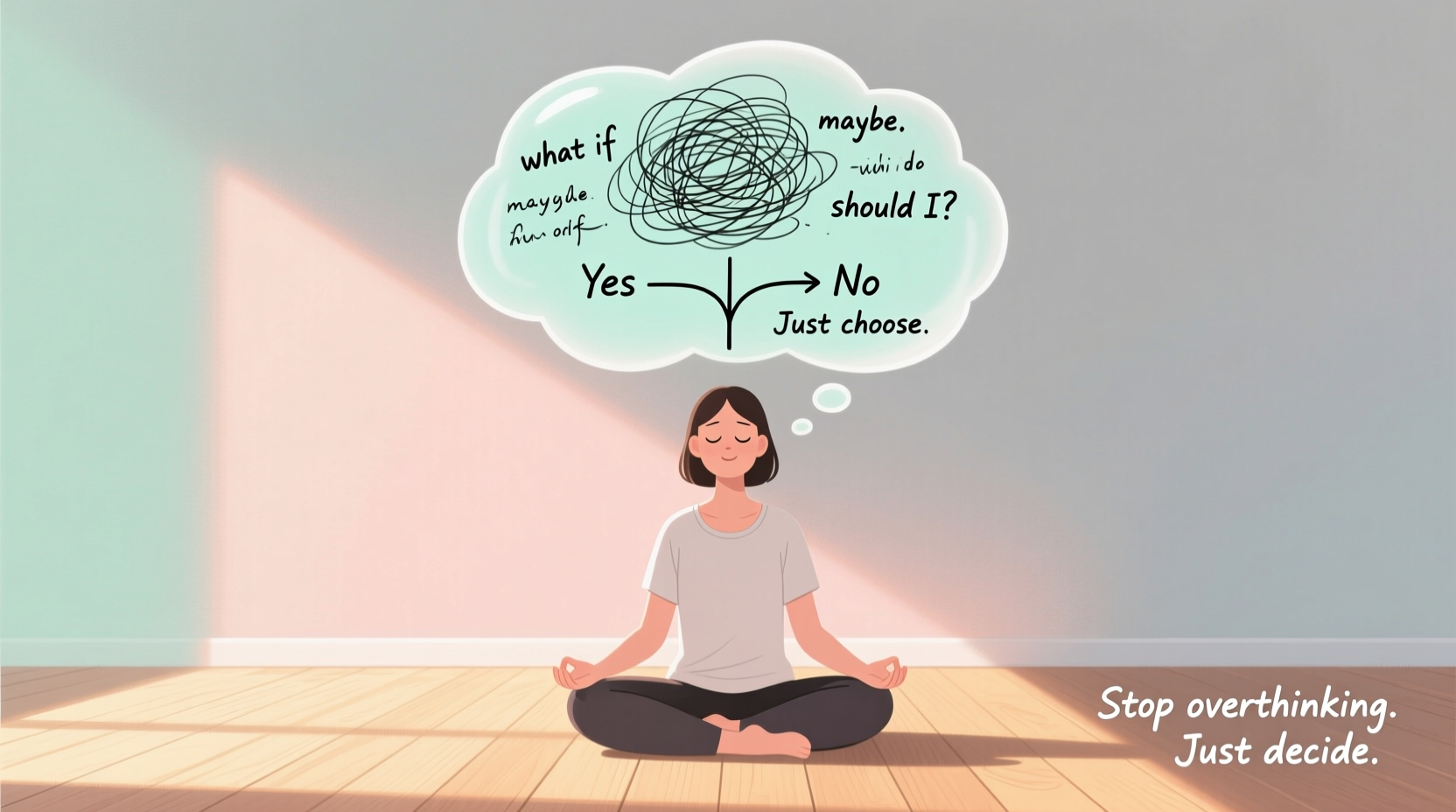
While major life decisions—like changing careers or buying a home—deserve careful thought, minor ones shouldn’t drain your mental energy. Yet people often spend more time picking a lunch option than planning their finances. This misallocation of cognitive resources leads to decision fatigue, where each additional choice reduces your ability to make sound judgments later in the day.
Psychological research shows that humans have a limited capacity for decision-making. When this bandwidth is consumed by trivial matters, important decisions suffer. A study from Columbia University found that shoppers presented with 24 varieties of jam were less likely to buy any than those offered only six options. Too many choices don’t empower—they paralyze.
Why We Overthink: The Psychology Behind Decision Paralysis
Decision paralysis doesn’t stem from laziness or lack of intelligence—it arises from deeply ingrained cognitive patterns. Three primary factors fuel it:
- Fear of regret: Many worry that choosing incorrectly will lead to long-term consequences, even when the stakes are low.
- Perfectionism: The belief that there’s one “best” option drives endless comparisons and delays action.
- Information overload: In the digital age, we’re bombarded with reviews, alternatives, and opinions, making it harder to trust our instincts.
Dr. Barry Schwartz, author of *The Paradox of Choice*, explains: “When there are too many options, people become overwhelmed, leading to anxiety, dissatisfaction, and ultimately, no decision at all.” This isn’t just theoretical—it plays out in real life every time someone spends 45 minutes comparing toothpaste brands online.
“We assume more choice means more freedom, but in reality, it often means more pressure.” — Dr. Barry Schwartz, Psychologist and Author
A Step-by-Step Guide to Breaking Free From Overthinking
Escaping decision paralysis requires intentional rewiring of habits. Follow this five-step process to regain control over small decisions:
- Define the stakes: Ask yourself, “Will this matter in a week? A month?” If not, set a strict time limit for deciding (e.g., 2 minutes).
- Set criteria before browsing: Decide what matters most—price, convenience, quality—before looking at options. This prevents being swayed by irrelevant details.
- Limits options to three: Instead of reviewing every possibility, pick three viable choices and compare only those.
- Use the 70% rule: If an option meets at least 70% of your needs, go with it. Waiting for 100% certainty is usually unnecessary.
- Reflect after acting: After making the choice, note whether the outcome was acceptable. You’ll often realize that “good enough” was sufficient.
This approach shifts focus from finding the perfect answer to achieving functional resolution. Over time, this builds confidence in your judgment and reduces hesitation.
Checklist: Daily Habits to Reduce Decision Fatigue
- Plan your next-day outfit the night before
- Pre-select default meals for weekdays
- Batch similar decisions (e.g., schedule all appointments on one day)
- Turn low-stakes preferences into rules (“I always order black coffee at drive-thrus”)
- Use apps or tools to automate recurring choices (subscription boxes, auto-refills)
- Practice saying “I’ll decide now and accept the result” aloud
- Track decision time spent weekly to identify problem areas
These micro-habits accumulate into significant mental relief. By reducing variability in routine decisions, you preserve willpower for meaningful choices.
Real Example: How Sarah Regained Control of Her Mornings
Sarah, a marketing manager in her early 30s, used to spend 20 minutes every morning standing in front of her closet, cycling through tops, bottoms, and shoes. She’d agonize over whether an outfit looked “professional enough” or if she was repeating styles too often. This delay caused her to skip breakfast, rush out the door, and start her day stressed.
After reading about decision fatigue, she implemented a capsule wardrobe—keeping only 10 mix-and-match pieces she loved. She also designated “uniform days”: business casual on Mondays/Wednesdays/Fridays, creative casual on Tuesdays/Thursdays. Within two weeks, her morning routine shortened by 15 minutes. More importantly, she reported feeling calmer and more focused at work.
“I realized I wasn’t choosing clothes—I was trying to manage my self-image through them,” Sarah said. “Once I removed the emotional weight, the decision became easy.”
Do’s and Don’ts: Smart Decision-Making Framework
| Do | Don't |
|---|---|
| Set time limits for low-impact decisions | Spend more than 5 minutes choosing snacks or household items |
| Ask, “What would I recommend to a friend?” | Assume you must optimize every single choice |
| Accept that trade-offs are normal | Believe there’s one objectively best option |
| Review past decisions to see outcomes | Dwell on hypothetical “what ifs” |
| Delegate or eliminate non-essential decisions | Try to personally control every detail |
This framework reinforces realistic expectations. Most decisions aren’t irreversible or high-risk. Learning to categorize them helps apply appropriate effort.
Expert Insight: The Role of Self-Trust in Decision-Making
Dr. Nina Patel, a cognitive behavioral therapist specializing in anxiety and performance, emphasizes that decision paralysis often reflects deeper issues of self-trust.
“When people overthink, they’re not just evaluating options—they’re questioning their own judgment. The solution isn’t better analysis; it’s building confidence through small, repeated acts of decisive action.” — Dr. Nina Patel, CBT Specialist
She recommends starting with “low-risk experiments”: deliberately making quick decisions on unimportant matters (like which pen to use) and observing that nothing catastrophic happens. Over time, this retrains the brain to tolerate uncertainty and trust intuition.
FAQ: Common Questions About Decision Paralysis
Is decision paralysis a sign of anxiety?
Yes, it frequently coexists with generalized anxiety disorder, obsessive-compulsive tendencies, or perfectionism. Chronic overthinking about minor choices can indicate underlying anxiety about control, failure, or self-worth. While occasional hesitation is normal, persistent paralysis may benefit from professional support.
How do I know if a decision deserves more time?
Use the “10/10/10 rule”: Will this matter in 10 days? 10 months? 10 years? If the answer is “no” at all levels, it’s likely a low-stakes decision. Reserve deep analysis for choices affecting health, finances, relationships, or long-term goals.
Can technology help reduce overthinking?
Certainly. Tools like decision matrices, habit-tracking apps, and even randomizers (e.g., flipping a coin) can break deadlocks. Apps such as Todoist or Notion allow you to predefine rules for recurring tasks. However, avoid using tech to gather endless data—this often worsens the problem.
Conclusion: Reclaim Your Time and Peace of Mind
Decision paralysis isn’t a personal flaw—it’s a modern cognitive challenge amplified by abundance and expectation. But every moment spent overanalyzing a menu or streaming service is a moment stolen from living. The goal isn’t to make perfect choices; it’s to make timely ones and move forward.
Start small. Pick one recurring decision that drains you—a grocery item, a commute route, a bedtime—and apply a new rule: decide quickly, act immediately, reflect later. Notice how little most outcomes actually affect your life. With repetition, you’ll build a mindset of action over analysis, clarity over confusion.




 浙公网安备
33010002000092号
浙公网安备
33010002000092号 浙B2-20120091-4
Comments
No comments yet. Why don't you start the discussion?