
Military identification tags—commonly known as dog tags—are more than just metal pieces stamped with information. For historians, collectors, and descendants of service members, they are vital artifacts that offer insight into identity, medical needs, and military service. German dog tags, in particular, carry a layered legacy shaped by over a century of evolving military doctrine, national transitions, and technological advances. Understanding them requires both linguistic knowledge and historical context. This guide breaks down the structure, symbolism, and evolution of German dog tags from the Imperial era to the modern Bundeswehr.
The Evolution of German Military ID Tags
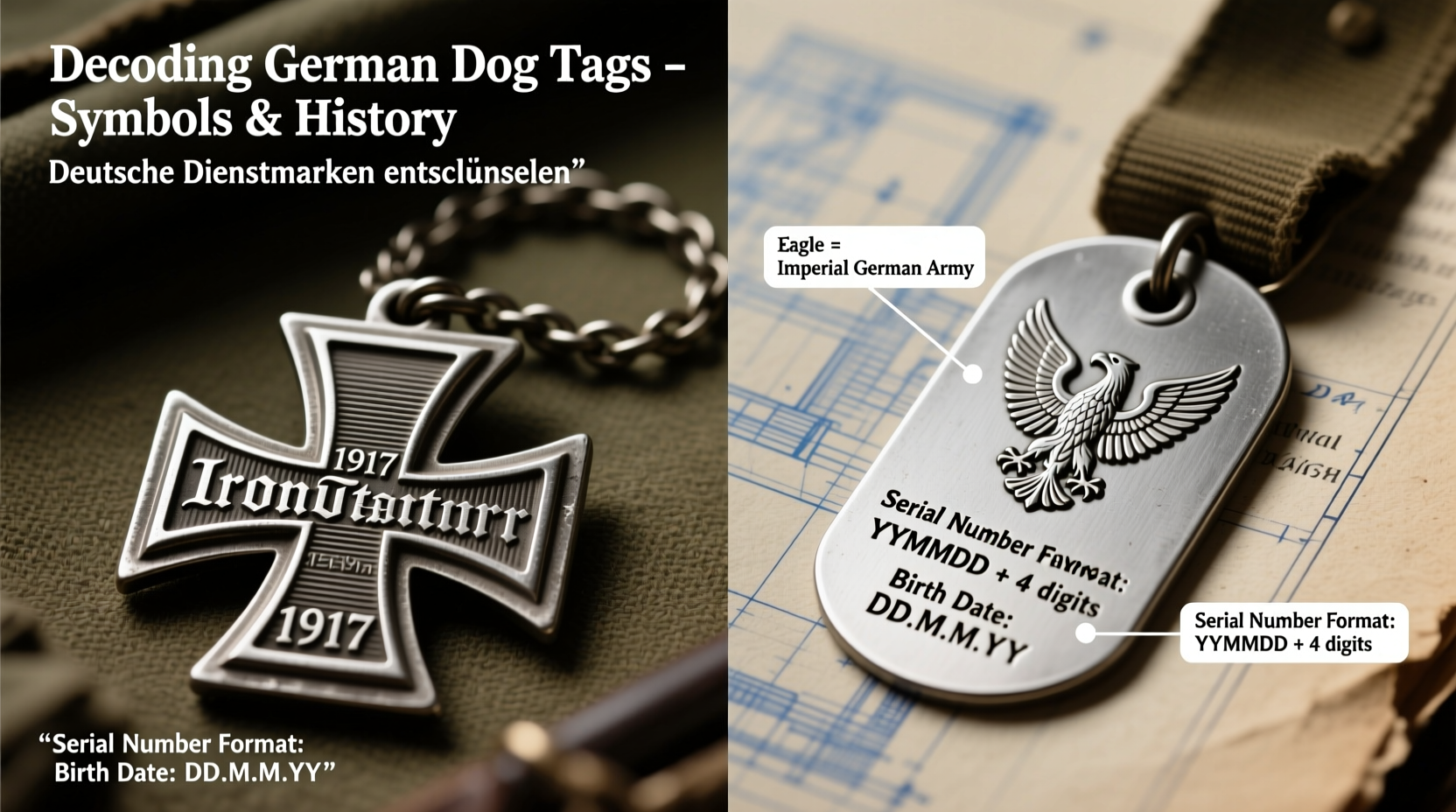
The use of identification tags in German-speaking armies began during World War I, when the sheer scale of casualties made battlefield identification essential. Before standardized tags, soldiers often carried handwritten notes or religious medals bearing names. The first official German ID tags were introduced in 1916 by the Imperial German Army (Deutsches Kaiserreich). These early tags were typically oval-shaped, made of aluminum or fiber, and stamped with minimal data: name, rank, unit, and religion.
During World War II, the Wehrmacht refined the design. The iconic twin-tag system was introduced—two identical rectangular tags on a single chain, allowing one to remain with the body while the other went to headquarters for record-keeping. Materials shifted to corrosion-resistant metals like zinc alloy, and coding systems expanded to include blood type and vaccination status.
After 1945, Germany’s military was disbanded. It wasn’t until 1955, with the founding of the Bundeswehr in West Germany, that a new identification system emerged—one aligned with NATO standards but retaining uniquely German elements. Today’s German dog tags reflect a balance between interoperability with allied forces and domestic administrative needs.
Key Historical Periods and Tag Types
| Era | Force | Material | Common Information |
|---|---|---|---|
| World War I (1914–1918) | Imperial German Army | Aluminum, fiber | Name, rank, unit, religion |
| World War II (1939–1945) | Wehrmacht / Waffen-SS | Zinc alloy | Name, serial number, blood type, tetanus shot date |
| Cold War (1955–1990) | Bundeswehr (West), NVA (East) | Stainless steel | NATO-standard fields plus national codes |
| Modern Era (1990–present) | Bundeswehr (reunified) | Stainless steel, laser-engraved | Digital compatibility, multilingual formatting |
Step-by-Step Guide to Decoding Modern German Dog Tags
Today’s Bundeswehr issues dog tags that follow a standardized format compatible with NATO allies. Each tag contains specific fields encoded with alphanumeric identifiers. Here is how to read one systematically:
- Identify the Format: Modern German tags are rectangular, stainless steel, and feature two lines of embossed text per side. One tag remains with the soldier; the second is intended for medical or administrative use.
- Read Line 1: Name and Service Number: This line usually begins with “DEU” (country code for Deutschland), followed by the soldier’s last name, first initial, and service number (Wehrdienstnummer). Example: DEU MÜLLER A 1234567.
- Line 2: Blood Type and Rh Factor: This appears as a combination like “A+”, “B−”, or “AB+”. Unlike U.S. tags, this is always listed even if redundant with medical records.
- Reverse Side: Religious Preference and Vaccination Status: May include abbreviations such as “RK” (Römisch-Katholisch), “EV” (Evangelisch), or “OH” (Ohne Konfession – no religion). Some also list the date of the last tetanus shot.
- Check for Additional Codes: In field operations, temporary tags may include mission-specific identifiers or GPS-compatible serial numbers.
Understanding Abbreviations and Symbols
German military documents rely heavily on abbreviations. On dog tags, space constraints make this especially true. Familiarize yourself with common ones:
- RK – Römisch-katholisch (Roman Catholic)
- EV – Evangelisch (Protestant/Lutheran)
- OH – Ohne Konfession (No religious affiliation)
- TG – Tetanusgeimpft (Tetanus vaccinated); often followed by a date (e.g., TG 24/03)
- NDH – Keine besonderen Hinweise (No special instructions; literally “no special notes”)
- ALL – Allergie (Allergy); may be followed by allergen (e.g., ALL PEN for penicillin)
“German dog tags are concise but rich in operational intelligence. A single symbol can inform battlefield medics about transfusion compatibility or religious care requirements.” — Dr. Klaus Reinhardt, Military Medical Historian, University of Potsdam
Deciphering World War II-Era Tags: A Closer Look
Interpreting Wehrmacht dog tags requires deeper historical literacy. The Nazi-era military used a mix of standardization and unit-specific coding. One notable feature is the inclusion of the *Erkennungsmarke* (recognition mark) number, which linked to central personnel files.
A typical WWII German tag might read:
MUSTERMANN H
12 E 4567 AB+ TG 43
This breaks down as:
- MUSTERMANN H: Last name and first initial (a placeholder name, equivalent to “John Doe”)
- 12 E 4567: Unit and service number. “12” could indicate the 12th Infantry Division; “E” stands for *Erfassung* (registration district); “4567” is the personal ID.
- AB+: Blood type (AB positive)
- TG 43: Tetanus vaccinated in 1943
Unlike modern tags, these did not include country codes or standardized fonts. Hand-stamping errors and regional variations are common, making authentication challenging for collectors.
Mini Case Study: Identifying a Family Heirloom
In 2021, a historian in Hamburg received a zinc dog tag from a private collector whose grandfather served in the Afrika Korps. The tag read:
SCHULZ K
5 P 8821 O+ TG 41
Using digitized Wehrmacht records, researchers traced “5 P 8821” to the 5th Panzer Regiment, active in North Africa between 1941 and 1943. The blood type O+ indicated universal donor status—critical in mobile field hospitals. The “TG 41” confirmed vaccination before deployment. By matching the service number with muster rolls, the team identified Karl Schulz, born 1919, reported missing in action near Tobruk in June 1942. This case illustrates how dog tags, when properly decoded, can restore individual narratives lost to time.
Frequently Asked Questions
Can civilians own authentic German dog tags?
Yes, many original German dog tags are legally available through antique dealers and auctions, especially those from World War I and II. However, selling or wearing certain Nazi-era insignia may be restricted under German law (§86a StGB). Tags without swastikas or political symbols are generally permissible for collection.
Do modern German dog tags include DNA information?
No, current Bundeswehr tags do not store DNA. They contain only essential medical and identification data. DNA sampling is handled separately through biometric enrollment for high-risk deployments.
Are East German (NVA) dog tags different from West German ones?
Yes. National People’s Army (NVA) tags used Cyrillic-style numbering and included state security codes. They often omitted religious designation due to the secular nature of the GDR regime. Post-reunification, all tags adopted the Bundeswehr standard.
Checklist: How to Analyze a German Dog Tag
- ✅ Determine the era based on material and shape
- ✅ Identify country and service branch codes (e.g., DEU, WAR for Wehrmacht)
- ✅ Decode the name and service number
- ✅ Interpret blood type and Rh factor
- ✅ Note religious preference or vaccination dates
- ✅ Consult archival databases for service confirmation
- ✅ Verify legality of possession, especially for pre-1945 items
Conclusion: Honoring History Through Understanding
German dog tags are small in size but immense in significance. Whether you’re a genealogist tracing ancestry, a collector preserving military history, or a student of 20th-century warfare, the ability to decode these tags transforms inert metal into human stories. Each engraving reflects not just logistics and medicine, but identity under extreme conditions. By learning their language—literal and symbolic—you contribute to a more nuanced understanding of Germany’s complex military past.




 浙公网安备
33010002000092号
浙公网安备
33010002000092号 浙B2-20120091-4
Comments
No comments yet. Why don't you start the discussion?