
During World War II, millions of soldiers wore small, stamped metal discs around their necks—dog tags. These simple pieces of metal carried vital information that could mean the difference between an identified casualty and an unknown grave. Today, these tags serve as powerful historical artifacts, offering insight into individual service members and the broader military system of the era. Understanding how to read and interpret them unlocks personal stories, medical data, and administrative codes used by the U.S. Armed Forces during one of history’s most pivotal conflicts.
The Purpose and Evolution of WWII Dog Tags
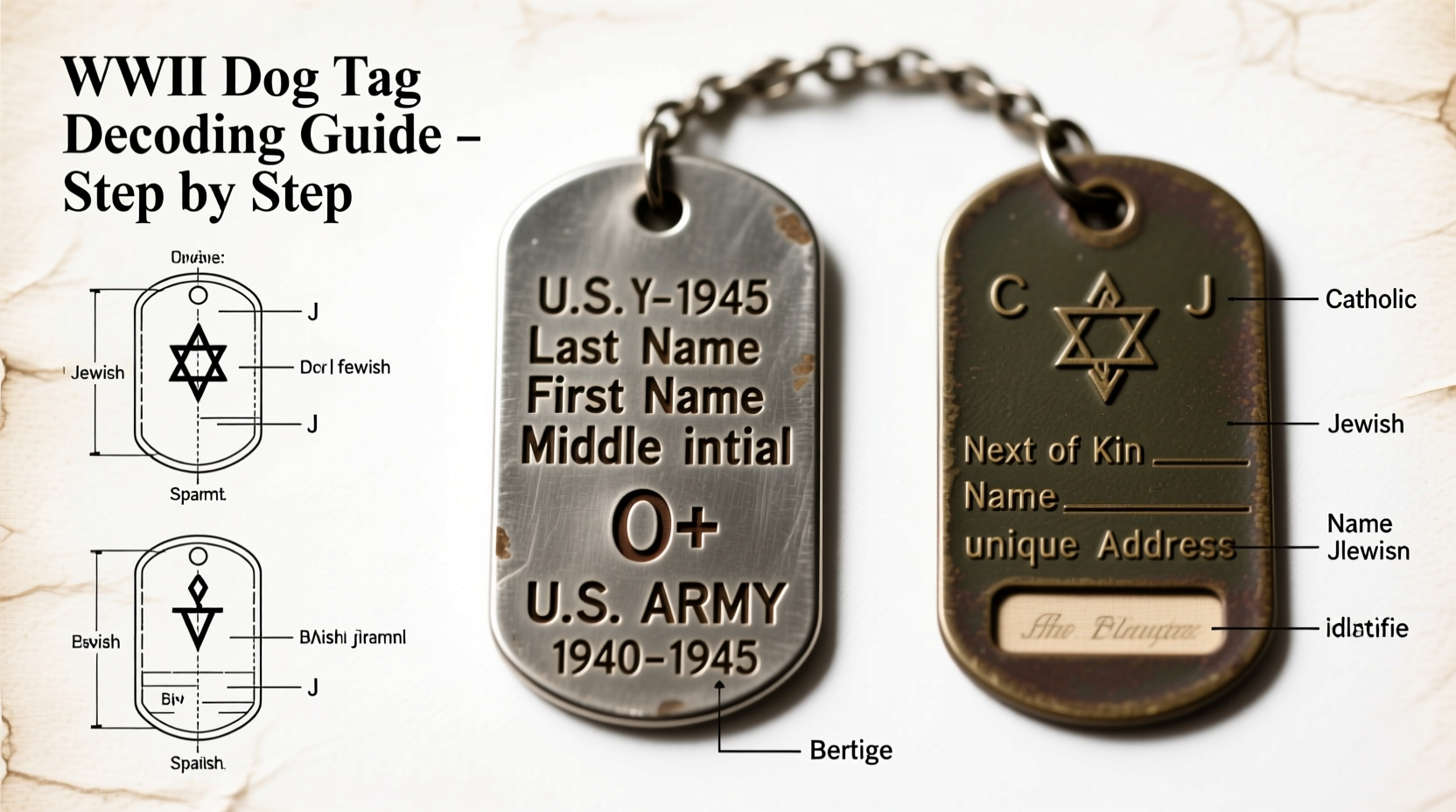
Dog tags were first introduced in limited form during the American Civil War but became standardized during World War I. By World War II, they had evolved into a reliable identification system for all branches of the U.S. military. Each soldier received two identical tags: one remained with the body if killed, and the other was sent to headquarters for record-keeping.
The primary purpose was battlefield identification. In chaotic combat zones, rapid and accurate identification of wounded or deceased personnel was essential for medical treatment, casualty reporting, and notification of next of kin. The tags also provided critical medical information such as blood type and inoculation status, which could save lives in field hospitals.
“Dog tags are more than metal—they’re a soldier’s identity under fire. Reading them correctly honors both the individual and the system that supported them.” — Dr. James Holloway, Military Archivist and Historian
Standard Format of U.S. WWII Dog Tags
While minor variations existed between services (Army, Navy, Marines), the standard U.S. Army dog tag issued from 1940 onward followed a consistent layout. Most tags were made of stainless steel, oval-shaped, and designed to be broken in half. Here is the typical format inscribed on each tag:
- Name: Full last name and first initial (e.g., SMITH J)
- Service Number: A unique identifier assigned to the soldier (e.g., 3456789)
- Religious Preference: Often abbreviated (P for Protestant, C for Catholic, H for Hebrew, or blank)
- Blood Type: Listed as either “B POS,” “O NEG,” etc.
- Branch/Unit Code (Optional): Sometimes included division or regiment code
Step-by-Step Guide to Decoding a WWII Dog Tag
Interpreting a WWII dog tag requires attention to detail and familiarity with military conventions. Follow this sequence to extract full meaning from each line.
- Identify the Name Format: Names appear as last name followed by first initial. Middle names or initials were typically omitted unless part of the legal name.
- Locate the Service Number: This nine-digit number replaced the older \"serial number\" system and uniquely identifies the individual in military records.
- Check Religious Affiliation: This field helped chaplains provide appropriate spiritual care. Note that atheists were not officially recognized; blanks often indicated no preference.
- Read Blood Type and Inoculations: Blood type was crucial for transfusions. Some later-war tags include “Tetanus” or “Anti-Gas” to indicate vaccination status.
- Look for Additional Markings: Tags may have notch at top (for use in embossing machines), manufacturer stamps, or branch-specific codes.
Example Breakdown: A Real WWII Dog Tag
Consider a hypothetical tag with the following engraving:
SMITH J
3456789
P
B POS
- SMITH J: Soldier's last name is Smith, first name begins with J.
- 3456789: Official service number. Can be used to search National Archives or veteran databases.
- P: Protestant faith designation.
- B POS: Blood type B, Rh positive—critical for medical readiness.
Deciphering Service Numbers and Unit Codes
The service number offers a window into enlistment patterns. During WWII, the U.S. Army used specific numbering ranges to denote enlistment origin:
| Number Range | Meaning |
|---|---|
| 1000000–1999999 | Regular Army |
| 3000000–3999999 | Selective Service (drafted personnel) |
| 8000000–8999999 | National Guard |
| 10000000+ | Enlisted after December 1940 expansion |
For example, a service number starting with “3” likely indicates a draftee, while “1” suggests a career soldier. This distinction helps researchers contextualize a soldier’s background.
Common Misinterpretations and Pitfalls
Amateur collectors and family historians often misread certain elements of WWII dog tags. Awareness of these errors improves accuracy in research.
- Mistaking initials: A name like “JOHNSON R M” might be misread as having two first names, when it’s actually last name Johnson, first initial R, middle initial M.
- Confusing blood type abbreviations: “O NEG” is O-negative, not zero negative. It does not imply deficiency.
- Overlooking duplicate tags: Two identical tags were issued. Finding only one doesn’t mean it’s rare—it was standard procedure to separate them upon death.
Mini Case Study: Identifying a Fallen Soldier
In 2017, a dog tag was found near Bastogne, Belgium, engraved with:
WILSON T
3789210
C
O NEG
Using the service number, researchers determined Private Thomas Wilson was drafted in 1943 (number beginning with 3) and served with the 101st Airborne Division. His blood type matched unit medical logs, and church records confirmed his Catholic affiliation. With additional archival work, his surviving niece was located, and the tag was returned to the family nearly 75 years after D-Day.
This case illustrates how even minimal data on a dog tag can lead to meaningful historical recovery when interpreted correctly.
Frequently Asked Questions
Did all Allied nations use the same dog tag format?
No. While the U.S. used a standardized metal disc, British forces often used rectangular porcelain tags, and German Wehrmacht tags were aluminum with different coding systems. Formats varied widely by country and branch.
Can I look up someone using just their dog tag info?
Yes, in many cases. The National Archives and Records Administration (NARA) maintains military service records. Service numbers and names can often trace enlistment, discharge, and service history—especially if combined with other details like birthdate or hometown.
Were African American soldiers’ dog tags different?
No, the physical tag was identical. However, some early-war records included racial designation (e.g., “Negro”) in administrative files, though this was never stamped on the tag itself. Integration progressed throughout the war.
Preservation and Research Checklist
If you own or are researching a WWII dog tag, follow these steps to ensure proper handling and meaningful investigation:
- Photograph the tag clearly on both sides
- Record all visible text exactly as engraved
- Note any manufacturer marks or wear patterns
- Search the service number in NARA’s online catalog or Fold3.com
- Contact veterans organizations or historical societies for assistance
- Respect privacy—do not publicly share personal data without consent
Conclusion: Honoring History Through Understanding
WWII dog tags are more than relics—they are intimate links to those who served. Each stamped letter and number carries weight, telling a story of duty, sacrifice, and identity. By learning how to decode them accurately, we preserve the legacy of individual soldiers and deepen our understanding of wartime logistics and human experience.




 浙公网安备
33010002000092号
浙公网安备
33010002000092号 浙B2-20120091-4
Comments
No comments yet. Why don't you start the discussion?