
In a world buzzing with notifications, open tabs, and endless to-do lists, the myth of multitasking persists as a badge of honor. Many professionals pride themselves on juggling emails during meetings, texting while writing reports, or checking social media while working on complex projects. But neuroscience tells a different story: the human brain isn’t built to handle multiple cognitive tasks simultaneously. What we call “multitasking” is actually rapid task-switching—each switch comes with a cognitive cost that erodes focus, accuracy, and efficiency. In contrast, deep work—the ability to focus without distraction on cognitively demanding tasks—emerges not just as a productivity tool, but as a biological necessity for high performance.
The Myth of Multitasking: What Neuroscience Reveals
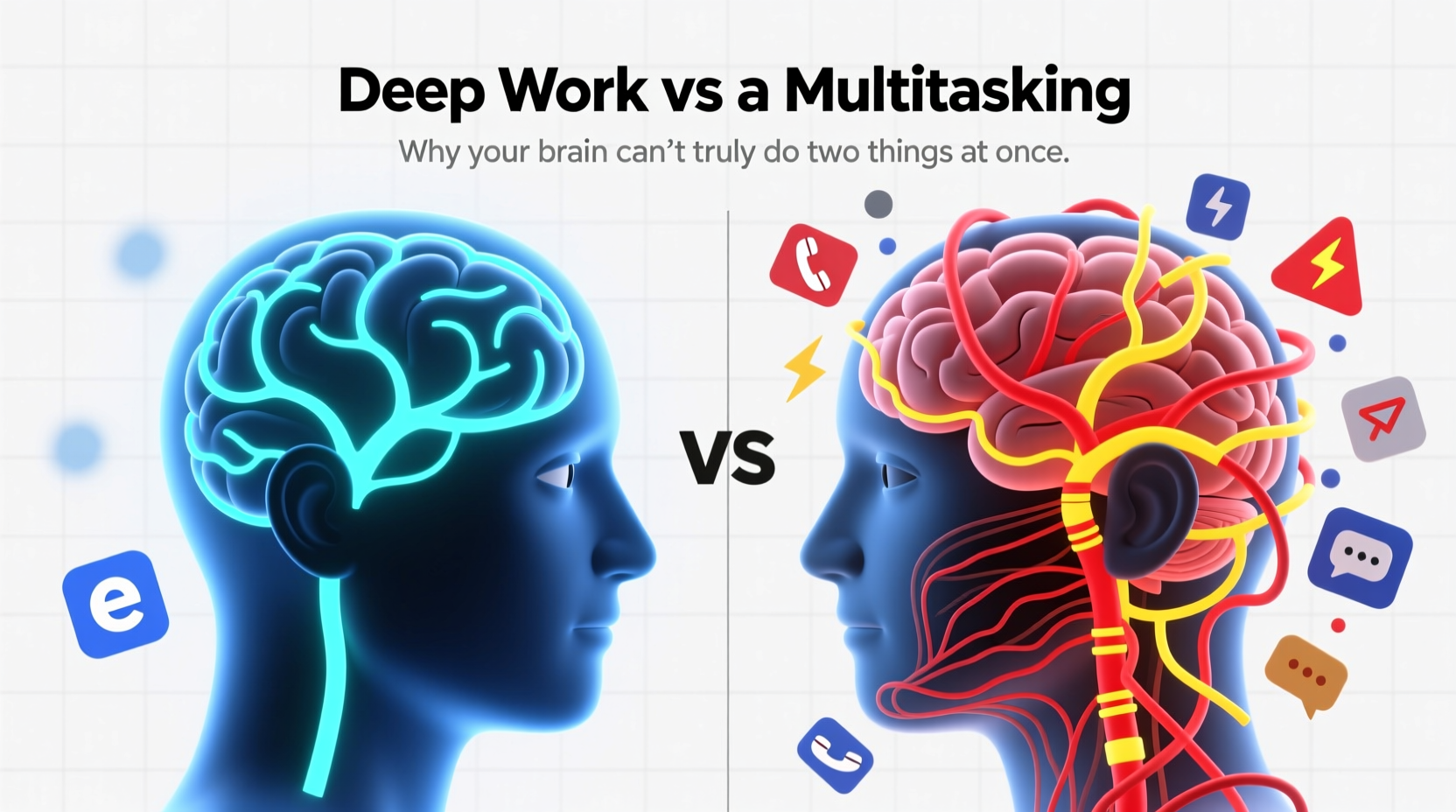
The idea that people can successfully perform two attention-intensive tasks at once is largely a cognitive illusion. Functional MRI studies show that when individuals attempt to multitask, their brains don’t activate two separate processing centers in parallel. Instead, they rapidly toggle between tasks, creating what researchers call “switch-costs.” These are measurable delays in reaction time and drops in accuracy each time attention shifts.
Dr. Earl Miller, a neuroscientist at MIT who studies attention and cognition, explains:
“We are *serial* processors with the illusion of being able to multitask. The brain must switch back and forth between tasks, and every switch incurs a cost in time and mental energy.” — Dr. Earl Miller, MIT Cognitive Neuroscientist
This switching isn’t seamless. It requires the prefrontal cortex—the brain’s command center for decision-making and focus—to disengage from one task, reorient, and engage with another. This process consumes glucose, the brain’s primary fuel, leading to faster mental fatigue. Over time, chronic multitasking can even weaken the brain’s ability to sustain attention, making deep concentration harder to achieve.
Deep Work: The Brain’s Natural State for High Performance
Deep work, a term popularized by Cal Newport in his book of the same name, refers to professional activities performed in a state of distraction-free concentration that push cognitive capabilities to their limit. When engaged in deep work, the brain operates in a state of flow—a psychological condition where attention is fully absorbed, time seems to distort, and performance peaks.
Neurologically, deep work aligns with how the brain evolved to function. Our ancestors relied on sustained attention for survival—tracking prey, crafting tools, or navigating terrain. The brain rewards prolonged focus with dopamine release, reinforcing engagement and motivation. In contrast, constant interruptions disrupt this reward system, leaving us mentally drained yet unproductive.
Deep work isn’t just about output; it’s about quality. Whether you’re coding, writing, designing, or analyzing data, the depth of thought determines the value of the result. Shallow work—answering routine emails, attending low-stakes meetings, scanning social feeds—can be done in fragmented bursts. But meaningful progress happens only when the mind is allowed to dive deeply into a single challenge.
Task-Switching vs. True Multitasking: Understanding the Difference
It’s important to distinguish between automatic behaviors (like walking and talking) and conscious cognitive tasks (like writing and analyzing data). The brain can manage simple, well-practiced motor functions alongside basic conversations because these rely on different neural pathways and require minimal executive control.
However, when both tasks demand attention—such as drafting an email while listening to a podcast—the brain struggles. Research from Stanford University found that heavy multitaskers performed worse on memory and attention tests than those who focused on one task at a time. They were more easily distracted, less able to filter irrelevant information, and slower to switch between tasks efficiently—ironically undermining the very skill they believed they were honing.
This paradox reveals a critical truth: frequent multitaskers aren’t better at multitasking—they’re worse at focusing.
Why Task-Switching Is Costly
Every time you shift focus, your brain goes through three steps:
- Disengagement: Letting go of the current task.
- Shifting: Redirecting attention to the new task.
- Re-engagement: Getting back up to speed on the new task.
Studies estimate that each switch can cost between 0.5 to 2 seconds—but in a typical workday filled with dozens or hundreds of interruptions, these seconds accumulate into hours of lost productivity. A University of California Irvine study found that after an interruption, it takes an average of 23 minutes and 15 seconds to return to the original task at full concentration.
Deep Work vs. Multitasking: A Practical Comparison
| Aspect | Deep Work | Multitasking |
|---|---|---|
| Cognitive Load | High, sustained focus on one complex task | Distributed across multiple tasks, often superficial |
| Productivity Quality | High-value output, innovation, problem-solving | Frequent errors, incomplete work, surface-level results |
| Time Efficiency | Less total time due to fewer errors and rework | More time spent due to switch costs and distractions |
| Mental Fatigue | Controlled and recoverable; ends with a sense of accomplishment | Chronic and draining; leads to burnout |
| Neurological Impact | Strengthens focus circuits and myelin development | Weakens attention span and increases stress hormones |
Real-World Impact: A Mini Case Study
Sarah, a marketing strategist at a mid-sized tech firm, used to pride herself on her ability to “handle everything at once.” She routinely checked Slack while writing campaign proposals, attended Zoom calls while scrolling through industry news, and responded to emails between meetings. Despite working 50-hour weeks, her deliverables were often late, riddled with errors, and lacked strategic depth.
After reading research on cognitive load, she decided to experiment. For two weeks, she blocked out three 90-minute sessions daily for deep work—during which she turned off notifications, closed her inbox, and worked in a quiet room. All other tasks were handled in designated “shallow work” blocks.
The results were striking. Her proposal quality improved dramatically, client feedback became more positive, and she completed work 30% faster. More importantly, she reported feeling less stressed and more in control of her time. Sarah didn’t become more productive by doing more—she succeeded by doing less, but with greater focus.
How to Cultivate Deep Work: A Step-by-Step Guide
Transitioning from a multitasking mindset to a deep work practice requires deliberate habit-building. Here’s a proven sequence to integrate deep work into your routine:
- Assess Your Current Workflow: Track how you spend your time for three days. Note every task and whether it was deep or shallow. Identify your biggest distractions (e.g., email, messaging apps).
- Define Your Deep Work Blocks: Schedule 60–90 minute sessions in your calendar. Treat them like non-negotiable appointments. Begin with one block per day.
- Create a Distraction-Free Environment: Silence phone notifications, close unnecessary browser tabs, and use tools like website blockers if needed. Use noise-canceling headphones if ambient noise is an issue.
- Set a Clear Objective for Each Session: Know exactly what you want to accomplish—e.g., “Draft introduction section of report” or “Debug module X.” Vague goals lead to vague results.
- Use a Ritual to Signal Focus Mode: Start each deep work session with a consistent trigger—like brewing tea, playing the same background music, or doing five minutes of mindful breathing. This trains your brain to enter focus mode quickly.
- Review and Refine Weekly: At the end of each week, evaluate what worked and what didn’t. Adjust duration, timing, or environment based on results.
Actionable Checklist: Transition from Multitasking to Deep Work
- ✅ Audit your weekly tasks and categorize them as deep or shallow.
- ✅ Schedule at least one 90-minute deep work block per day.
- ✅ Turn off all non-essential notifications during focus periods.
- ✅ Close email and messaging apps until the block is complete.
- ✅ Define a specific goal for each deep work session.
- ✅ Use a timer to maintain structure (e.g., Pomodoro: 50 minutes work, 10 minutes break).
- ✅ Reflect weekly on focus quality and output improvements.
- ✅ Gradually increase deep work capacity as mental endurance builds.
Frequently Asked Questions
Can the brain ever truly multitask?
No—not when it comes to two cognitively demanding tasks. The brain can automate simple tasks (like walking or driving a familiar route) while engaging in conversation, but when both tasks require active thinking, performance declines. True parallel processing doesn’t occur in the prefrontal cortex.
Is multitasking always bad?
Not entirely. It can be efficient for combining a low-cognitive task (like folding laundry) with passive input (like listening to a podcast). However, pairing two high-focus tasks—such as writing and analyzing data—is counterproductive. The key is intentionality: know when to focus and when to allow background activity.
How long does it take to build deep work stamina?
Most people can sustain 20–30 minutes of uninterrupted focus initially. With consistent practice over 2–4 weeks, this can extend to 90-minute blocks. Like building muscle, mental focus strengthens gradually with repetition and recovery.
Conclusion: Reclaim Your Cognitive Power
The belief that multitasking makes us more productive is one of the most persistent myths of the digital age. In reality, it fragments attention, depletes mental energy, and undermines the quality of our work. Deep work, by contrast, honors the brain’s natural design for sustained focus and delivers superior results with less effort over time.
You don’t need to eliminate all distractions overnight. Start small: protect one hour each day for undistracted work. Turn off notifications. Close your door—or your laptop lid—when necessary. Every act of focused attention is a vote for clarity, creativity, and control.




 浙公网安备
33010002000092号
浙公网安备
33010002000092号 浙B2-20120091-4
Comments
No comments yet. Why don't you start the discussion?