
When temperatures drop and layering becomes essential, the choice of mid-layer can make or break both comfort and style. Two of the most enduring staples in men’s and women’s wardrobes—the denim jacket and the chore coat—often serve as go-to outer pieces. But when it comes to wearing them beneath heavier outerwear like wool overcoats, parkas, or field jackets, one performs more effectively than the other. Understanding how each functions as a mid-layer involves more than just fabric weight—it’s about cut, structure, breathability, and compatibility with outer shells.
The denim jacket, rooted in American workwear and later embraced by youth culture, offers durability and timeless appeal. The chore coat, originally worn by French laborers, brings utilitarian design and slightly more insulation. Yet neither was designed primarily as a mid-layer. So which adapts better when sandwiched between a sweater and a winter coat?
Understanding Mid-Layer Functionality
A successful mid-layer serves three core purposes: thermal retention, moisture management, and structural compatibility with outer layers. It should trap body heat without adding bulk, wick light sweat from base layers, and slide smoothly under an outer coat without bunching or restricting movement.
The ideal mid-layer is tailored enough to avoid excess fabric but has enough room to accommodate a lightweight sweater or flannel shirt underneath. Materials matter too—natural fibers like cotton offer breathability but vary in insulation; synthetic blends may add warmth but risk overheating or friction against outer fabrics.
Both the denim jacket and the chore coat are traditionally made from cotton, but their construction diverges in ways that affect performance under outerwear. Evaluating them requires breaking down key factors: thickness, drape, collar design, closure systems, and shoulder articulation.
Material & Insulation: Denim vs Heavy Cotton Twill
Denim jackets are typically constructed from 10–14 oz cotton denim—a tightly woven twill known for its abrasion resistance and stiffness. While durable, this fabric doesn’t insulate well on its own. Most classic denim jackets lack lining or padding, relying instead on the wearer’s base layer for warmth. Their tight weave does provide some wind resistance, but once wet, denim loses efficiency and takes time to dry.
In contrast, chore coats often use 12–16 oz cotton canvas or moleskin, sometimes lined with brushed cotton or wool-blend flannel. This added lining gives them a slight edge in warmth, especially in transitional weather. The fabric is less rigid than denim, allowing for easier layering and better drape under structured outerwear. Some modern chore coats even include quilted linings or synthetic insulation, making them borderline mid-layers themselves.
“Mid-layers need to be functional, not fashionable first. A stiff denim jacket might look cool alone, but under a topcoat, it fights the silhouette.” — Marcus Reed, Menswear Designer & Layering Specialist
Fit & Structure: How Each Jacket Behaves Under Coats
Fit is arguably the most critical factor when assessing mid-layer viability. A poorly fitting piece creates pressure points, restricts arm movement, and disrupts airflow around the body.
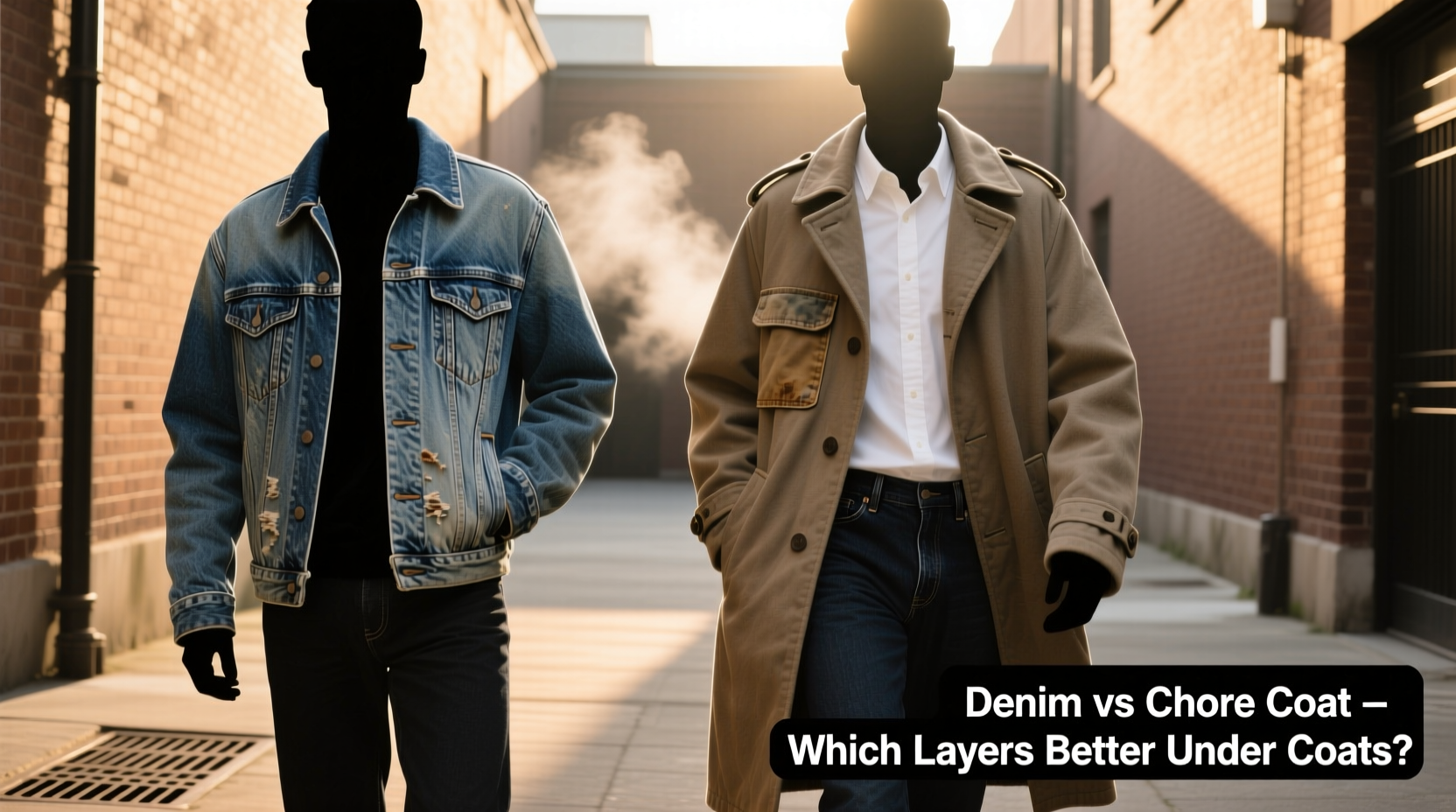
Denim jackets tend to have boxy silhouettes with minimal shaping at the waist. Rigid shoulders and thick collars often stand upright, creating gaps between the neck and outer coat. When zipped or buttoned, they can puff outward at the chest, especially if worn over a chunky knit. This makes them difficult to wear under close-fitting overcoats or trench styles.
Chore coats, meanwhile, usually feature a straighter, slightly tapered cut with rounded corners at the hem. They’re designed for mobility, with roomy but balanced proportions. Many include adjustable cinch tabs at the waist, allowing wearers to fine-tune the fit before adding an outer layer. Their collars lie flat more naturally, and button-front closures (often hidden behind a storm placket) reduce bulk at the chest.
| Feature | Denim Jacket | Chore Coat |
|---|---|---|
| Fabric Weight | 10–14 oz denim | 12–16 oz canvas/moleskin |
| Lining | Rarely lined | Often lined (flannel, wool blend) |
| Collar Behavior | Stiff, tends to flare | Soft, lies flat |
| Closure Bulk | Visible buttons/snaps, moderate bulk | Hidden placket, low profile |
| Shoulder Seam | Set-in, rigid | Raglan or slightly dropped, flexible |
| Best Outerwear Pairings | Loose parkas, unstructured field coats | Trenches, wool topcoats, car coats |
Real-World Example: Urban Commuter Layering
Consider Alex, a city-based designer who walks 20 minutes to work each morning in late autumn. His commute begins indoors (70°F office), transitions through chilly streets (40°F), and ends back in heated environments. He wears a merino turtleneck, needs a mid-layer for outdoor warmth, and tops it with a double-breasted wool overcoat.
On Monday, he tries his vintage Levi’s Type III denim jacket underneath. The result? The stiff collar pushes up against the overcoat’s lapel, forcing it open slightly at the neck. The thick denim resists compression across the shoulders, causing the wool coat to ride up when he raises his arms. By midday, he feels restricted and slightly overheated.
On Tuesday, he swaps in a navy cotton chore coat lined with herringbone flannel. The softer fabric conforms smoothly under the overcoat. The cinched waist keeps the mid-layer tidy, and the hidden button placket eliminates front bulk. The coat drapes cleanly, maintains warmth during transit, and allows full range of motion. He arrives comfortable and composed.
This scenario illustrates how subtle differences in construction impact real-world usability—even when both garments appear equally suitable on the surface.
Step-by-Step Guide to Testing Mid-Layer Compatibility
Determining whether your denim jacket or chore coat works under a specific coat shouldn’t be guesswork. Follow this practical evaluation process:
- Start with base layer: Wear the shirt or sweater you’d normally pair with the mid-layer.
- Add the mid-layer: Put on the denim jacket or chore coat. Ensure it zips/buttons comfortably without pulling.
- Assess mobility: Raise your arms, cross them, and simulate reaching forward. Note any tightness or binding.
- Add outer coat: Slip on your intended overcoat. Avoid forcing it—struggling indicates poor compatibility.
- Check collar alignment: Look in a mirror. Does the outer coat lie flat? Is the lapel lifted by the mid-layer collar?
- Test movement again: Repeat arm motions. Pay attention to shoulder drag, back tension, or hem lift.
- Evaluate warmth: Walk around for 5–10 minutes. Are you overheating quickly? Is there dead air space indicating poor heat retention?
- Adjust or replace: If issues arise, consider trimming layers, choosing a slimmer mid-layer, or opting for a different outer shell.
This method helps identify mismatches before committing to a layered outfit in cold conditions.
Expert Tips for Optimizing Either Jacket as a Mid-Layer
- Sizing matters: Consider sizing up in your denim jacket if planning to wear it under a coat—but only if the shoulders still align properly.
- Break in denim: Wash and wear your denim jacket frequently before layering season. Softened fabric drapes better and reduces friction.
- Unbutton mid-layers: Leaving a denim jacket or chore coat unfastened allows outerwear to close cleanly and prevents front bulge.
- Layer strategically: Place thinner mid-layers (like chore coats) closer to the body and save thicker ones (like heavy denim) for standalone use.
- Trim the profile: Remove bulky patches or embroidery that can create pressure points under outerwear.
When to Choose Denim vs Chore Coat as a Mid-Layer
The decision ultimately hinges on context: climate, outerwear type, activity level, and personal style.
Choose a denim jacket as a mid-layer when:
- You're wearing a loose, unstructured outer layer like a barn coat or oversized parka.
- Style is a priority and you want visible texture or contrast in your layers.
- The weather is cool but not freezing (above 45°F).
- You’re engaging in active movement where ventilation matters more than insulation.
Choose a chore coat as a mid-layer when:
- You need reliable warmth under a tailored wool coat or trench.
- You value clean lines and professional presentation.
- Temperatures dip below 40°F and wind resistance is crucial.
- You plan to transition between indoor and outdoor environments frequently.
FAQ: Common Questions About Layering Jackets
Can I wear a denim jacket under a pea coat?
Possibly, but with limitations. Pea coats have broad lapels and structured shoulders. A slim, well-worn denim jacket with a soft collar may work, but expect some restriction. Unbuttoning the denim helps maintain the pea coat’s drape.
Do chore coats work under puffer jackets?
Yes, especially if the puffer has a relaxed fit. The smooth front and flexible fabric of a chore coat slide easily under nylon shells. Just ensure the combined bulk doesn’t compress the puffer’s loft, reducing its insulating power.
Is layering two jackets bad for warmth?
Not inherently. Proper layering traps air between garments, enhancing insulation. However, excessive bulk or moisture-trapping materials (like untreated denim) can lead to overheating and dampness. Balance warmth with breathability and fit.
Final Verdict: Which Works Better?
While both garments have earned their place in the modern wardrobe, the chore coat emerges as the superior mid-layer under coats. Its thoughtful design—softer fabric, flatter collar, streamlined closure, and frequent lining—makes it inherently more compatible with structured outerwear. It provides modest insulation without sacrificing mobility, and its silhouette complements rather than conflicts with overcoats.
The denim jacket, while iconic, functions best as an outer layer or standalone piece. Its rigidity, bulk, and aesthetic-driven construction limit its utility in technical layering systems. That said, in casual, relaxed outfits with roomy outerwear, a broken-in denim jacket can still play a role—especially when style outweighs function.
Ultimately, dressing for cold weather isn’t just about stacking layers—it’s about synergy. The right mid-layer doesn’t just add warmth; it enhances the entire system. For those seeking seamless integration, temperature regulation, and polished appearance, the chore coat is the more intelligent choice.




 浙公网安备
33010002000092号
浙公网安备
33010002000092号 浙B2-20120091-4
Comments
No comments yet. Why don't you start the discussion?