
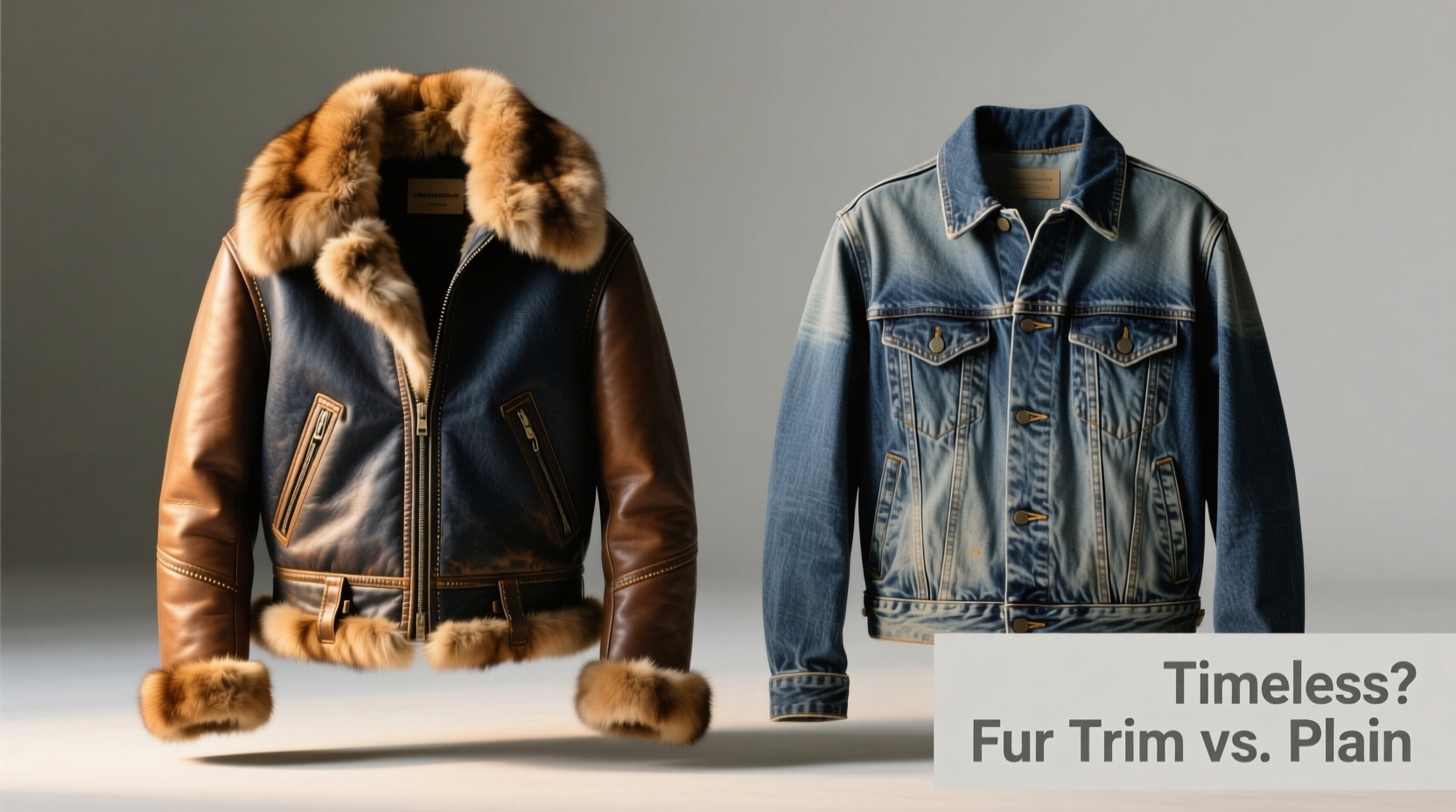
The denim jacket has long been a cornerstone of casual fashion—worn by rebels, rock stars, artists, and everyday individuals seeking comfort without sacrificing style. But as trends evolve, so do the details. One of the most debated variations in recent years is the addition of fur trim on collar edges. While some see it as a bold statement of individuality, others argue it undermines the classic simplicity that made the denim jacket iconic. So, when comparing a denim jacket with fur trim versus a plain version, which truly stands the test of time?
This isn’t just about personal taste—it’s about longevity, adaptability across seasons and decades, and how each style integrates into a wide range of wardrobes. To answer this question thoroughly, we’ll examine design heritage, versatility, cultural shifts, maintenance needs, and real-world wearability.
Design Origins and Historical Context
The original denim jacket emerged in the late 19th century as durable workwear for laborers and miners. Levi Strauss & Co. patented the first riveted denim jacket in 1880 (the Type I), designed purely for function. Over time, its rugged appeal caught the attention of cowboys, soldiers during WWII, and eventually youth subcultures like greasers, hippies, and punks.
Throughout much of the 20th century, the denim jacket remained largely unembellished—two chest pockets, button front, sturdy stitching, and a simple pointed collar. It was only in the 1970s and 1980s that decorative elements began appearing, including embroidery, patches, and later, faux fur trims influenced by outdoor and skiwear aesthetics.
Fur-trimmed collars gained popularity in the early 2000s, particularly among urban outerwear brands looking to merge streetwear with alpine-inspired silhouettes. These styles were often marketed as “lived-in” or “arctic-ready,” even if they weren’t functional in cold climates. The look became associated with celebrity culture and seasonal trends rather than enduring wardrobe staples.
“Timelessness in fashion doesn’t come from novelty—it comes from restraint. The clean lines of a plain denim jacket have survived because they don’t shout; they whisper confidence.” — Marcus Lang, Vintage Apparel Curator at The Modern Wardrobe Archive
Versatility Across Outfits and Occasions
One of the key markers of a timeless garment is its ability to transition seamlessly between different settings and pairings. A plain denim jacket excels here. Whether layered over a white tee and jeans for weekend errands, worn open over a dress for brunch, or thrown on top of a hoodie for casual Fridays, it adapts effortlessly.
In contrast, a denim jacket with fur trim introduces a visual weight at the neckline that can dominate an outfit. This makes it harder to balance with other textures and layers. For example:
- A plain denim jacket pairs well with scarves, turtlenecks, and tailored coats underneath.
- A fur-trimmed version may clash with high collars or bulky knits, creating a crowded upper silhouette.
- The fur element tends to anchor the jacket to colder months, limiting its year-round usability.
Styling Flexibility Comparison
| Style Combination | Plain Denim Jacket | Fur-Trimmed Denim Jacket |
|---|---|---|
| Casual T-shirt + Jeans | ✔️ Effortless blend | ⚠️ Can feel overly styled |
| Dress or Skirt | ✔️ Adds cool contrast | ❌ Often disrupts flow |
| Hoodie or Sweatshirt | ✔️ Layer-friendly | ⚠️ Neck bulk creates imbalance |
| Overcoat or Trench Layering | ✔️ Invisible under-collar layer | ❌ Fur gets compressed, loses shape |
| Suit or Blazer Combo | ✔️ Works in avant-garde styling | ❌ Rarely cohesive |
The data shows a clear advantage for the plain version when it comes to integration with diverse ensembles. Its neutrality allows it to serve as a supporting player rather than a focal point—making it more likely to remain relevant regardless of passing fads.
Maintenance and Longevity Challenges
Another factor in determining timelessness is practical durability. Even if a piece looks great today, frequent repairs, cleaning difficulties, or material degradation can shorten its usable life.
Faux fur trims, while animal-friendly, are notoriously high-maintenance. They mat easily, trap odors, and require specialized cleaning methods. Exposure to rain, humidity, or friction from backpacks and seatbelts accelerates wear. Once matted or shedding, the trim rarely regains its original appearance.
Plain denim jackets, especially those made from rigid or selvedge denim, age beautifully. Fades develop naturally, buttons hold up, and fabric softens over time without compromising structure. There’s no added component to fail—the entire garment ages as one unit.
Real-World Example: Two Jackets, Ten Years Later
Consider two friends who bought denim jackets in 2014—one opted for a vintage-style plain Levi’s Trucker, the other chose a popular brand’s limited-edition black denim jacket with synthetic wolf-fur trim.
Ten years later, the plain jacket remains a go-to layer. Its copper buttons show patina, the collar has softened slightly, and the fade pattern tells a story of daily use. It still works with everything from joggers to chinos.
The fur-trimmed jacket, however, has seen reduced rotation. The trim has flattened, picked up lint, and begun to shed fibers. Attempts to steam or brush it back to life yielded minimal results. Today, it’s worn only occasionally, mostly during photo shoots or themed events—not daily wear.
This scenario illustrates how aesthetic choices impact long-term usability. Novelty wears off; functionality endures.
Expert Insights on Fashion Longevity
Industry professionals consistently emphasize minimalism and consistency when evaluating timelessness. Dr. Lena Patel, professor of Fashion Theory at Central Saint Martins, notes:
“The most enduring garments share a common trait: they leave room for the wearer to express themselves. When a jacket has a loud detail like fur trim, it competes with personal identity instead of complementing it.” — Dr. Lena Patel, Fashion Psychologist
This idea ties into the concept of \"silent luxury\"—a growing movement favoring understated quality over conspicuous embellishment. As consumers shift toward mindful consumption and slow fashion, the demand for low-decibel classics rises.
Furthermore, archival studies of museum collections reveal that plain denim jackets outnumber decorated versions by a wide margin in curated permanent exhibits. Curators cite re-wearability and historical authenticity as deciding factors.
When Fur Trim Makes Sense (And When It Doesn’t)
It would be unfair to dismiss fur-trimmed denim jackets entirely. They have their place—just not necessarily as core wardrobe items.
These jackets shine in specific contexts:
- Themed outfits: Winter festivals, music events, or editorial shoots where boldness is the goal.
- Limited-edition releases: Collector’s pieces meant for display or occasional wear.
- Personal expression: For individuals whose style leans maximalist or avant-garde.
However, if your aim is to own a single denim jacket that lasts a decade or more—and continues to look appropriate across changing trends—a plain model is objectively the safer investment.
Checklist: Is Your Denim Jacket Built to Last?
Use this checklist to evaluate whether a denim jacket—plain or trimmed—will stand the test of time:
- ✅ Made from 100% cotton or high-cotton blend (avoid stretch-heavy fabrics)
- ✅ Double-stitched seams and bar tacks at stress points
- ✅ Metal buttons and rivets (not plastic)
- ✅ Minimal hardware or detachable embellishments
- ✅ Color is classic indigo, black, or medium wash (avoid extreme distressing)
- ✅ No glued-on trims or adhesives (fur should be securely stitched, though ideally absent)
- ✅ Fits well now and allows for slight shrinkage after washing
A jacket scoring six or seven points is likely built for longevity. Most fur-trimmed models lose points on #4 and #6 due to added complexity and weaker attachment methods.
FAQ: Common Questions About Denim Jacket Timelessness
Can a fur-trimmed denim jacket become timeless if it’s well-made?
Possibly, but only in niche circles. Like platform shoes or logo-heavy bags, some trend-driven designs gain retro status decades later. However, this kind of \"revival timelessness\" differs from continuous relevance. A fur-trimmed jacket might be nostalgic in 2040—but it won’t be a daily staple the way a plain trucker jacket could be.
Does the color affect timelessness more than the trim?
Color plays a role, but trim has a greater stylistic impact. A black plain denim jacket remains versatile and modern, whereas a light blue jacket with chunky cream fur trim immediately signals a particular era (e.g., mid-2010s). Neutral colors help both styles, but the structural simplicity of the plain version gives it broader reach.
Are there sustainable concerns with fur trim?
Even faux fur raises sustainability issues. Most synthetic trims are made from polyester or acrylic, which shed microplastics during washing and degrade slowly in landfills. In contrast, a plain cotton denim jacket is easier to recycle, repair, or repurpose at end-of-life. Ethical fashion advocates generally recommend avoiding non-essential synthetic additions.
Final Verdict: Which Style Endures?
After examining design history, versatility, maintenance, cultural perception, and real-world performance, the conclusion is clear: a plain denim jacket is significantly more timeless than one with fur trim.
Its strength lies not in what it adds, but in what it omits. Free from seasonal flourishes and fragile details, it remains adaptable, durable, and universally flattering. It respects the wearer’s autonomy to define their style moment by moment, rather than locking them into a singular aesthetic narrative.
That said, fashion is personal. There’s value in self-expression, and a fur-trimmed jacket may perfectly reflect someone’s current identity. The distinction lies in purpose: choose the fur version for statement-making moments; choose the plain version for lifelong companionship.
Step-by-Step Guide to Choosing Your Timeless Denim Jacket
- Define your primary use: Will you wear it daily, seasonally, or occasionally?
- Assess your existing wardrobe: Does it lean minimalist, eclectic, or edgy?
- Try both styles: Wear each with multiple outfits to test compatibility.
- Evaluate care requirements: Are you willing to hand-wash or take special precautions?
- Think long-term: Visualize wearing it five years from now. Which feels more natural?
- Make your choice: Prioritize the plain jacket for timelessness, or embrace the fur trim as a curated accent piece.
Conclusion: Build a Legacy, Not Just a Look
True style isn’t measured by how much attention you draw today, but by how confidently you can wear a piece ten years from now. The denim jacket, in its purest form, is a symbol of resilience, rebellion, and quiet confidence. Adding fur trim may amplify its presence in the short term, but it risks diluting the very qualities that make it endure.
If you’re investing in a jacket meant to last—if you want one that transitions from college campuses to city streets, from first jobs to family outings—choose simplicity. Choose integrity. Choose the plain denim jacket.




 浙公网安备
33010002000092号
浙公网安备
33010002000092号 浙B2-20120091-4
Comments
No comments yet. Why don't you start the discussion?