
A cluttered desk doesn’t just make work harder—it adds mental strain. The average professional spends nearly 4.3 hours per week searching for misplaced items or navigating disorganized spaces, according to a study by the National Association of Professional Organizers. That’s more than half a workday lost monthly. When it comes to organizing your workspace, two solutions dominate: desktop storage boxes and built-in desk drawers. Both promise order, but only one may truly deliver lasting clarity. Understanding their strengths, limitations, and how they align with your workflow is key to making an informed decision.
The Clutter Problem: Why It Matters
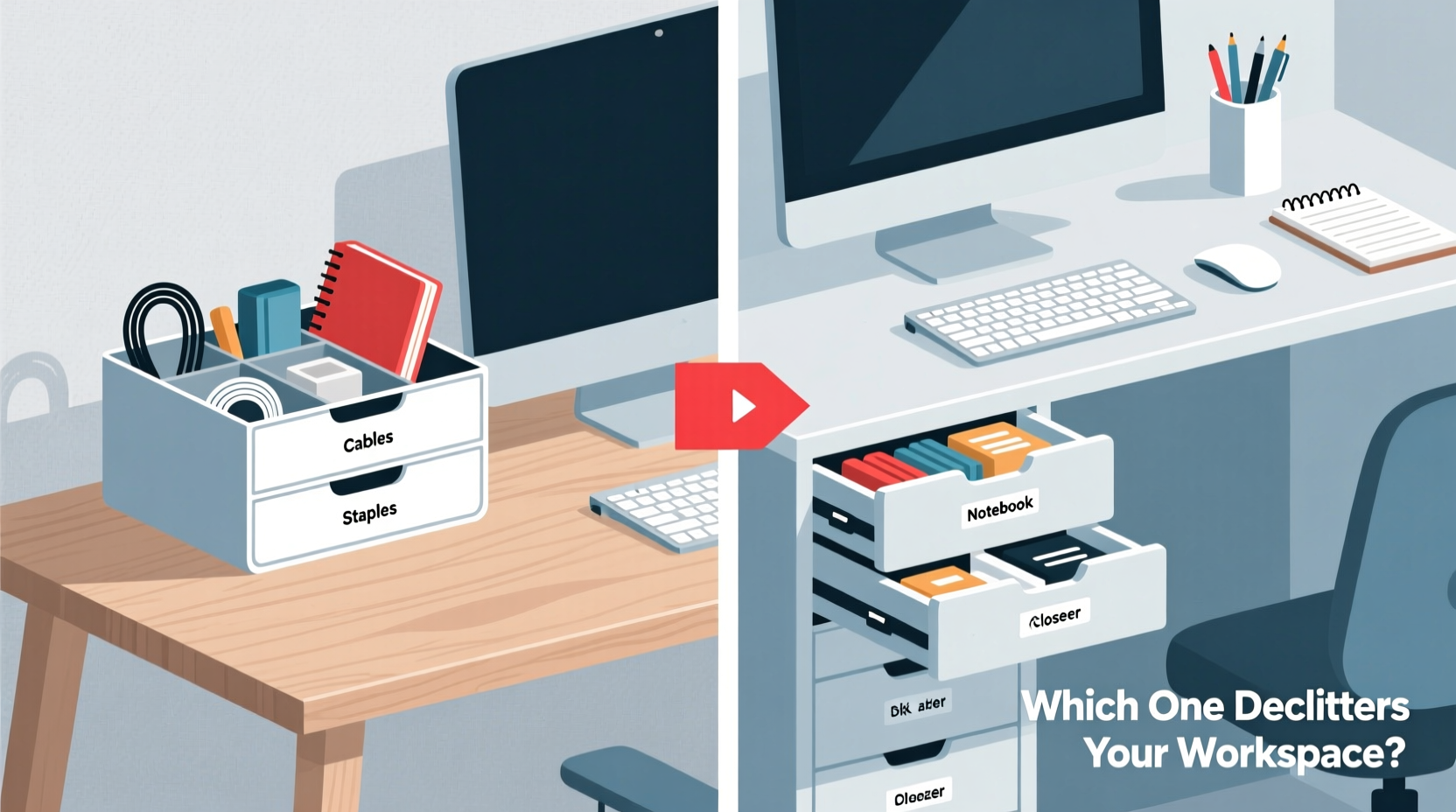
Clutter isn't just visual noise. Research from Princeton University shows that physical disarray competes for attention, reducing focus and cognitive performance. A messy desk can trigger low-grade stress responses, even if you're not consciously aware of it. Effective organization isn't about aesthetics alone—it's about creating a space where productivity can thrive.
When evaluating tools like desktop storage boxes and desk drawers, consider more than capacity. Think about accessibility, adaptability, visibility, and long-term maintenance. These factors determine whether your system supports—or sabotages—your daily efficiency.
Desktop Storage Boxes: Flexibility Meets Visibility
Desktop storage boxes are standalone organizers typically made from fabric, plastic, wood, or metal. They come in modular trays, stackable units, or multi-compartment desktop caddies designed to sit on top of your desk.
These containers excel in visibility and flexibility. Because they’re open or semi-open, users can instantly see what’s inside without pulling out drawers. This reduces time spent hunting for pens, sticky notes, or USB drives. Modular designs allow customization—add a tray for cables today, swap in a document sorter tomorrow.
They’re also ideal for renters or those with non-custom desks. Since no installation is required, they can be moved, reconfigured, or removed entirely when needs change. For remote workers using multiple locations—a coffee shop, home office, co-working space—portability becomes a major advantage.
However, desktop boxes consume valuable surface area. On smaller desks (under 48 inches), dedicating 15–20% of the workspace to storage can feel restrictive. Additionally, over time, these units may accumulate dust or appear cluttered if not maintained regularly.
Desk Drawers: Hidden Order with Built-In Structure
Built-in desk drawers offer concealed storage, preserving desk surface space for active tasks. Integrated into the desk frame, they provide a clean, minimalist appearance. High-end models often include soft-close mechanisms, dividers, and lockable options for sensitive materials.
Drawers are excellent for storing bulkier or less frequently used items: file folders, notebooks, charging bricks, or office supplies in bulk. Their enclosed nature protects contents from dust and keeps distractions out of sight—and thus, out of mind.
Yet this concealment has a downside. Out of sight can quickly become out of reach. Without clear labeling or internal organization, drawers devolve into “junk drawers,” where items vanish into darkness. Pulling open a drawer filled with tangled cords and loose paperclips defeats the purpose of decluttering.
“Hidden storage works only if it’s systematically organized. Otherwise, it becomes a black hole for productivity.” — Laura Bennett, Certified Professional Organizer
Additionally, desk drawers lack adaptability. If your desk has three shallow drawers and you need deeper space for art supplies or tech gear, you’re limited by design. Retrofitting inserts helps, but rarely matches the modularity of desktop systems.
Comparative Analysis: Key Decision Factors
| Feature | Desktop Storage Box | Desk Drawer |
|---|---|---|
| Accessibility | High – items visible and within reach | Medium – requires opening; risk of disorganization |
| Space Efficiency | Low – uses desk surface area | High – frees up work surface |
| Customization | High – modular, movable, reconfigurable | Low – fixed size and depth |
| Durability | Varies – fabric bins wear faster than wood/metal | High – especially in solid-core furniture |
| Aesthetic Impact | Depends on design – can enhance or clutter look | Minimalist – maintains clean lines |
| Mobility | High – easy to pack and move | None – tied to desk structure |
Real-World Example: Sarah’s Home Office Transformation
Sarah, a freelance graphic designer, worked from a compact IKEA Linnmon desk (47” x 23”). Initially, she relied solely on two small drawers beneath the desktop. Within months, they were overloaded with sketchbooks, adapters, and client contracts. She resorted to piling papers on the desk, reducing her usable space to less than half.
She introduced a three-tier desktop organizer: one tray for drawing tools, another for digital accessories, and a lower bin for ongoing project files. Though it occupied 8” of depth, the immediate visibility reduced search time and encouraged daily tidying. After six weeks, she reported a 30% increase in task-switching efficiency and fewer instances of misplacing essential items.
Her solution wasn’t perfect—she missed having hidden storage for personal items—but the trade-off in functionality was worth it. Eventually, she added a slim rolling cabinet beside the desk for deep storage, combining the strengths of both systems.
Step-by-Step: Choosing the Right System for You
- Assess Your Desk Size: Measure available surface and drawer dimensions. Under 50” wide? Prioritize space-saving solutions.
- Track Your Workflow: For one week, note how often you access different items. Frequently used tools belong in visible, reachable zones.
- Categorize Items: Group supplies into “daily use,” “occasional,” and “rarely used.” Match categories to storage types.
- Test One Solution at a Time: Try a desktop box for two weeks. Evaluate ease of access and impact on focus.
- Optimize or Combine: If one method falls short, layer the other. Use drawers for archives, boxes for active tools.
Checklist: Declutter Your Workspace Effectively
- 🗹 Remove everything from drawers and desktop containers
- 🗹 Sort items by category (writing tools, tech, paperwork, personal)
- 🗹 Discard broken, expired, or unused items
- 🗹 Assign a home for each remaining item
- 🗹 Label compartments clearly
- 🗹 Implement a weekly 10-minute reset routine
Frequently Asked Questions
Can I use both desktop boxes and desk drawers together?
Absolutely. Many professionals combine both: desktop boxes for daily essentials like pens and notepads, and drawers for backup supplies, files, or personal items. This hybrid approach maximizes visibility and surface space while maintaining a clean aesthetic.
Which option is better for small desks?
For very small desks (under 42”), vertical desktop organizers or wall-mounted alternatives may be preferable. However, if drawer space is shallow or poorly divided, a slim, multi-tier desktop box might offer superior utility despite using surface area.
Do desktop storage boxes look unprofessional?
Not if chosen wisely. Sleek materials like powder-coated steel, bamboo, or matte acrylic blend well in professional environments. Avoid brightly colored fabric bins in client-facing spaces. Design consistency matters more than the type of storage.
Final Recommendation: It Depends on Your Habits
There is no universal winner between desktop storage boxes and desk drawers. The best choice depends on your behavior, space, and priorities.
If you value speed, transparency, and adaptability—especially in dynamic or shared workspaces—desktop storage boxes are likely the better fit. They promote accountability, reduce search fatigue, and support evolving needs.
If you prefer minimalism, have ample drawer space with good internal organization, and work in a fixed location, built-in drawers can maintain a polished, distraction-free environment.
In many cases, the optimal solution isn’t either/or—it’s both. Use drawers for long-term, infrequent storage and desktop boxes for tools you touch every hour. The goal isn’t just to hide clutter, but to eliminate it through intentional design.




 浙公网安备
33010002000092号
浙公网安备
33010002000092号 浙B2-20120091-4
Comments
No comments yet. Why don't you start the discussion?