
Confusion between leeks, green onions, and scallions is common—even among experienced home cooks. Though all three belong to the Allium family and share a mild onion-like flavor, they differ significantly in structure, taste intensity, culinary applications, and preparation methods. Mistaking one for another can alter the texture and balance of a dish, especially when raw or used as a primary aromatic. Understanding these vegetables individually—and how they contrast—is essential for precision in both everyday cooking and refined cuisine. This guide clarifies their distinctions, explains proper usage, and offers practical advice on substitutions, storage, and flavor pairing.
Definition & Overview
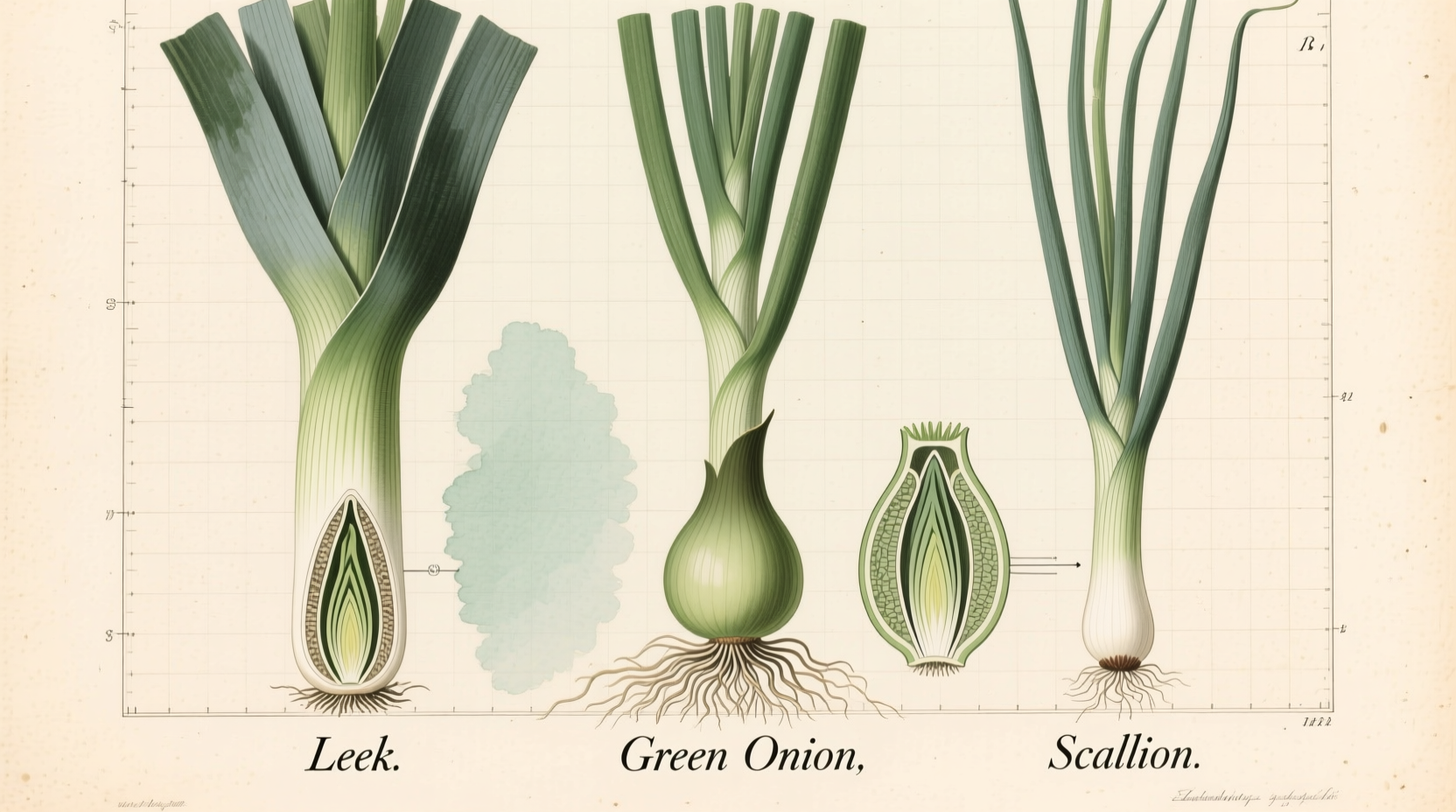
Leeks (Allium ampeloprasum var. porrum) are large, cylindrical members of the onion family with broad, flat leaves and a thick white-to-light-green stalk. Unlike bulb-forming onions, leeks grow an elongated shaft composed of tightly wrapped layers. They have a sweet, delicate onion flavor with subtle garlic notes, making them ideal for slow-cooked dishes like soups, stews, and gratins. Native to the eastern Mediterranean, leeks have been cultivated for over 3,000 years and are a staple in French, Welsh, and Middle Eastern cuisines.
Green onions, also known as spring onions, refer broadly to young onions harvested early, while the bulb is still small and tender. They feature a white base that begins to form a miniature bulb and long green tops. The term “green onion” is often used generically but typically describes varieties pulled before full maturity, retaining crispness and mild heat.
Scallions (Allium fistulosum or sometimes Allium cepa var. *cepa*) are technically a distinct species—often lacking any bulb development. True scallions do not form bulbs at all; their stems remain uniformly tubular from root to tip. Commonly grown as perennial bunching onions, they are prized for their juicy crunch and fresh, clean bite. In many markets, the terms “scallion” and “green onion” are used interchangeably, though botanically and culinarily, subtle differences exist.
Key Characteristics
| Vegetable | Flavor Profile | Texture | Color/Form | Shelf Life (Refrigerated) |
|---|---|---|---|---|
| Leek | Sweet, mellow, faintly garlicky; minimal sharpness when cooked | Firm, layered stalk; becomes silky when sautéed | Thick white base fading into broad blue-green leaves; up to 2 inches wide | 7–14 days (store unwashed, loosely wrapped) |
| Green Onion | Mildly pungent; white part slightly sharper, green part grassy | Crisp, snappy; white end firmer than green | Small white bulb base with hollow green tubes; ~½ inch wide | 5–7 days (trim roots, store in water or damp cloth) |
| Scallion | Delicate, fresh, mildly peppery; no strong aftertaste | Juicy, crunchy throughout; consistent diameter | No bulb; slender white stem transitioning smoothly into green | 7–10 days (keep dry or stand in water) |
Practical Usage: How to Use Each Vegetable
Leeks: Building Depth in Savory Dishes
Leeks shine when used as a foundational aromatic. Their sweetness intensifies with slow cooking, making them superior to yellow onions in delicate sauces, custards, and puréed soups like vichyssoise. Because of their layered structure, leeks trap dirt between folds—thorough cleaning is non-negotiable.
To prepare leeks:
- Trim off dark green leafy tops (reserve for stock if desired).
- Cut vertically through the root end to expose layers.
- Rinse under running water, fanning out layers to remove grit.
- Slice crosswise into half-moons or julienne depending on recipe needs.
Best culinary uses:
- Sautéed bases: Combine with carrots and celery for a mirepoix alternative.
- Puréed soups: The backbone of potato-leek soup, where their silkiness enhances mouthfeel.
- Braised or roasted: Halved lengthwise and grilled or baked, brushed with butter and herbs.
- Quiches and tarts: Pre-cooked leeks add moisture and savory depth without overpowering eggs.
Pro Tip: Never use the tough, fibrous green leaves of leeks in finished dishes—but don’t discard them. Freeze them along with onion peels and carrot ends to make vegetable stock later.
Green Onions: Freshness with Mild Heat
Green onions offer more bite than scallions and a slight crunch that holds up well in salads, stir-fries, and garnishes. The white portion delivers a sharper, more traditional onion zing, while the greens contribute chlorophyll-rich freshness.
How to use effectively:
- Raw applications: Slice thinly on a diagonal for tacos, noodle bowls, or avocado toast.
- Stir-fries: Add in the last minute of cooking to preserve texture.
- Dipping sauces: Finely minced into soy-ginger or peanut mixtures.
- Omelets and scrambled eggs: Fold in just before eggs set for bursts of color and flavor.
Average substitution ratio: Replace ¼ cup chopped yellow onion with ⅓ cup chopped green onion (white and light green parts) in most recipes requiring mild allium presence.
Scallions: The Crisp Garnish Specialist
True scallions are favored in Asian, Latin American, and modern fusion kitchens for their uniform texture and clean finish. Since they lack developed bulbs, there’s no need to worry about bitterness or excessive pungency.
Ideal uses include:
- Garnishing: Whole or sliced over ramen, bibimbap, or black bean soup.
- Salads: Julienned into slaws or grain salads for bright contrast.
- Quick pickles: Soak in rice vinegar, sugar, and salt for 20 minutes for tangy condiments.
- Compound butters: Blend with softened butter, lemon zest, and herbs for steak or fish topping.
In professional kitchens, chefs often keep pre-trimmed scallions standing upright in a container of cold water to maintain crispness during service.
Variants & Types
Types of Leeks
- King Richard: Fast-growing, medium-sized summer leek; best eaten young.
- Blue Solaise: Cold-hardy winter variety with deep blue-green foliage; excellent for roasting.
- Jolant: A hybrid with high yield and resistance to bolting; commonly found in supermarkets.
Forms of Green Onions
- Spring-harvested green onions: Smaller, tender, with pale pink blush near the base.
- Larger mature green onions: Develop a noticeable bulb; more pungent, suitable for grilling.
- Red baron green onions: Purple-tinged stems; slightly stronger flavor, visually striking in salads.
Scallion Varieties
- White Ice: Classic bunching type; prolific grower, widely available.
- Deep Purple: Ornamental and edible, with vibrant stems used for visual appeal.
- Japanese negi: A regional variant, longer and thicker; used in yakitori and miso soup.
Did You Know? In Japan, certain types of scallions (like negi) are blanched by hilling soil around the stems to increase the length of the tender white section—a technique called \"etiolation.\"
Comparison with Similar Ingredients
The confusion between these three stems largely arises from overlapping appearances and inconsistent labeling. Here's how to tell them apart at a glance:
| Feature | Leek | Green Onion | Scallion |
|---|---|---|---|
| Bulb Formation | No true bulb; thickened stem only | Small, roundish bulb beginning to form | No bulb; stem remains cylindrical |
| Diameter | 1–2 inches at base | ~½ inch | ¼–½ inch, uniform |
| Leaf Structure | Broad, flat, waxy leaves | Hollow, narrow green tubes | Hollow, pencil-thin tubes |
| Cooking Role | Main ingredient or aromatic base | Bridge between raw and cooked elements | Primarily garnish or finishing touch |
| Preparation Time | Requires extensive washing | Quick rinse, trim roots | Minimal prep; slice and use |
“In classical French technique, leeks are treated as equals to onions in building flavor foundations. But in contemporary plating, scallions serve as punctuation marks—adding color, scent, and textural contrast at the very end.” — Chef Elena Moreau, Culinary Instructor, Institute of Fine Foods
Practical Tips & FAQs
Can I substitute leeks for green onions?
Only partially and with caution. Raw leeks are too fibrous and bland to replace green onions as a garnish. However, cooked leeks can stand in for onions in a 1:1 ratio. For a closer match, use only the white and light green parts of leeks, finely sliced and sautéed until soft. Avoid using raw leeks where green onions are specified unless you’re aiming for subtlety over punch.
Are scallions just baby green onions?
Not necessarily. While some scallions are immature green onions, true scallions come from a different species (Allium fistulosum) that never forms a bulb. Botanical origin matters less in practice than appearance and texture—look for the absence of a bulb when selecting scallions for authentic results.
How should I store each?
- Leeks: Keep unwashed in the crisper drawer, wrapped loosely in plastic. Do not cut until ready to use.
- Green onions: Trim roots slightly, place upright in a glass with an inch of water, cover loosely with a bag, and refrigerate. Change water every two days.
- Scallions: Store dry in a breathable produce bag, or use the water method above. Avoid sealing in airtight containers unless completely dry.
Which has the mildest flavor?
When raw: scallions < leeks < green onions. When cooked: leeks become the mildest due to caramelization and loss of volatile compounds. Scallions lose much of their character with prolonged heat, so they're rarely used as a base ingredient.
What dishes highlight each best?
| Vegetable | Signature Dish Applications |
|---|---|
| Leek | Potato-leek soup, tarte Tatin aux poireaux, braised leeks with mustard sauce, leek and goat cheese quiche |
| Green Onion | Korean pancakes (pajeon), scallion pancakes (cong you bing), green onion oil noodles, shrimp fried rice |
| Scallion | Pho garnish, tuna tartare topping, scallion mashed potatoes, Mexican salsas verdes, compound butters |
Can I freeze them?
Leeks freeze well when blanched first—ideal for future soups or stocks. Green onions and scallions can be frozen but will lose crispness; best reserved for cooked dishes. Chop before freezing and store in labeled portions. Never freeze raw for garnish use.
Summary & Key Takeaways
While leeks, green onions, and scallions may appear similar in the produce aisle, they play distinctly different roles in the kitchen:
- Leeks are substantial, sweet alliums meant for slow cooking and structural integrity in rich dishes. They require careful cleaning but reward with nuanced flavor.
- Green onions bridge the gap between raw sharpness and cooked mellowness, offering versatility across cuisines. Their small bulb indicates maturity and slightly stronger taste.
- Scallions are defined by what they lack—a bulb—and excel as fresh, crisp accents. Their uniform shape and mild profile make them ideal for finishing plates.
Choosing the right one depends not just on availability but on intent: Are you building a flavor foundation or adding a final flourish? Substitutions are possible but must account for texture, water content, and heat sensitivity. By recognizing these differences, cooks gain greater control over balance, presentation, and authenticity in their meals.




 浙公网安备
33010002000092号
浙公网安备
33010002000092号 浙B2-20120091-4
Comments
No comments yet. Why don't you start the discussion?