
For aspiring artists and seasoned illustrators alike, the question isn't just about tools—it's about progress. Which medium accelerates the journey from shaky lines to confident strokes? The debate between digital art tablets and traditional paper sketchbooks isn't merely nostalgic; it's foundational to how artists train their hands, eyes, and minds. While both have passionate advocates, understanding their distinct roles in skill development reveals a more nuanced answer than either/or.
Digital tablets offer undo buttons, layers, and instant color—but at the cost of tactile feedback and direct hand-eye coordination. Paper sketchbooks demand precision with no room for error, fostering discipline and observational accuracy. So which one actually helps you improve faster? The truth lies not in choosing one over the other, but in knowing when each is most effective—and how they complement one another throughout different stages of growth.
The Learning Curve: Speed of Initial Progress
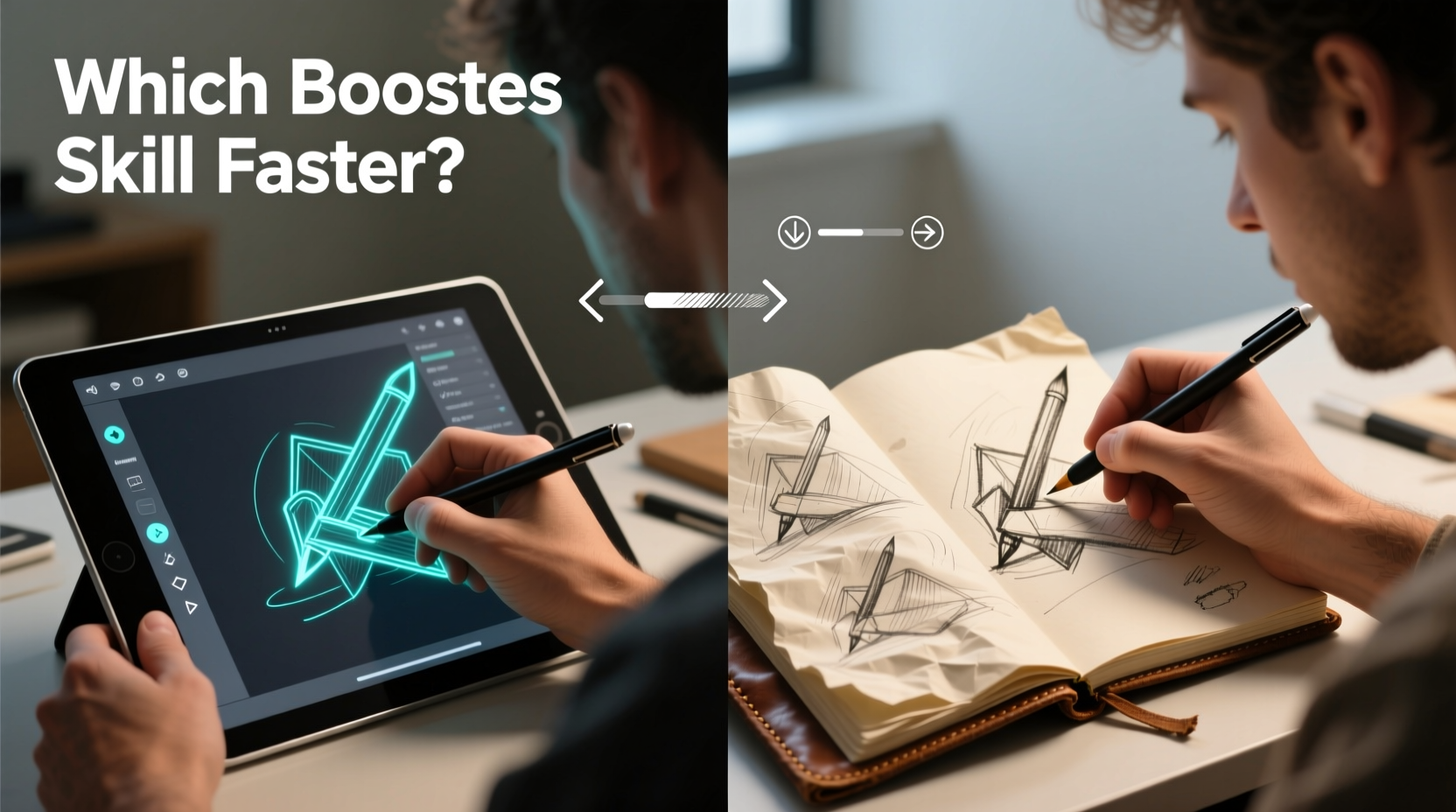
When beginning to draw, early progress depends heavily on frequency, consistency, and feedback loops. Digital tools can make practice feel easier by reducing friction—mistakes vanish with a tap, colors apply instantly, and references overlay seamlessly. This convenience encourages more frequent use, especially among younger learners or those drawn to animation and game art.
However, ease doesn’t always equal effectiveness. Because digital interfaces introduce a layer of abstraction—the stylus touches a flat surface while the line appears elsewhere on screen—beginners may struggle with hand-eye coordination. This \"decoupling\" effect forces the brain to recalibrate spatial judgment, slowing down muscle memory development compared to drawing directly on paper where vision and touch align perfectly.
Paper sketchbooks, by contrast, provide immediate physical feedback. Pressure, texture, and line weight are all tangible. There’s no eraser shortcut (unless manually used), so every stroke carries consequence. This accountability sharpens observational skills and forces deliberate decision-making. As a result, many foundational art instructors insist students start with pencil and paper to build core competencies before transitioning to digital.
Skill Transfer and Artistic Foundation
The strongest predictor of long-term improvement isn’t tool preference—it’s depth of understanding. Skills like proportion, perspective, gesture, value control, and composition are universal. Whether rendered in charcoal or Photoshop, these principles remain unchanged. Where the medium matters is in how quickly and thoroughly those principles are internalized.
Studies in motor learning suggest that physical resistance and sensory input enhance neural retention. When you press harder with a pencil and feel the grain of the paper, your nervous system records more data than when gliding a smooth stylus across glass. This richer sensory experience strengthens the connection between intent and execution, leading to faster refinement of fine motor skills.
“Drawing on paper builds what I call ‘tactile intelligence’—an intuitive sense of mark-making that digital tools can simulate but not replicate.” — Lena Torres, Illustration Instructor at Rhode Island School of Design
Artists who begin digitally often report hitting plateaus when attempting realistic rendering or expressive linework. They can navigate software efficiently but lack the confidence in freehand control that comes from years of analog practice. Conversely, artists trained primarily on paper typically adapt to digital workflows more smoothly because their fundamental skills are already solid.
Comparison: Core Training Benefits Side-by-Side
| Skill Area | Paper Sketchbook Advantage | Digital Tablet Advantage |
|---|---|---|
| Hand-Eye Coordination | Direct alignment between hand movement and visual output | Requires adaptation due to screen/stylus separation |
| Mistake Management | Encourages planning and precision; limited erasing | Undo function reduces fear of error, promotes experimentation |
| Line Confidence | Builds boldness through commitment to each stroke | Can lead to hesitant, over-edited lines due to easy correction |
| Value & Texture Control | Tactile feedback enhances shading precision and nuance | Simulated textures; relies on software presets |
| Workflow Efficiency | Slower setup, scanning, editing required for digital use | Instant color, layers, transformations, export options |
| Portability & Accessibility | No power needed; works anywhere | Battery-dependent; requires device and software |
This table underscores a key insight: paper excels in building foundational abilities, while digital shines in production efficiency and creative exploration. For rapid skill acquisition in the early and intermediate phases, direct-draw media hold a measurable edge.
A Real Artist’s Journey: From Notebook to Screen
Jamal Reed, now a concept artist at a mid-sized game studio, began drawing at 17 with nothing but a $5 sketchpad and mechanical pencil. “I couldn’t afford a tablet,” he recalls. “So I drew every day on whatever paper I could find—napkins, receipts, the margins of old homework.” Over two years, he filled more than 40 sketchbooks, focusing solely on figure drawing, perspective, and still life.
When he finally acquired a mid-range graphics tablet at 19, he expected an instant upgrade in quality. Instead, he struggled. “My lines were wobbly, my proportions off. I realized I’d never had to deal with offset cursor tracking before.” But because his fundamentals were strong, he adapted within three months. Today, he credits his paper-first approach: “If I’d started digitally, I’d have learned shortcuts instead of skills. My time with pencil taught me patience, observation, and how to *see*—not just copy.”
Jamal’s story reflects a broader pattern: artists who delay digitization often develop deeper technical fluency, enabling them to leverage digital tools more effectively later.
Strategic Integration: A Hybrid Approach for Faster Growth
The fastest path to improved drawing skills isn’t loyalty to one tool—it’s strategic use of both. A balanced training regimen leverages the strengths of each medium at the appropriate stage.
- Foundation Phase (Months 1–6): Focus entirely on paper. Practice contour drawing, gesture sketches, value scales, and perspective grids using pencil, charcoal, or ink. Avoid erasers to encourage decisive mark-making.
- Transition Phase (Months 6–9): Introduce the digital tablet for specific exercises—color theory studies, simple compositions, or tracing overlays for anatomy review. Continue primary sketching on paper.
- Integration Phase (Month 10+): Use digital tools for finished pieces, iterative design, and client work. Keep a daily paper sketchbook for warm-ups, observational studies, and idea generation.
This phased model ensures that core skills are built in an environment that demands precision and attention, while gradually incorporating digital advantages without sacrificing discipline.
Actionable Checklist: Optimize Your Skill Development
- ✅ Dedicate at least 70% of practice time to paper during the first six months
- ✅ Limit eraser use to preserve line honesty and encourage problem-solving
- ✅ Practice blind contour drawing weekly to improve eye-hand coordination
- ✅ Use a digital tablet only after mastering basic perspective and proportion on paper
- ✅ Maintain a daily sketchbook habit—digital or analog—for consistency
- ✅ Analyze master drawings both on screen and in print to understand technique across media
- ✅ Revisit paper-only challenges quarterly to maintain tactile sensitivity
Frequently Asked Questions
Can I become a good artist using only a digital tablet?
Yes, but with caveats. You can achieve technical proficiency and professional success with digital tools alone, especially in fields like UI/UX, animation, or digital painting. However, you may need to consciously train skills that paper naturally reinforces—such as pressure control, gesture flow, and observational accuracy—through targeted exercises.
Is drawing on paper obsolete in the digital age?
No. While digital workflows dominate commercial pipelines, paper remains essential for rapid ideation, tactile learning, and unrestricted creativity. Many top studios still require applicants to submit traditional drawing samples as proof of foundational skill. Paper also offers freedom from technical distractions—no updates, drivers, or battery anxiety.
What if I can’t afford both?
Start with paper. A sketchbook and pencil cost under $10 and provide everything needed to build core abilities. Save for a tablet later. Strong fundamentals will make the transition smoother and more productive. Investing in skill beats investing in gear—at least in the beginning.
Conclusion: Tools Serve the Artist, Not the Other Way Around
The question isn’t whether digital tablets or paper sketchbooks improve drawing skills faster—it’s how you use them. Paper cultivates discipline, awareness, and direct expression. Tablets enable iteration, efficiency, and modern application. But neither replaces the need for consistent effort, critical observation, and patient refinement.
If speed of improvement is your goal, begin with constraints. Let the limitations of paper sharpen your perception and strengthen your hand. Master the fundamentals where there’s no hiding behind Ctrl+Z. Then, bring that hard-earned skill to the digital realm, where it can be amplified rather than replaced.
Ultimately, the best tool is the one that pushes you to grow—not the one that makes drawing easiest. Pick up a sketchbook today. Draw something imperfect. Learn from it. Repeat. That’s where real progress begins.




 浙公网安备
33010002000092号
浙公网安备
33010002000092号 浙B2-20120091-4
Comments
No comments yet. Why don't you start the discussion?