
The art world has long revered the brushstroke of a master painter, the texture of oil on canvas, and the centuries-old traditions that define fine art. Yet as technology reshapes every aspect of culture, digital art has emerged as a powerful force—challenging conventions and raising urgent questions about value, authenticity, and legitimacy in gallery spaces. While both digital and traditional painting offer unique creative possibilities, their reception in galleries diverges significantly. Understanding this divide is essential for artists navigating today’s competitive landscape and collectors shaping the future of art.
The Historical Weight of Traditional Painting
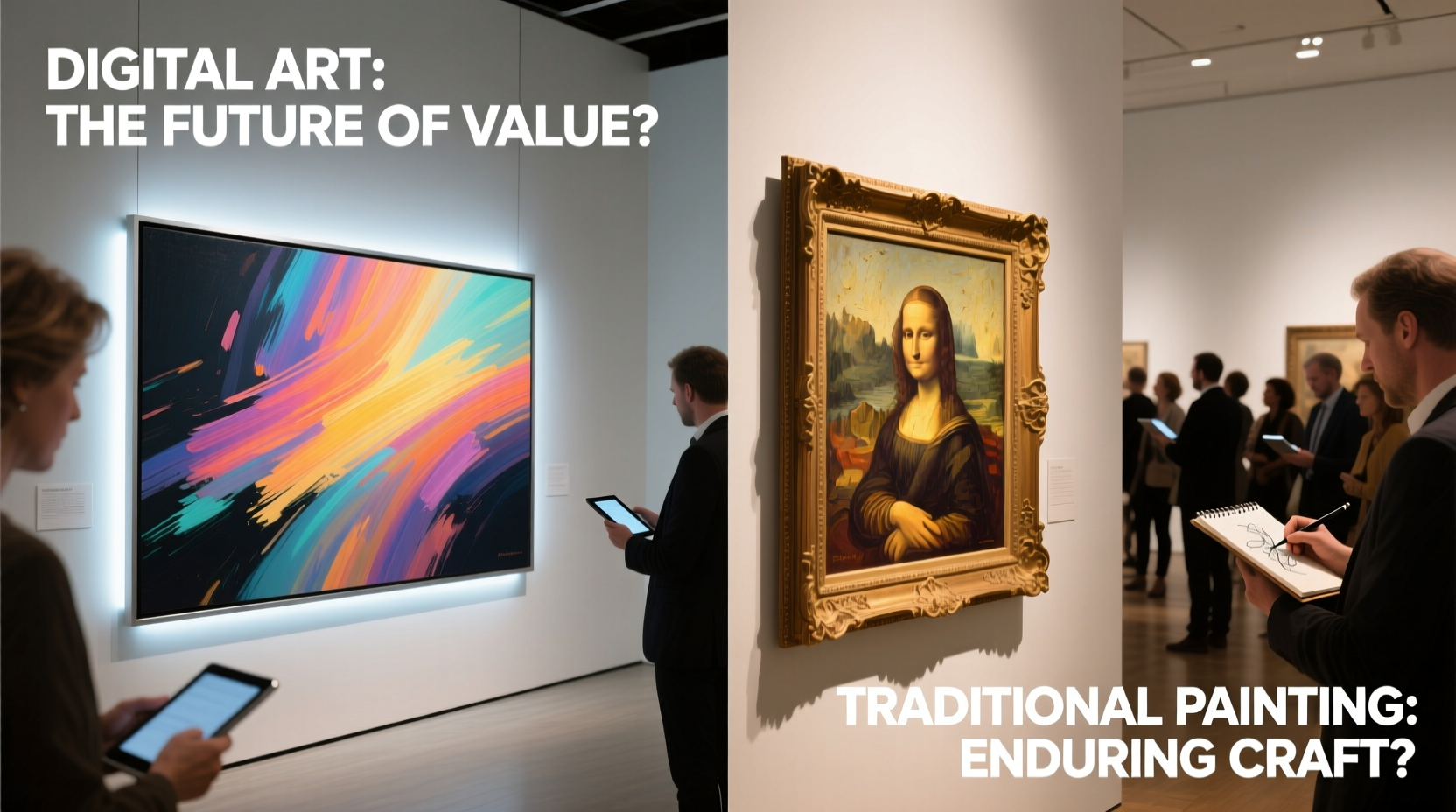
Traditional painting carries an undeniable legacy. For hundreds of years, oil, watercolor, and acrylic works have occupied the walls of major museums and private collections. The physicality of a painted canvas—the artist’s hand evident in each stroke, the layers built over time—has long been associated with skill, patience, and emotional depth. This tangible presence contributes to its perceived value, not just monetarily but culturally.
Galleries have historically prioritized works they can authenticate through provenance, material analysis, and expert appraisal. A 19th-century landscape or a mid-century abstract expressionist piece comes with a paper trail: exhibition history, ownership records, and often direct links to the artist. These factors reinforce scarcity and uniqueness—two pillars of art market value.
“Painting isn’t just about image-making; it’s about presence. You can feel the energy in a brushstroke.” — Dr. Lila Chen, Curator of Modern Art at the Metropolitan Arts Institute
This deep-rooted respect for physical craftsmanship continues to influence curatorial decisions. Many prestigious institutions still allocate prime exhibition space to traditional media, reinforcing its dominance in public perception and critical discourse.
The Rise of Digital Art in Gallery Spaces
Digital art, by contrast, began as a fringe movement—often dismissed as commercial, reproducible, or lacking in \"soul.\" Early digital works were displayed on monitors or printed on standard paper, making them seem transient compared to a stretched canvas. However, advancements in display technology, archival printing, and blockchain-based authentication (via NFTs) have dramatically shifted this narrative.
In recent years, major institutions like the Tate Modern, MoMA, and the Centre Pompidou have begun acquiring and exhibiting digital pieces. Artists such as Refik Anadol and teamLab have received widespread acclaim for immersive installations that blend data, motion, and sound into visually stunning experiences. These works are no longer seen as mere illustrations but as complex artistic statements that redefine what art can be.
Still, challenges remain. Unlike a painting that can hang unchanged for decades, digital art may require specific hardware, software updates, or environmental controls. Preservation becomes a technical as well as aesthetic concern. Moreover, the ease of duplication—while mitigated by NFTs—still raises skepticism among traditional collectors wary of intangible assets.
Comparing Value: Scarcity, Authenticity, and Market Trends
Value in the art world hinges on several interrelated factors: scarcity, authorship, historical significance, and demand. Traditional paintings naturally embody scarcity—one original exists, and even reproductions lack the aura of the authentic piece. Digital files, however, can be copied infinitely unless controlled through technological safeguards.
NFTs (non-fungible tokens) have attempted to solve this issue by creating verifiable ownership of digital assets on the blockchain. When Beeple sold Everydays: The First 5000 Days for $69 million at Christie’s in 2021, it marked a turning point—not just for digital art, but for how galleries and auction houses perceive its worth.
Yet outside high-profile sales, many digital artists struggle to gain equivalent recognition. A solo exhibition of oil paintings might lead to gallery representation and press coverage, while a similar digital show could be labeled a \"tech demo\" rather than a serious artistic endeavor. This disparity reflects deeper biases within the art establishment.
| Factor | Traditional Painting | Digital Art |
|---|---|---|
| Scarcity | High – one original exists | Variable – depends on editioning and NFTs |
| Authenticity | Established via provenance and materials | Verified via blockchain or metadata |
| Preservation | Stable if stored properly | Requires ongoing tech maintenance |
| Market Acceptance | Widespread and institutionalized | Growing but selective |
| Perceived Skill | Strong association with manual technique | Often underestimated despite complexity |
Barriers to Recognition in Galleries
Despite progress, digital art faces structural barriers in mainstream galleries. One major obstacle is infrastructure. Displaying digital work often requires projectors, screens, servers, or custom setups—costs many smaller galleries are unwilling or unable to absorb. In contrast, hanging a painting is simple, inexpensive, and familiar.
Curators also face pressure to maintain audience expectations. Collectors who invest six or seven figures in art often prefer pieces they can touch, hang, and pass down. A digital file, even if authenticated, lacks the same emotional resonance for many buyers.
There's also a generational gap in understanding. Older curators and critics may view digital tools as shortcuts—believing that filters, algorithms, or AI diminish artistic merit. This overlooks the sophisticated design thinking, coding skills, and conceptual depth involved in quality digital work.
However, younger institutions and independent galleries are leading change. Spaces like ZKM in Germany, bitforms gallery in New York, and LABoral in Spain specialize in new media and actively champion digital creators. These venues treat technology not as a gimmick but as a legitimate medium for artistic exploration.
A Real-World Example: From Rejection to Acclaim
Jessica Tran, a multidisciplinary artist based in Toronto, spent years submitting her digital mixed-media pieces to regional galleries. Despite winning online art competitions and building a strong social media following, she was repeatedly told her work \"didn’t fit the collection\" or \"wasn’t suitable for our wall space.\"
Frustrated but determined, she partnered with a local tech incubator to create an interactive installation using generative algorithms and motion sensors. The piece, titled Resonance Fields, responded to viewers’ movements with evolving color patterns and ambient soundscapes. She premiered it at a pop-up exhibit during a digital arts festival.
The response was overwhelming. A curator from the Vancouver Art Gallery attended the show and invited her to submit a proposal. Within a year, Resonance Fields was part of a group exhibition on contemporary innovation in art. Jessica now consults with museums on integrating digital works into permanent collections.
Her journey underscores a key truth: recognition often follows visibility. Digital artists must seek alternative platforms, collaborate across disciplines, and advocate for their work in spaces that value experimentation.
How Artists Can Bridge the Gap
Whether working in oils or code, artists aiming for gallery success must navigate both creative and strategic challenges. Below is a checklist designed to help digital and traditional painters alike increase their chances of recognition.
Action Checklist for Artists Seeking Gallery Representation
- Build a cohesive portfolio – Ensure your body of work demonstrates a clear vision and consistent style.
- Document everything – Include high-resolution images, creation notes, and context for each piece.
- Target the right galleries – Research institutions that align with your medium and aesthetic.
- Engage with the art community – Attend openings, join artist talks, and network with curators.
- Leverage hybrid formats – Print digital art on archival materials or incorporate physical elements into installations.
- Consider NFT exhibitions – Participate in virtual galleries or blockchain-based art fairs to build credibility.
- Pursue grants and residencies – Many support experimental or interdisciplinary projects.
Looking Ahead: Toward Equal Recognition?
The divide between digital and traditional painting won’t vanish overnight. But signs point to gradual convergence. As younger generations—more comfortable with screens, apps, and virtual environments—enter positions of influence in museums and collecting circles, the definition of \"valuable art\" will continue to expand.
Some forward-thinking galleries are already adopting hybrid models. The Serpentine Galleries in London launched an annual Future Art Archives initiative, commissioning digital artists to create works preserved on decentralized networks. Meanwhile, the Uffizi Gallery in Florence has begun offering digital twins of classical masterpieces, acknowledging that digital engagement enhances rather than replaces physical experience.
Ultimately, value should stem from impact, not medium. A moving digital animation can evoke emotion as powerfully as a Renaissance portrait. What matters is the artist’s voice, the depth of their message, and their ability to connect with viewers—regardless of whether the work was made with a stylus or a sable brush.
Frequently Asked Questions
Can digital art be displayed in traditional galleries?
Yes, but it often requires special arrangements. Many galleries now accept digital prints on fine-art paper, framed similarly to photographs. For screen-based or interactive works, artists may need to provide equipment or collaborate with technicians. Some institutions partner with media conservators to ensure proper presentation.
Is digital art less valuable than traditional painting?
Not inherently. While average resale prices for traditional paintings remain higher, exceptional digital works—especially those authenticated via NFTs or exhibited in major institutions—can command significant value. The market is evolving rapidly, and early skepticism is giving way to broader acceptance.
Do galleries buy digital art for their permanent collections?
An increasing number do. Museums like SFMOMA, the Whitney, and the Victoria and Albert Museum have acquired digital and new media artworks. These institutions often store files in secure digital archives and maintain backup systems to preserve longevity. Collection policies are adapting to include born-digital pieces alongside physical ones.
Conclusion: Redefining What Art Can Be
The conversation around digital art versus traditional painting isn’t truly about which is better—it’s about expanding access, rethinking value, and honoring diverse forms of creative expression. Galleries play a gatekeeping role, but they are not immune to change. As artists persist in pushing boundaries, audiences grow more receptive, and institutions modernize their practices, the distinction between \"digital\" and \"traditional\" will blur into irrelevance.
If you're creating meaningful work—whether with a paintbrush or a graphics tablet—your voice deserves space on the wall. Seek out allies, tell your story with confidence, and contribute to the evolution of art itself. The future of galleries isn’t just about preserving the past—it’s about reflecting the full spectrum of human creativity.




 浙公网安备
33010002000092号
浙公网安备
33010002000092号 浙B2-20120091-4
Comments
No comments yet. Why don't you start the discussion?