
The art world is undergoing a quiet revolution. As digital tools become more sophisticated and accessible, digital art has surged in popularity, challenging the centuries-old dominance of traditional painting. For collectors, investors, and artists alike, one pressing question emerges: which form of art holds greater resale value over time? While emotional appeal and aesthetic preference play roles, resale value hinges on factors like scarcity, authenticity, provenance, and market demand. Understanding these dynamics is essential for anyone looking to build or preserve wealth through art.
Understanding Resale Value in the Art Market
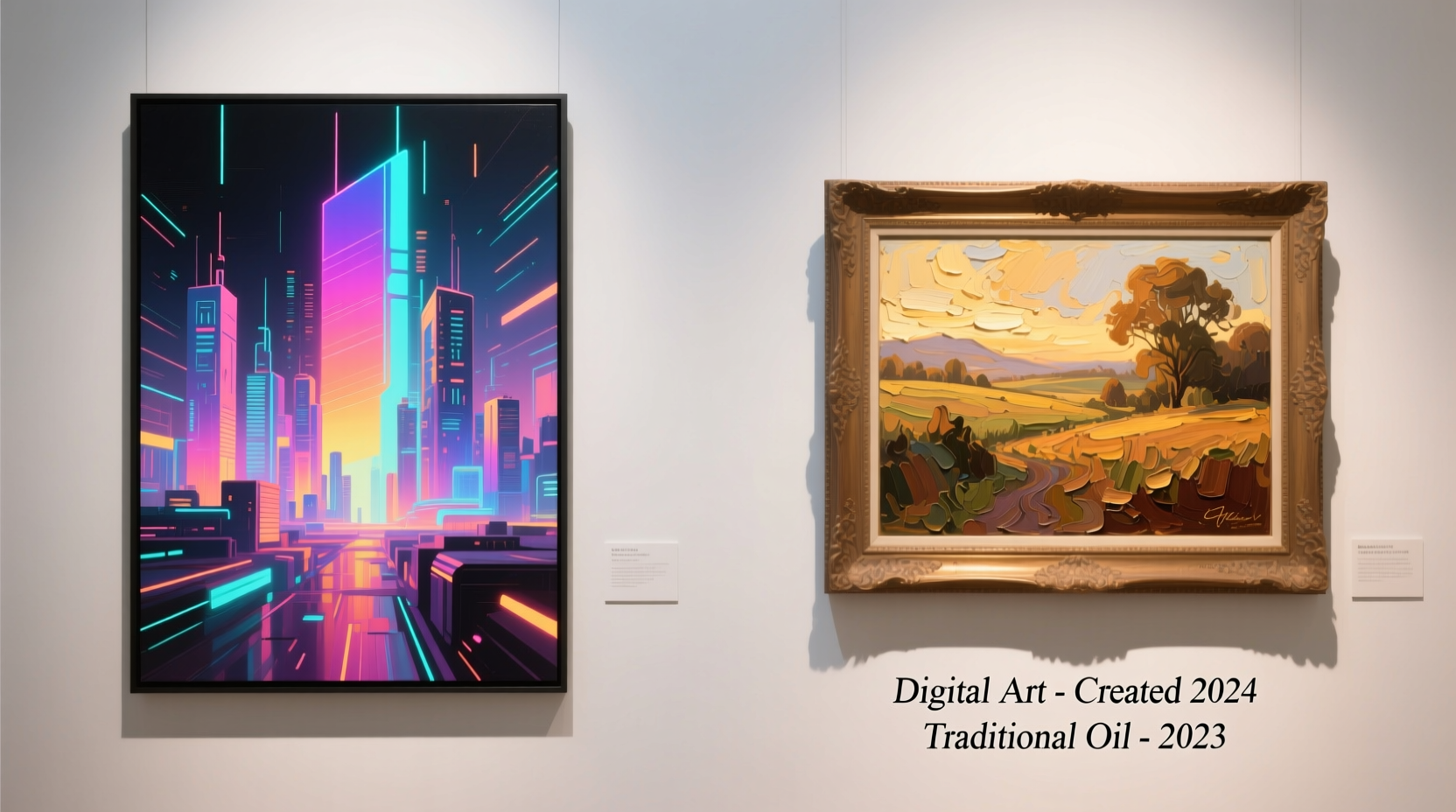
Resale value refers to how much an artwork can be sold for in the secondary market—auctions, galleries, private sales—after its initial purchase. Unlike commodities with fixed pricing, art values fluctuate based on reputation, historical significance, condition, and cultural relevance. Traditional paintings have long been considered stable assets, often appreciating over decades. In contrast, digital art, particularly in its newer forms like NFTs (non-fungible tokens), operates under different rules that challenge conventional valuation models.
For traditional paintings, physical presence adds intrinsic weight. A canvas by a recognized artist carries tangible history—brushstrokes, texture, age—that cannot be replicated. This materiality contributes to perceived authenticity and exclusivity. Digital art, however, exists as data. Even when displayed on high-resolution screens or printed, its core form is intangible. Yet, blockchain technology now allows digital works to be \"tokenized,\" creating verifiable ownership and scarcity—key drivers of value.
“Art’s value isn’t just in what it looks like, but in what it represents—provenance, legacy, and cultural moment.” — Dr. Lena Moreau, Art Economist, Sotheby’s Institute
Market Trends: How Collectors View Each Medium
Traditional painting remains dominant in major auction houses. In 2023, Christie’s and Sotheby’s reported that 94% of their fine art sales were physical works, with Impressionist and Modern masters leading price records. Works by Monet, Basquiat, and Frida Kahlo continue to fetch tens of millions, driven by institutional recognition and museum representation.
Digital art, while growing rapidly, occupies a niche segment. The 2021 sale of Beeple’s *Everydays: The First 5000 Days* for $69 million at Christie’s marked a watershed moment. However, such peaks are outliers. Most digital artworks, especially NFTs, experience volatile price swings. Post-2022 crypto downturn, many NFT collections lost 70–90% of their value, raising concerns about sustainability.
Collectors of traditional paintings often prioritize long-term holdings. Museums, foundations, and high-net-worth individuals treat them as generational assets. Digital art attracts a younger, tech-savvy demographic focused on innovation and community. Their buying behavior is more speculative, influenced by social media trends and platform activity rather than curatorial validation.
Factors Influencing Resale Value
Several key elements determine whether an artwork retains or increases its value over time. These apply differently across mediums.
Scarcity and Editioning
Traditional paintings are inherently unique—one-of-a-kind objects. Limited editions in printmaking exist, but original oil or acrylic works cannot be duplicated without losing authenticity. This singularity enhances desirability.
Digital art can be infinitely copied, but blockchain enables controlled scarcity. An artist can mint one “original” NFT or a limited run (e.g., 1/10). However, enforcement depends on buyer trust in the platform and metadata integrity. Unauthorized copies still circulate widely online, diluting perception of exclusivity.
Provenance and Authentication
Physical artworks come with certificates of authenticity, exhibition records, and ownership history—critical for appraisal. Auction houses vet these documents rigorously. Damage, restoration, or unclear lineage can significantly reduce value.
Digital works rely on blockchain ledgers for provenance. While transparent and tamper-resistant, they don’t capture context like exhibition history or critical reviews. A digital file may have perfect ownership records but lack cultural weight if the artist hasn’t gained recognition beyond online circles.
Cultural and Institutional Recognition
Museums, critics, and academic institutions play a gatekeeping role in validating artistic importance. Traditional painters benefit from this ecosystem. Being included in a MoMA retrospective or taught in art schools elevates an artist’s market status.
Digital artists struggle for equivalent recognition. Though institutions like the Centre Pompidou and Tate have begun collecting digital pieces, integration into mainstream art history remains limited. Without institutional anchoring, long-term value retention is uncertain.
Preservation and Longevity
Oil paintings, when properly stored, can last centuries. Conservation techniques are well-established. Fading, cracking, or mold can be mitigated with climate control and professional care.
Digital files face obsolescence risks. File formats, storage devices, and display technologies evolve rapidly. A .psd file from 2005 may not open in future software. Hardware-dependent installations require maintenance. Even NFTs depend on platforms remaining operational—a concern if marketplaces shut down.
“An artwork must survive beyond its creator. With digital pieces, we’re still learning how to ensure that survival.” — Rafael Klein, Curator of Media Art, ZKM Karlsruhe
Comparative Analysis: Digital vs Traditional
| Factor | Traditional Painting | Digital Art |
|---|---|---|
| Uniqueness | Nearly always one-of-a-kind | Can be replicated; scarcity enforced via blockchain |
| Authentication | Physical COA, expert appraisal, provenance trail | Blockchain ledger, smart contracts |
| Market Stability | High; slow appreciation over decades | Low to moderate; highly speculative |
| Institutional Support | Strong; museums, galleries, academia | Emerging; selective adoption |
| Preservation | Well-understood conservation methods | Risk of format obsolescence, hardware failure |
| Liquidity | Moderate; requires appraisal and network access | Variable; dependent on platform and community |
Real-World Examples: Lessons from the Market
Case Study: Banksy vs Pak
In 2021, street artist Banksy saw his 2006 painting *Game Changer* sell for £14.4 million at auction. The work, depicting a child playing with a nurse doll, gained symbolic weight during the pandemic. Its physical form, coupled with global fame and verified origin, made it a blue-chip asset.
The same year, digital artist Pak sold *The Merge* as an NFT for $91.8 million through Sotheby’s. It was the most expensive digital artwork ever sold. However, unlike Banksy’s piece, *The Merge* consists of abstract, algorithmically generated blobs owned collectively by thousands. No single buyer possesses the full work. Secondary market trading has been minimal, and no major institution has acquired it. While groundbreaking, its long-term value trajectory remains untested.
This contrast highlights a fundamental divide: physical art derives value from singular narrative and objecthood; digital art often relies on novelty and technological novelty, which may not endure.
Actionable Checklist for Buyers and Investors
- Verify the artist’s track record: exhibitions, publications, gallery representation.
- Check authentication method—physical COA for paintings, blockchain explorer link for NFTs.
- Assess condition (for traditional) or file stability (for digital).
- Evaluate institutional recognition: has the work been shown in reputable venues?
- Consider storage and preservation needs—climate control for canvases, backup systems for digital files.
- Research past auction results or secondary sales to gauge demand consistency.
- Consult an independent appraiser before high-value purchases.
Future Outlook: Where Is the Market Heading?
The line between digital and traditional is blurring. Artists like David Hockney create iPad drawings, then print and sign them as limited editions—blending digital creation with physical collectibility. Hybrid models may offer the best of both worlds: innovative production with tangible ownership.
Blockchain could enhance traditional art markets too. Digitally certifying a painting’s provenance on a decentralized ledger reduces fraud and streamlines transactions. Some startups already offer fractional NFT ownership of physical masterpieces, increasing accessibility without sacrificing authenticity.
However, true parity in resale value will take time. For digital art to match traditional painting’s staying power, it must overcome skepticism around durability, deepen institutional ties, and demonstrate consistent appreciation across economic cycles. Until then, traditional paintings remain the safer bet for long-term value retention.
Frequently Asked Questions
Can digital art appreciate like traditional paintings?
Yes, but selectively. Works by established digital artists with strong reputations—like Refik Anadol or teamLab—have seen steady growth. However, most NFTs lack the cultural foundation needed for sustained appreciation. Appreciation depends more on artist credibility than medium alone.
Are NFTs a good investment?
They can be, but carry high risk. Only a small fraction of NFTs retain value long-term. Successful investments typically involve early support of emerging artists who later gain mainstream attention. Treat NFTs as speculative assets, not guaranteed stores of value.
Do museums buy digital art?
Increasingly, yes. Institutions like the Whitney, LACMA, and the V&A have acquired digital and new media works. However, acquisition processes are slower due to conservation challenges and curatorial caution. Physical documentation (prints, installations) is often preferred over pure file-based art.
Final Thoughts: Making Informed Choices
The debate over digital art versus traditional painting isn’t about which is “better,” but which aligns with your goals. If you seek emotional connection, tactile beauty, and predictable long-term value, traditional painting offers proven reliability. If you’re drawn to innovation, technological frontiers, and community-driven movements, digital art presents exciting opportunities—albeit with higher volatility.
Ultimately, resale value stems not from medium, but from meaning. An artwork gains worth when it resonates across time—when it tells a story, captures a moment, or challenges perception. Whether rendered in oil or code, enduring value comes from cultural impact, artist intent, and the human desire to own something meaningful.




 浙公网安备
33010002000092号
浙公网安备
33010002000092号 浙B2-20120091-4
Comments
No comments yet. Why don't you start the discussion?