
For aspiring artists, the decision between starting with digital art or traditional sketching often feels like choosing between two worlds. One offers infinite undo buttons and vibrant layers; the other demands precision with pencil and paper. While both paths lead to artistic growth, they differ significantly in how they shape a beginner’s foundational skills. The real question isn’t which medium is better overall—but which helps build core drawing abilities more effectively in the early stages.
Understanding this distinction is crucial. Beginners need to develop hand-eye coordination, observational accuracy, confidence in line work, and spatial awareness. These are not just techniques—they’re the muscles of visual thinking. How quickly and deeply these are developed depends on the tools used and the feedback loop between action and result.
The Core Skills Every Artist Needs
Before comparing mediums, it's important to define what \"building skills faster\" actually means. For beginners, progress should be measured by mastery of fundamental abilities:
- Line control: Drawing confident, accurate lines without hesitation or correction.
- Proportion and perspective: Understanding spatial relationships and rendering objects in three-dimensional space.
- Observational drawing: Translating what the eye sees onto a surface with fidelity.
- Shading and value: Creating depth through light and shadow using gradations of tone.
- Hand-eye coordination: Training muscle memory so that mental intent matches physical execution.
These skills form the backbone of all visual art, regardless of medium. They require consistent practice, immediate feedback, and deliberate repetition. How each medium supports—or hinders—this process determines its effectiveness for skill acceleration.
Traditional Sketching: The Foundation of Discipline
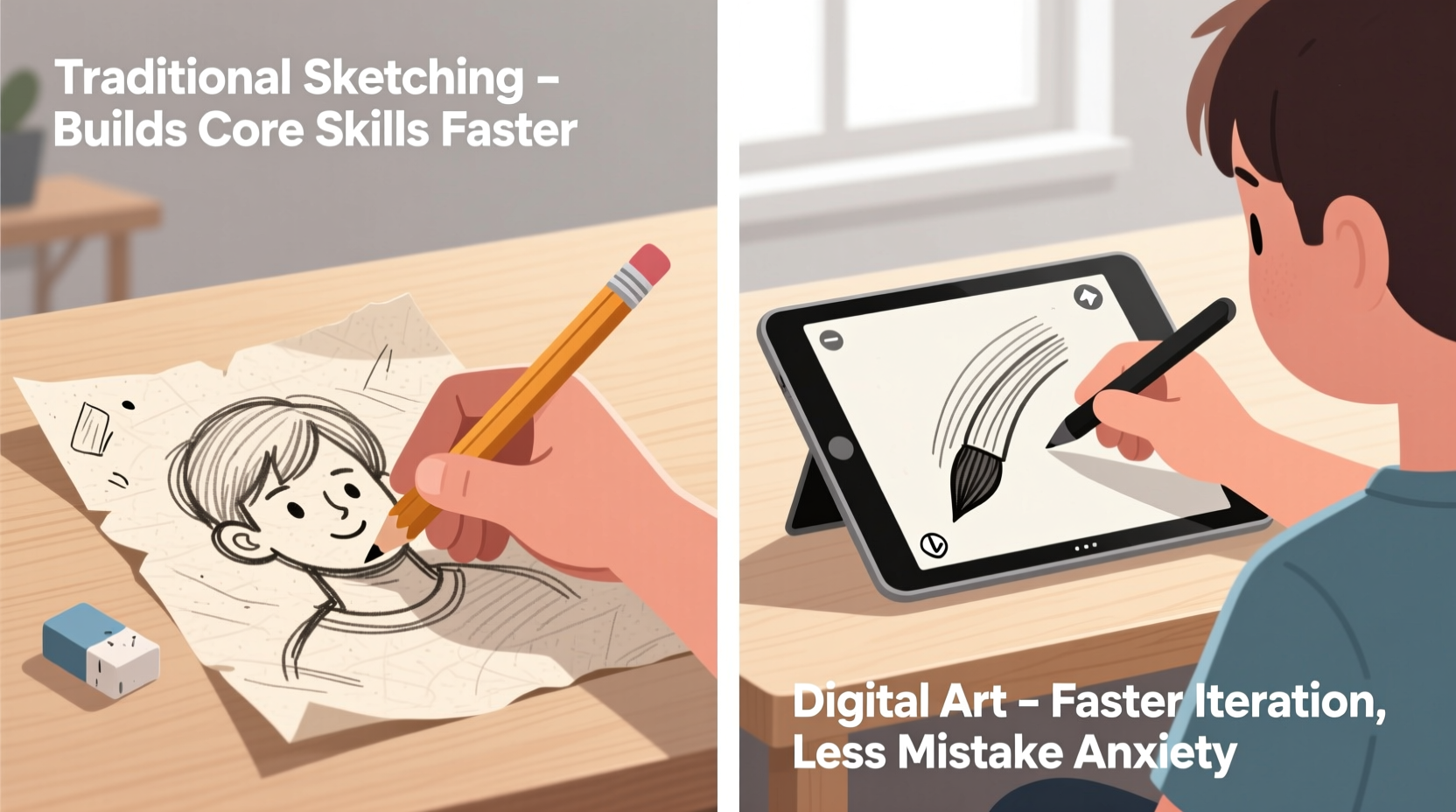
Traditional sketching—using pencils, charcoal, or ink on paper—remains the gold standard for learning to draw. It forces immediacy. Every mark is permanent until erased, and even erasures leave traces. This limitation cultivates patience, intentionality, and focus.
When you draw with a pencil, there’s no layer panel to hide behind, no blur tool to soften edges. You must commit to your strokes. That pressure accelerates learning because mistakes are visible and must be analyzed, not deleted. Over time, this trains the brain to anticipate outcomes before acting—a hallmark of skilled draftsmanship.
“Drawing by hand is the fastest way to train your eyes to see like an artist. The resistance of the medium teaches you restraint and precision.” — Rafael Smith, Art Educator & Curriculum Designer
Studies in art pedagogy consistently show that students who begin with observational drawing using physical media develop stronger spatial reasoning and compositional judgment within six months compared to those who start digitally. The tactile feedback from graphite on paper creates a direct neural link between motor control and visual processing.
Digital Art: Speed, Flexibility, and Hidden Crutches
Digital art, created using tablets and software like Procreate, Photoshop, or Krita, offers undeniable advantages: unlimited undo, symmetry guides, perspective rulers, and instant color changes. For someone eager to produce polished work quickly, digital tools are empowering.
However, these conveniences can slow down skill development when overused. Features like auto-smoothing, stabilizers, and snap-to-shape functions reduce the demand for precise hand movement. A beginner might create a clean line—not because their motor control has improved, but because the software corrected it.
This creates a dangerous illusion of competence. An artist may believe they’ve mastered line work when, in reality, they're relying on digital assistance. When removed from the software environment—say, asked to draw on paper—their actual skill level becomes apparent.
That said, digital platforms excel in experimentation. Trying different brushes, colors, or compositions takes seconds. This encourages creative risk-taking, which is valuable. But creativity without technical foundation often plateaus early.
Comparative Breakdown: Digital vs Traditional for Skill Growth
| Skill Area | Traditional Advantage | Digital Advantage |
|---|---|---|
| Line Control | Requires full manual precision; builds muscle memory faster | Stabilization tools reduce natural tremor but mask weakness |
| Observational Accuracy | Direct translation from eye to hand; no distractions | Potential distraction from UI elements and tools |
| Shading & Value | Physical blending teaches tonal transitions organically | Gradient tools can shortcut understanding of light logic |
| Error Correction | Limited erasing promotes careful planning | Unlimited undos encourage trial-and-error over discipline |
| Learning Curve | Slower initial results, deeper long-term gains | Faster visible output, but potential skill gaps |
The table illustrates a key insight: traditional methods prioritize long-term skill integrity, while digital methods favor short-term output quality. For beginners aiming to build strong fundamentals, the former provides a steeper but more rewarding climb.
A Realistic Learning Timeline
Consider two beginners: Maya starts with pencil and sketchbook; Jordan begins with a tablet and stylus. Both practice 30 minutes a day.
Month 1–2: Jordan produces cleaner-looking sketches thanks to smoothing and undo. Maya’s work appears rougher, with visible construction lines and smudges. Friends praise Jordan’s “talent,” though much of it is software-assisted.
Month 3–4: Maya begins to internalize proportions and gesture. Her lines are more confident. She draws from life regularly, building observational fluency. Jordan struggles when asked to draw without symmetry guides or layers.
Month 5–6: Maya completes a detailed portrait with accurate anatomy and shading—all on one sheet of paper. Jordan can create vibrant concept art but relies heavily on reference images and tracing. When attempting freehand drawing, their work lacks structural solidity.
This scenario reflects a common pattern observed in art schools and online communities. Early digital users often hit a skill ceiling around the six-month mark unless they supplement with traditional exercises.
The Hybrid Approach: Best of Both Worlds
The most effective path isn’t choosing one over the other—it’s sequencing them strategically. Start with traditional sketching to build raw skill, then transition to digital once core competencies are established.
- Weeks 1–8: Focus exclusively on pencil drawing. Use grid exercises, gesture sketches, and still-life studies.
- Weeks 9–12: Introduce basic digital tools for coloring simple line art. Avoid complex features.
- Months 4–6: Alternate between media. Sketch traditionally, then digitize and refine. This reinforces skill transfer.
- After 6 months: Use digital as a primary tool if desired, but maintain weekly analog practice to preserve foundational strength.
This phased method ensures that technology enhances ability rather than replacing it. Think of traditional drawing as weight training for the artistic mind—digital art becomes the performance gear worn once the body is conditioned.
Actionable Checklist for Beginners
To maximize skill development, follow this checklist during your first six months:
- ✅ Spend at least 70% of practice time on traditional sketching (pencil/paper)
- ✅ Complete 10-minute daily warm-ups: contour drawing, gesture poses, line weight drills
- ✅ Draw from real life at least twice a week (objects, people, landscapes)
- ✅ Limit digital use to coloring or inking only after a drawing is fully sketched by hand
- ✅ Avoid using symmetry, rulers, or stabilizers in digital apps for the first 3 months
- ✅ Review old sketches monthly to track improvement in proportion and confidence
- ✅ Keep a dedicated sketchbook with dated entries for accountability
This structured approach prevents dependency on digital crutches while ensuring steady, measurable growth.
Frequently Asked Questions
Can I learn to draw well using only digital tools?
Yes, but it requires extreme discipline. You must disable assistive features like stroke smoothing, avoid tracing, and frequently test your skills on paper. Most self-taught digital artists who achieve high proficiency eventually incorporate traditional exercises to fill skill gaps.
Is traditional sketching outdated in the digital age?
No. Just as musicians still practice scales on acoustic instruments, artists benefit from unmediated creation. The physical act of drawing strengthens neural pathways that digital interfaces cannot replicate. Traditional sketching remains essential for developing authentic visual literacy.
How long should I stick to traditional before going digital?
A minimum of 3–6 months of consistent practice is recommended. By then, you should be able to draw basic forms in perspective, render simple lighting, and capture gestures accurately. Once these skills feel automatic, digital tools can amplify—not replace—your abilities.
Conclusion: Build the Foundation First
When it comes to building artistic skills faster, traditional sketching holds a clear edge for beginners. Its limitations are its strengths—forcing intention, precision, and deep observational engagement. Digital art, while powerful, often delays mastery by masking weaknesses behind technological aids.
The goal for any new artist isn’t to produce perfect images quickly, but to develop the internal framework that makes great art possible. That framework is built through repetition, resistance, and reflection—elements inherent in traditional drawing.
Start with pencil and paper. Embrace the smudges, the crooked lines, the imperfect shadows. Each one is a lesson etched into muscle and mind. Once that foundation is solid, bring in digital tools to expand your reach, not compensate for gaps.




 浙公网安备
33010002000092号
浙公网安备
33010002000092号 浙B2-20120091-4
Comments
No comments yet. Why don't you start the discussion?