
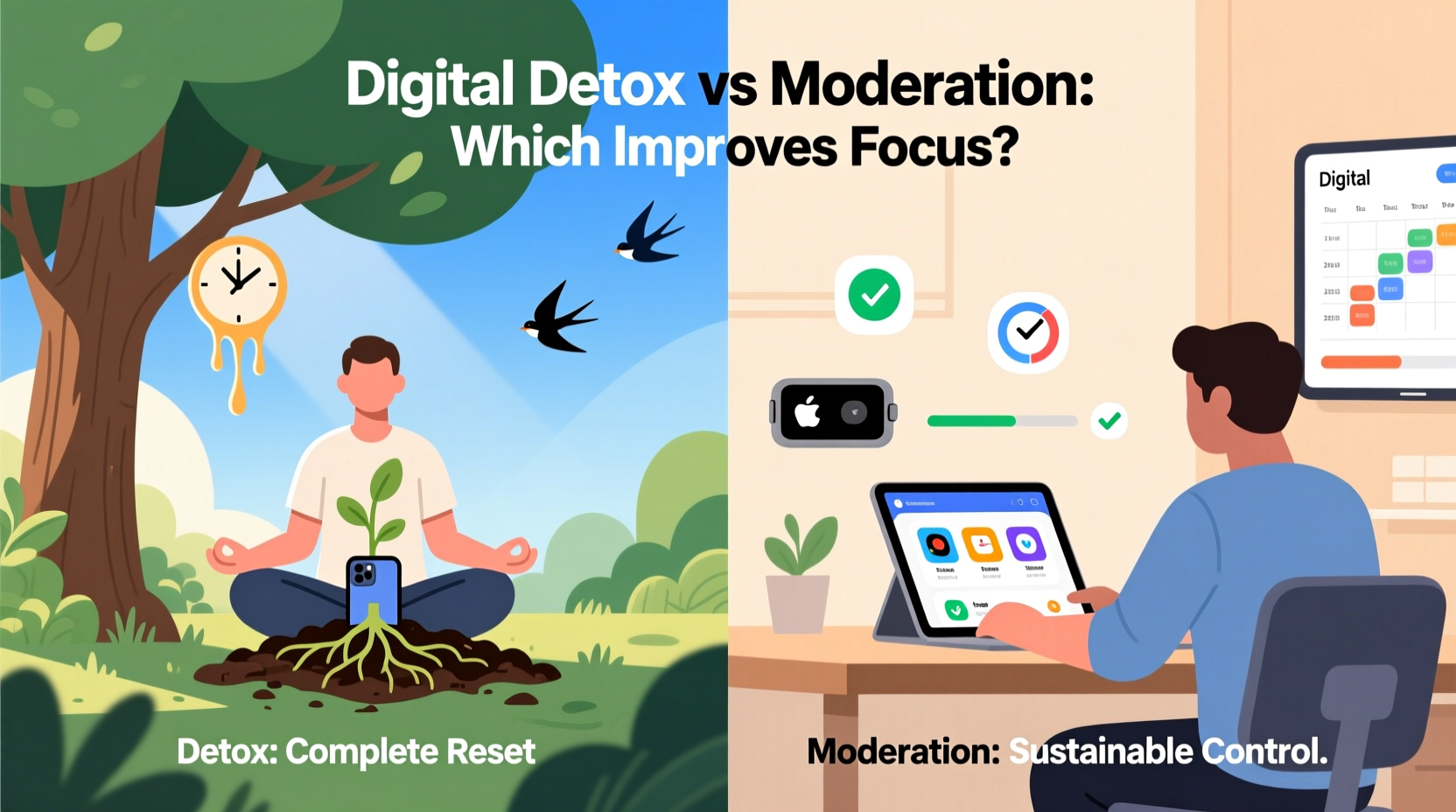
In an age where notifications ping every few minutes and digital distractions are engineered to be irresistible, the quest for sustained focus has become a modern challenge. Many turn to two primary strategies: digital detox—a complete break from screens—and digital moderation—mindful, intentional use without total abstinence. But which method actually works better for improving concentration, mental clarity, and long-term cognitive health?
The answer isn’t as simple as choosing one over the other. Research and behavioral studies suggest that while digital detoxes offer short-term relief, sustainable focus improvements come from structured moderation. Yet, under certain conditions, a well-planned detox can serve as a powerful reset. The key lies in understanding your habits, triggers, and goals.
The Cognitive Cost of Constant Connectivity
Human brains evolved to respond to novelty. Every alert, message, or social media update delivers a micro-dose of dopamine—the brain’s reward chemical. Over time, this creates a feedback loop that conditions us to seek distraction rather than engage in deep, focused work.
A 2023 study published in the Journal of Applied Psychology found that knowledge workers check their devices an average of 96 times per day. Each interruption takes up to 23 minutes to fully recover from in terms of cognitive re-engagement. This “attention residue” accumulates throughout the day, leading to mental fatigue, reduced productivity, and increased stress.
Chronic exposure to fragmented attention doesn’t just affect performance—it alters brain structure. Neuroimaging studies show decreased gray matter density in regions associated with executive function among individuals who report high screen dependency.
“Attention is the rarest and purest form of generosity.” — Simone Weil, philosopher and social theorist
Digital Detox: Reset or Retreat?
A digital detox involves abstaining from non-essential digital devices—smartphones, social media, email, even laptops—for a defined period. It can last from 24 hours to several weeks. Proponents argue it allows the mind to reset, reduces anxiety, and restores natural rhythms of thought.
For some, the benefits are immediate. A 2022 University of Pennsylvania trial showed participants who completed a 7-day digital detox reported:
- Improved sleep quality (78%)
- Greater sense of presence in daily life (65%)
- Increased ability to concentrate during reading or creative tasks (61%)
Yet, these gains often fade within days of returning to normal usage. Without behavior change, the detox becomes a temporary escape—not a solution. As Dr. Natalia Perez, cognitive neuroscientist at MIT, explains:
“A digital detox is like a juice cleanse for your attention. It feels good in the moment, but unless you change your diet, the effects don’t last.”
Worse, abrupt disconnection can trigger withdrawal symptoms—irritability, restlessness, fear of missing out (FOMO)—especially among heavy users. For many, this makes detoxes unsustainable and even counterproductive.
Moderation: The Sustainable Path to Focus
Digital moderation focuses on intentional use—keeping technology as a tool, not a compulsion. Unlike detoxing, it doesn’t require total removal. Instead, it emphasizes awareness, boundaries, and gradual habit change.
Moderation works because it aligns with how behavior change actually happens: through small, consistent adjustments. Rather than fighting against ingrained habits, it reshapes them.
Core principles of effective digital moderation include:
- Time-blocking: Designating specific windows for checking email or messages, rather than responding in real-time.
- Notification hygiene: Disabling non-essential alerts to reduce interruptions.
- Device zoning: Keeping phones out of bedrooms or workspaces during focus periods.
- Usage tracking: Using built-in screen time tools to gain insight into actual behavior.
Over six months, a longitudinal study at the University of British Columbia tracked professionals practicing moderation techniques. Results showed a 42% increase in self-reported focus duration and a 31% reduction in task-switching frequency. Crucially, these improvements were maintained long after the study ended.
Real Example: A Writer’s Journey to Clarity
Sophie, a freelance journalist, struggled with chronic distraction. She’d start writing at 9 a.m., only to find herself scrolling through Twitter by 9:17. Her drafts took twice as long to complete, and she felt mentally drained by noon.
Instead of quitting her devices cold turkey, she adopted moderation. She began by turning off all notifications except calls and messages from family. She used a browser extension to block social media during work hours (10 a.m.–1 p.m.). She also started using a physical notebook for morning planning, delaying device use until after breakfast.
Within three weeks, Sophie noticed she could write for 90 minutes without interruption. After two months, her weekly output increased by 60%. She didn’t eliminate technology—she redesigned her relationship with it.
Comparing Detox and Moderation: A Practical Breakdown
| Factor | Digital Detox | Digital Moderation |
|---|---|---|
| Duration | Short-term (24 hrs–2 weeks) | Ongoing, lifestyle-based |
| Focus Improvement | Immediate but often temporary | Gradual but sustainable |
| Behavior Change | Limited unless followed by new habits | Core objective—builds long-term discipline |
| Feasibility | Low for most professionals | High—adaptable to daily life |
| Risk of Relapse | High—return to old patterns common | Low—designed for resilience |
| Best For | Burnout recovery, acute stress, mental reset | Long-term focus, productivity, cognitive health |
When a Digital Detox Makes Sense
While moderation is more sustainable, there are situations where a digital detox serves a vital purpose:
- After burnout: When mental exhaustion is severe, stepping away completely can provide necessary healing space.
- Breaking addiction cycles: For individuals whose usage borders on compulsive, a forced pause can disrupt the pattern.
- Major life transitions: Starting a new job, moving, or ending a relationship may warrant a reset in digital habits.
The key is to treat detox not as a standalone fix, but as a launchpad for lasting change. Used strategically, it can create the psychological distance needed to reflect and rebuild.
Step-by-Step Guide to Building Focus Through Moderation
If you’re ready to improve focus sustainably, follow this six-week plan:
- Week 1: Audit Your Usage
Use screen time reports (iOS Digital Wellbeing or Android Dashboard) to log app usage. Identify top distraction sources. - Week 2: Reduce Notifications
Turn off all non-critical alerts. Keep only essential communication channels active. - Week 3: Create Focus Blocks
Schedule 90-minute focus sessions with no devices. Use a timer and physical notebook. - Week 4: Design Your Environment
Remove phones from sight during work. Charge devices outside the bedroom. - Week 5: Replace Habits
When the urge to check arises, substitute with a ritual: drink water, stretch, or jot down thoughts. - Week 6: Review and Refine
Assess progress. Which changes stuck? What still needs adjustment? Set a monthly review habit.
This gradual approach avoids overwhelm and builds real skill in attention management.
Frequently Asked Questions
Can I do both—a detox and moderation?
Yes, and it’s often ideal. A short detox (e.g., 48 hours) can act as a starting point, creating mental space to implement moderation strategies with fresh perspective.
Is digital moderation realistic for people in tech-heavy jobs?
Absolutely. Moderation isn’t about elimination—it’s about control. Even developers, marketers, and remote workers benefit from scheduled focus blocks, notification discipline, and end-of-day shutdown rituals.
How long before I see results from moderation?
Most people notice subtle improvements in focus and reduced mental clutter within 2–3 weeks. Significant gains typically appear by week 6, especially when combined with good sleep and low multitasking.
Actionable Checklist: Build Better Focus Today
- ✅ Turn off non-essential phone notifications
- ✅ Schedule one 90-minute focus block this week
- ✅ Move your phone charger out of the bedroom
- ✅ Install a website blocker for top distractions
- ✅ Track screen time for three consecutive days
- ✅ Delete one app you use primarily out of habit
- ✅ Plan a five-minute mindfulness break before starting work
Conclusion: Choose the Strategy That Serves You Long-Term
Digital detoxes offer a compelling narrative: unplug, recharge, return renewed. And for some, in specific moments, they deliver. But for lasting improvement in focus, digital moderation is the superior path. It respects the reality of modern life while empowering you to reclaim agency over your attention.
The goal isn’t to live disconnected—it’s to stay connected on your own terms. By building systems that support deep work, reduce friction, and honor cognitive limits, you create a foundation for sustained mental clarity.
Start small. Pick one habit from the checklist. Master it. Then build from there. Focus isn’t lost because of technology—it’s eroded by unchecked habits. And habits, unlike fleeting willpower, can be redesigned.




 浙公网安备
33010002000092号
浙公网安备
33010002000092号 浙B2-20120091-4
Comments
No comments yet. Why don't you start the discussion?