
For decades, journaling has been recommended by therapists, psychologists, and wellness experts as a tool for emotional regulation and stress reduction. In recent years, the rise of digital tools—note-taking apps, mood trackers, encrypted diaries—has introduced a new dimension to this age-old practice. But does typing your thoughts into a smartphone app carry the same mental health benefits as writing them by hand in a physical notebook? When it comes to reducing anxiety, the answer isn't as straightforward as one might assume.
Anxiety thrives on rumination—repetitive, intrusive thoughts that loop without resolution. Journaling interrupts this cycle by externalizing emotions, creating psychological distance from distressing thoughts. However, the medium through which we journal can influence how effectively this process works. The tactile rhythm of handwriting, the immediacy of digital input, the permanence of ink versus the editability of text—all shape our experience differently.
The Science Behind Journaling and Anxiety Reduction
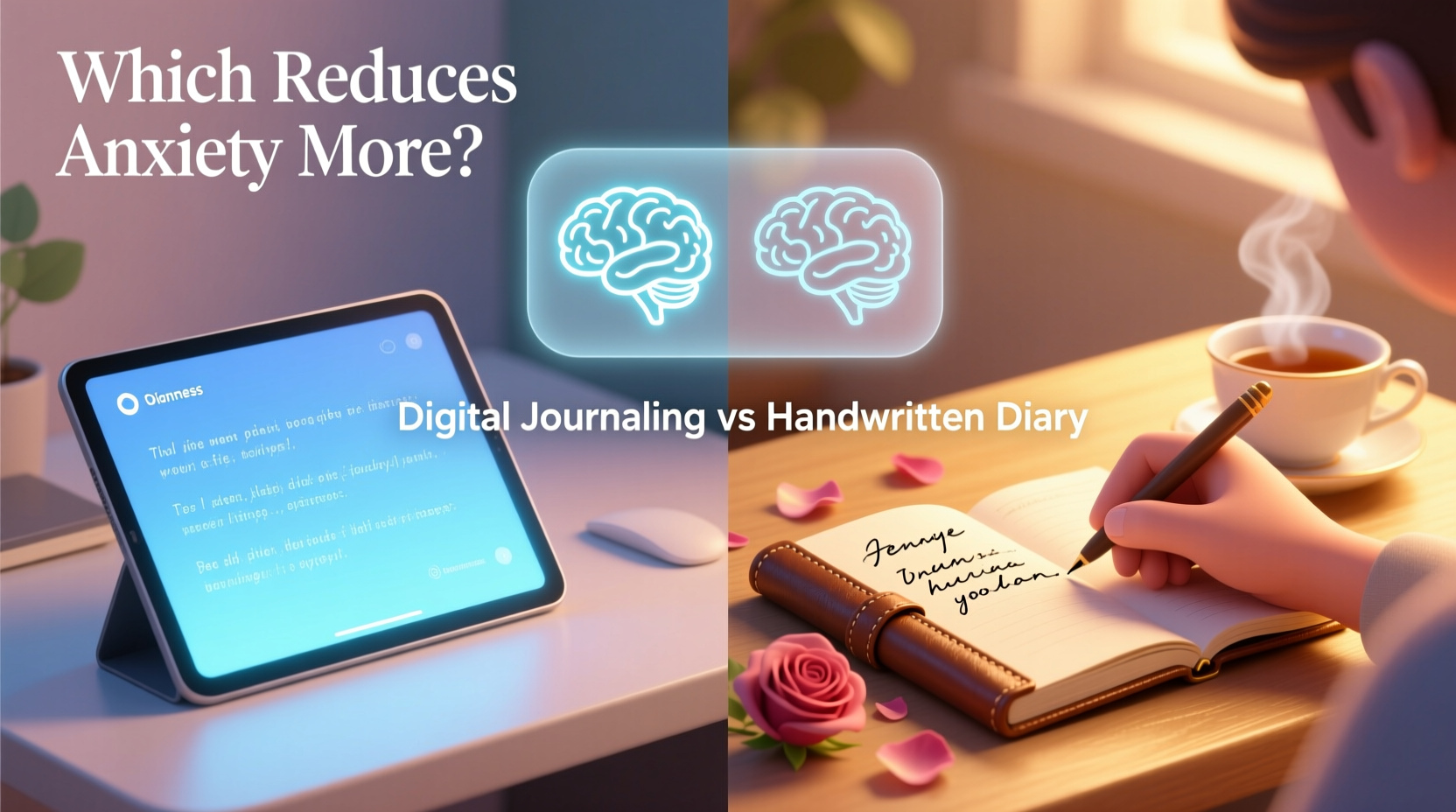
Expressive writing, a concept popularized by psychologist Dr. James Pennebaker, involves writing openly about emotionally significant experiences for 15–20 minutes over several days. Multiple studies have shown that this practice leads to measurable reductions in anxiety, improved immune function, and better sleep.
In a landmark 1997 study published in the Journal of Consulting and Clinical Psychology, participants who wrote about traumatic events showed significantly lower anxiety levels and fewer doctor visits over the following months compared to control groups. Notably, the benefit was tied not just to content but to the act of organizing chaotic emotions into coherent narrative form.
What remains less clear is whether these benefits are amplified or diminished depending on the medium. A 2020 meta-analysis from the University of Cambridge reviewed 34 studies on expressive writing and found that while both digital and handwritten methods reduced anxiety, handwritten journaling had a slightly stronger effect—particularly when participants wrote about personal trauma or daily stressors.
“Writing by hand engages the brain more deeply than typing. It activates regions involved in memory, emotion processing, and self-regulation—key components in managing anxiety.” — Dr. Rebecca Tran, Cognitive Psychologist, University of Edinburgh
How Handwriting Influences Emotional Processing
The physical act of writing by hand is fundamentally different from typing. Neurological research shows that handwriting stimulates sensorimotor integration—the brain’s coordination of movement and perception. This engagement creates what researchers call “embodied cognition,” where the body’s actions contribute to deeper thinking and emotional insight.
When you write slowly with a pen, you naturally pace yourself. This slowness allows space for reflection, making it easier to identify patterns in anxious thinking. You're less likely to rush through painful memories or suppress uncomfortable feelings. The permanence of ink also discourages over-editing, promoting honesty.
In contrast, typing encourages speed and efficiency. While useful for capturing large volumes of information, rapid keystrokes can bypass emotional depth. A 2021 study at UCLA observed that students who typed their journals during exam periods reported higher cognitive load and less emotional clarity than those who wrote by hand—even though both groups spent the same amount of time journaling.
Digital Journaling: Convenience, Features, and Limitations
Digital platforms offer undeniable advantages: cloud backup, search functionality, voice-to-text, encryption, and integration with mood-tracking apps. These features make journaling more accessible, especially for people with busy lifestyles or mobility challenges.
Apps like Day One, Journey, and Reflectly provide prompts, reminders, and templates designed to guide users toward mindfulness and gratitude—elements strongly linked to reduced anxiety. Some even use AI to detect emotional tone and suggest coping strategies. For individuals overwhelmed by blank pages, structured digital formats can lower the barrier to entry.
However, digital journaling introduces distractions. Notifications, autocorrect suggestions, and the temptation to switch apps can fragment attention. A 2022 study in Computers in Human Behavior found that participants using smartphones for journaling were twice as likely to abandon entries mid-sentence due to interruptions. Moreover, the blue light emitted by screens may disrupt circadian rhythms, counteracting relaxation efforts if done before bed.
Another concern is privacy. Despite encryption claims, data breaches involving journaling apps have occurred. Knowing that your innermost thoughts could be exposed—even hypothetically—can heighten anxiety rather than relieve it.
Comparative Analysis: Key Differences That Matter
| Factor | Handwritten Diary | Digital Journaling |
|---|---|---|
| Pace & Flow | Slower, reflective; supports deep processing | Faster, efficient; may encourage surface-level writing |
| Cognitive Engagement | High (activates motor memory and emotion centers) | Moderate (more automatic, less neural activation) |
| Distractions | Minimal (no notifications or pop-ups) | High (device interruptions common) |
| Privacy & Security | Physical control (lockable diary) | Risk of data leaks despite encryption |
| Accessibility | Limited to physical access | Available across devices, searchable, portable |
| Emotional Honesty | Often higher (perceived permanence reduces filtering) | Can be lower (editing ease encourages self-censorship) |
A Real-World Example: Sarah’s Transition from Digital to Analog
Sarah, a 34-year-old project manager, used a popular journaling app for two years to manage work-related stress. She appreciated the ability to tag entries and set daily reminders. However, she noticed her anxiety wasn’t improving—she often skipped days, deleted entries she deemed “too negative,” and felt pressured to maintain a polished digital record.
After reading about the cognitive benefits of handwriting, she switched to a simple Moleskine notebook. At first, she found it awkward and slow. But within three weeks, she began noticing shifts: her entries became longer, more candid, and included reflections she wouldn’t have typed. She started recognizing recurring triggers—like meetings scheduled back-to-back—and proactively adjusted her calendar.
“There’s something grounding about seeing my own handwriting,” Sarah said. “It feels like I’m talking to myself, not performing for an algorithm. My nighttime anxiety dropped noticeably after six weeks.”
Choosing the Right Method: A Step-by-Step Guide
Selecting between digital and handwritten journaling shouldn’t be arbitrary. Consider your lifestyle, goals, and emotional needs. Follow this sequence to make an informed decision:
- Assess Your Primary Goal: Are you seeking emotional release, habit tracking, or creative expression? Handwriting excels at emotional processing; digital tools are better for organization and consistency.
- Evaluate Your Environment: Do you travel frequently or work in unpredictable settings? Digital journals offer flexibility. If you have a stable routine, a physical diary might integrate well into a nightly ritual.
- Test Both Methods: Commit to each for one week. Use the same prompt (e.g., “What made me feel anxious today?”) and compare how you feel afterward. Note differences in clarity, emotional relief, and completion rate.
- Consider Sensory Preferences: Do you enjoy the sound of pen on paper? Or do you prefer the clean look of formatted text? Sensory comfort increases long-term adherence.
- Review Privacy Needs: If you’re documenting sensitive topics (grief, relationship issues, trauma), consider whether digital storage feels safe enough. A locked notebook may provide greater peace of mind.
- Choose Based on Evidence, Not Hype: Don’t default to digital because it’s modern, or analog because it’s “authentic.” Base your choice on what actually reduces your anxiety.
Maximizing Benefits: A Practical Checklist
- ✅ Write at the same time daily (preferably evening) to build consistency
- ✅ Focus on feelings, not grammar or structure
- ✅ Avoid rereading old entries immediately after writing—they can trigger rumination
- ✅ Keep your journal in a dedicated space (bedside table, desk drawer) to reduce friction
- ✅ Use prompts if stuck: “What am I avoiding?” or “What would I tell a friend feeling this way?”
- ✅ Limit editing—especially in digital formats—to preserve authenticity
- ✅ Revisit entries monthly to spot emotional trends and progress
Frequently Asked Questions
Does typing journal entries count as expressive writing?
Yes, typing can still support emotional processing, especially if done mindfully. However, research suggests it produces weaker cognitive and emotional effects than handwriting. To compensate, minimize distractions, disable notifications, and avoid editing as you write.
Can digital journaling worsen anxiety?
In some cases, yes. Constant connectivity, fear of data exposure, and the pressure to curate a “perfect” digital record can increase stress. If you notice heightened anxiety after journaling on a device, consider switching to paper or using offline-only apps.
How long should I journal to see results?
Studies show measurable reductions in anxiety after 3–4 sessions of 15–20 minutes each. For lasting impact, aim for consistent practice over 4–6 weeks. Even brief entries (5 minutes) can help if done regularly.
Conclusion: Match the Medium to Your Mind
There is no universal winner in the debate between digital journaling and handwritten diaries. What matters most is alignment with your psychological needs and daily habits. For deep emotional processing and anxiety reduction, handwriting holds a slight edge due to its slower pace, sensory engagement, and resistance to distraction. Yet digital tools offer unmatched convenience and analytical power for tracking mood over time.
The most effective approach may not be choosing one over the other, but integrating both wisely. Use a notebook for unfiltered emotional release at the end of a stressful day. Later, transfer key insights into a secure digital log to monitor long-term patterns. This hybrid model leverages the strengths of each format.
Ultimately, the best journal is the one you’ll actually use—and keep using. Whether it’s leather-bound or cloud-synced, what counts is showing up for yourself, word by honest word.




 浙公网安备
33010002000092号
浙公网安备
33010002000092号 浙B2-20120091-4
Comments
No comments yet. Why don't you start the discussion?