
In an age of constant digital distraction, maintaining daily focus has become one of the most valuable—and elusive—skills. Many people turn to planning tools to structure their days, reduce mental clutter, and stay on track. But a critical question remains: should you use a digital planner or a paper journal?
The choice isn’t just about preference—it’s about cognitive impact, workflow efficiency, and long-term consistency. Each method influences attention span, memory retention, and task completion in distinct ways. Understanding these differences can help you select the tool that aligns not only with your lifestyle but also with how your brain works best.
Cognitive Load and Mental Clarity
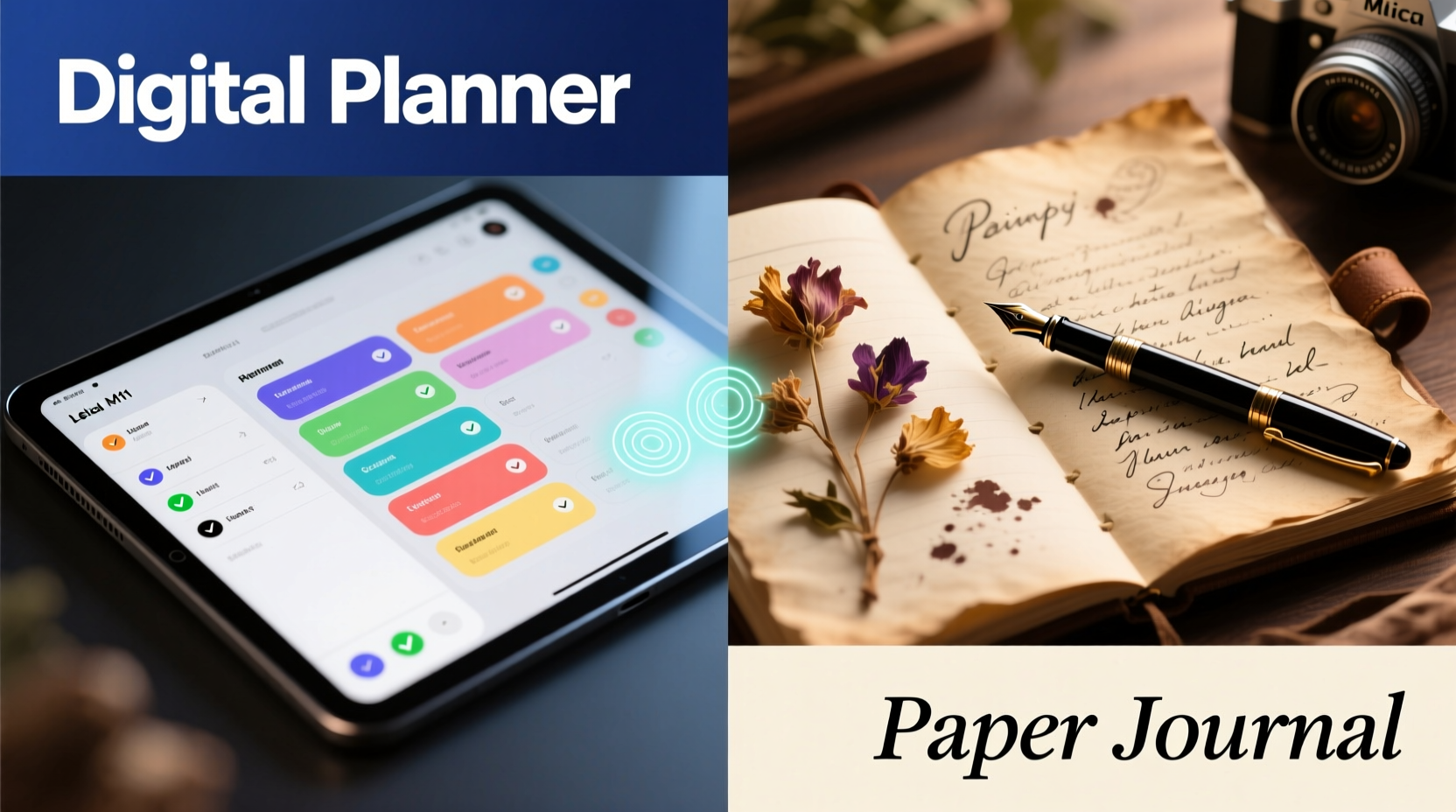
One of the primary factors affecting daily focus is cognitive load—the amount of mental effort being used in working memory. A well-designed planning system reduces this load by externalizing tasks, freeing up mental space for deeper thinking.
Paper journals often provide a cleaner cognitive environment. Without notifications, pop-ups, or app-switching temptations, writing by hand allows for uninterrupted thought flow. Studies suggest that handwriting engages the brain more deeply than typing, promoting better comprehension and recall. When you write something down manually, neural pathways associated with memory and understanding are activated more fully.
Digital planners, while powerful, come with inherent risks of cognitive fragmentation. Even when used solely for planning, devices host multiple applications and distractions. The mere presence of a smartphone or tablet can trigger subconscious urges to check messages or browse content, subtly eroding concentration.
“Writing by hand creates a stronger connection between intention and action. It slows the mind down enough to process meaningfully.” — Dr. Rebecca Lin, Cognitive Psychologist
Feature Comparison: Digital Planners vs Paper Journals
To make an informed decision, it helps to compare core features side by side. Below is a detailed breakdown of strengths and limitations across key dimensions.
| Feature | Digital Planner | Paper Journal |
|---|---|---|
| Accessibility | Synched across devices; accessible anywhere with login | Only available physically where you carry it |
| Searchability | Instant keyword search across entries | No search function; relies on indexing or memory |
| Customization | Templates, colors, integrations (calendar, email, etc.) | Limited to what you draw/write; highly personalizable in style |
| Distraction Risk | High—device invites multitasking | Low—no built-in interruptions |
| Speed of Entry | Faster for long-form text and repetitive tasks | Slower, but encourages concise, intentional input |
| Memory Retention | Lower due to passive data entry | Higher—handwriting boosts encoding into long-term memory |
| Durability & Backup | Cloud backup protects against loss; vulnerable to tech failure | Physical wear over time; no recovery if lost or damaged |
This comparison reveals a fundamental trade-off: digital tools offer convenience and scalability, while analog systems promote mindfulness and cognitive engagement.
Real-World Example: A Week with Each System
Jenna, a freelance designer based in Portland, tested both methods over two consecutive weeks to see which improved her daily focus. Her goal was simple: complete three priority tasks each day without context switching.
During the first week, she used a popular digital planner synced with her calendar and task manager. She appreciated automatic reminders and color-coded project tags. However, she found herself frequently opening other apps during planning sessions—checking emails, scrolling social media, or adjusting unrelated settings. By midweek, her task completion rate dropped to 57%.
In the second week, Jenna switched to a minimalist paper journal with a structured daily layout. No screens, no alerts. Each morning, she spent ten minutes handwriting her top priorities, schedule blocks, and one focus intention. Despite initial skepticism about \"going old-school,\" she reported feeling calmer and more present. Her task completion rose to 89%, and she noted fewer instances of reactive work.
What changed wasn’t the complexity of her workload—but the medium through which she engaged with it.
Key Takeaway from Jenna’s Experiment
The absence of digital stimuli allowed Jenna to enter a state of focused intention before the day began. Writing by hand created a ritual that signaled mental readiness, unlike tapping on a screen, which blended seamlessly into her usual distracted habits.
When to Choose a Digital Planner
Digital planners excel in environments requiring coordination, automation, and rapid iteration. They’re ideal for professionals managing complex workflows across teams, deadlines, and platforms.
- Project managers benefit from Gantt charts, recurring tasks, and team sharing features.
- Remote workers often rely on integration with Zoom, Slack, or Google Calendar.
- Data-driven individuals appreciate analytics like time tracking, habit streaks, and progress dashboards.
If your role demands frequent updates, collaboration, or mobility across devices, a digital solution likely supports your operational needs better.
When a Paper Journal Enhances Focus
Paper journals shine when the goal is clarity, reflection, and sustained attention. Their strength lies not in functionality, but in forcing simplicity.
Because there’s no undo button, auto-save, or copy-paste shortcut, users tend to think more deliberately before writing. This constraint fosters intentionality—a quality essential for deep work.
Journaling by hand also supports metacognition: the ability to reflect on your own thinking. Morning pages, gratitude logs, or end-of-day reviews become more meaningful when written slowly and personally. These practices ground the mind, reducing anxiety and improving emotional regulation—all of which contribute to better focus.
“I’ve tried every app out there, but nothing keeps me present like my Moleskine. It’s not about features—it’s about focus.” — Marcus Tran, Software Engineer and Minimalist Productivity Advocate
Step-by-Step Guide to Building a Focused Planning Routine
- Define your focus goals: Are you aiming to reduce distractions, improve task completion, or enhance self-awareness?
- Choose your medium: Based on your environment and discipline level, decide whether digital or paper suits your current needs.
- Create a daily ritual: Dedicate 10–15 minutes at the same time each day (preferably morning) to plan your priorities.
- Limit inputs: Write only your top 3 tasks, schedule blocks, and one mindset intention (e.g., “Stay calm under pressure”).
- Review weekly: Reflect on what worked. Did your tool support focus, or did it become a source of friction?
- Adjust accordingly: Switch formats if needed. Some thrive with hybrid models—paper for daily focus, digital for long-term tracking.
Hybrid Approach: Best of Both Worlds?
Many high-performing individuals combine both systems strategically. For example:
- Use a paper journal for daily planning, mood tracking, and reflective writing.
- Use a digital planner for master calendars, deadline tracking, and shared project timelines.
This separation of concerns allows the brain to engage deeply with priorities while still benefiting from technology’s organizational power. The key is strict compartmentalization—never mixing the two during active planning time.
Checklist: Choosing Your Focus-Optimized Planner
Answer the following to determine which system will best support your daily focus:
- ✅ Do I work in a high-distraction digital environment?
- ✅ Am I prone to checking notifications during planning time?
- ✅ Do I value speed and searchability over mindfulness?
- ✅ Do I collaborate frequently with others on tasks?
- ✅ Do I find handwriting calming and clarifying?
- ✅ Am I consistent with physical organization (e.g., not losing notebooks)?
- ✅ Do I want to build a reflective, meditative planning habit?
If you answered “yes” to the first four, lean toward digital. If the last three resonate more, paper may be your optimal choice.
Frequently Asked Questions
Can digital planners really harm focus?
Not inherently—but they increase the risk of fragmented attention. The convenience of having everything in one device comes at the cost of constant potential interruption. Even silent notifications alter cognitive states by creating anticipation. To mitigate this, use full-screen mode, disable non-essential alerts, and limit planner access to scheduled times.
Is handwriting too slow for modern productivity?
While slower than typing, handwriting enforces prioritization. You naturally omit fluff and focus on essentials. Research shows that students who take handwritten notes retain information better than those who type verbatim. In planning, this slowness becomes a feature, not a bug—it forces clarity of thought.
What if I lose my paper journal?
This is a legitimate concern. To reduce risk, keep your journal in a designated spot, consider scanning key pages monthly, or maintain a lightweight digital backup of critical dates and goals. Alternatively, use your paper journal for daily focus and your digital tool for archival purposes.
Conclusion: Match the Tool to Your Mind
There is no universal answer to whether digital planners or paper journals improve daily focus. The right choice depends on your personality, environment, and cognitive style.
If you thrive on connectivity, automation, and speed, a digital planner—used with discipline—can be a powerful ally. But if your challenge is mental clutter, reactivity, and shallow engagement, returning to pen and paper might be the simplest path to deeper focus.
Ultimately, the best planner is the one you use consistently and intentionally. It should serve as a bridge to clarity, not another source of noise. Whether pixel or paper, let your tool amplify your attention—not steal it.




 浙公网安备
33010002000092号
浙公网安备
33010002000092号 浙B2-20120091-4
Comments
No comments yet. Why don't you start the discussion?