
In an age where digital tools dominate productivity, many still reach for a pen and paper when organizing their thoughts. The debate between digital planners and paper journals isn’t just about convenience—it touches on how we process information, retain knowledge, and maintain deep focus. While digital planners offer automation and accessibility, paper journals provide tactile engagement that may enhance cognitive performance. Understanding the science behind each method reveals not only how they affect memory and attention but also who benefits most from each format.
The Cognitive Impact of Writing by Hand
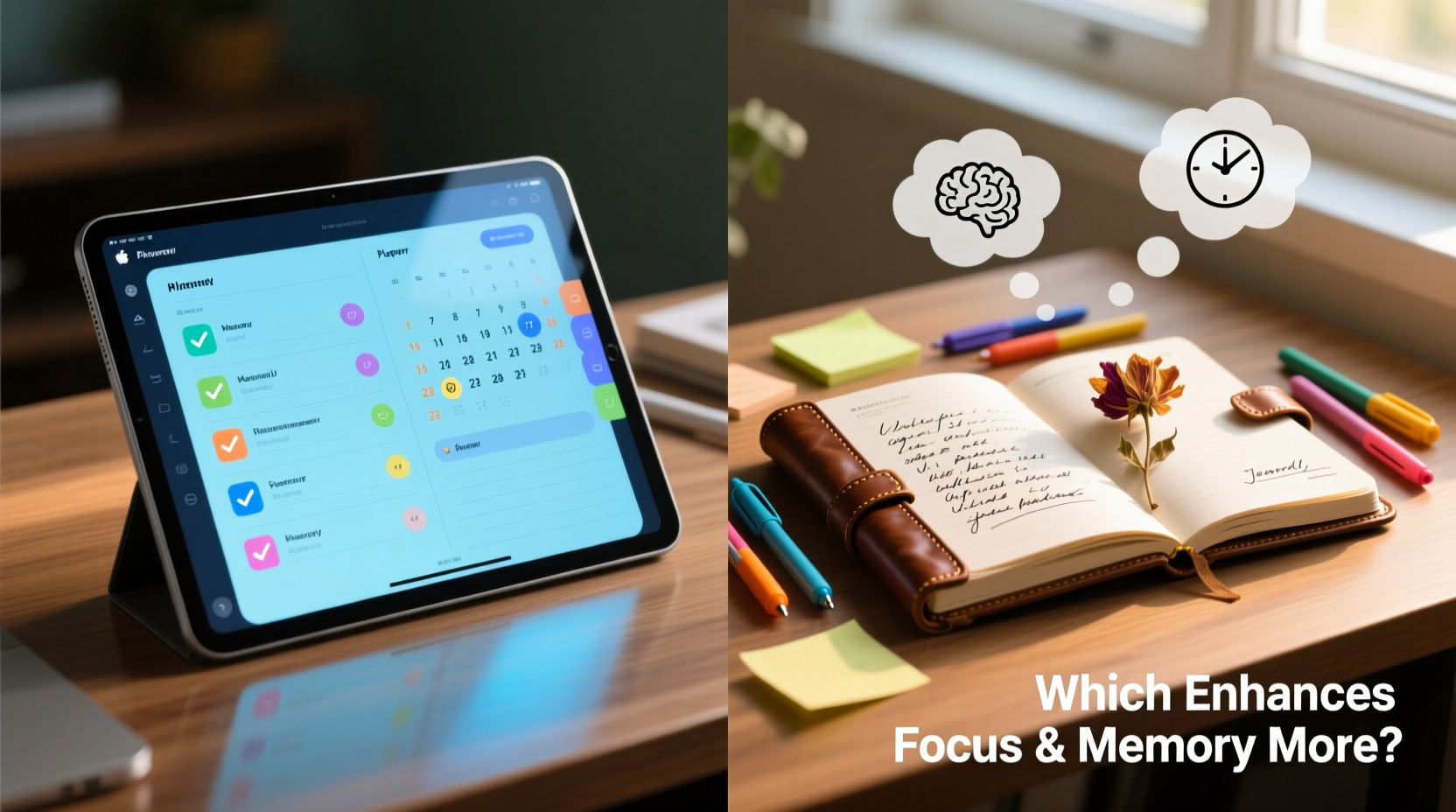
Neuroscience research consistently shows that writing by hand activates regions of the brain linked to thinking, language, and memory processing. A landmark study from Princeton University and UCLA found that students who took notes longhand performed better on conceptual questions than those who typed their notes on laptops. The reason? Typing encourages verbatim transcription, while handwriting forces summarization and interpretation—mental processes that deepen understanding.
When you write with a pen, your brain engages in what researchers call “generative note-taking.” You must listen, interpret, and rephrase ideas in real time, creating stronger neural connections. This act of synthesis is less common with digital input, where speed often replaces reflection.
“Writing by hand is slower, but that slowness is precisely what makes it more effective for learning and retention.” — Dr. Virginia Berninger, Cognitive Psychologist, University of Washington
Digital Planners: Efficiency at a Cost?
Digital planners excel in organization, searchability, and integration. Apps like Notion, GoodNotes, or Microsoft OneNote allow users to tag entries, embed multimedia, and sync across devices instantly. For professionals managing complex schedules or collaborative projects, these tools streamline workflows and reduce clutter.
However, this efficiency comes with cognitive trade-offs. The constant connectivity of digital devices introduces distractions—notifications, emails, and app switches—that fragment attention. A 2023 study published in Computers & Education showed that participants using digital planners experienced 40% more task-switching behavior than those using paper, leading to shallower information encoding.
Moreover, the uniformity of digital text reduces visual distinctiveness. On paper, variations in handwriting, doodles, margins, and spatial layout create mental “landmarks” that aid recall. Digital notes, especially when copied verbatim, lack these cues, making them harder to retrieve later.
Memory Retention: Why Paper May Have the Edge
Memory formation relies on three stages: encoding, storage, and retrieval. Handwriting strengthens all three. Encoding is enhanced through motor engagement; storage benefits from the unique sensory experience of ink on paper; retrieval is supported by spatial memory—remembering where something was written on a page.
A 2021 study in Acta Psychologica tested participants’ ability to recall grocery lists after recording them either digitally or on paper. After one week, the paper group recalled 25% more items. MRI scans revealed greater activation in the hippocampus—a key region for memory—during the paper-based task.
This doesn’t mean digital tools are ineffective. They can support memory through features like spaced repetition (e.g., Anki flashcards) or audio annotations. But for raw, unaided recall—such as remembering a meeting detail without checking your device—paper consistently outperforms screens.
Focus and Distraction: The Hidden Battle
Focus is not just about concentration—it’s about minimizing interruptions. A paper journal is inherently distraction-free. There are no pings, pop-ups, or infinite scroll. It exists in a single mode: writing.
Digital planners, even when used offline, carry the psychological weight of multitasking. Knowing your email is one swipe away changes how your brain allocates attention. Researchers at the University of California, Irvine, found that it takes an average of 23 minutes to fully regain deep focus after a single interruption.
Additionally, screen fatigue plays a role. Prolonged exposure to blue light reduces melatonin production and contributes to mental exhaustion, particularly during evening planning sessions. In contrast, writing by hand in low-glare conditions supports sustained attention without taxing the visual system.
Comparison Table: Digital Planner vs Paper Journal
| Feature | Digital Planner | Paper Journal |
|---|---|---|
| Memory Encoding | Moderate (especially with verbatim typing) | High (due to active processing and motor engagement) |
| Focus Support | Low to Moderate (prone to distractions) | High (minimal interruptions) |
| Searchability | High (text search, tags, filters) | Low (requires indexing or memory) |
| Portability | High (syncs across devices) | Moderate (limited to physical copy) |
| Customization | High (templates, colors, links) | Moderate (depends on creativity and tools) |
| Long-term Retention | Moderate (with active review systems) | High (spatial and sensory cues aid recall) |
| Eco-Impact | Moderate (device production, energy use) | Low (if sustainably sourced paper used) |
Real-World Example: A Writer’s Workflow Shift
Sophie, a freelance journalist, used a digital planner exclusively for years. She relied on Google Calendar, Trello, and Evernote to manage deadlines and story ideas. Despite her organizational precision, she noticed declining creativity and difficulty recalling interview details without checking her notes.
After reading about the cognitive benefits of handwriting, she experimented with a hybrid approach. She began using a paper journal for brainstorming, drafting article outlines, and daily reflections. Digital tools were reserved for scheduling and file storage.
Within six weeks, Sophie reported sharper recall during interviews, improved narrative flow in her writing, and fewer instances of “mental blanking.” She attributed this shift to the deeper engagement fostered by writing by hand. “My thoughts feel more connected now,” she said. “It’s like my brain has time to catch up with my pen.”
Step-by-Step Guide: Choosing the Right Tool for Your Goals
Selecting between a digital planner and a paper journal shouldn’t be arbitrary. Follow this five-step process to align your choice with your cognitive needs:
- Define your primary goal: Are you aiming to improve memory, boost focus, increase productivity, or reduce stress? Memory and focus favor paper; rapid access and collaboration lean toward digital.
- Assess your environment: Do you work in a high-distraction setting? If so, a paper journal may help create a focused zone. Remote workers with multiple devices might benefit from digital syncing.
- Test both methods: Spend one week using only a paper journal for planning and note-taking, then repeat with a digital planner. Track your recall accuracy, focus duration, and emotional response.
- Evaluate integration needs: If you collaborate frequently or rely on calendar syncs, a digital solution may be non-negotiable. Look for apps that allow handwriting input (e.g., Apple Notes with iPad).
- Consider a hybrid model: Many find success combining both. Use paper for creative thinking and memory-critical tasks, and digital for logistics and long-term archiving.
Checklist: Optimizing Your Planning System
- ☐ Use paper for brainstorming, goal-setting, and reflective journaling
- ☐ Reserve digital tools for scheduling, reminders, and file attachment
- ☐ Disable notifications when using digital planners for note-taking
- ☐ Review handwritten notes within 24 hours to reinforce memory
- ☐ Index your paper journal with tabs or a table of contents for easier navigation
- ☐ Back up critical digital notes regularly to prevent data loss
- ☐ Limit screen-based planning to specific times of day to reduce cognitive load
Frequently Asked Questions
Can digital planners be as effective as paper for memory?
They can, but only if used intentionally. Typing notes verbatim reduces retention. To improve effectiveness, summarize key points after recording, use voice-to-text sparingly, and review notes manually. Apps with drawing capabilities (like Samsung Notes or GoodNotes) allow handwriting on tablets, offering a middle ground.
Does the type of paper journal matter?
Yes. Research suggests that blank or dotted paper promotes freer thinking and spatial organization compared to lined pages. High-quality paper that prevents ink bleed enhances the tactile experience, reinforcing focus. Consider journals with undated pages for flexibility and weekly spreads for time management.
Is it possible to overuse a paper journal?
While rare, excessive journaling without reflection can become ritualistic rather than productive. Focus on quality over quantity. Write with purpose—whether it’s problem-solving, gratitude logging, or planning—and set time limits to avoid mental fatigue.
Expert Insight: Bridging the Analog-Digital Divide
“The future isn’t paper versus digital—it’s about leveraging the strengths of each. We should design workflows that use paper for deep cognitive work and digital for distribution and retrieval.” — Dr. Maryanne Wolf, Author of *Reader, Come Home* and Cognitive Neuroscientist
This integrated philosophy reflects a growing trend among high-performing professionals: using analog tools for creation and digital platforms for execution. By matching the medium to the mental task, users optimize both brain function and workflow efficiency.
Conclusion: Choose Based on Purpose, Not Habit
The question isn’t whether digital planners or paper journals are universally better—it’s which tool serves your current cognitive goals. If your priority is deep focus, long-term memory, and creative clarity, a paper journal offers unmatched advantages. If you need instant access, searchability, and integration with other tools, digital planners deliver practical value.
The most effective planners aren’t defined by technology but by intentionality. Whether you choose a Moleskine notebook or a cloud-based app, what matters is how you engage with it. Slow down. Summarize. Reflect. These habits—not the medium—determine real improvement in focus and memory.




 浙公网安备
33010002000092号
浙公网安备
33010002000092号 浙B2-20120091-4
Comments
No comments yet. Why don't you start the discussion?