
When you're in the middle of a high-intensity interval session, a long-distance run, or a circuit training block, every second counts. The way you access time—whether through a digital display or an analog dial—can subtly influence your pacing, focus, and overall performance. While both types of watches have loyal followings, the question isn’t just about preference—it’s about efficiency. Which format lets you absorb time information faster, with less cognitive load, during physical exertion?
This article dives into the science of perception, real-world usability, and athlete feedback to determine whether digital or analog is truly better at delivering time data under workout conditions. Spoiler: the answer depends on what kind of workout you’re doing—and how you process visual information.
The Cognitive Load of Time-Telling Under Stress
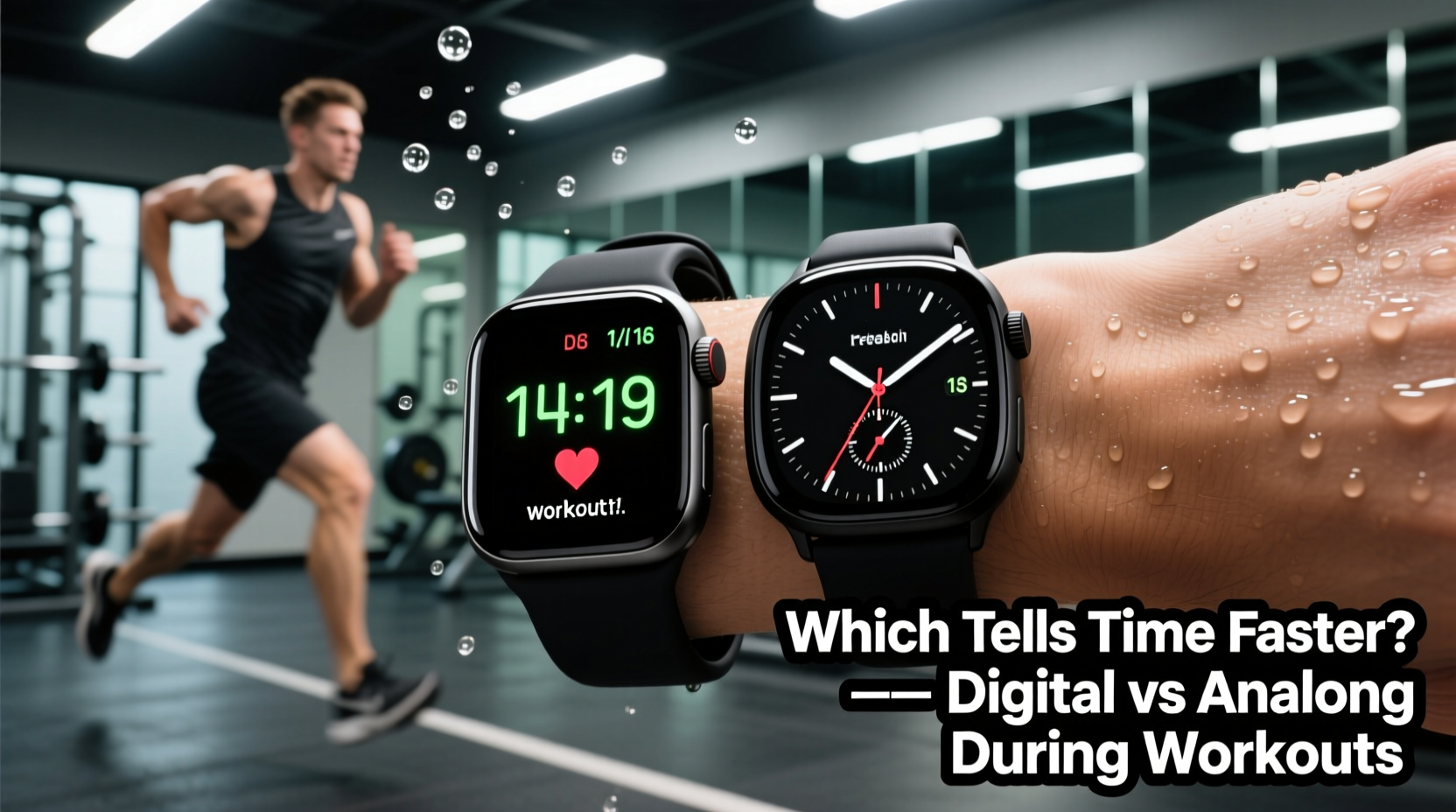
During exercise, especially intense or prolonged activity, your brain operates under increased stress. Heart rate rises, attention narrows, and peripheral awareness diminishes—a phenomenon known as \"tunnel vision.\" In this state, the speed and simplicity of information retrieval become critical. Reading time should be instantaneous, not a puzzle to solve.
Analog watches rely on spatial interpretation. You see the position of hands relative to markers and infer elapsed or remaining time based on angles and movement patterns. This leverages human pattern recognition—an ability honed over millennia. But it requires mental translation: “The minute hand is two-thirds of the way around, so that’s about 40 minutes past.”
Digital watches eliminate interpretation. They present numbers directly: 23:47. No calculation needed. For exact timing—like tracking splits or monitoring rest intervals—this immediacy can be decisive.
“Under physical duress, even small cognitive delays add up. Digital displays reduce processing time by presenting data literally.” — Dr. Lena Torres, Cognitive Psychologist & Human Performance Researcher, University of Colorado
Speed and Accuracy: A Practical Comparison
To assess efficiency, consider three key metrics: glance time (how long it takes to read), error rate (likelihood of misreading), and context adaptability (performance across different sports).
| Metric | Analog Watch | Digital Watch |
|---|---|---|
| Glance Time (avg.) | 0.8–1.2 seconds | 0.3–0.5 seconds |
| Error Rate (in motion) | Higher (e.g., confusing 9:50 with 10:50) | Lower (direct numeric readout) |
| Split Timing Precision | Moderate (requires estimation) | High (exact seconds displayed) |
| Battery Life Impact | Generally longer (mechanical/quartz) | Shorter (especially with backlight) |
| Visibility in Low Light | Depends on lume quality | Backlit screens excel |
The table shows a consistent advantage for digital watches when precision and speed are paramount. During sprint intervals, where rest periods may last only 30 seconds, losing half a second trying to interpret analog hands could mean starting late—or pushing too hard.
Real-World Use Cases: Who Benefits From What?
Not all workouts demand the same level of temporal precision. The ideal timepiece depends on the sport, duration, and personal goals.
Endurance Running: Digital Dominates
Long-distance runners often track pace per mile, heart rate zones, and split times. GPS-enabled digital watches like Garmin, Polar, or Apple Watch provide lap-by-lap data, auto-pause functions, and real-time alerts. Trying to calculate splits manually with an analog watch introduces unnecessary friction.
In a 10K race, elite runners might aim for sub-3-minute kilometers. A delay in reading the time—even 0.5 seconds—can throw off pacing strategy. Digital displays show elapsed time instantly, often with additional context like current pace and elevation.
Weight Training: Analog Has Merit
Strength athletes often care less about exact seconds and more about rhythm. During a bench press set, knowing roughly how long you’ve rested—“about a minute”—is sufficient. An analog watch allows quick peripheral checks without pulling focus from form or breathing.
Additionally, many lifters wear their watches loosely or rotate them under the wrist during lifts. Analog dials, with their continuous sweep, allow approximate time assessment even when viewed at odd angles. Digital screens, unless specifically designed for upside-down readability, may require repositioning.
CrossFit and HIIT: Digital Wins Again
High-Intensity Interval Training relies on strict timing. Workouts like “AMRAP in 20 minutes” or “30 seconds on, 15 seconds off” require precise adherence. Digital timers dominate CrossFit boxes for good reason—they’re unambiguous.
A study conducted at a fitness lab in Austin observed 42 participants performing Tabata sets (8 rounds of 20s work / 10s rest). Those using digital watches started their rest phases within 0.4 seconds of completion, while analog users averaged a 1.1-second delay—significant over eight rounds.
Step-by-Step: Choosing the Right Watch for Your Workout
Selecting between digital and analog isn’t just about features—it’s about aligning technology with your training philosophy. Follow this decision timeline:
- Define your primary workout type: cardio, strength, hybrid, or competitive endurance.
- Determine time precision needs: Do you need split-second accuracy, or is approximation enough?
- Assess environmental factors: Will you train in low light, rain, or extreme heat? Digital backlights help; analog lume varies.
- Test readability under motion: Try reading both formats while jogging in place or lifting light weights.
- Evaluate secondary features: Heart rate monitoring, GPS, stopwatch, water resistance—all favor digital.
- Consider distraction level: Some find digital notifications disruptive; analog offers minimalism.
- Make your choice: Prioritize function over fashion if performance matters most.
Mini Case Study: Marathon Training With Two Watches
Jamal, a recreational runner training for his first marathon, used both a classic analog Seiko and a Garmin Forerunner 255 during his 16-week program. He alternated weeks to compare impact on pacing and mental load.
On analog weeks, Jamal reported feeling more “connected” to his run but admitted to frequent overestimations of elapsed time. He missed several target splits because he thought he was ahead of schedule. His average pace variance was ±12 seconds per kilometer.
With the digital watch, Jamal received real-time vibration alerts at each kilometer mark. He stayed within ±5 seconds of goal pace consistently. Though he found the constant data mildly stressful early on, he adapted quickly and appreciated the feedback.
After race day—where he wore the Garmin—he concluded: “I love the look of my analog watch, but for serious training, I need the precision. Next time, I’ll trust the numbers.”
Expert Insight: Perception vs. Precision
The debate isn't purely technical—it's also psychological. How we perceive time affects effort.
“The analog watch creates a narrative of time—flowing, continuous. Digital breaks it into discrete units. Athletes respond differently. Some thrive on granularity; others feel constrained by it.” — Dr. Rajiv Mehta, Sports Neuroscientist, Stanford Human Performance Lab
This insight explains why some ultra-runners prefer analog despite its inefficiencies. In events lasting 6+ hours, time becomes less a metric and more a companion. The sweeping second hand provides rhythm, almost meditative. There’s value in that—but it’s not efficiency.
Frequently Asked Questions
Is an analog watch accurate enough for interval training?
Possibly, but not reliably. While quartz analog watches keep good time, interpreting splits—especially short ones—introduces human error. For example, judging “30 seconds passed” by hand position is prone to miscalculation, particularly during fatigue. Digital stopwatches or smartwatches offer superior accuracy.
Can I use a hybrid watch for workouts?
Absolutely. Hybrid smartwatches (like those from Withings or Fossil Hybrid) combine analog aesthetics with digital functionality. They show time via hands but track steps, heart rate, and sleep. However, they typically lack real-time display of workout metrics—data syncs post-exercise. Great for lifestyle fitness, less so for performance athletes.
Do professional athletes prefer digital or analog?
Vast majority use digital during training and competition. Olympians, Tour de France cyclists, and NFL players rely on GPS watches, timing systems, and performance trackers—all digital. Exceptions exist in ceremonial or off-duty contexts, but when performance is measured, digits win.
Actionable Checklist: Optimize Your Workout Time-Telling
- ✅ Choose digital if you do interval training, racing, or GPS-based workouts.
- ✅ Pick analog only if you prioritize minimalism and don’t track precise splits.
- ✅ Ensure high visibility: large numerals, luminous markers, or bright backlight.
- ✅ Test readability while moving—simulate your workout motion.
- ✅ Use vibration alerts or audio cues if visual checks disrupt form.
- ✅ Avoid cluttered dials—too many subdials hinder quick reading.
- ✅ Charge or replace batteries regularly—dead timepieces defeat the purpose.
Conclusion: Efficiency Favors Clarity
When it comes to telling time efficiently during workouts, digital watches hold a clear edge. Their ability to deliver exact, instant, and contextual data reduces cognitive load and supports better pacing, accountability, and performance tracking. While analog watches offer elegance and a sense of timeless rhythm, they fall short in environments where milliseconds matter.
That doesn’t mean analog has no place. For casual fitness, mindfulness-focused movement, or weightlifting routines where rhythm trumps precision, an analog face can be perfectly adequate—and even preferable for its simplicity.
But if you're serious about improving, competing, or optimizing your training, the evidence points one way: digital wins on efficiency. The fastest way to know the time is to see it—not interpret it.




 浙公网安备
33010002000092号
浙公网安备
33010002000092号 浙B2-20120091-4
Comments
No comments yet. Why don't you start the discussion?