
Many home cooks use onions and shallots interchangeably, assuming they are simply different sizes of the same ingredient. While both belong to the Allium family and share a pungent lineage with garlic and leeks, their differences in flavor, texture, and culinary function are significant enough to affect the outcome of a dish. Understanding these distinctions is essential for achieving balance in sauces, sautés, dressings, and slow-cooked meals. Choosing the wrong allium can tilt a delicate sauce toward harshness or mute the aromatic foundation of a French ragu. This guide breaks down the botanical, sensory, and functional contrasts between onions and shallots, offering practical guidance for using each correctly—and knowing when substitution is acceptable.
Definition & Overview
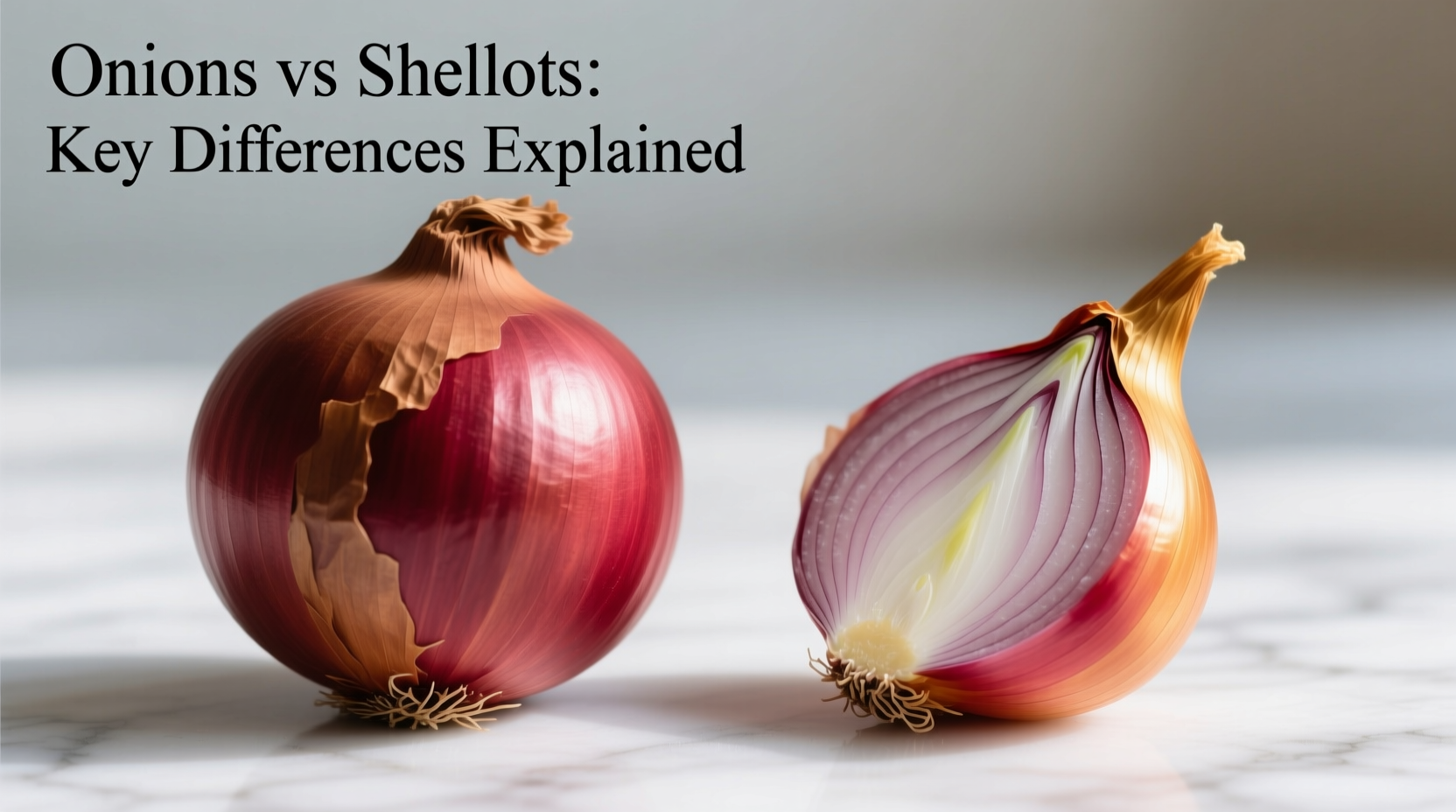
Onions (Allium cepa) are among the most widely used vegetables in global cuisine. Typically round with papery outer layers ranging from white to yellow to red, onions serve as a foundational ingredient in countless savory dishes. Their sharp, sulfurous bite mellows significantly with cooking, transforming into deep sweetness through caramelization. Onions are high in water content and contain volatile sulfur compounds that cause tearing during cutting.
Shallots (Allium cepa var. aggregatum), often mistaken for a hybrid of onions and garlic, are actually a specific cultivar group of onion that grows in clusters, much like garlic cloves. They have a coppery-pink skin and flesh that ranges from pale gray to lavender-gray. Shallots offer a more refined, complex flavor profile—less aggressive than onions, with subtle garlicky undertones and a hint of sweetness even when raw. They are prized in French, Southeast Asian, and Middle Eastern cooking for their ability to add depth without overpowering.
The confusion between the two stems partly from regional naming conventions. In some parts of the world, particularly South Asia, “shallot” refers to what Western cooks call scallions or green onions, adding further ambiguity. True shallots, as recognized in European and North American kitchens, are distinct both botanically and culinarily.
Key Characteristics
| Characteristic | Onion (Yellow) | Shallot |
|---|---|---|
| Flavor (Raw) | Sharp, pungent, sulfurous; can be harsh or biting | Mild, sweet, slightly garlicky; less acrid |
| Flavor (Cooked) | Sweetens dramatically; develops rich umami when caramelized | Balanced sweetness with nuanced complexity; retains elegance |
| Aroma | Strong, eye-watering when cut | Subtle, fragrant, with floral and garlic notes |
| Texture | Crisp when raw; softens evenly when cooked | Finer grain; melts smoothly into sauces |
| Color & Form | Spherical, single bulb; brown, white, or red skin | Oblong, clustered bulbs resembling garlic; coppery skin |
| Culinary Function | Base aromatics (mirepoix, sofrito); bulk cooking | Delicate sauces, vinaigrettes, reductions, fines herbes |
| Shelf Life | 2–3 months in cool, dry storage | 1–2 months; more perishable due to lower dry matter |
Practical Usage: How to Use Each Ingredient
When to Use Onions
Onions are ideal when volume, structure, and transformative sweetness are needed. They form the backbone of mirepoix (with carrots and celery), sofrito, and curries. Because they cook down predictably and caramelize deeply, they're perfect for:
- Beef bourguignon and stews requiring long simmering
- Onion rings, fritters, or any dish where texture matters
- Chutneys, relishes, and pickles needing bold acidity and crunch
- Grilled or roasted vegetable medleys
When to Use Shallots
Shallots shine in applications where subtlety and integration are paramount. Their fine cell structure allows them to dissolve almost entirely into emulsions and sauces, making them indispensable in professional kitchens. Ideal uses include:
- Reduction sauces like beurre blanc or demi-glace
- Vinaigrettes and salad dressings (especially in French cuisine)
- Marinades for poultry, fish, or scallops
- Quick sautés where you want aroma without chunkiness
- Raw garnishes for tartares or crudos
Pro Tip: For ultra-smooth sauces, sweat minced shallots in butter until tender, then strain them out before adding cream or wine. This captures their essence without textural interruption—a technique commonly used in haute cuisine.
Variants & Types
Types of Onions
Understanding onion varieties helps match the right type to the dish:
- Yellow Onions: Most common; excellent for cooking. High sulfur content transforms into sweetness over heat.
- White Onions: Crisper and slightly milder; favored in Mexican cuisine for salsas and grilled applications.
- Red Onions: Contain anthocyanins (natural pigments); best raw in salads, sandwiches, or pickled. Less sweet when cooked.
- Sweet Onions (e.g., Vidalia, Walla Walla): Lower in pyruvic acid (responsible for pungency), higher in sugar. Best eaten raw or lightly grilled.
Types of Shallots
True shallots come in several forms, though availability varies by region:
- Gray Shallots (French Shallots): Also called eschalots gris, these are the gold standard. Small, elongated, with grayish flesh and superior flavor. Grown in regions like Brittany, France.
- Echalote Banane: Banana-shaped, golden-brown skin. Milder and sweeter; increasingly available in specialty markets.
- Jersey Shallots: Larger, pinker, and less intense. Often found in U.S. supermarkets but considered inferior in depth to French types.
- Pickled or Preserved Shallots: Used as condiments; retain tang and slight sweetness. Excellent on cheese boards or in charcuterie.
A growing number of hybrid products labeled \"shallots\" in grocery stores are actually single-bulb onions bred to mimic shallot size and mildness. These are convenient but lack the layered complexity of true multiplier shallots.
Comparison with Similar Ingredients
Confusion often arises between shallots, onions, scallions, and pearl onions. A clear comparison clarifies proper usage:
| Ingredient | Best Used For | Can Substitute For Shallots? | Notes |
|---|---|---|---|
| Yellow Onion | Stews, soups, roasting | Limited; use ½ amount + dash of garlic | Too strong raw; may dominate delicate sauces |
| Scallions (Green Onions) | Garnishes, stir-fries, salads | No; entirely different texture and function | Only white part has mild allium flavor; green part is grassy |
| Pearl Onions | Braised dishes, cocktails (e.g., Gibsons) | No; firmer, less sweet, more fibrous | Often peeled and blanched; not a flavor substitute |
| Garlic | Flavor accent, aromatics | No; far more pungent and singular in profile | Shallots complement garlic but are not replacements |
| Red Onion | Salads, pickling, garnishes | Only in raw applications; use sparingly | Adds color but lacks shallot’s nuance |
“In classical French cooking, we never use onion in a beurre blanc. It’s always shallot—finely minced, reduced in vinegar, then enriched with butter. The onion would make it coarse.”
— Chef Laurent Baudoin, former sous-chef at Le Bernardin
Practical Tips & FAQs
Can I substitute onions for shallots?
Yes, but with adjustments. Use **half the amount of finely minced yellow onion** and add a small pinch of garlic powder (⅛ tsp per shallot) to approximate depth. This works best in cooked dishes, not raw preparations. Avoid substituting raw onion in vinaigrettes—it will taste harsh and unbalanced.
How should I store shallots and onions?
Store both in a cool, dark, well-ventilated space—not the refrigerator unless peeled. Onions last longer: up to 12 weeks if kept dry. Shallots are more fragile; use within 4–6 weeks. Never store either near potatoes, which emit moisture and ethylene gas, accelerating spoilage.
Why do recipes specify shallots for sauces?
Shallots integrate seamlessly into emulsified sauces because they break down more completely than onions. Their natural sugars promote smooth reduction without curdling, and their milder flavor doesn’t compete with butter, cream, or wine. In a classic demi-glace, shallots contribute aromatic lift without overwhelming the meat essence.
Are shallots healthier than onions?
Nutritionally, both are low in calories and rich in antioxidants, vitamin C, and quercetin. Shallots contain slightly higher levels of polyphenols and flavonoids, giving them a marginal edge in antioxidant capacity. However, the difference is negligible in typical culinary use. Both support cardiovascular health and possess anti-inflammatory properties.
How do I peel shallots easily?
Place whole shallots in boiling water for 1 minute, then transfer to ice water. The skins will slip off effortlessly. Alternatively, trim the ends, then squeeze gently from the base—the clove will pop out. For large batches, this method saves time and minimizes waste.
What dishes absolutely require shallots?
Certain recipes rely on shallots for authenticity and balance:
- Beurre Blanc: A Loire Valley butter sauce made with white wine, vinegar, and shallots.
- Vietnamese Nuoc Cham: Fish sauce-based dipping sauce where raw shallot adds brightness.
- Tarte à l’Oignon (French onion tart): Often combines both—onions for bulk, shallots for aroma.
- Coq au Vin: Traditional versions use shallots in the lardons and sauce for refinement.
Summary & Key Takeaways
While onions and shallots are related, they are not interchangeable without consequence. Recognizing their differences empowers better cooking decisions and elevates dish quality.
- Onions are robust, versatile, and ideal for building foundational flavors in hearty dishes. Their high water and sulfur content transform beautifully under heat.
- Shallots offer a more sophisticated, layered taste—mildly sweet, subtly garlicky, and less tear-inducing. They excel in refined applications like sauces, dressings, and quick sautés.
- True shallots grow in clusters and differ botanically from single-bulb onions. Beware of commercial hybrids marketed as shallots.
- Substitutions are possible in a pinch, but adjust quantity and consider adding a touch of garlic to compensate for missing complexity.
- Storage conditions affect shelf life: keep both dry and ventilated, but expect shallots to degrade faster.
Next time a recipe calls for shallots, resist the urge to swap in an onion without consideration. Taste the difference side by side—raw, then sautéed—and notice how each shapes a dish. Your palate will thank you.




 浙公网安备
33010002000092号
浙公网安备
33010002000092号 浙B2-20120091-4
Comments
No comments yet. Why don't you start the discussion?