
Synthetic diamonds have long fascinated scientists, jewelers, and hobbyists alike. While commercial production relies on high-pressure, high-temperature (HPHT) chambers or chemical vapor deposition (CVD) reactors, the idea of creating a diamond at home sparks curiosity. However, true diamond synthesis requires extreme conditions far beyond typical household capabilities. This guide explores what is realistically possible for enthusiasts, focusing on safe, educational approaches that simulate or approximate the process—without risking injury or false expectations.
It’s important to clarify: you cannot grow gem-quality synthetic diamonds in your garage with kitchen tools. But with careful research, proper equipment, and respect for scientific principles, you can engage in hands-on experiments that teach the fundamentals behind diamond formation. This article outlines feasible DIY-friendly methods, safety protocols, and alternative projects that bring you closer to understanding how diamonds are made—safely and practically.
Understanding Synthetic Diamonds: Science vs. Myth
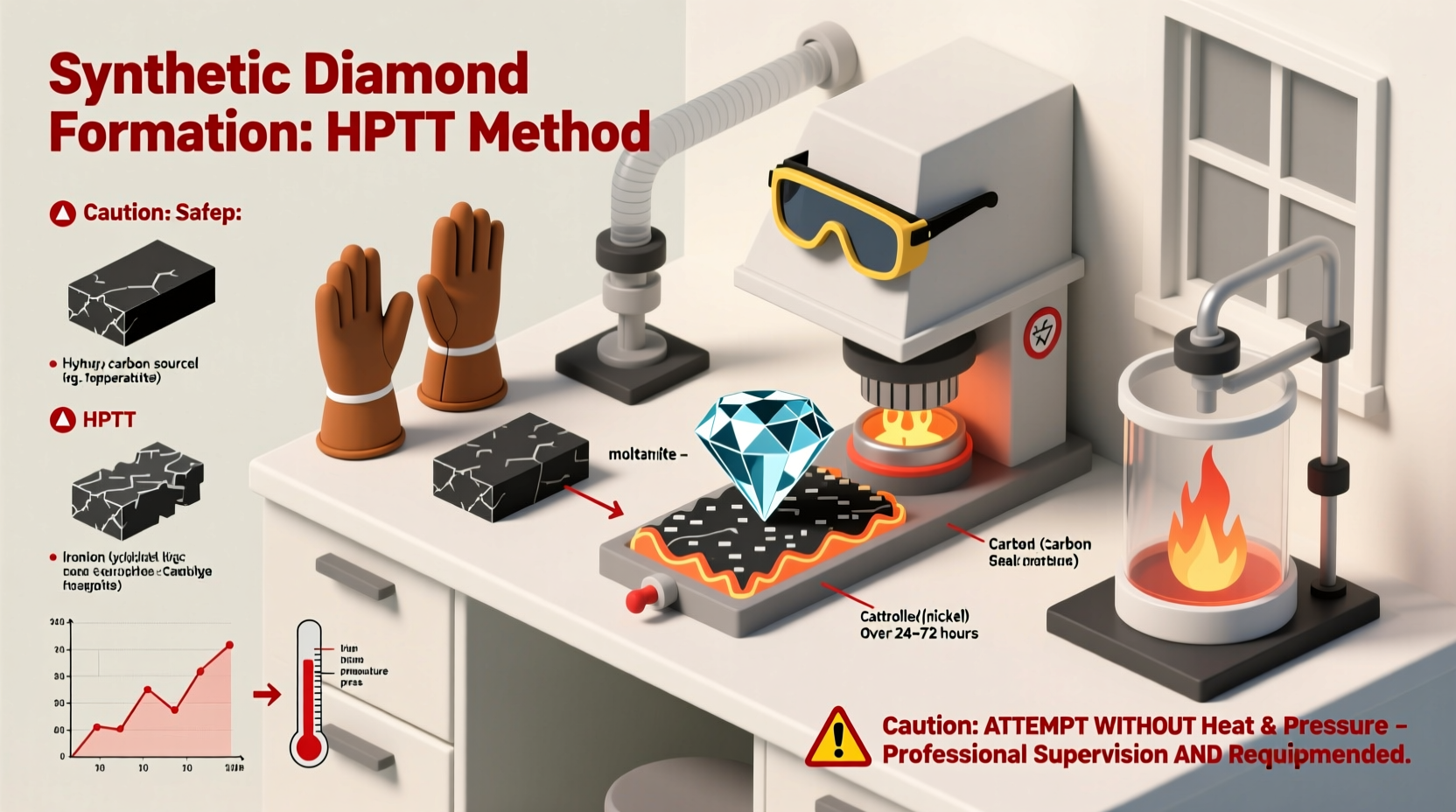
Diamonds form naturally under immense pressure and temperature deep within the Earth’s mantle. Synthetic versions replicate these conditions artificially. The two primary industrial methods are:
- High-Pressure High-Temperature (HPHT): Mimics natural conditions using presses capable of generating over 5 GPa of pressure and temperatures above 1,400°C.
- Chemical Vapor Deposition (CVD): Breaks down hydrocarbon gases like methane in a vacuum chamber, depositing carbon atoms onto a substrate to grow diamond layers.
Both processes require specialized equipment costing tens of thousands of dollars, precise control systems, and advanced safety measures. Attempting to replicate them without proper infrastructure is not only ineffective but also extremely dangerous.
“While the dream of growing a diamond at home is compelling, it's crucial to distinguish between educational experimentation and actual synthesis.” — Dr. Lena Torres, Materials Scientist at MIT
Safe and Practical DIY Approaches
Though full-scale diamond synthesis isn't feasible at home, several low-cost, instructive projects help demonstrate key concepts. These are ideal for students, educators, or curious tinkerers who want to explore material science safely.
1. Simulating CVD with Graphite Sublimation
This experiment demonstrates carbon phase changes under heat. Using a simple setup, you can observe how solid carbon transitions into vapor—a principle relevant to CVD processes.
- Obtain a graphite rod (from an old battery or pencil lead).
- Place it inside a heat-resistant glass tube or flask.
- Apply controlled heat using a blowtorch or high-wattage soldering iron (in a well-ventilated area).
- Observe sublimation: the graphite turns directly into vapor without melting.
The black residue deposited on cooler surfaces mimics early-stage carbon deposition, though it forms amorphous carbon or soot—not crystalline diamond.
2. Building a Miniature Vacuum Chamber (for Educational Use)
A basic vacuum chamber introduces learners to low-pressure environments used in CVD reactors. While not capable of diamond growth, it illustrates gas behavior and plasma effects.
You’ll need:
- A sealed transparent container (e.g., large jar with lid)
- A manual vacuum pump (available from science supply stores)
- A small electrode (aluminum foil strips connected to wires)
- A high-voltage source (such as a piezoelectric igniter)
Evacuate the air and apply voltage across the electrodes. In near-vacuum, you may see faint plasma discharges—similar to those in industrial CVD setups when ionizing methane gas.
What You Can’t Do at Home (And Why)
Despite online claims about “growing diamonds with microwave ovens” or “pressure bottles,” no credible evidence supports such methods producing real diamonds. Below is a clear comparison of myth versus reality.
| Claimed Method | Reality Check | Risk Level |
|---|---|---|
| Microwave + Carbon Source | May create carbon soot or plasma; no crystalline structure formed | Medium (fire, explosion risk) |
| Bottle Pressure Reactor | Household containers cannot withstand required pressures (>50,000 atm) | High (explosion hazard) |
| DIY HPHT Press | Industrial presses use hydraulic systems rated for extreme stress; DIY versions fail structurally | Very High |
| “Seed Crystal” in Oven | Ovens max out around 300°C—far below needed 1,400°C+ | Low (wasted time/effort) |
The takeaway: while creative, these ideas do not yield diamonds. They often misinterpret scientific concepts and pose unnecessary risks.
Alternative Projects That Teach Diamond Science
If your goal is education and engagement, consider these safer, more rewarding alternatives:
Crystal Growth Analogy Experiments
Growing sugar or alum crystals teaches nucleation, supersaturation, and lattice formation—principles analogous to diamond growth.
- Dissolve alum powder in hot water until saturated.
- Let solution cool slowly with a string suspended inside.
- Observe crystal formation over days.
This mirrors how diamond seeds initiate growth in CVD reactors—just at a molecular level far simpler to manage.
Modeling Diamond Lattice Structures
Use ball-and-stick molecular model kits or 3D printing to build tetrahedral carbon networks. Understanding sp³ hybridization helps visualize why diamond is so hard.
Simulate Conditions with Software
Tools like Materials Studio (educational licenses available) or free physics simulators allow virtual modeling of carbon under pressure. Explore phase diagrams showing where diamond becomes stable versus graphite.
Frequently Asked Questions
Can I make a real diamond at home with a microwave?
No. While some videos show glowing carbon in microwaves, this creates plasma or soot—not crystalline diamond. Real CVD requires precise gas mixtures, vacuum, and temperature control impossible in consumer appliances.
Are lab-grown diamonds different from synthetic ones?
No—they are the same. “Lab-grown” and “synthetic” both refer to man-made diamonds with identical physical and chemical properties to mined diamonds.
Is it legal to try making synthetic diamonds at home?
Yes, experimenting is legal, but selling misrepresented materials as diamonds is fraud. Always be honest about the nature and origin of any material you produce.
Checklist: Safe & Educational Diamond-Related DIY
- ✅ Study phase diagrams of carbon (graphite vs. diamond stability)
- ✅ Perform graphite sublimation demo with proper ventilation
- ✅ Build a simple vacuum chamber for plasma observation
- ✅ Grow analog crystals (alum, sugar) to learn nucleation
- ✅ Model diamond lattice structures physically or digitally
- ❌ Avoid pressurized containers or improvised high-pressure devices
- ❌ Don’t waste money on “diamond-making kits” with no scientific basis
Realistic Expectations: A Case Study
Mark, a high school chemistry teacher, wanted his students to understand material synthesis. Instead of chasing impossible results, he designed a unit comparing natural and synthetic diamond formation. Students built vacuum chambers, observed plasma, grew alum crystals, and presented models of carbon lattices.
The outcome? No diamonds were produced—but student engagement soared. One student later pursued materials engineering, citing the project as her inspiration. Mark’s approach proves that meaningful learning doesn’t require perfect outcomes—just curiosity and rigor.
Conclusion: Learning Over Literal Results
Creating synthetic diamonds at home remains outside the reach of DIY due to extreme technical and safety barriers. But that doesn’t mean the journey isn’t worthwhile. By focusing on education, simulation, and hands-on exploration of related principles, you gain valuable insight into one of nature’s most remarkable materials.
Respect the science. Prioritize safety. Embrace the process. Whether you're a student, educator, or lifelong learner, the pursuit of knowledge is its own reward—and far more durable than any stone.




 浙公网安备
33010002000092号
浙公网安备
33010002000092号 浙B2-20120091-4
Comments
No comments yet. Why don't you start the discussion?