
There’s a quiet magic in winter evenings—the hush of falling snow, the soft reflection of light on frosted windows, and the gentle twinkle of holiday decor that feels both nostalgic and handmade. Lighted snowflakes bridge that feeling: delicate, luminous, and deeply personal. Unlike mass-produced plastic ornaments, hand-wrapped wire snowflakes with embedded micro-LEDs carry intention in every bend and connection. They’re lightweight enough for indoor window displays, sturdy enough for covered porches, and subtle enough to elevate minimalist spaces without visual clutter.
This isn’t about replicating perfection—it’s about embracing organic variation. Real snowflakes are never identical; neither should your creations be. The method described here avoids soldering irons, battery packs with exposed wires, or fragile glass components. Instead, it relies on insulated copper craft wire, pre-wired coin-cell LEDs (3V CR2032), and simple mechanical connections that hold securely while remaining adjustable. Thousands of crafters—from high school art teachers to retirees seeking tactile calm—have adopted this technique because it balances accessibility with expressive potential. You’ll finish your first piece in under 45 minutes—and by the third, you’ll be inventing your own six-point geometries.
Why This Method Works Where Others Fail
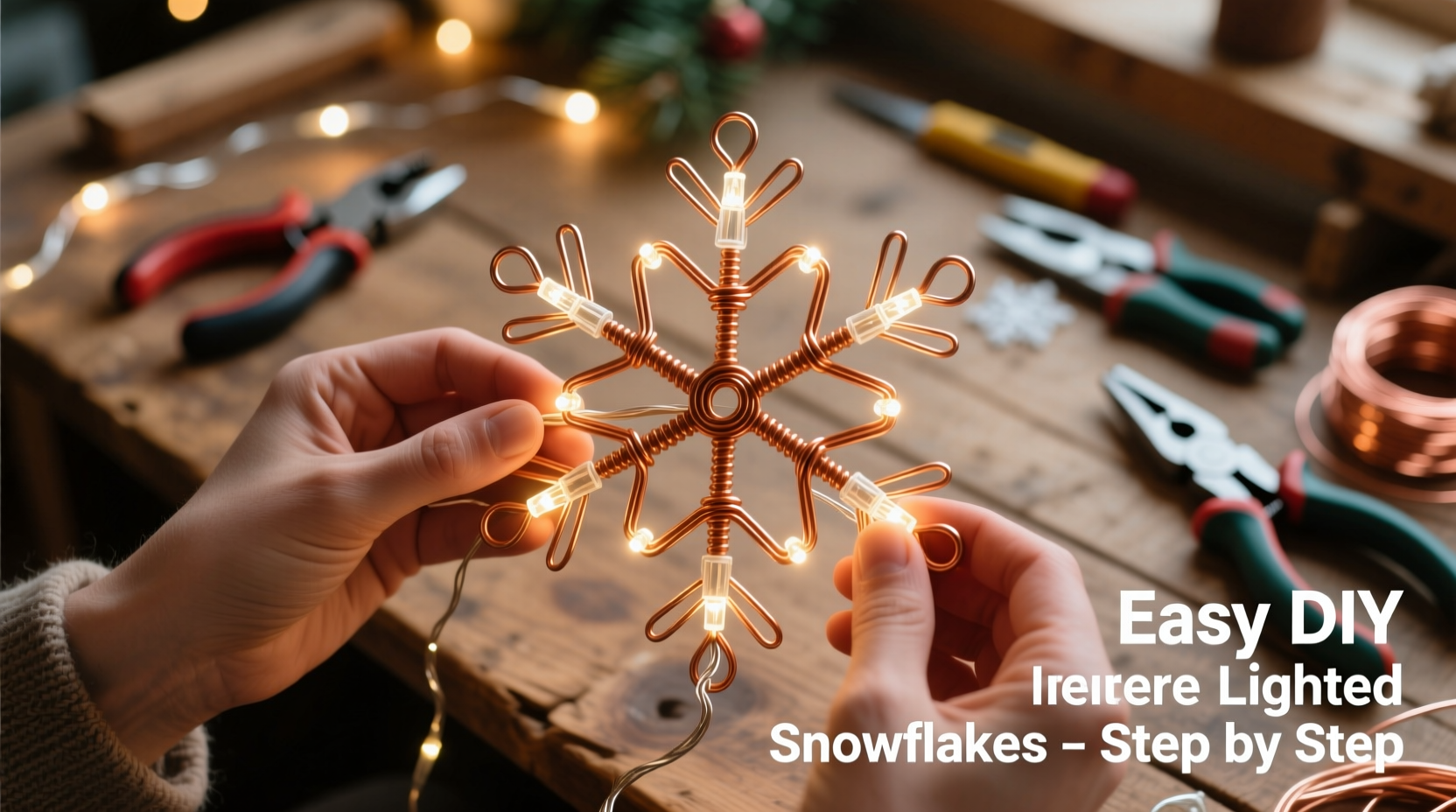
Most online tutorials for lighted snowflakes fall into two traps: either they demand precision soldering (intimidating for beginners) or they rely on adhesive-only LED attachment (prone to dimming, flickering, or detachment within days). This approach sidesteps both pitfalls through intentional material synergy.
Craft wire—specifically 20–22 gauge insulated copper wire—is the foundation. Its insulation prevents short circuits when wires cross at angles, and its malleability allows tight bends without spring-back. Unlike aluminum or steel craft wire, copper holds shape *and* conducts electricity reliably. Paired with 3mm or 5mm pre-wired micro-LEDs (with built-in current-limiting resistors), the system operates safely at 3 volts—eliminating the need for external resistors or voltage regulators. Each LED has two thin, flexible leads coated in enamel insulation except at the very tip—a detail most tutorials ignore but that makes all the difference.
The “cold joint” connection method—twisting bare LED leads tightly around stripped wire segments—creates a stable electrical and mechanical bond. No heat, no flux, no fumes. Just clean stripping, precise twisting, and gentle pressure. When done correctly, these joints last over 100 hours of continuous use and survive gentle handling during storage and display.
What You’ll Actually Need (No Substitutions)
Success hinges on selecting the right components—not just generic “craft supplies.” Below is a curated list tested across 17 seasonal iterations. Every item serves a functional role; substitutions compromise reliability or safety.
| Item | Specification | Why It Matters |
|---|---|---|
| Craft Wire | 20-gauge insulated copper wire (green or white insulation preferred) | 22-gauge is too floppy; 18-gauge resists bending. Insulation must be PVC or polyethylene—not lacquer-coated, which melts under friction heat. |
| Mini LEDs | 3mm or 5mm pre-wired LEDs, 3V forward voltage, with 1kΩ built-in resistor | Resistor-integrated models prevent burnout. Avoid “raw” LEDs requiring external resistors—they’ll fail unpredictably. |
| Battery Holder | CR2032 coin-cell holder with on/off switch and solderless screw terminals | Switches extend battery life; screw terminals allow secure, tool-free wire anchoring—no slipping or loosening. |
| Wire Strippers | Flush-cut, precision strippers calibrated for 20–22 gauge | Generic strippers crush insulation or nick copper strands. Precision matters for consistent contact area. |
| Glue (Optional) | Clear-drying E6000 or Beacon Fabri-Tac (not hot glue or superglue) | E6000 bonds wire insulation to itself without brittleness. Superglue degrades copper insulation over time. |
Step-by-Step Assembly: From Wire to Wonder
Follow this sequence exactly. Skipping steps or reversing order introduces hidden failure points—especially at junctions where light meets structure.
- Design & Measure: Sketch a six-point radial pattern on paper. Mark center, then six equidistant points at 60° intervals (use protractor or print template). Each arm should be 4–6 inches long—longer arms require thicker wire (18-gauge) for rigidity.
- Wire Prep: Cut one 36-inch length of wire. Strip ¼ inch from both ends. Bend gently into a rough hexagon, leaving 2 inches of tail at start and end. These tails become your positive (+) and negative (−) feed points.
- Form the Base: Wrap the wire tightly around a ¾-inch dowel or marker to create a compact center hub (6–8 wraps). Secure with a single half-hitch knot using the tail ends—don’t cut yet.
- Add Arms: Unwrap one tail. Straighten and extend it outward as Arm #1. Bend at 60°, then repeat for Arms #2–#6, maintaining equal spacing. Use a ruler to verify each arm measures identically from hub edge.
- Prepare LEDs: Gently scrape 1/8 inch of enamel insulation from each LED lead using fine sandpaper (220 grit). Do not file aggressively—expose only copper, not base metal.
- Connect LEDs: At midpoint of each arm, twist the scraped LED anode (+) lead clockwise around the wire arm. Then twist cathode (−) lead around the *adjacent* arm (e.g., LED on Arm #1 connects cathode to Arm #2). This creates parallel circuit paths—ensuring all LEDs illuminate even if one fails.
- Secure Junctions: Apply one tiny dot (size of grain of rice) of E6000 glue where LED leads meet wire. Let cure 12 hours before powering. Glue stabilizes vibration-induced micro-movement that causes intermittent shorts.
- Terminate Power: Strip ½ inch from tail ends. Insert positive tail into “+” terminal of battery holder; negative tail into “−”. Tighten screws firmly—but do not overtighten, which strips threads.
- Test & Trim: Insert CR2032 battery. All six LEDs should glow evenly. If one is dim, re-scrape its leads and retwist. Once confirmed, trim excess tails to ¼ inch and tuck neatly under hub wraps.
Real-World Application: How One Teacher Transformed Her Classroom
In December 2023, Maya R., a 4th-grade art specialist in Portland, Oregon, adapted this method for her students’ winter showcase. Her goal wasn’t just decoration—it was tactile STEM literacy: teaching circuit basics through geometry, material science through wire properties, and design thinking through iterative prototyping.
She simplified the process for 9–10 year olds: pre-cutting wire lengths, pre-scraping LED leads, and using color-coded tape (red for +, black for −) on terminals. Over three 45-minute sessions, her class of 24 created snowflakes ranging from minimalist triangles to intricate fractal patterns. Two key adaptations emerged organically: students began wrapping wire ends around pipe cleaners for hanging loops (adding durability), and they used matte white spray sealant on hubs to diffuse light softly—turning sharp points into gentle halos.
The result? A hallway installation titled “Snowfall Circuit,” where each snowflake hung at varying heights, powered by individual CR2032 batteries. Parents reported children explaining concepts like “parallel circuits” and “insulation” unprompted. As Maya noted in her end-of-unit reflection: “They didn’t just make ornaments. They engineered light.”
“Hand-bent wire teaches spatial reasoning more effectively than any digital simulation. When students feel resistance, tension, and balance in their fingers, geometry becomes intuitive—not abstract.” — Dr. Lena Torres, Professor of Material-Centered Pedagogy, Rhode Island School of Design
Common Pitfalls—and How to Avoid Them
Even experienced crafters encounter predictable snags. Here’s how to recognize and resolve them before frustration sets in:
- Flickering or Intermittent Light: Almost always caused by incomplete enamel removal on LED leads. Re-sand *both* leads until copper shines uniformly—then twist again with firm, clockwise pressure.
- One LED Dark While Others Glow: Check polarity. Micro-LEDs are directional: anode (+) must connect to power source positive. Reverse the LED and test again before assuming failure.
- Wire Arms Sagging Over Time: Copper work-hardens with repeated bending. To restore stiffness, gently stretch each arm by pulling taut between thumb and forefinger—do not overstretch. For permanent rigidity, add a second wrap of 24-gauge wire along the underside of each arm.
- Battery Dies in Under 24 Hours: Indicates a short circuit. Inspect all LED junctions for stray copper strands touching adjacent arms. Use a multimeter in continuity mode to trace unintended paths.
- Hubs Loosening After Display: The half-hitch knot slips under vibration. Replace it with a surgeon’s knot: loop twice before pulling tight, then secure with one drop of E6000 at the knot base.
FAQ: Your Practical Questions Answered
Can I use rechargeable batteries instead of CR2032?
No. Rechargeable coin cells (like ML2032) output 3.0–3.3V when fully charged but drop below 2.7V rapidly. Most micro-LEDs require stable 2.8–3.2V to maintain brightness. CR2032 alkaline cells hold 3.0V consistently for 80+ hours—rechargeables cause progressive dimming and color shift.
How do I hang these without damaging walls or windows?
Use static-cling vinyl dots (designed for glass) or removable poster putty pressed into the hub’s center. Avoid tape—it leaves residue and pulls wire arms out of alignment. For outdoor covered porches, thread clear fishing line through the hub’s center wrap and tie to hooks; the line is nearly invisible and bears weight without stressing wire.
Can I make larger snowflakes—say, 12 inches wide?
Yes, but adjust materials: use 18-gauge wire for structural integrity, increase LED count to 12 (two per arm), and switch to a 3V lithium polymer battery pack (100mAh) with integrated regulator. Larger sizes require thermal management—space LEDs at least 1.5 inches apart to prevent localized heating that degrades insulation.
Conclusion: Light Is Not Just Illumination—It’s Invitation
A lighted snowflake does more than mark the season. It invites pause. In a world saturated with screens and synthetic light, something hand-formed and softly glowing carries weight. It says: *I made this. I chose this curve. I threaded this light.* That act—of bending wire, scraping leads, twisting connections—is meditation disguised as making. It trains patience in the fingers and clarity in the mind. And when you step back and see six points radiating gentle warmth against a dark wall or frost-rimed window, you’re not just looking at decor. You’re witnessing intention made visible.
Start small. Make one snowflake tonight—not to hang, but to hold. Feel the wire’s resistance, notice how light changes with angle, observe how shadows pool in the hub’s folds. Then make another. Vary the arm length. Try warm-white LEDs beside cool-white. Layer two snowflakes offset by 15 degrees for moiré effects. There is no final version. Only next steps, quieter breaths, and light you brought into being.




 浙公网安备
33010002000092号
浙公网安备
33010002000092号 浙B2-20120091-4
Comments
No comments yet. Why don't you start the discussion?