
For beginner drone pilots, choosing between the DJI Mini 3 and the DJI Mini 4 Pro isn’t just about price—it’s about safety, confidence, and long-term usability. The Mini 4 Pro introduces advanced obstacle avoidance, improved flight intelligence, and enhanced camera capabilities, but at a higher cost. For someone just starting out, the question becomes: does this technological leap justify the extra investment?
The answer depends on your flying environment, learning curve, and how much risk you're willing to accept during early flights. New pilots are more prone to errors—misjudging distances, reacting slowly to obstacles, or losing orientation. In these moments, automated safety systems can mean the difference between a smooth landing and a shattered drone.
Key Differences That Matter for Beginners
At first glance, both drones share similarities: sub-250g weight (avoiding stricter registration in many countries), excellent battery life, and strong 4K cameras. But beneath the surface, their operational philosophies diverge significantly.
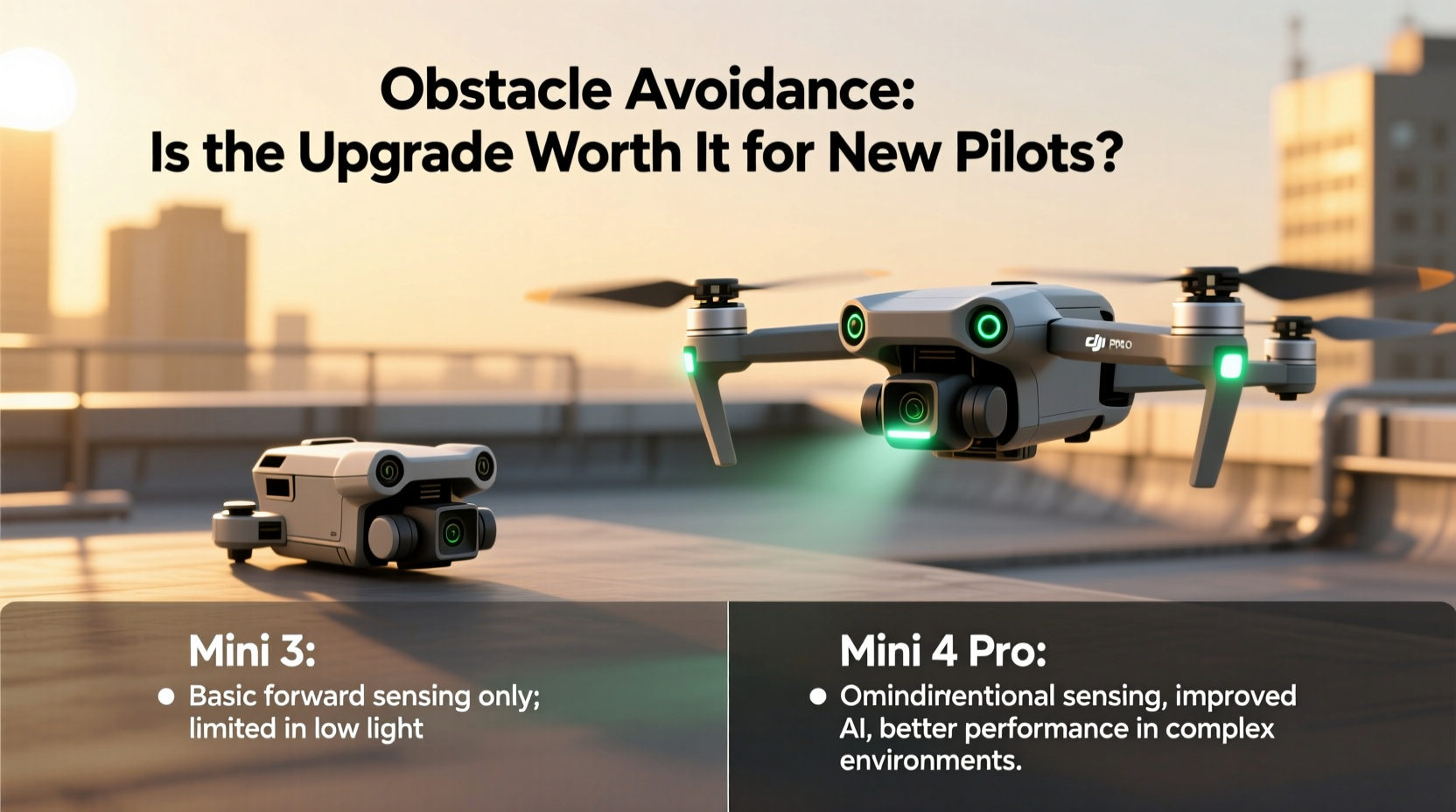
The Mini 3 relies on basic downward and upward vision sensors. It can hover steadily and land safely under ideal conditions, but it lacks side and front-facing obstacle detection. This means if you fly toward a tree, building, or fence, the drone won’t stop itself. You’re entirely responsible for spatial awareness.
In contrast, the Mini 4 Pro features omnidirectional obstacle sensing—front, back, sides, up, and down—powered by eight-way radar-like vision systems and APAS 5.0 (Advanced Pilot Assistance System). It actively detects and avoids obstacles in complex environments, even when flying forward in GPS-denied areas using its auxiliary visual sensors.
“New pilots often overestimate their depth perception from a screen. Obstacle avoidance isn’t a crutch—it’s a critical learning aid that prevents costly mistakes.” — Mark Tran, UAV Flight Instructor and Drone Safety Advocate
Obstacle Avoidance: How It Works and Why It Matters
Obstacle avoidance isn't just about preventing crashes. It changes how you learn to fly. With the Mini 4 Pro, you can focus more on composition, framing, and flight path planning, rather than constantly scanning for hazards. The system gives you breathing room to make small errors without immediate consequences.
The Mini 4 Pro uses a combination of stereo vision cameras on all sides, infrared sensors, and intelligent algorithms to build a real-time 3D map of its surroundings. When an object is detected within approximately 25 meters, the drone can either:
- Alert the pilot with on-screen warnings
- Automatically brake to prevent impact
- Re-route around obstacles while maintaining flight path (in Smart RTH and ActiveTrack modes)
This level of automation is absent in the Mini 3. While it has basic hover stability and downward terrain tracking, it offers no proactive collision prevention. If you accidentally command a forward movement into a wall, the Mini 3 will comply—no hesitation, no warning.
Real-World Scenarios: Where the Upgrade Pays Off
To understand the practical benefits, consider a typical beginner experience.
Mini Case Study: Flying Near Trees in a Park
Alex, a new drone owner, takes his DJI Mini 3 to a local park known for tall pines and narrow clearings. Excited to capture sweeping shots, he launches near a tree line. As he flies forward, the sun glare makes depth perception difficult. He misjudges the distance to a thick branch and collides—damaging a propeller and motor housing. Repair costs exceed $120.
Had Alex used a Mini 4 Pro, the forward-facing sensors would likely have detected the obstruction. Depending on settings, the drone might have braked automatically or rerouted slightly upward. Even if he ignored the warning, the system could have minimized impact severity.
This scenario isn’t rare. According to a 2023 survey by Drone U, nearly 43% of beginner drone incidents involved collisions with stationary objects—trees, walls, or poles—most occurring within the first five flights.
Feature Comparison: Mini 3 vs Mini 4 Pro
| Feature | DJI Mini 3 | DJI Mini 4 Pro |
|---|---|---|
| Weight | 249g | 249g |
| Obstacle Sensing | Down & Up only | Omnidirectional (8-way) |
| APAS Version | None | APAS 5.0 |
| Max Video Resolution | 4K/30fps | 4K/60fps HDR |
| Smart Return to Home | Basic return path | Obstacle-aware rerouting |
| ActiveTrack Mode | Track subjects with manual clearance | Auto-avoidance during subject tracking |
| Price (Base Model) | $659 | $899 |
The table highlights that while both drones are lightweight and portable, the Mini 4 Pro adds significant layers of protection and intelligence—especially valuable when operating in dynamic or cluttered spaces.
Is the Upgrade Worth It for New Pilots?
For beginners, the answer leans strongly toward yes—if budget allows. Here’s why:
- Reduced crash risk: First flights are unpredictable. Wind gusts, disorientation, and joystick mistakes happen. Obstacle avoidance acts as a safety net.
- Faster learning curve: You can experiment with complex maneuvers like orbiting or terrain-following without constant fear of collision.
- Better smart features: The Mini 4 Pro supports advanced functions like Waypoints, Cruise Control, and Dynamic Home Lock—all enhanced by obstacle detection.
- Higher resale value: Drones with modern safety systems retain value longer, especially as regulations evolve.
- Future-proofing: As DJI phases out older models, software updates and support favor newer hardware like the Mini 4 Pro.
That said, if you plan to fly exclusively in wide-open fields with unobstructed views, the Mini 3 remains a capable and cost-effective option. But most beginners don’t have consistent access to such ideal conditions. Parks, neighborhoods, and scenic overlooks often come with hidden risks: power lines, signage, or sudden elevation changes.
Step-by-Step: How to Decide Which Drone Fits Your Needs
Follow this decision framework to determine whether the Mini 4 Pro’s obstacle avoidance justifies the upgrade:
- Assess your typical flying environment: Do you frequently encounter trees, buildings, or uneven terrain? If yes, prioritize obstacle sensing.
- Evaluate your comfort with manual control: Are you confident in judging distances from a screen? If not, automation helps bridge the gap.
- Check your budget flexibility: Can you absorb the $240+ price difference? Consider it insurance against early damage.
- Plan for long-term use: Will you want advanced features like automated missions or cinematic tracking later? The Mini 4 Pro supports them natively.
- Review local regulations: Some regions may soon require obstacle detection for certain flight categories. Being ahead of the curve avoids future obsolescence.
Checklist: What to Test Before Choosing
- ✅ Fly a simulator or borrow a friend’s drone to gauge your spatial awareness
- ✅ Visit your intended launch sites and note potential hazards
- ✅ Compare video samples from both models in similar lighting
- ✅ Check availability of spare parts and repair costs
- ✅ Read user reviews focusing on real-world crash rates for each model
Frequently Asked Questions
Does obstacle avoidance work in all conditions?
No system is perfect. Obstacle detection can struggle in low light, fog, or against transparent surfaces (like glass) and thin wires. It also requires sufficient texture or contrast to detect objects. Always remain vigilant.
Can I disable obstacle avoidance on the Mini 4 Pro?
Yes. You can turn off avoidance in specific modes (e.g., Sport Mode) for unimpeded speed. However, this removes automatic braking and rerouting—use only in wide-open areas.
Is the Mini 3 obsolete now that the Mini 4 Pro exists?
Not entirely. The Mini 3 still delivers excellent image quality and flight time. It’s suitable for experienced flyers or those on a tight budget. But for new users, it lacks the safety margins that modern entry-level drones increasingly offer.
Final Verdict: Safety Over Savings
For new pilots, the DJI Mini 4 Pro’s obstacle avoidance isn’t just a convenience—it’s a foundational tool for safe, confident flying. The $240 premium over the Mini 3 represents less than three moderate repairs. One avoided crash pays for the upgrade.
More importantly, it reduces stress. When you’re not constantly bracing for impact, you can focus on what matters: capturing beautiful footage, mastering controls, and enjoying the experience. Learning should be about growth, not anxiety over every maneuver.
Drones are investments in perspective—both literally and figuratively. Choosing the Mini 4 Pro means investing in your own development as a pilot, with technology that supports rather than replaces skill-building.




 浙公网安备
33010002000092号
浙公网安备
33010002000092号 浙B2-20120091-4
Comments
No comments yet. Why don't you start the discussion?