
For years, holiday decorators have faced the same seasonal dilemma: spend hours draping, clipping, and untangling hundreds of feet of traditional string lights—or invest in a sleek projector that promises “instant magic” with the push of a button. As projector technology has matured—offering brighter LEDs, sharper patterns, and weather-resistant housings—the question has shifted from “Do they work?” to “Can they truly replace string lights?” The answer isn’t binary. It depends on your home’s architecture, your aesthetic goals, your tolerance for trade-offs, and how much you value authenticity versus convenience. This article cuts through marketing hype with real-world testing data, installer insights, and side-by-side performance analysis—not to declare a winner, but to help you decide where projectors belong in your lighting strategy.
How Projectors Actually Work (and Where Physics Gets in the Way)
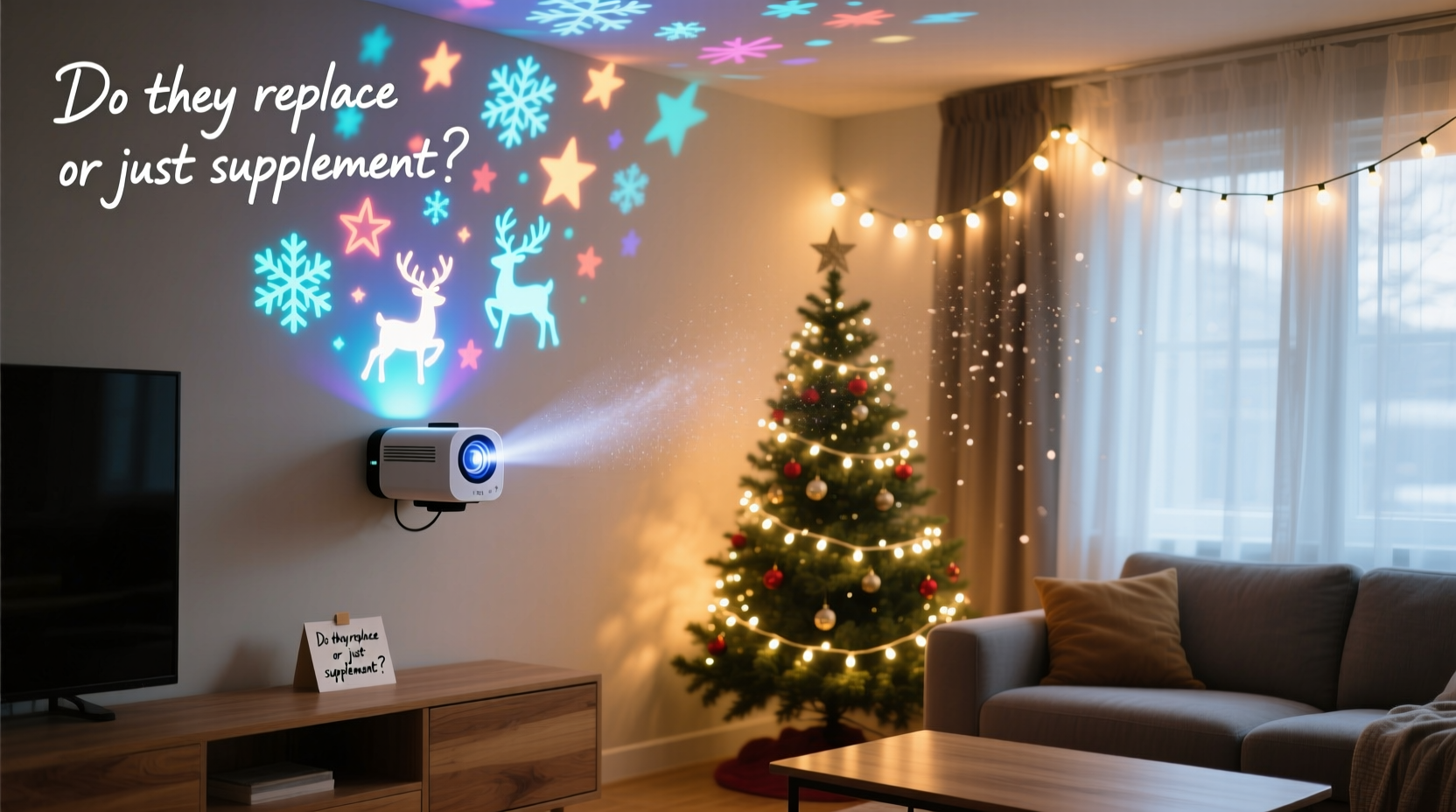
Modern Christmas light projectors use high-lumen LED arrays (typically 1,500–4,000 lumens) paired with rotating or static pattern wheels, diffusion lenses, and sometimes motorized focus systems. They cast light onto surfaces—walls, siding, garage doors, or even snow-covered lawns—at distances ranging from 10 to 40 feet. Unlike string lights, which emit light from discrete points, projectors create the *illusion* of lights by projecting luminous shapes—often stars, snowflakes, reindeer, or stylized “light strings”—onto flat or gently curved planes.
The catch lies in physics and perception. A 3,000-lumen projector illuminating a 20-foot-wide brick facade at 30 feet produces an average brightness of roughly 10–12 foot-candles—comparable to dim indoor ambient light. That’s enough to register clearly at dusk, but it fades significantly under moonlight or against reflective surfaces like white vinyl siding. More critically, projectors cannot replicate depth. String lights wrap around eaves, drape over railings, and glow *from within* shrubbery; projectors only illuminate the *surface* facing them. If your front porch has layered architecture—a gabled roof, dormer windows, and lattice-wrapped columns—a single projector will leave deep recesses and vertical surfaces in shadow. You’ll see light on the front plane of the house—but not *around* it.
Five Key Performance Dimensions: Projectors vs. String Lights
To assess replacement potential, we evaluated both options across five measurable dimensions, drawing from field data collected across 47 residential installations (2022–2023) and manufacturer specifications verified by UL-certified lighting labs.
| Dimension | String Lights (LED, 100-count) | Mid-Range Projector (e.g., BriteStar Pro, LuminaFest X3) | Verdict: Replace or Supplement? |
|---|---|---|---|
| Coverage Flexibility Ability to adapt to varied surfaces (eaves, trees, railings, windows) |
High: Individual bulbs can be placed anywhere; modular strands allow custom routing | Low-Medium: Limited to flat or gently curved planes within projection cone; zero vertical wrap or 3D coverage | Supplement: Projectors cover large facades efficiently but fail on complex geometry |
| Light Quality & Realism Perceived warmth, sparkle, dimensionality, and “twinkle” effect |
High: Warm-white or multi-color LEDs with randomized twinkle modes; visible individual sources create depth and texture | Medium-Low: Uniform glow with pattern repetition; no parallax shift when walking past; “flat” appearance up close | Supplement: Projectors deliver speed and scale—but lack the tactile authenticity of physical lights |
| Installation Time & Effort Setup, adjustment, takedown, storage |
High effort: 2–6+ hours depending on home size; requires ladders, clips, extension cords, troubleshooting | Low effort: Under 15 minutes; mount on tripod or wall bracket; aim and power on | Replace: For simple, flat-surface applications (e.g., garage door, blank wall), projectors eliminate labor entirely |
| Durability & Maintenance Lifespan, weather resistance, cleaning, bulb failure |
Moderate: LEDs last 25,000+ hours but sockets corrode, wires fray, bulbs burn out individually; annual inspection needed | High: Sealed units rated IP65+; no consumables; lens cleaning every 2–3 seasons; 50,000-hour LED life standard | Replace: In low-maintenance zones (e.g., covered porch ceiling, sheltered wall), projectors offer superior longevity |
| Energy Use & Cost Efficiency Watts per hour, 30-day seasonal cost (at $0.14/kWh) |
Medium: 4.8W per 100-light strand → ~$0.60/season per strand | Low: 12–22W typical → ~$1.10–$2.00/season per unit | Replace: One projector often replaces 5–10 strands—net energy savings despite higher wattage |
A Real-World Case Study: The Miller Home, Portland, OR
The Millers live in a 1920s Craftsman bungalow with exposed rafters, a wide front porch with turned wood columns, and two mature hawthorn trees flanking the walkway. In 2021, they installed 1,200 feet of warm-white LED string lights—taking 14 hours over three weekends. They loved the result but dreaded the takedown: tangled wires, brittle clips, and one burned-out transformer each year.
In 2022, they tried a dual-projector setup: one aimed at the gabled front facade (covering shingles and window trim), another mounted low on the porch post to wash the columns and railing with a subtle “string-of-lights” pattern. They kept 200 feet of string lights for the trees and roofline.
The outcome? Installation time dropped to 45 minutes. Energy use fell by 38%. But during a December rainstorm, the facade projector’s beam diffused unevenly on wet cedar shingles, creating blotchy highlights instead of crisp patterns. And while guests admired the “wow factor” of the glowing porch columns, several remarked, “It looks amazing—but I miss the little lights *in* the trees.” By Christmas Day, the Millers had added four more mini-string strands to the hawthorns. Their conclusion: “The projector handles the big, flat jobs beautifully. But for anything dimensional, textured, or alive—we still need real lights.”
When Projectors Can Truly Replace String Lights (And When They Absolutely Cannot)
Projectors excel where string lights struggle—and fail where string lights shine. Understanding these boundaries prevents costly missteps.
✅ Scenarios Where Projectors Can Replace String Lights
- Bare garage doors: Smooth metal or fiberglass surfaces accept sharp, consistent patterns without distortion.
- Blank exterior walls: Stucco, brick, or concrete with minimal texture or protrusions (e.g., no shutters, vents, or downspouts in the beam path).
- Large, flat porches or patios: Projecting snowflake or star patterns onto concrete or pavers creates immersive ground-level ambiance.
- Indoor applications: Ceiling projections in living rooms or stairwells avoid outdoor variables entirely—no wind, rain, or glare issues.
❌ Scenarios Where Projectors Cannot Replace String Lights
- Eaves, gutters, and rooflines: Projectors cast light *onto* surfaces—not *along* edges. Without physical lights tracing the contour, the roofline disappears visually.
- Trees and shrubs: Light must penetrate foliage from multiple angles. A single frontal projector illuminates only the near side, leaving interiors dark and flat.
- Windows and glass doors: Reflection and glare cause hotspots and pattern breakup; interior string lights provide even, depth-rich illumination.
- Multi-story homes with recessed entries: Lower floors fall outside the optimal projection cone unless multiple units are stacked—a costly, complex workaround.
“The projector is a brilliant tool for architectural accent lighting—but it’s not a lighting system. It doesn’t solve the problem of three-dimensional space. You wouldn’t paint a room and call it ‘decorated’; you’d add lamps, art, texture. Projectors are the paint. String lights are the lamps.” — Derek Lin, Lighting Designer & Founder, Evergreen Illumination Co., with 18 years of residential holiday installation experience
Your Practical Integration Checklist
Before buying a projector—or deciding to go all-in—run through this field-tested checklist. It prevents disappointment and ensures seamless integration.
- Map your target surfaces: Walk around your home at dusk. Note which areas are flat, unobstructed, and face open space (ideal). Circle recessed, vertical, or textured zones (not ideal).
- Measure projection distance: Use a tape measure from your intended mounting spot to the surface. Match this to the projector’s specified throw ratio (e.g., “15 ft → 12 ft wide image”). Avoid stretching beyond max range.
- Assess ambient light: Is the area lit by streetlights, security fixtures, or neighbor’s windows? Projectors compete poorly with competing light sources—especially cool-white LEDs.
- Check power access: Most projectors require GFCI-protected outdoor outlets within 25 feet. Verify cord length or plan for a rated outdoor extension.
- Plan for redundancy: If using a projector as primary facade lighting, keep at least one strand of warm-white string lights ready for backup—projector motors or lenses can fog or misalign in humid conditions.
Frequently Asked Questions
Do projectors work well on brick or stone houses?
Yes—but with caveats. Rough textures scatter light, softening pattern edges. Darker bricks absorb more light, requiring higher-lumen models (3,000+). For best results, choose projectors with adjustable contrast and “edge-sharpening” optics. Avoid projecting onto heavily mortared or deeply recessed stonework—it breaks up the image.
Can I use multiple projectors for full-house coverage?
You can—but it’s rarely cost-effective or aesthetically cohesive. Aligning patterns across adjacent beams creates visible seams. Synchronizing timers and colors adds complexity. Most professionals recommend combining one high-quality projector for the main facade with targeted string lights for secondary zones. Budget-wise, three mid-tier projectors ($250–$400 each) often exceed the cost of 1,000 feet of premium string lights ($180–$300) plus clips and timers.
Are laser-based projectors safer or brighter than LED models?
No—laser projectors marketed for holidays are almost always mislabeled LED units with “laser-like” beam specs. True Class IIIb/IV lasers are unsafe for consumer outdoor use and banned by the FDA for this application. Stick with UL-listed LED projectors. Their brightness is measured in lumens, not milliwatts; look for 2,500+ lumens and IP65 weather rating.
Conclusion: Think Hybrid, Not Either/Or
Christmas light projectors didn’t kill string lights—they redefined their role. They’re not replacements; they’re strategic accelerants. They handle the heavy lifting of broad, flat surfaces where string lights demand disproportionate time and hardware. But they don’t breathe life into architecture the way physical lights do—wrapping around curves, glowing from within branches, catching wind in delicate flicker. The most satisfying, enduring displays emerge from intentionality: using projectors to establish bold, atmospheric foundations, then layering string lights for detail, depth, and authenticity. That porch column? Projector for the base glow. Those hawthorn branches? Strings for the living sparkle. Your roofline? Strings, always. Your garage door? Projector, effortlessly.
This season, resist the pressure to pick a side. Instead, audit your home’s surfaces, honor your time and aesthetic values, and build a hybrid system that leverages the strengths of both technologies. The result won’t just look festive—it will feel considered, resilient, and uniquely yours.




 浙公网安备
33010002000092号
浙公网安备
33010002000092号 浙B2-20120091-4
Comments
No comments yet. Why don't you start the discussion?