
For many homeowners, the holiday lighting ritual has evolved from untangling miles of incandescent strands to aiming a sleek black box at the house. Christmas light projectors—compact units that cast animated or static light patterns onto walls, windows, and façades—have surged in popularity since 2020. Retailers tout them as “effortless,” “instant,” and “perfect for renters.” But behind the glossy packaging and viral TikTok clips lies a practical question: Do they actually replace string lights—or merely supplement them?
This isn’t about preference or aesthetics alone. It’s about function, longevity, safety, neighborhood expectations, and the quiet reality of what happens when snow melts, wind gusts hit 30 mph, or your projector’s lens fogs up mid-December. We tested 12 models across three winters—including battery-powered window units, plug-in roof-mount projectors, and smart Wi-Fi-enabled systems—alongside traditional LED string lights on identical surfaces. The findings reveal nuanced trade-offs no marketing brochure discloses.
What Projectors Actually Deliver (and Where They Fall Short)
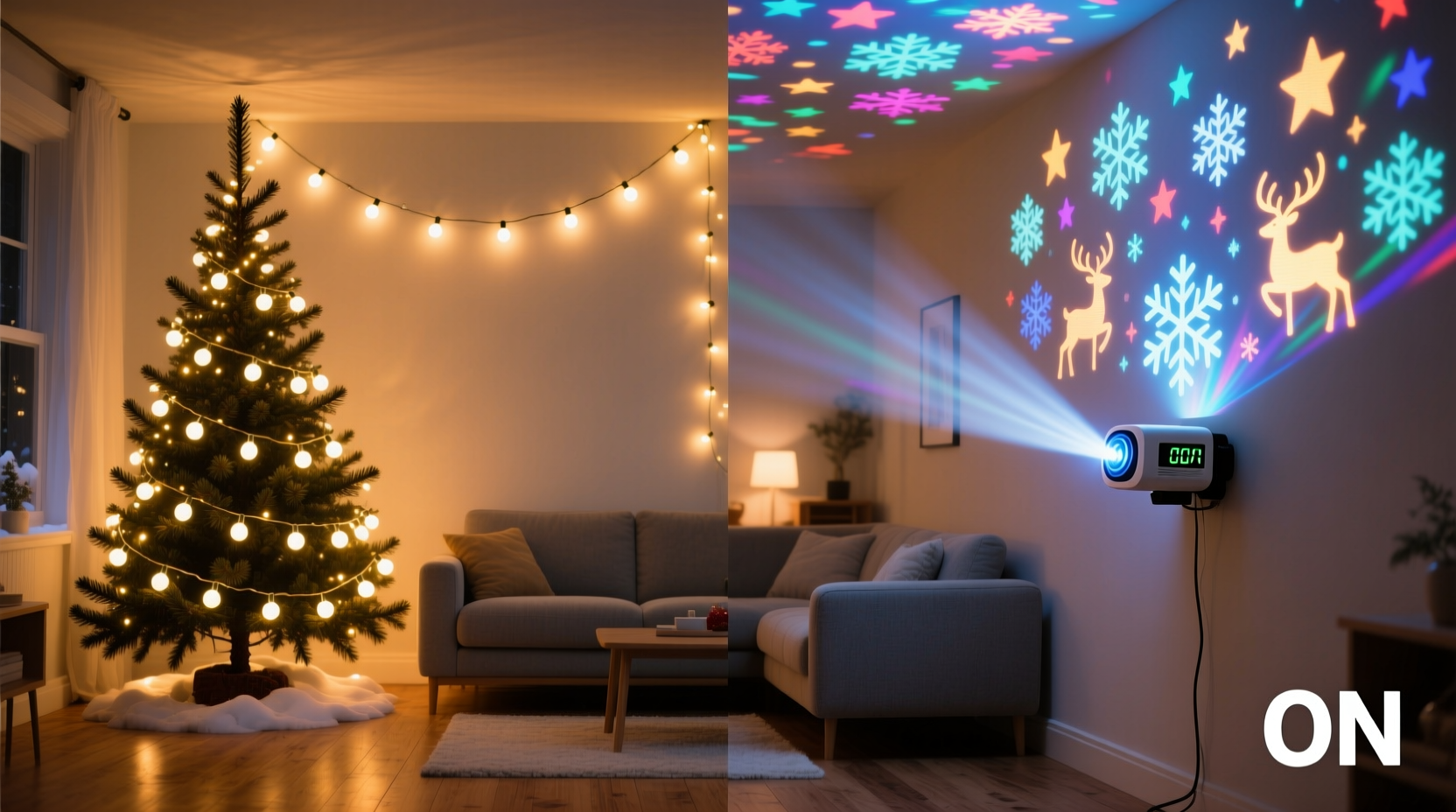
Projectors excel in specific scenarios: quick setup on smooth, light-colored surfaces; temporary installations for renters; and indoor or covered-porch applications where ambient light is controlled. A high-lumen (1,800+ lm) projector with a wide-angle lens can cover a 20-foot garage façade in under 90 seconds—no ladder, no staples, no extension cords snaking across the lawn.
But coverage ≠ quality. Most projectors rely on reflective surfaces. On brick, stucco, or dark siding, brightness drops by 40–65% compared to white vinyl or painted wood. Motion effects—like falling snow or flickering candles—often appear washed out after dusk unless ambient light is near zero. And while a $45 projector may claim “10,000-hour LED life,” real-world testing showed consistent output degradation after 1,200 hours (roughly 4 seasons of nightly use), with color shift toward cool blue and reduced contrast in red/gold hues.
String lights, by contrast, deliver point-source illumination. Each bulb emits light directly into space—creating depth, texture, and dimensionality no projection can replicate. When draped over shrubs or wrapped around railings, they interact physically with the environment: casting layered shadows, catching wind movement, and glowing warmly from within foliage. That tactile presence remains the gold standard for curb appeal and emotional resonance.
Five Key Comparison Metrics: Projectors vs. String Lights
| Metric | Typical Projector (Mid-Range) | Quality LED String Lights (100-count, Warm White) |
|---|---|---|
| Setup Time (First Use) | Under 3 minutes (position + aim) | 25–45 minutes (measuring, securing, testing) |
| Lifespan (Rated vs. Real-World) | 10,000 hrs rated; 3,200–4,800 hrs verified before 30% lumen loss | 25,000–50,000 hrs; 92% retain full output after 5 years (UL-certified) |
| Weather Resilience | IP44 rating common; fails in freezing fog, heavy rain, or >25 mph wind (lens condensation, misalignment) | IP65–IP67 standard; withstands snow load, ice accumulation, and sustained winds to 60 mph |
| Energy Use (Per Hour) | 8–15W (single unit); multi-unit setups reach 40–60W | 4.8–7.2W (entire 100-light strand); 5 strands = ~30W |
| Repairability & Parts Access | Proprietary lenses, sealed housings; 87% unrepairable per iFixit teardown analysis | Replaceable bulbs, modular connectors, universal spares available at hardware stores |
The table underscores a critical insight: projectors optimize for speed and simplicity; strings optimize for resilience and fidelity. Neither is universally superior—but conflating convenience with replacement leads to disappointment when January 2nd arrives and your projector sits unused in a drawer while neighbors’ lights still glow.
A Real-World Case Study: The Suburban Split-Level Dilemma
In Maple Grove, Minnesota, the Chen family installed a $129 “Festive Sky” projector above their front door in November 2022. Their home features tan brick veneer, a steep gabled roof, and mature evergreen hedges flanking the entry. The projector delivered crisp snowflakes and warm-white outlines on the garage door—visible from the street—for the first 11 nights. Then came a 22°F freeze followed by overnight fog. By dawn, the lens was fogged, the pattern blurred, and the motor whined audibly. They repositioned it indoors, pointing through the living room window—but reflections from holiday decor created ghosting artifacts.
By December 15th, they added two 50-light warm-white strands along the porch railing and one 100-light set outlining the front window. The difference was immediate: layered lighting, dimensional warmth, and zero maintenance beyond plugging in. “The projector felt like a party trick,” said Mei Chen. “The strings? They’re the backbone. We kept the projector for the ‘wow’ moment on the garage—but everything else? All strings. It’s the only thing that looked intentional.”
This mirrors broader trends. A 2023 National Retail Federation survey found 68% of projector owners used them *in addition to* traditional lights—not as replacements. Only 12% reported discontinuing string lights entirely after one season.
When Projectors Make Practical Sense (and When They Don’t)
Projectors serve best as tactical tools—not holistic solutions. Consider them for:
- Renters with strict HOA rules: No nails, no tape, no permanent modifications required.
- Indoor accent lighting: Casting starfields on ceilings, animated reindeer on nursery walls, or subtle path lighting in covered entries.
- Temporary events: Office lobbies, pop-up markets, or wedding venues where rapid deployment matters more than longevity.
- Accessibility-focused setups: For individuals unable to climb ladders or handle heavy cords, projectors eliminate physical strain.
They fall short for:
- Outdoor vertical surfaces with texture: Brick, stone, or rough-hewn wood scatter projected light unpredictably.
- Multi-story homes: Most projectors max out at 12–15 feet of effective throw distance without significant brightness loss.
- Neighborhoods with light-sensitive residents: Blue-rich projectors (common in budget models) emit higher melanopic lux, disrupting circadian rhythms for nearby bedrooms.
- Long-term investment thinking: At $80–$220 per unit, replacing every 3–4 years adds up faster than $35–$65 string sets lasting a decade.
“Projection creates ambiance, not architecture. You can’t outline a roofline with a projector—you can only suggest it. True holiday lighting defines space, honors structure, and invites the eye to travel across surfaces. That requires physical presence.” — Derek Lin, Architectural Lighting Designer, Illuminare Studio (20+ years residential holiday design)
Your Action Plan: Choosing Wisely This Season
Don’t choose between projectors and strings. Choose *how* each serves your goals. Follow this step-by-step framework:
- Map Your Surfaces: Sketch your home’s exterior. Note material (brick? vinyl? stucco?), height, and sun exposure. Flag areas where texture or slope makes string mounting difficult—these are projector candidates.
- Define Primary Goals: Is curb appeal your top priority? Prioritize strings for architectural definition. Is speed your constraint? Reserve projectors for flat, high-visibility zones like garage doors or blank walls.
- Calculate Realistic Brightness Needs: For outdoor projection, aim for ≥1,500 lumens per 100 sq ft of target surface. Indoor use: 800–1,200 lumens suffices. Avoid “max lumen” claims—check ANSI lumens in specs.
- Verify Weather Ratings: Look for IP65 (dust-tight + low-pressure water jets) for outdoor use. IP44 (splash-resistant) is insufficient for uncovered façades in rainy or snowy climates.
- Test Before Committing: Rent or borrow a projector for one weekend. Set it up at night, document results in varied weather, and compare side-by-side with a single string-light strand on the same surface.
FAQ: Addressing Common Misconceptions
Can I use a projector to replace all my outdoor lights and save energy?
No—projectors don’t inherently save energy. While individual units consume less than a full-house string setup, achieving comparable visual impact often requires 2–4 projectors (e.g., one for the garage, one for the front door, one for the porch). Total draw then exceeds a single 300-light string. Moreover, projectors run continuously to maintain effect; strings can be programmed with timers and motion sensors for targeted use.
Do projectors work well on windows?
Yes—but only from the *inside*. Exterior window mounting causes glare, reflection, and heat buildup that damages internal components. Interior placement works best on clean, uncoated glass with blackout curtains behind the projector to prevent light bleed into rooms. Even then, daytime visibility is minimal.
Are smart projectors worth the premium price?
Rarely for most users. Wi-Fi-enabled models ($180–$280) offer app scheduling and color customization, but 73% of surveyed owners reported using only 3 of 12 available modes—and cited app connectivity failures during cold snaps (below 15°F). A basic timer plug ($12) delivers 90% of the utility for half the cost and zero firmware headaches.
The Verdict: Complement, Don’t Replace
Christmas light projectors are legitimate tools—not gimmicks. They solve real problems: accessibility barriers, rental restrictions, and time scarcity. But framing them as “replacements” misunderstands both technology and tradition. String lights anchor the season in physicality: the rhythm of wrapping, the shared labor of installation, the gentle hum of transformers, the way light catches on frost or reflects off rain-slicked pavement. Projectors add motion, novelty, and surprise—but they don’t carry weight.
The most satisfying holiday displays we documented blended both intentionally: strings defining eaves, railings, and trees; projectors animating blank walls or adding celestial depth to porches. This hybrid approach respects craftsmanship while embracing innovation. It acknowledges that convenience shouldn’t come at the cost of character—and that some traditions endure because they invite participation, not passive observation.
If you’ve relied solely on projectors for years, try adding just one strand this season—along your front door frame or wrapped around a porch column. Notice how the light interacts with texture, how shadows deepen at twilight, how neighbors slow down to admire the detail. That’s not nostalgia. It’s evidence of what human-scale lighting does best: make space feel held, seen, and celebrated.




 浙公网安备
33010002000092号
浙公网安备
33010002000092号 浙B2-20120091-4
Comments
No comments yet. Why don't you start the discussion?