
As the holiday season approaches, homeowners across the country face the same annual ritual: untangling strands of Christmas lights, testing bulbs, climbing ladders, and securing clips to gutters. It’s time-consuming, sometimes dangerous, and often frustrating. Enter the Christmas light projector—a plug-and-play alternative promising dazzling displays with minimal effort. Marketed as an easy upgrade, these devices claim to project thousands of twinkling points of light onto your home’s exterior with the flick of a switch. But do they truly match up to traditional string lights in visual impact, ambiance, and longevity—or are they little more than a seasonal novelty?
To answer this, we’ve evaluated projectors based on brightness, coverage, color quality, durability, ease of use, and long-term value—comparing them directly with conventional LED and incandescent light strings. The verdict isn’t black and white, but understanding where each option excels can help you make an informed decision for your holiday display.
Brightness and Coverage: How Far Can a Projector Reach?
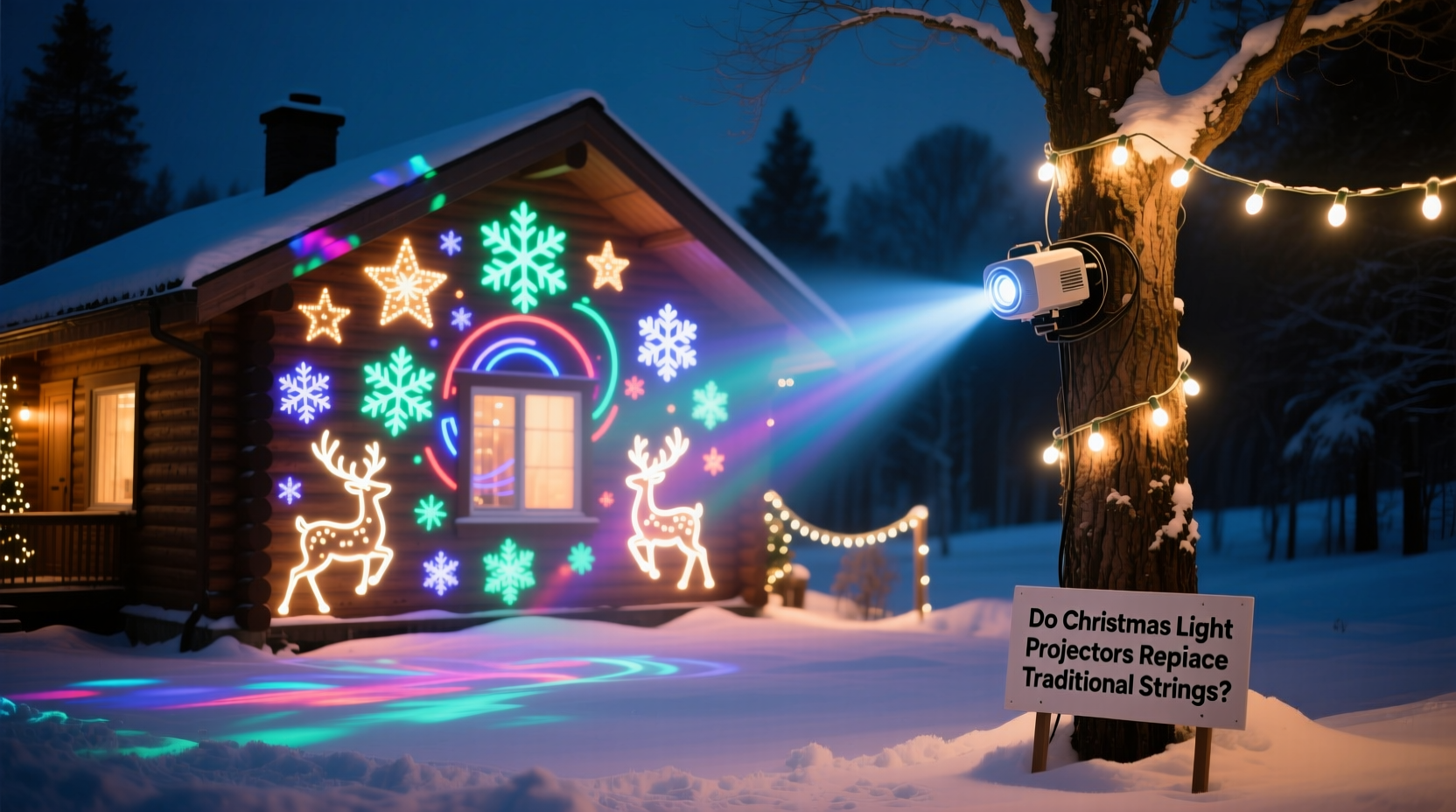
One of the first considerations when choosing holiday lighting is how much surface area you need to illuminate. Traditional string lights are linear—they cover eaves, railings, windows, and trees along defined paths. Projectors, by contrast, emit a wide beam that fans out over large wall spaces.
Most commercial Christmas light projectors offer a spread between 300 and 700 square feet, depending on distance and model. At 20 feet from a wall, a high-lumen projector (typically 5,000–7,000 lumens) can create a field of shimmering dots resembling stars or snowflakes. However, brightness diminishes significantly with distance and ambient light. In urban areas or homes near streetlights, the effect can appear washed out after dusk.
Traditional string lights, especially modern LEDs, provide consistent illumination regardless of surroundings. Because the light source is distributed along physical wires, there's no loss of intensity over space. A 100-bulb strand spaced every 4 inches delivers predictable sparkle at eye level, making it ideal for outlining architectural features.
Visual Quality and Ambiance: Sparkle vs. Projection
The core difference between projectors and string lights lies in how they generate light. Strings produce actual points of illumination; projectors cast images of light through lenses. This distinction affects realism, depth, and emotional impact.
Projectors typically use rotating discs or digital patterns to simulate falling snow, twinkling stars, or drifting reindeer. While visually interesting, these effects lack the three-dimensional presence of real bulbs. There’s no physical glow, no subtle variation in hue or intensity, and no interplay with wind or texture. On foggy nights, the projected image may blur or distort, losing definition.
String lights, particularly warm-white LEDs, create a cozy, inviting atmosphere. Their fixed positions allow for intricate designs—curtains of icicles, spirals around columns, or cascading vines. You can mix colors, dim levels, and even program sequences with smart controllers. The result feels tangible, authentic, and immersive.
“People respond emotionally to real light sources. A projector might catch attention, but it doesn’t evoke the same warmth as walking under a canopy of hand-strung lights.” — Daniel Reeves, Lighting Designer & Holiday Display Consultant
That said, projectors excel in motion-based themes. Want a sleigh ride across your roofline or animated snowfall on the garage? Projectors deliver dynamic storytelling that static strings can’t replicate without complex wiring and multiple projectors.
Installation and Maintenance Comparison
Where projectors truly shine is convenience. Most models require only three steps: place, aim, and plug in. No ladders, no extension cords snaking across lawns, no hours spent clipping and adjusting. Many include stakes for grass mounting or adjustable stands for porches. Setup takes under five minutes.
String lights demand planning, tools, and physical labor. You’ll need gutter clips, zip ties, voltage testers, and possibly a second person to hold the ladder. Even with pre-lit garlands or modular systems, installation averages 1–3 hours depending on home size. However, once installed, they’re stable and resistant to weather shifts.
Maintenance differs too. Projectors have moving parts—motors, lenses, cooling fans—that can fail over time. Moisture ingress is a common issue if left outdoors unprotected. String lights, especially commercial-grade LEDs, are built for endurance. Individual bulb failure rarely disrupts the whole strand, and replacements are inexpensive.
| Feature | Light Projectors | Traditional String Lights |
|---|---|---|
| Setup Time | Under 5 minutes | 30 minutes – 3+ hours |
| Ladder Required? | No | Yes, usually |
| Durability (avg lifespan) | 2–4 seasons | 5–10+ seasons |
| Motion Effects | Yes, built-in | No (unless programmable) |
| Weather Resistance | Moderate (check IP rating) | High (especially outdoor-rated LEDs) |
| Storage Size | Compact (single unit) | Bulky (coils, reels, containers) |
Cost Analysis: Upfront vs. Long-Term Value
At first glance, projectors seem like a bargain. Entry-level models start at $30–$50, while premium versions with multiple patterns and remote controls range from $80–$120. Compare that to outfitting a two-story home with quality LED strings, which can easily run $200–$400 depending on length and features.
But long-term value tells a different story. A set of commercial LED strings, properly stored, can last a decade. Replacing a single faulty section costs less than $15. Projectors, however, are not modular. If the lens cracks or motor fails, the entire unit is often unusable. Replacement parts are rarely available, pushing consumers toward new purchases every few years.
Additionally, projectors consume more energy. A typical unit draws 40–60 watts during operation. Running two projectors for six hours nightly over 30 days adds roughly 15–20 kWh to your electric bill. In contrast, a 100-light LED strand uses about 4–6 watts. Ten strands running simultaneously would still use less power than a single projector.
Real-World Example: The Johnson Family’s Experiment
The Johnsons of suburban Denver decided to test both options side by side in December 2023. Their goal: decorate their front façade using one projector and one full string-light setup, then gather neighbor feedback.
They mounted a top-tier 7,000-lumen projector on their driveway, aiming at the upper half of their two-story home. Simultaneously, they installed 800 warm-white LED mini lights along eaves, windows, and porch railings. Both displays ran nightly from December 1–31.
Results were telling. The projector drew initial “oohs” from passing drivers due to its sweeping snowflake animation. However, neighbors noted it looked “flat” and “like a movie screen.” Several commented it was hard to see past 30 feet. In contrast, the string lights received consistent praise for their “cozy,” “inviting” feel. One neighbor said, “It makes me want to knock on the door and say hello.”
By mid-month, the projector developed condensation inside the lens, causing blurriness. The family had to bring it indoors overnight, reducing daily usage. Meanwhile, the string lights remained unaffected by snow and wind.
Post-holiday, the Johnsons concluded: projectors work best as accent pieces—not primary lighting. They now use one projector to highlight their yard tree while relying on strings for structural illumination.
When to Choose a Projector (And When Not To)
Projectors aren't inherently inferior—they serve different purposes. Here’s a practical checklist to determine if a projector suits your needs:
- You live in a rental and can’t attach fixtures to walls or gutters
- Your home has tall vertical surfaces difficult to reach safely
- You want animated effects (snow, Santa, shooting stars)
- You prioritize fast setup and teardown
- You have limited storage space for bulky light collections
Conversely, avoid relying solely on projectors if:
- You desire rich, layered lighting with depth and texture
- You're in a bright neighborhood where projection contrast suffers
- You plan to keep decorations up for 10+ years
- You value energy efficiency and low operating costs
- You enjoy crafting custom light arrangements
Step-by-Step: Creating a Balanced Holiday Display
Instead of treating projectors and string lights as competitors, consider combining them. This hybrid approach leverages the strengths of both. Follow this timeline to build a cohesive, efficient display:
- Week 1: Plan Your Layout – Sketch your home’s exterior. Mark areas ideal for outlines (strings) and large blank walls (projectors).
- Week 2: Purchase Supplies – Buy LED strings for borders and one or two projectors for background effects. Ensure all are rated for outdoor use.
- Week 3: Install Strings First – Begin with permanent-looking elements: roofline, windows, doors. Test connections before finalizing placement.
- Week 4: Position Projectors – Place units on stable ground, angled upward. Avoid pointing at sidewalks to prevent glare complaints.
- Final Check: Sync Timers – Program all lights to turn on at dusk and off at 10 or 11 PM for optimal viewing and savings.
This method creates dimension—physical lights define shape and structure, while projections add magical overlays. Think of it like layering audio tracks: strings are the rhythm section, projectors the special effects.
Frequently Asked Questions
Can I use multiple projectors for better coverage?
Yes, but avoid overlapping beams unless the models support synchronization. Otherwise, conflicting patterns (e.g., snowflakes over stars) create visual chaos. Space them to cover separate walls or levels.
Do projectors work on brick or textured surfaces?
They can, but uneven textures distort the image. The effect becomes pixelated or fragmented. Smooth stucco, vinyl siding, or painted wood yields the clearest results.
Are there smart Christmas light projectors?
A few models now offer app control, scheduling, and pattern rotation via Bluetooth or Wi-Fi. However, reliability varies. Stick to reputable brands like Luminara, Noma, or Lightorama if seeking smart features.
Conclusion: Function Meets Festivity—Choose Wisely
Christmas light projectors are not a gimmick—but they’re also not a complete replacement for traditional strings. They solve specific problems: accessibility, speed, and motion-based visuals. For apartment dwellers, seniors, or those with mobility challenges, they offer a viable path to participation in holiday traditions.
Yet, they fall short in authenticity, durability, and emotional resonance. Real lights flicker gently in the breeze. They reflect off frosted glass. They invite closer inspection. Projectors, for all their convenience, remain a spectacle viewed from afar.
The most effective holiday displays blend innovation with tradition. Use projectors to enhance, not replace. Let them dance across your chimney while strings frame your doorway. Combine ease with elegance. That balance—between practicality and poetry—is what makes a home truly feel festive.




 浙公网安备
33010002000092号
浙公网安备
33010002000092号 浙B2-20120091-4
Comments
No comments yet. Why don't you start the discussion?