
As holiday decorating trends evolve, Christmas light projectors have surged in popularity. Marketed as a quick, hassle-free alternative to traditional string lights, these devices promise dazzling displays with minimal effort. Plug in, aim, and instantly transform your home’s exterior into a winter wonderland. But do they truly replace the charm, brightness, and versatility of physical string lights? For homeowners weighing convenience against impact, the answer isn’t straightforward.
The rise of LED technology and smart lighting has expanded how we decorate, but tradition still holds strong. Many families continue to spend hours draping strings of lights across roofs, trees, and porches. Others are turning to projectors as a modern shortcut. Understanding the strengths and limitations of both options is key to making an informed decision—one that balances aesthetics, budget, safety, and seasonal joy.
How Christmas Light Projectors Work
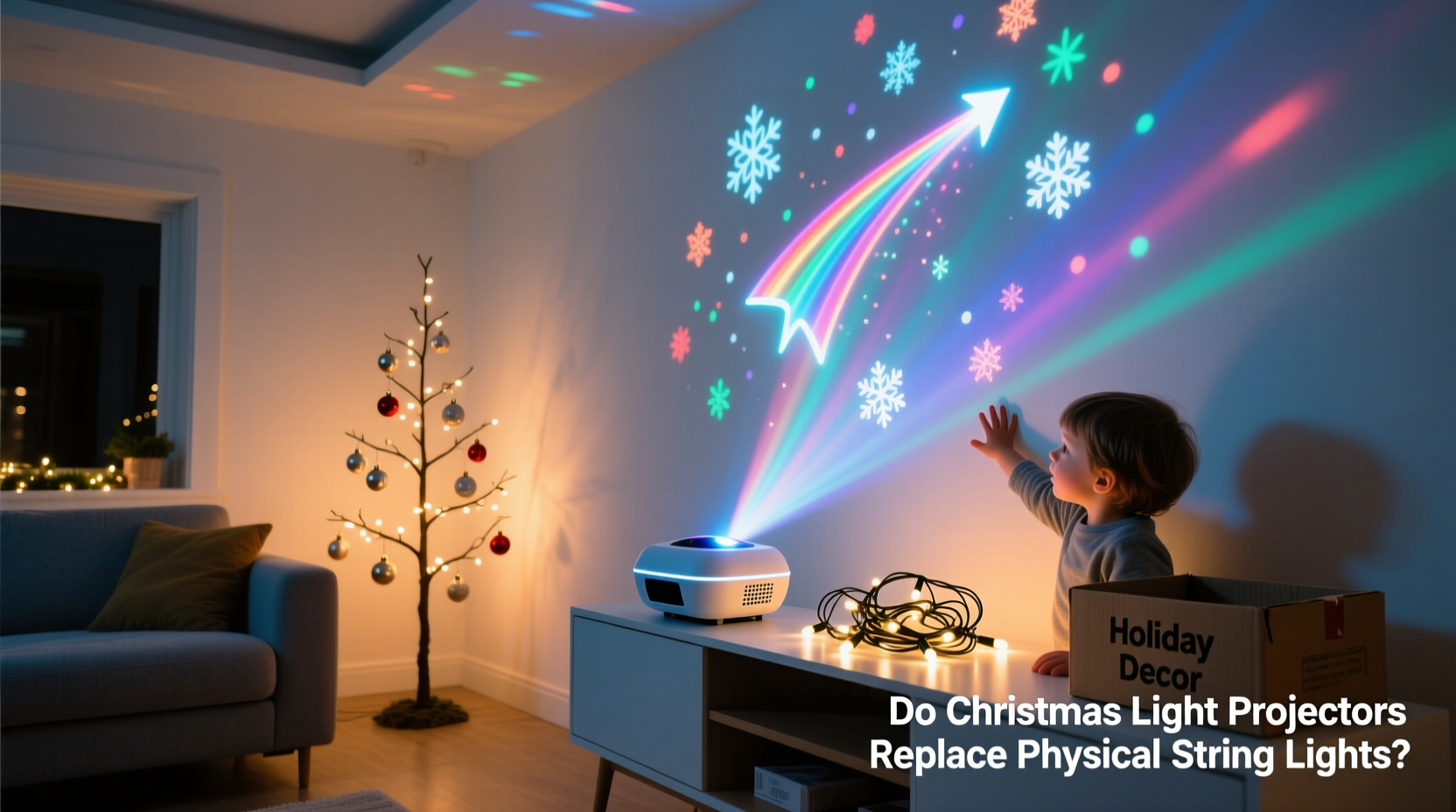
Christmas light projectors use high-lumen LED bulbs and rotating lenses or digital patterns to cast colorful light designs onto walls, lawns, and siding. Most models plug into a standard outdoor outlet and feature multiple modes—twinkling stars, falling snow, animated reindeer, or static multicolored dots resembling traditional bulb strings. Some advanced versions offer remote controls, timers, and even app-based customization.
These projectors are typically compact, lightweight, and easy to install. They require no climbing, no extension cords weaving across the yard, and no risk of tangled wires. Simply place the unit on a stable surface or mount it with included brackets, point it at the desired surface, and switch it on. Within seconds, your house can be covered in shimmering red and green specks or a dynamic holiday scene.
However, performance varies significantly based on environment. Projected light loses intensity over distance and struggles in bright ambient conditions. A projector might look stunning on a dark brick wall at 15 feet but fade into obscurity on a white stucco surface 30 feet away. Obstructions like trees, railings, or uneven facades can distort or block parts of the pattern, creating patchy results.
Physical String Lights: Tradition With Tangible Appeal
String lights have long been the backbone of holiday decor. Available in incandescent and LED varieties, they come in multiple lengths, colors, and bulb styles—mini, C7, C9, icicle, net, and rope lights. Their physical presence allows for precise placement, layering, and three-dimensional effects that projectors simply can’t replicate.
Unlike projected light, which sits flat on a surface, string lights wrap around objects, outlining rooflines, framing windows, and weaving through tree branches. This dimensionality creates depth and realism. A strand of C9 bulbs along a gutter catches wind and snow, reflecting light dynamically throughout the night. The tactile glow feels warmer, more authentic—something many decorators value deeply.
Modern LED string lights are energy-efficient, durable, and often rated for 40,000+ hours of use. Many are designed for outdoor use, with waterproof casings and shatter-resistant bulbs. Smart versions integrate with voice assistants and apps, allowing color changes, scheduling, and synchronization with music—all without sacrificing physical presence.
“Light has texture. When you see real bulbs glowing in the cold air, there’s a presence—almost a heartbeat—to the display. Projectors mimic the look, but not the soul.” — Daniel Reeves, Professional Holiday Lighting Designer
Comparing Projectors vs. String Lights: A Practical Breakdown
| Feature | Christmas Light Projectors | Physical String Lights |
|---|---|---|
| Setup Time | 2–5 minutes | 1–6+ hours |
| Installation Difficulty | Very low (no tools needed) | Moderate to high (ladders, clips, wiring) |
| Energy Use | 15–30 watts per unit | 4–10 watts per 25-light strand |
| Visibility Range | Up to 50 feet (diminishes with distance) | Visible up to 100+ feet |
| Weather Resistance | Varies; many lack full IP ratings | Most outdoor-rated strands are weatherproof |
| Lifespan | 2–5 seasons (LEDs degrade over time) | 5–10+ seasons with proper storage |
| Cost (Initial) | $30–$80 per projector | $10–$30 per strand (multiple needed) |
| Decorative Flexibility | Low (fixed patterns only) | High (custom layouts, shapes, integration) |
The data shows a clear trade-off: projectors win on speed and simplicity, while string lights dominate in visual impact and longevity. A single projector may cover a large wall, but it cannot outline a porch railing or drape across a tree canopy. Meanwhile, string lights demand labor but deliver unmatched control over design.
When Projectors Make Sense — And When They Don’t
Projectors shine in specific scenarios. Renters who can’t modify exteriors benefit from their non-invasive setup. Apartment dwellers with limited outdoor access use them to create festive curb appeal without permission issues. Homeowners with mobility challenges or fear of heights appreciate not needing ladders. In neighborhoods with strict HOA rules about lighting, a projector might be the only viable option.
They’re also ideal for temporary displays—think pop-up holiday markets, storefront promotions, or last-minute decorating. Because they’re portable and reusable, some users rotate patterns each year, keeping their look fresh without buying new materials.
But projectors fall short in several key areas. First, they rely on surfaces. Homes with large front lawns or gravel driveways lose projection quality due to scattering. Second, most projectors emit light in fixed patterns—meaning you can’t customize spacing or shape. Third, the effect is purely visual; there’s no physical interaction. You can’t touch it, adjust it mid-display, or layer it seamlessly with other decor.
Real-World Example: Two Neighbors, Two Approaches
Consider two homes on the same street. Sarah uses four Christmas light projectors: two aimed at her front wall, one on the garage, and one casting snowflakes onto her driveway. Setup took under ten minutes. Her display is visible from the road and draws compliments for its “cool tech” vibe. However, when viewed up close, the lights appear flat. On windy nights, tree shadows break the pattern. By mid-December, one unit fails due to moisture ingress.
Her neighbor, James, spends a Saturday installing 18 strands of LED string lights. He outlines his roofline, wraps pillars, and decorates his front tree. It takes six hours and requires a ladder, clips, and multiple extension cords. But once complete, the display glows with depth and warmth. Even in heavy snow, the lights remain visible and vibrant. His setup becomes a neighborhood landmark, with families stopping to take photos.
Sarah saved time and effort. James invested in experience. Both achieved festivity—but in fundamentally different ways.
Step-by-Step: Choosing the Right Option for Your Home
- Evaluate your home’s exterior. Identify large, flat surfaces suitable for projection. Note obstacles like trees, fences, or sloped roofs that may interfere.
- Assess your physical ability and tools. Do you have a reliable ladder? Are you comfortable working at height? If not, projectors may be safer.
- Determine your budget. Calculate the cost of enough string lights to cover your space versus purchasing one or more projectors.
- Consider longevity. Will you reuse these decorations next year? String lights stored properly can last a decade. Projectors may need replacement sooner.
- Test before committing. Rent or borrow both types to see how they perform on your property during nighttime hours.
- Think about integration. Can you combine both? Many decorators use projectors for background effects and string lights for focal points.
Hybrid Approach: Best of Both Worlds?
An increasing number of decorators are adopting a hybrid model. They use projectors to fill large blank areas—like side walls or garage doors—while reserving string lights for architectural details. This approach reduces labor while maintaining visual richness. For example, a projector might blanket a second-story wall in twinkling dots, while string lights frame the front door and wrap the porch columns.
Some smart projectors now sync with Wi-Fi-enabled string lights, allowing coordinated color shifts and timed animations. This fusion creates a dynamic, layered display that neither method could achieve alone. As technology improves, the line between projected and physical lighting continues to blur—but not disappear.
Frequently Asked Questions
Can I leave a Christmas light projector outside all season?
Most manufacturers advise against prolonged outdoor exposure unless the unit is explicitly rated for it (IP65 or higher). Moisture, temperature swings, and debris can damage internal components. If possible, bring the projector indoors during storms or extreme cold.
Do projectors work on all wall colors?
No. Dark or textured surfaces absorb or scatter light, reducing brightness and clarity. Light-colored, smooth walls (white, beige, stucco) yield the best results. Avoid aiming at glass, metal, or heavily shadowed areas.
Are string lights worth the extra effort?
For many, yes. The sense of accomplishment, the nostalgic glow, and the durability make them worthwhile. Families often turn installation into a tradition. Plus, well-maintained strands can be reused for years, lowering long-term costs.
Expert Insight: Industry Perspective
“We’ve seen a 200% increase in projector sales over the past five years,” says Lisa Tran, retail analyst at HolidayHome Insights. “But our data shows that only 12% of projector owners completely abandon string lights. Most use them as supplements—not replacements. There’s still a deep emotional connection to the ritual of hanging lights.”
This insight reveals a cultural truth: holiday decorating isn’t just about appearance. It’s about memory, family, and the act of preparation. Projectors offer convenience, but they don’t provide the same sense of involvement. For many, the climb up the ladder, the careful draping of strands, and the final moment of flipping the switch are integral to the season’s meaning.
Final Verdict: Complement, Not Replace
Christmas light projectors do not fully replace physical string lights—and likely never will. They serve a niche: fast, accessible, low-effort decoration for those who prioritize convenience over craftsmanship. They’re excellent tools for specific applications, especially where safety, access, or time are limiting factors.
But they lack the brilliance, dimension, and emotional resonance of real lights. No projector can replicate the way a strand of vintage-style bulbs glows through frost-covered pine needles or how synchronized LEDs dance to carols on a quiet winter night. Physical lights engage the senses in a way that projected light cannot.
Rather than viewing them as competitors, think of projectors and string lights as collaborators. Each has strengths. Each has a role. Used together, they can create displays that are both efficient and enchanting.
Take Action This Holiday Season
This year, assess your priorities. If you’re short on time or unable to install traditional lights, try a projector—you might be pleasantly surprised. If you crave authenticity and long-term value, invest in quality LED string lights. Or experiment with both: use a projector to enhance your backdrop while preserving the classic look of real bulbs on your porch and trees.
Whichever path you choose, remember that the goal isn’t perfection—it’s celebration. Whether powered by plug-in magic or decades-old tradition, holiday lights exist to spark joy, welcome neighbors, and mark the season with warmth.




 浙公网安备
33010002000092号
浙公网安备
33010002000092号 浙B2-20120091-4
Comments
No comments yet. Why don't you start the discussion?