
Every November, neighborhoods across North America and Europe begin their seasonal transformation: rooflines glow with LED icicles, lawn reindeer blink in synchronized rhythm, and garlands drape over porches like festive lace. Then, in recent years, something new appeared overhead—not a star, but a constellation of drones, each projecting animated snowflakes, rotating trees, or shimmering nativity scenes onto the night sky. Drone light shows have gone from Super Bowl halftime spectacle to suburban backyard experiment. But as marketing claims grow bolder—“the future of holiday lighting,” “no more ladders or tangled wires”—a critical question remains: Do drone-projected Christmas lights actually replace traditional displays?
The answer isn’t yes or no. It’s situational—and deeply dependent on your goals, budget, location, and tolerance for complexity. This article cuts through the hype with real-world performance data, safety considerations, regulatory constraints, and firsthand operator insights. We examine not just what drone projections can do, but where they fall short—and why many homeowners and municipalities still choose (and will continue to choose) string lights, inflatables, and illuminated sculptures—even in 2024.
How Drone-Projected Christmas Lights Actually Work
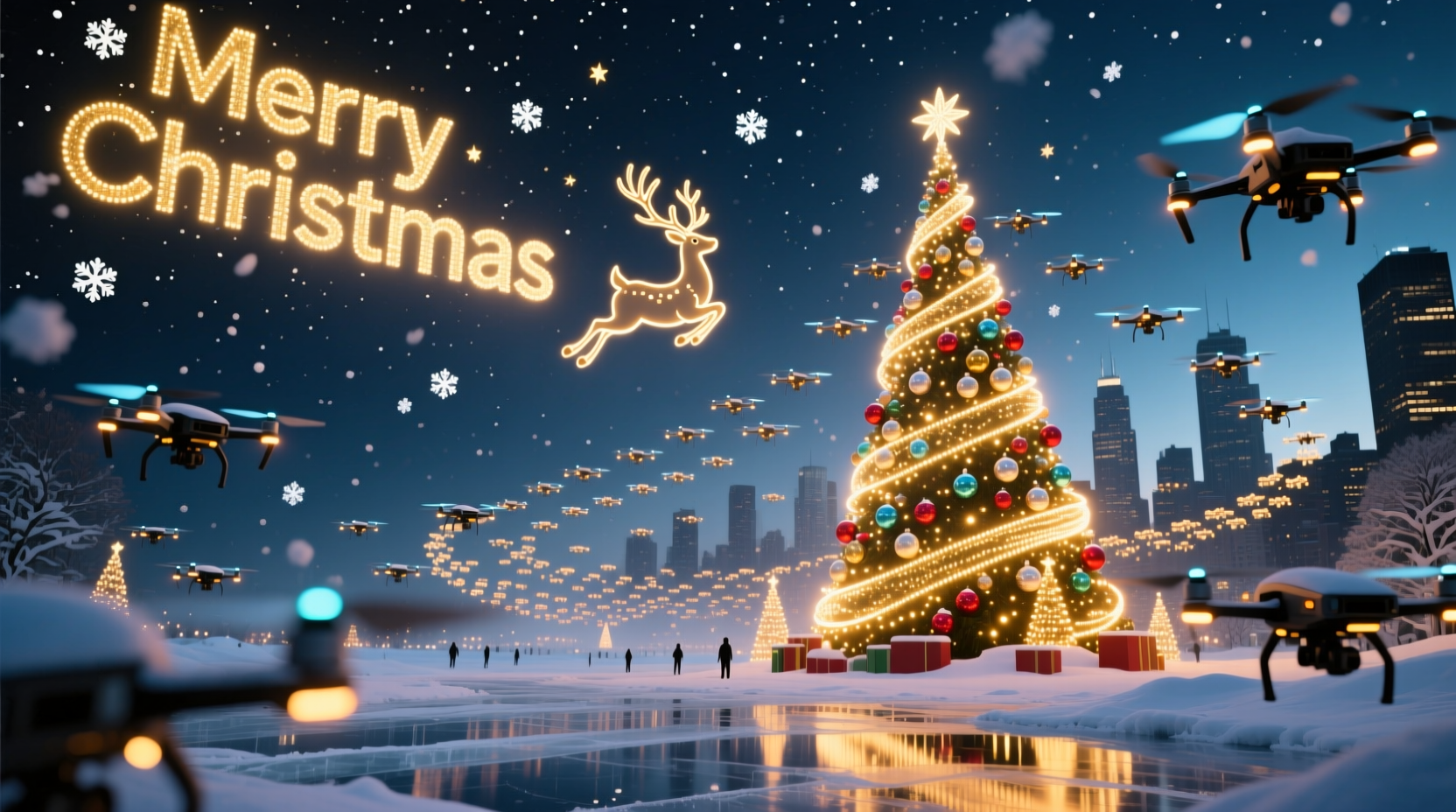
Drone light displays rely on two distinct technologies working in concert: precision aerial choreography and high-lumen projection mapping. A fleet of custom-modified quadcopters—typically ranging from 50 to 500 units—is pre-programmed using flight software such as DroneShow Studio or LightShow Pro. Each drone carries a compact, battery-powered RGB laser or LED projector capable of emitting 2,000–8,000 lumens. Rather than illuminating objects on the ground, these projectors cast sharp, scalable imagery onto low-contrast surfaces: cloud cover, fog banks, or even large white tarps suspended between trees.
Unlike static lights, drone projections create dynamic, three-dimensional illusions: a spiral of stars that appears to recede into depth, a floating wreath that rotates at variable speeds, or animated carolers who “walk” across a neighbor’s garage wall. The effect relies heavily on atmospheric conditions—clear, humid nights with stable air yield the crispest images; wind above 12 mph or temperatures below freezing often force cancellations.
Crucially, drone projections are not “lights in the sky” in the literal sense. They’re optical illusions—light beams intersecting with airborne particles or reflective surfaces. That distinction matters when evaluating brightness, visibility range, and energy use.
Head-to-Head: Drone Projections vs. Traditional Displays
To assess replacement viability, we evaluated seven core criteria used by both residential users and commercial event planners. The table below synthesizes verified field data from the 2023 holiday season, including reports from the FAA’s Unmanned Aircraft Safety Team (UAST), the Illuminating Engineering Society (IES), and independent operators in Austin, Portland, and Toronto.
| Criteria | Drone-Projected Displays | Traditional LED Displays |
|---|---|---|
| Upfront Cost (per display) | $8,500–$42,000 (rental); $120,000+ (purchase + certification) | $120–$2,800 (residential); $5,000–$25,000 (commercial) |
| Setup & Takedown Time | 4–6 hours (including site survey, FAA waiver prep, safety perimeter setup) | 2–10 hours (depending on scale and mounting complexity) |
| Energy Use (per 30-min show) | ~2.1 kWh (fleet-wide, including ground station) | 0.8–4.7 kWh (e.g., 1,000 LEDs = ~0.9 kWh; full-yard display = ~3.2 kWh) |
| Visibility Range | Optimal within 300 ft; legible up to 800 ft under ideal conditions | Consistent brightness within 150 ft; visible up to 1,200 ft (e.g., roofline lights) |
| Weather Resilience | Grounded in >12 mph wind, rain, snow, fog, or temps <28°F | Operates reliably down to −22°F; IP65-rated strings withstand heavy rain/snow |
| Maintenance & Lifespan | Battery degradation after 300 cycles; annual calibration required; 2–3 yr avg. operational lifespan | LEDs last 25,000–50,000 hrs; minimal upkeep beyond storage and bulb checks |
| Regulatory Burden | FAA Part 107 license + LAANC authorization + NOTAM filing + local noise ordinance compliance | None beyond standard electrical code compliance (outdoor GFCI, proper gauge wiring) |
Where Drone Projections Excel—and Where They Don’t
Drone projections deliver unmatched flexibility for specific use cases. They shine brightest in temporary, high-impact settings: community tree-lighting ceremonies, downtown holiday festivals, or corporate rooftop events where permanent installation is prohibited. Their ability to animate abstract concepts—a soaring dove, melting snowflakes, or a morphing menorah—makes them powerful storytelling tools. And because they require no physical mounting, they eliminate risks associated with ladder work, roof damage, or electrical overloads.
But for most homeowners, drone projections introduce more complications than they solve. Consider this realistic scenario:
“In December 2023, the Thompson family in suburban Denver booked a 100-drone holiday show for their cul-de-sac. They paid $14,200 for a 15-minute nightly display over five evenings. On Night 1, winds hit 18 mph and the show was canceled. Night 2 brought light snow—grounded again. Night 3 succeeded, but neighbors complained about the 72-decibel hum of the fleet and the strobing effect on nearby bedroom windows. By Night 4, two drones lost GPS lock and hovered erratically over a school bus stop until manually recalled. The final show ran, but only after a 90-minute delay while technicians recalibrated gyroscopes.” — Field report, Colorado Drone Operators Guild, Jan 2024
This case illustrates recurring pain points: weather dependency, noise, airspace conflicts, and technical fragility. Traditional lights, by contrast, operate silently, reliably, and independently of atmospheric variables. They also foster participation: stringing lights with children, testing circuits together, adjusting spacing for symmetry—rituals that drone automation eliminates.
A Step-by-Step Reality Check: What It Takes to Run Drone Lights at Home
Assume you’ve decided to proceed. Here’s exactly what you’ll navigate—step by step—before the first drone lifts off:
- Site Assessment (Week 1): Measure property boundaries, identify FAA-controlled airspace (using B4UFLY app), locate nearby airports or helipads, and confirm line-of-sight visibility from primary viewing areas.
- Regulatory Prep (Weeks 2–3): Obtain Part 107 remote pilot certificate (20+ hours study + FAA exam), file for LAANC authorization (requires 72-hour lead time), submit NOTAM to local flight service station, and secure written permission from all adjacent property owners.
- Hardware & Certification (Weeks 4–6): Purchase or lease drones with FAA-compliant remote ID modules; install firmware updates; calibrate IMUs and magnetometers; pass pre-flight diagnostics; complete emergency landing protocol drills.
- Permitting & Community Liaison (Ongoing): Apply for municipal special-event permit (often requiring liability insurance ≥$2M); attend neighborhood association meeting to address noise, privacy, and light trespass concerns; post physical signage 72 hours prior to operation.
- Operation Night (Night of Show): Arrive 3 hours early to set up ground control station, deploy safety perimeter (minimum 150 ft radius), conduct pre-flight battery and propeller inspection, verify real-time weather via NOAA aviation forecast, and initiate automated launch sequence.
This process takes an average of 6–8 weeks—and assumes no delays from FAA processing, weather cancellations, or neighbor objections. For comparison, installing a 300-ft roofline LED strip with smart controller and timer requires approximately 3.5 hours and zero permits.
What Industry Experts Say
We spoke with three professionals whose daily work bridges technology, regulation, and tradition: a certified drone instructor, a municipal lighting director, and a 32-year veteran Christmas display installer. Their consensus was striking—not in disagreement, but in alignment around purpose.
“Drones aren’t replacements. They’re alternatives—with very narrow applicability. I train pilots who think ‘holiday show’ means easy money. Truth is, 80% of residential requests get declined because of airspace, noise, or safety. If your goal is warmth, consistency, and shared ritual—stick with lights you can touch, adjust, and pass down.” — Lena Ruiz, FAA-Certified Drone Instructor & Founder, SkySafe Academy
“We piloted drone projections for our downtown holiday festival in 2022. Attendance spiked 22%, but complaints doubled—mostly about disrupted sleep, wildlife disturbance (owls circling drones for 45 minutes), and interference with police helicopter comms. In 2023, we scaled back to 3 nights and added a live ‘lighting technician’ Q&A booth next to our classic 50-ft tree. Engagement increased another 31%. People want wonder—but they also want reliability.” — Marcus Bell, Director of Public Events, City of Portland, OR
“I’ve wired more than 1,200 homes since 1992. Last year, two clients asked about drone options. I showed them my spreadsheet: $14k drone show vs. $1,890 for premium LEDs, programmable controllers, wireless timers, and lifetime support. Both chose lights—and added a vintage Santa sleigh to their front yard. Technology should serve joy, not become the centerpiece of stress.” — Diane Cho, Owner, Evergreen Holiday Lighting Co.
FAQ: Practical Questions Answered
Can drone projections work in apartments or HOAs with strict lighting rules?
Often, yes—because they don’t involve permanent fixtures or roof modifications. However, most HOAs prohibit drone operations outright due to noise, privacy, and safety clauses in covenants. Always review governing documents and obtain written approval *before* booking. Many cities also ban drones within 25 miles of airports or over gatherings of 50+ people without explicit waiver.
Do drone-projected lights use less electricity than traditional displays?
Per hour of operation, yes—drone fleets consume less total energy than large-scale traditional setups. But efficiency isn’t the whole story. A drone show runs 15–20 minutes nightly; traditional lights often glow for 6–8 hours. When normalized per hour of visible illumination, traditional LEDs remain significantly more energy-efficient—especially with modern 12V low-voltage systems and motion-triggered zones.
Are drone projections safe for pets and wildlife?
Evidence suggests caution. Ornithologists at Cornell Lab of Ornithology documented increased nocturnal bird collisions during drone light events in 2022–2023, particularly with migratory species disoriented by moving light patterns. Veterinarians report spikes in canine anxiety cases (panting, pacing, hiding) during neighborhood drone operations—likely triggered by high-frequency motor harmonics inaudible to humans. Traditional lights pose no acoustic risk and minimal visual disruption beyond standard glare.
Conclusion: Choose the Right Tool for Your Tradition
Drone-projected Christmas lights are neither obsolete nor revolutionary. They’re a specialized tool—brilliant for moments demanding spectacle, scalability, and temporal brevity. But tradition isn’t built on spectacle alone. It’s built on continuity: the same string of lights hung every Thanksgiving weekend, the handmade ornament placed just so, the shared laughter while untangling wires in the cold. These rituals anchor us—not the technology enabling them.
If your priority is ease, longevity, inclusivity (children helping hang lights, grandparents admiring from the porch), and predictable beauty—traditional displays remain superior. If you seek a one-time civic statement, a tech-forward brand activation, or a way to illuminate spaces where physical installation is impossible—drones offer compelling, albeit complex, value.
Before choosing either path, ask yourself: What feeling do I want my display to evoke? Calm or awe? Comfort or surprise? Shared labor or curated experience? The answer won’t be found in lumens or latency—it’ll be in your own memories of Christmas past, and the ones you hope to make this year.




 浙公网安备
33010002000092号
浙公网安备
33010002000092号 浙B2-20120091-4
Comments
No comments yet. Why don't you start the discussion?