
Nothing evokes the quiet magic of the winter season quite like the crisp, resinous aroma of a freshly cut pine tree in your living room. That complex, green-woody fragrance—laced with alpha-pinene, limonene, and bornane—is not just nostalgic; it’s biologically active, mood-modulating, and deeply tied to seasonal ritual. Yet many households now layer that natural scent with essential oil diffusers: lavender for calm, eucalyptus for clarity, citrus for brightness, or even “forest blend” oils promising enhanced woodland ambiance. What happens when these two aromatic systems coexist? Do diffusers simply add to the pine scent—or do they actively interfere, obscure, or even degrade it? This isn’t just about preference. It’s about olfactory chemistry, human perception thresholds, and how we steward authentic sensory experiences in increasingly engineered environments.
How Pine Tree Scent Actually Works—And Why It’s Fragile
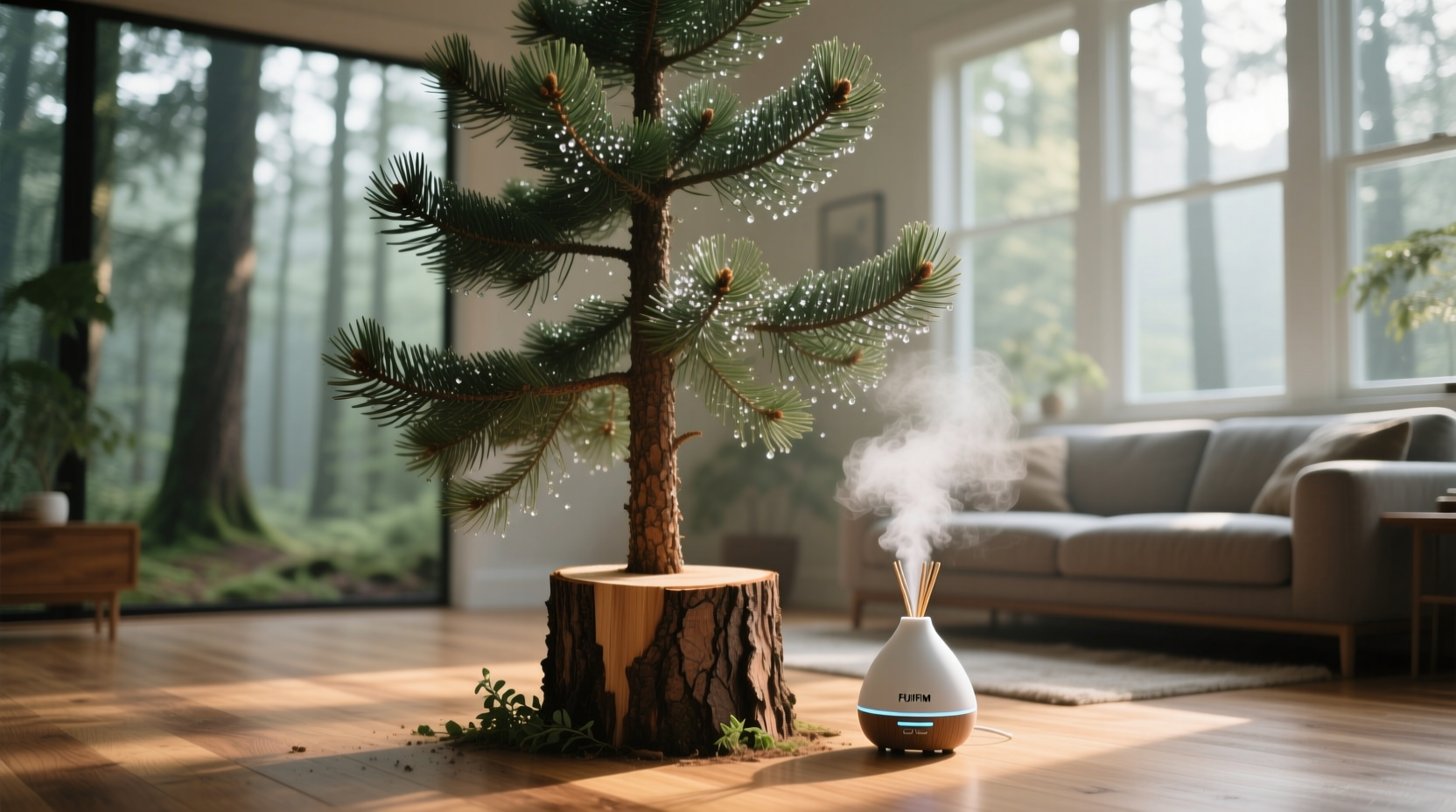
A live or freshly cut Christmas pine (whether Fraser fir, Balsam fir, or Douglas fir) releases volatile organic compounds (VOCs) continuously through its needles and cut trunk. The dominant molecules include alpha-pinene (sharp, green, turpentine-like), beta-pinene (drier, spicier), limonene (citrus-tinged brightness), and bornane (cool, camphoraceous depth). These compounds don’t exist in isolation—they form a dynamic, evolving bouquet shaped by temperature, humidity, airflow, and needle age. Within 48 hours of cutting, monoterpene concentrations begin shifting: alpha-pinene degrades faster than beta-pinene, subtly altering the scent profile from bright and zesty toward drier, more woody-resinous.
Crucially, human olfaction doesn’t perceive this as a static “pine smell.” We detect it as a layered, spatial experience: sharper top notes near the trunk, softer green-resin midnotes at eye level, and fainter, warmer base notes rising from heated floor surfaces. This complexity is easily disrupted—not by volume alone, but by molecular competition.
The Science of Aromatic Interference: Masking, Blending, and Neural Fatigue
When you introduce an essential oil diffuser into a room with a real pine tree, three primary interference mechanisms occur:
- Masking: Strong top-note oils (e.g., peppermint, grapefruit, rosemary) physically dominate the olfactory receptors’ binding sites, reducing sensitivity to subtler pine terpenes. This isn’t neutral addition—it’s competitive inhibition.
- Perceptual Blending: Oils with overlapping compounds (e.g., “forest blend” diffuser oils containing synthetic alpha-pinene or limonene) don’t reinforce the pine scent—they create dissonance. Real pine VOCs oxidize and interact with ambient air; synthetic versions in diffuser blends are often stabilized or diluted with carrier alcohols (like ethanol or propylene glycol), producing a flatter, less nuanced vapor.
- Olfactory Fatigue & Adaptation: Continuous exposure to any dominant aroma—even pleasant ones—triggers receptor downregulation within 15–20 minutes. Diffusers running constantly accelerate neural adaptation, making both the pine scent and the oil scent progressively harder to distinguish.
Dr. Linda Buck, Nobel laureate in Physiology/Medicine for her work on olfactory receptors, explains:
“The nose doesn’t sum scents like a mixer—it prioritizes, filters, and adapts in real time. Introducing a second high-intensity volatile stream doesn’t enrich perception; it forces the brain to resolve conflict. In many cases, the result is diminished awareness of the original, more complex source.”
Do’s and Don’ts: Practical Guidelines for Coexistence
Interference isn’t inevitable—but it *is* highly probable without intentional management. Below is a distilled comparison of evidence-based practices, grounded in atmospheric chemistry, sensory psychology, and decades of professional holiday interior experience.
| Action | Why It Helps | Risk If Ignored |
|---|---|---|
| Diffuse only during low-pine-activity windows (e.g., mornings before needle respiration peaks, or evenings after lights are off) | Pine VOC emission is highest midday (10 a.m.–3 p.m.) when ambient temps rise. Diffusing outside this window reduces molecular competition. | Constant overlap saturates air with competing monoterpenes, accelerating perceived “flatness” in both scents. |
| Use ultrasonic diffusers—not heat-based or nebulizing units | Ultrasonic models disperse oil micro-droplets without thermal degradation, preserving delicate top notes and minimizing airborne alcohol vapors that dull pine’s green sharpness. | Heat diffusers volatilize carrier solvents that coat nasal cilia, reducing sensitivity to pine’s subtle esters and sesquiterpenes. |
| Choose oils with minimal monoterpene overlap (e.g., sandalwood, vanilla absolute, or vetiver) | These contain sesquiterpenes and lactones—molecules with slower volatility and distinct receptor pathways—creating harmonic contrast rather than competitive masking. | Using high-alpha-pinene oils (e.g., rosemary, sage, or “pine needle” blends) creates chemical redundancy, not synergy. |
| Maintain 3+ feet of physical separation between diffuser and tree trunk | Creates distinct micro-zones of scent concentration, allowing olfactory system to parse each source separately before blending occurs downstream in airflow. | Proximity causes localized VOC saturation, triggering rapid olfactory fatigue and perceived “chemical” off-notes. |
| Limit diffusion to ≤45 minutes per session, max twice daily | Preserves nasal receptor sensitivity and prevents cumulative solvent buildup in indoor air (especially critical in tightly sealed, energy-efficient homes). | Continuous diffusion leads to perceptual burnout—many report the pine tree “losing its smell” entirely after 36–48 hours of unbroken diffuser use. |
A Real-World Scenario: The Anderson Family Holiday Experiment
In December 2023, the Andersons—a family of four in Portland, Oregon—conducted an informal but rigorous home test. They purchased a locally harvested Noble fir (known for high limonene content and long-lasting scent) and set up identical rooms: one with the tree alone, the other with the same tree plus a popular ultrasonic diffuser running bergamot oil (high limonene, citrus-forward) on continuous mode.
Over five days, they documented observations using standardized sensory language (based on the ASTM E544-22 odor profiling scale) and invited 12 neutral observers (friends and neighbors unaware of the setup) to evaluate each room independently.
Results were telling: By Day 2, 92% of observers described the diffuser room as having “a clean, artificial citrus note over something woody—but hard to identify the wood.” Only 17% detected classic pine characteristics (resin, forest floor, green snap). In contrast, the control room maintained strong consensus on “bright, sappy, slightly peppery pine” through Day 5. Crucially, when asked to rate “emotional resonance”—a proxy for authenticity—observers rated the diffuser room 32% lower on feelings of “tradition,” “calm,” and “natural immersion.”
The Andersons concluded: Diffusers didn’t ruin their tree—but they decisively redirected attention away from its inherent complexity. Their solution? Switching to a single 30-minute evening diffusion of cedarwood atlas oil (low monoterpene, high sesquiterpene), placed beside a north-facing window. Pine scent remained vivid, and the added warmth felt complementary—not competitive.
Step-by-Step: Optimizing Scent Harmony Without Sacrificing Either Experience
Follow this sequence to preserve your pine tree’s integrity while thoughtfully incorporating essential oils:
- Day 0 (Tree Arrival): Let the tree acclimate in a cool garage or porch for 4–6 hours. Fill the stand with water immediately upon bringing it indoors. No diffuser use yet.
- Day 1 Morning: Run a 20-minute diffusion of frankincense oil (resinous, grounding, zero monoterpene overlap) in the farthest corner of the room. Open windows for 5 minutes afterward to reset baseline air.
- Day 1 Afternoon: Observe scent intensity. If pine is robust (you smell it clearly within 6 feet), skip diffusion. If muted (common in dry, heated homes), mist tree trunk lightly with water + 2 drops of pure Siberian fir needle oil—applied *directly to bark*, not diffused. This replenishes lost terpenes without airborne competition.
- Days 2–6: Alternate diffusion days. On “off” days, place a small bowl of whole cloves and orange peel near the tree base—steam-volatilized spices enhance pine’s warmth without molecular conflict.
- Day 7+: As needle drop increases, shift to grounding base-note oils only (vetiver, patchouli, or aged sandalwood) in 15-minute bursts. Avoid all citrus, mint, or herbaceous oils—they clash with aging pine’s increasing camphor notes.
FAQ: Addressing Common Concerns
Can diffuser oils damage my real pine tree?
No direct phytotoxic harm occurs from typical residential diffuser use—the oil vapor concentration is far too low to affect needle physiology. However, prolonged exposure to ethanol-based carrier solvents (common in cheaper diffuser blends) may accelerate needle desiccation in low-humidity environments. Always use 100% pure, solvent-free essential oils in ultrasonic diffusers.
Will using a “pine-scented” essential oil actually boost the real tree’s aroma?
Not meaningfully—and often counterproductively. Commercial “pine” oils are typically distilled from Scots pine needles or synthetic isolates. They lack the full VOC spectrum of a living tree (missing key sesquiterpenes and oxygenated derivatives) and introduce stabilizing alcohols that blunt olfactory perception. You’ll get louder aroma, not richer aroma.
What if I have allergies or sensitivities? Does combining scents increase risk?
Yes. Pine terpenes and certain essential oils (e.g., eucalyptus, rosemary) share metabolic pathways in the liver. For sensitive individuals, concurrent exposure can heighten respiratory reactivity—even without clinical allergy. If you experience throat tightness, headache, or increased mucus production, discontinue diffuser use immediately and increase ventilation. Real pine alone rarely triggers such responses at typical indoor concentrations.
Conclusion: Honor the Complexity, Not Just the Convenience
A real pine tree is not background ambiance—it’s a living, breathing, chemically expressive organism occupying space in your home. Its scent is a transient, intricate dialogue between biology and environment: a story written in molecules that shifts hour by hour, day by day. Essential oil diffusers offer convenience, intentionality, and therapeutic nuance—but they operate on different principles: standardization, repetition, and controlled release. When used without awareness, they don’t enhance the pine experience—they compress it. They replace layered discovery with singular emphasis, quiet reverence with ambient noise.
The most meaningful holiday spaces aren’t those saturated with layered scents, but those where each aromatic element is given room to breathe, evolve, and be truly perceived. That means choosing restraint over abundance, timing over constant presence, and curiosity over habit. Your pine tree doesn’t need enhancement. It needs space—physically, chemically, and sensorially—to express itself fully. And when you grant it that, the resulting quiet richness will resonate deeper than any diffuser ever could.




 浙公网安备
33010002000092号
浙公网安备
33010002000092号 浙B2-20120091-4
Comments
No comments yet. Why don't you start the discussion?