
Every November, a quiet debate stirs in homes across North America and Europe: Is the tradition of bringing a living evergreen into the home still meaningful—or has modern convenience rendered it obsolete? As essential oil diffusers flood retail shelves with “forest fresh,” “Balsam fir,” and “Alpine pine” blends, many consumers wonder whether these compact devices offer a viable, ethical, and sensorially satisfying alternative to cutting down or sourcing a real Christmas tree. The short answer is no—but the full story is far more nuanced. This isn’t just about nostalgia or aesthetics. It’s about air chemistry, ecological impact, human psychology, and the layered nature of ritual. Real trees deliver a multisensory experience rooted in biology and seasonality—something no diffuser can replicate. Yet diffusers do serve real, legitimate roles in contemporary holiday life. Understanding where each belongs—and where they fall short—is essential for making intentional, values-aligned choices.
The Science of Scent: Why Pine Oil ≠ Pine Tree
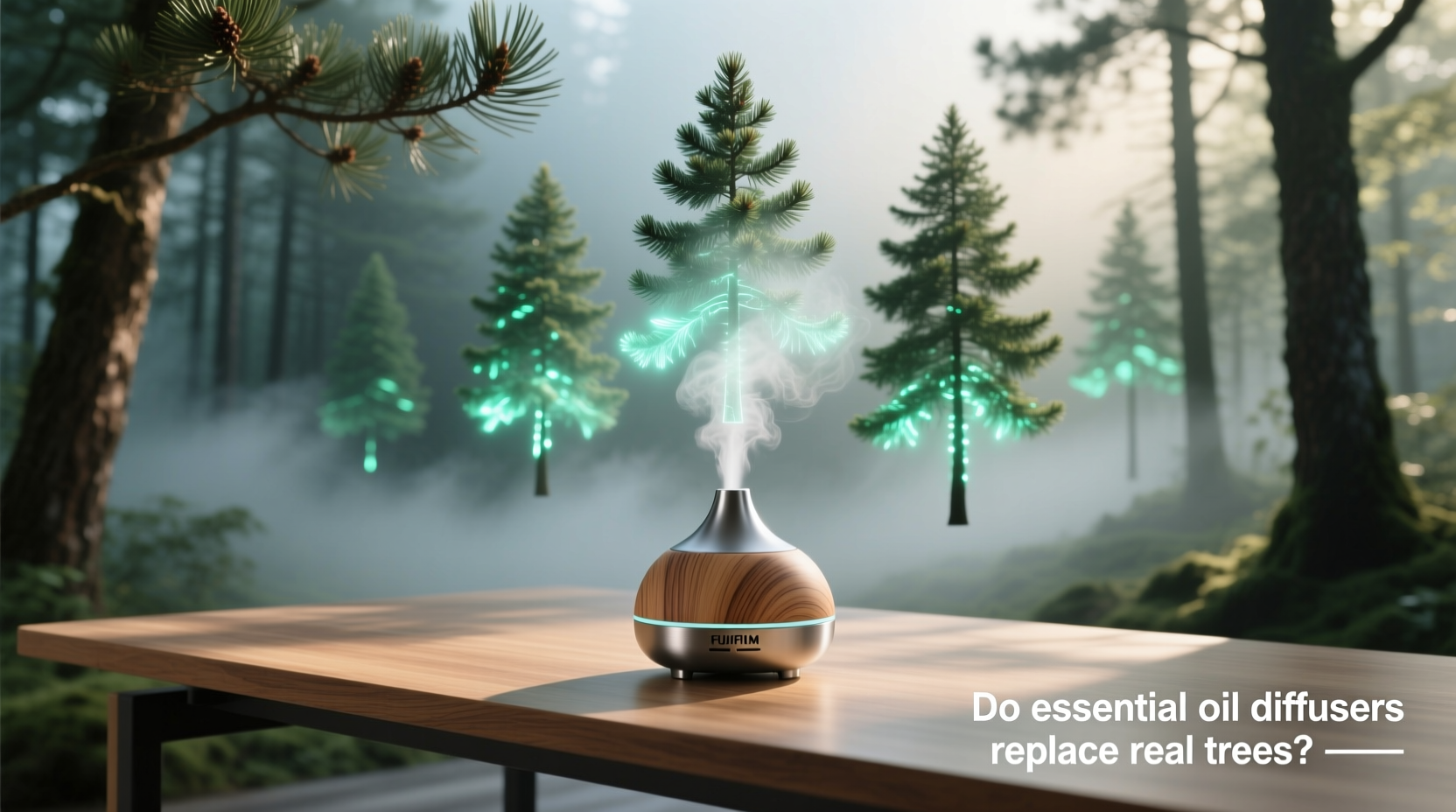
A real Fraser fir or balsam spruce releases over 50 volatile organic compounds (VOCs) when cut—including α-pinene, β-pinene, limonene, and camphene—each contributing distinct olfactory and physiological effects. These compounds aren’t just “smell molecules”; they interact with human limbic systems, modulate cortisol levels, and even exhibit mild antimicrobial activity in ambient air. In contrast, most commercial pine-scented essential oils contain only 3–7 dominant constituents, heavily skewed toward α-pinene for cost and stability. Many “pine” blends sold for diffusers are actually synthetic aroma chemicals or diluted isolates—not true steam-distilled conifer oil at all.
Crucially, a live tree emits scent *dynamically*: intensity rises with room temperature, humidity, and physical disturbance (like hanging ornaments or brushing branches). Its fragrance evolves over time—from sharp and resinous on Day 1 to deeper, woodier, and subtly sweet by Week 3—as terpenes oxidize and secondary metabolites release. A diffuser delivers a static, linear aromatic profile. It cannot mimic the subtle green, damp-earth, and faintly citrusy top notes of a freshly cut noble fir—or the warm, honeyed undertone of a mature Douglas fir drying naturally in a stand.
“Trees don’t just smell—they breathe, transpire, and interact with indoor air quality in ways no device can simulate. Their scent is an emergent property of biology, not chemistry.” — Dr. Lena Torres, Environmental Sensory Scientist, University of Vermont Rubenstein Ecosystem Science Lab
Eco-Impact: Not All ‘Green’ Choices Are Equal
It’s tempting to assume that skipping a tree in favor of a reusable diffuser is automatically more sustainable. But lifecycle analysis tells a different story. A real, locally grown, responsibly harvested Christmas tree sequesters carbon during its 6–10 year growth cycle, supports pollinator habitat, and—when composted or chipped—returns nutrients to soil. According to the National Christmas Tree Association, over 95% of real trees in the U.S. are grown on farms (not wild-harvested), and nearly all post-holiday trees are recycled: 43 million were mulched in 2023 alone.
Diffusers, meanwhile, rely on complex supply chains: glass or plastic housing (often single-use packaging), electronic components with rare-earth metals, electricity consumption (even low-watt models add up over weeks of daily use), and essential oils whose sourcing raises concerns. True pine needle oil requires ~1,000 kg of needles to yield 1 kg of oil—a harvest that can deplete understory vegetation if not managed regeneratively. Most affordable “pine” oils are derived from slash pine (*Pinus elliottii*) grown in monoculture plantations in Brazil or Vietnam, where biodiversity loss and pesticide runoff are documented issues.
What Diffusers *Do* Offer: Practical Advantages & Legitimate Use Cases
While diffusers don’t replace trees, they fill important functional gaps—especially for people whose circumstances make a real tree impractical or unsafe. Consider these validated benefits:
- Allergy mitigation: For those with severe mold or pollen sensitivities, a real tree can introduce spores and dust that trigger reactions. A diffuser eliminates that vector entirely.
- Space & safety: In studio apartments, historic buildings with narrow stairwells, or homes with unsteady furniture or mobility challenges, a 6-foot tree poses real logistical and fire-risk hurdles. A diffuser requires zero floor space and no water stand.
- Pet compatibility: Cats and dogs may chew pine needles (which contain irritating terpenes and pose choking hazards) or knock over stands. Diffusers eliminate ingestion risks—provided pet-safe oils (e.g., avoiding tea tree or citrus) are used.
- Extended ambiance: Real trees lose needle retention and scent intensity after 3–4 weeks. A diffuser maintains consistent fragrance for the full holiday season—and beyond, into winter solstice or New Year rituals.
Importantly, diffusers also democratize access to seasonal scent for communities historically excluded from tree traditions—renters with strict no-tree policies, dormitory residents, or individuals in long-term care facilities where live plants are prohibited for infection-control reasons.
Comparative Functionality: What Each Delivers (and Doesn’t)
The table below outlines key dimensions where real trees and pine-scented diffusers diverge—not as competitors, but as tools serving different human needs:
| Function | Real Christmas Tree | Pine-Scented Diffuser |
|---|---|---|
| Tactile Experience | Textural variety: rough bark, waxy needles, pliable boughs, sticky resin | None—purely olfactory |
| Visual Anchor | Structural centerpiece; supports lights, garlands, ornaments, and family photos | Minimal visual presence; often hidden on shelves or desks |
| Air Quality Impact | Increases humidity slightly; may trap airborne dust; negligible VOC emissions unless treated with flame retardants | Introduces concentrated VOCs; may irritate asthmatics at high concentrations; no humidifying effect |
| Ritual Participation | Involves selection, transport, trimming, watering, decorating—multi-step embodied practice | Press-button activation; minimal physical engagement |
| Lifespan & Disposal | 4–6 weeks peak freshness; fully compostable or recyclable via municipal programs | Device lasts years; oils require ongoing purchase; plastic components rarely recyclable |
Mini Case Study: The Urban Apartment Dilemma
Maya R., a graphic designer in Chicago, lived in a 450-square-foot walk-up for seven years. Her first holiday season there, she bought a 5-foot Fraser fir—only to realize too late that navigating it up three narrow flights of stairs was impossible without disassembling her front doorframe. She returned it, frustrated and disillusioned. For the next four years, she used a pine-scented diffuser, appreciating its ease and consistency—but felt something missing. “It smelled like Christmas, sure,” she says, “but it didn’t *feel* like it. There was no shared effort with my partner to get it upright, no morning surprise of new fallen needles on the rug, no reason to pause and really look at the branches while stringing lights.”
In Year 5, Maya discovered a local urban farm offering “mini firs”—3-foot trees grown in biodegradable pots. She ordered one, carried it up the stairs in two trips, and placed it on a low platform beside her sofa. She added a small diffuser nearby—not to replace the tree, but to gently amplify the scent on dry winter days when the tree’s natural aroma softened. “The tree is the heart. The diffuser is the whisper in the background. They’re not substitutes. They’re collaborators.”
Step-by-Step: Building a Hybrid Holiday Sensory Practice
For those who value both authenticity and practicality, a thoughtful integration—not replacement—offers the richest experience. Follow this evidence-informed sequence:
- Assess your non-negotiables: List hard constraints (e.g., “no standing water,” “must fit through 28-inch doorway,” “cat-proof”) before choosing any element.
- Select your anchor: Choose either a real tree or a high-quality artificial tree (preferably PVC-free, with PE tips for realism) as your visual and structural centerpiece.
- Add layered scent intentionally: If using a real tree, place a diffuser 6+ feet away—never directly above or behind it—to avoid accelerating needle desiccation. Use a blend of true balsam fir + cedarwood oil to complement, not compete with, the tree’s natural profile.
- Engage other senses deliberately: Play forest soundscapes (wind in pines, distant woodpeckers) for 20 minutes daily. Serve pine-needle-infused simple syrup in hot cider. Display pressed evergreen boughs in ceramic bowls—tactile and aromatic without water risk.
- Close the loop: After the season, take your real tree to a certified mulch site. Save the mulch for spring garden use—and note the date you dropped it off. That tangible act of return reinforces ecological reciprocity.
FAQ
Can pine essential oil cause respiratory irritation?
Yes—especially in enclosed spaces or for individuals with asthma, COPD, or chemical sensitivities. α-Pinene, while generally recognized as safe (GRAS) for food use, becomes an airway irritant at concentrations exceeding 0.1 ppm—easily reached by ultrasonic diffusers running 8+ hours daily. Always ventilate rooms and limit diffusion to 30–60 minute intervals.
Are “eco-friendly” artificial trees truly sustainable?
Most are not. Even “recycled PET” trees contain virgin plastics for structural integrity and typically last only 3–5 years before shedding tips or warping. A 2022 study in Environmental Science & Technology found that an artificial tree must be reused for at least 12 years to offset its higher carbon footprint versus annual real trees. The most sustainable choice remains a real, locally sourced, composted tree—or a rental service where available.
Do real trees significantly increase indoor mold counts?
Not inherently. A healthy, well-watered tree introduces negligible mold spores. Problems arise only when trees sit in stagnant water for >7 days, allowing Aspergillus and Cladosporium to colonize the cut stump. Using a clean stand, changing water every 2 days, and making a fresh ½-inch cut before display reduces risk to baseline indoor levels.
Conclusion
Essential oil diffusers with pine scent are elegant tools—not replacements. They excel at delivering consistent aroma, accommodating constraints, and extending seasonal feeling beyond the lifespan of biological material. But they cannot replicate the quiet gravity of a living conifer in your living room: the way its branches hold light, the subtle shift in air density near its boughs, the shared labor of decoration, or the ecological honesty of its brief, beautiful presence. Choosing a real tree isn’t about rejecting innovation; it’s about honoring complexity—the interplay of biology, memory, and responsibility. And choosing a diffuser isn’t about surrendering tradition; it’s about adapting meaningfully to real-world limits. The most resonant holidays emerge not from choosing one over the other, but from understanding what each offers, what each asks of us, and how they might coexist with intention. Your home doesn’t need to be either “authentic” or “convenient.” It can be both—thoughtfully, respectfully, and deeply human.




 浙公网安备
33010002000092号
浙公网安备
33010002000092号 浙B2-20120091-4
Comments
No comments yet. Why don't you start the discussion?