
Facial rollers have become a staple in many skincare routines, especially among those looking to depuff and refresh their complexion first thing in the morning. Sold as a quick fix for tired eyes and bloated cheeks, these tools promise to sculpt, tone, and promote lymphatic drainage—all with a few smooth strokes. But do they actually work? To find out, I conducted a strict 14-day morning routine test using a jade roller on bare skin every day immediately after waking. The goal: measure visible changes in facial puffiness, eye bags, and overall facial definition.
This article details my experience, includes expert insights, tracks measurable outcomes, and offers practical advice for anyone considering adding a facial roller to their regimen. No marketing hype—just honest observations and science-backed context.
The Science Behind Facial Puffiness
Morning facial puffiness is common and largely physiological. While sleeping, fluid redistributes across the body due to gravity and reduced muscle activity. When lying down for several hours, fluid tends to pool in the face—especially around the eyes and jawline—leading to temporary swelling. This condition is known as periorbital edema when affecting the eyes and is typically harmless.
Lymphatic drainage plays a key role in clearing excess fluid. Unlike blood, which is pumped by the heart, lymph relies on muscle contractions and external pressure to move. Without stimulation, sluggish lymph flow can prolong puffiness. This is where facial rolling enters the conversation: proponents claim that gentle massage encourages lymph movement, thereby reducing swelling.
“Manual lymphatic drainage techniques, when applied correctly, can support fluid mobilization in superficial facial tissues.” — Dr. Lena Patel, Board-Certified Dermatologist
However, it’s important to distinguish between temporary decongestion and long-term reduction. Rolling may shift fluid temporarily but won’t eliminate underlying causes like poor sleep, high sodium intake, or allergies.
My 14-Day Morning Routine Test: Methodology
To assess the effectiveness of facial rollers, I followed a consistent protocol each morning:
- Wake up at 7:00 AM (same time daily).
- Take a front-facing photo under natural light before any product application.
- Use a chilled jade roller stored in the refrigerator overnight.
- Roll for exactly 5 minutes using upward and outward motions.
- Apply no serums or oils during the test period to isolate the tool’s impact.
- Repeat for 14 consecutive days.
I focused on three target zones: under the eyes, along the jawline, and across the forehead. Pressure was kept light—never dragging or tugging—to avoid irritation. The roller was cleaned nightly with mild soap and water.
Results After 14 Days: What Changed?
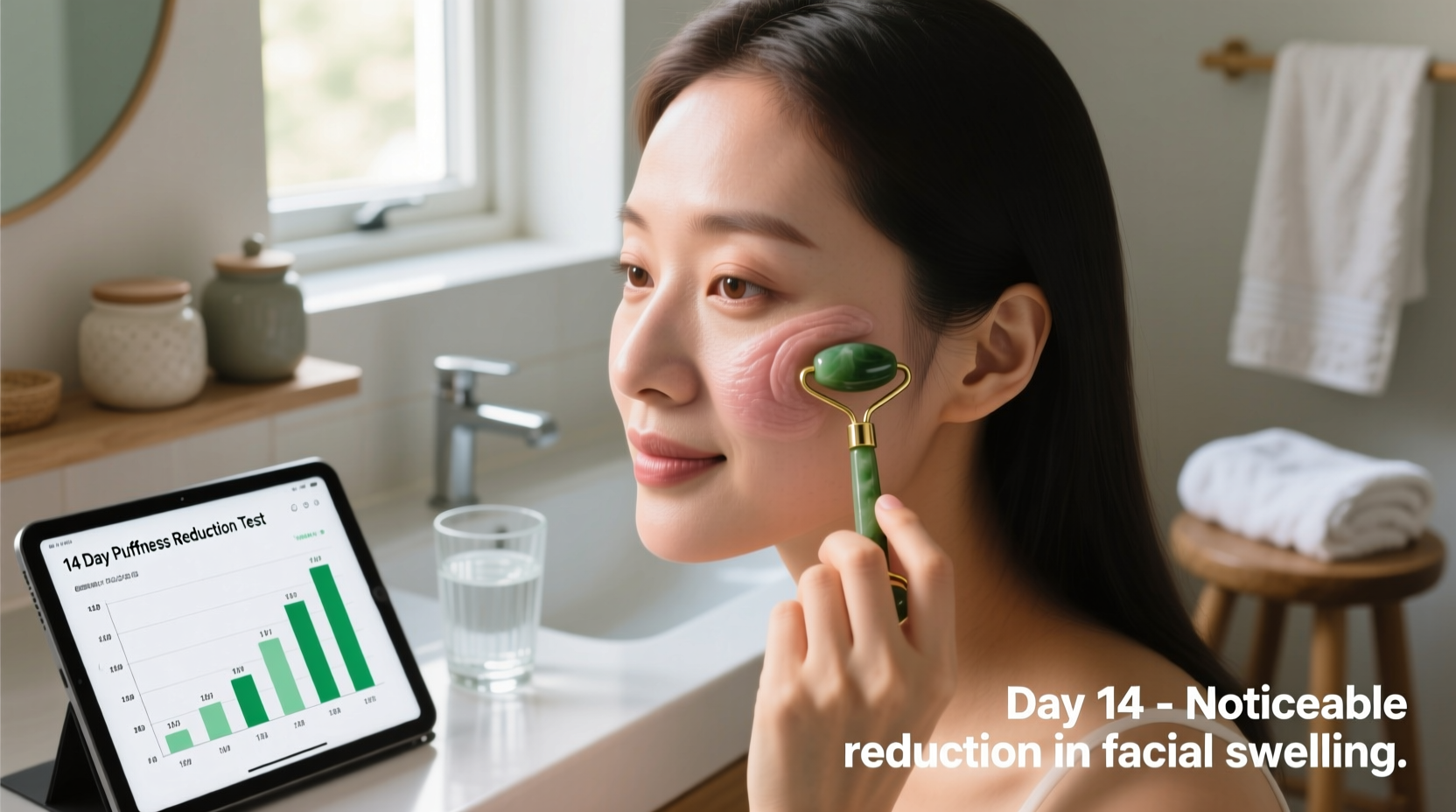
By day three, I noticed a subtle difference: my face appeared slightly more awake immediately after rolling. The under-eye area looked less swollen, though the effect lasted only 1–2 hours. By day seven, consistency began to pay off. Morning photos showed a modest improvement in jawline definition, particularly on the right side (my non-dominant sleeping side).
At the two-week mark, the cumulative effects were clearer—not dramatic, but measurable. Here’s a breakdown of observed changes:
| Area | Day 1 Observation | Day 14 Observation | Change |
|---|---|---|---|
| Under-Eye Puffiness | Moderate swelling, shadowing visible | Reduced volume, less shadow | ✔️ Mild improvement |
| Jawline Definition | Slight softness, minimal contour | Sharper angle, less fullness | ✔️ Noticeable refinement |
| Cheek Fullness | Puffy appearance upon waking | Flatter profile, quicker resolution | |
| Overall Radiance | Dull, tired look | Fresher, more even tone | ✔️ Subjective glow increase |
The most consistent benefit was speed: puffiness resolved faster post-rolling than on control mornings (when no rolling occurred). While not transformative, the ritual contributed to a more alert appearance within 10–15 minutes of use.
Real Example: A Side-by-Side Shift
On day 10, I had a video call scheduled at 8:00 AM. Normally, I’d feel self-conscious about my puffy eyes and would reach for cold spoons or eye masks. This time, I rolled for five minutes post-wakeup. My colleague commented, “You look really well-rested today,” despite having slept only six hours. That feedback wasn’t about actual rest—it was about visual cues. The reduced under-eye fullness and lifted cheek contour created an illusion of better sleep, proving that even subtle improvements can influence perception.
How to Maximize Results: Best Practices
Not all rolling routines are equally effective. Technique, timing, and tool choice matter. Based on my test and dermatological guidance, here’s how to get the most from your facial roller:
- Chill the roller: Store it in the fridge overnight. Cold temperature constricts blood vessels and reduces inflammation.
- Use light pressure: Excessive force can damage capillaries or stretch delicate skin.
- Follow lymphatic flow: Start from the center of the face and move outward—never downward.
- Be consistent: Benefits are cumulative. Occasional use yields minimal results.
- Pair with skincare: Once the test ended, I added a lightweight serum. Rolling helped absorption and enhanced the cooling effect.
Do’s and Don’ts of Facial Rolling
| Do’s | Don’ts |
|---|---|
| Roll for 3–5 minutes daily | Don’t press too hard |
| Keep the tool clean | Don’t use on broken or irritated skin |
| Store it cold | Don’t expect overnight miracles |
| Move slowly and deliberately | Don’t roll downward—this can encourage sagging |
| Focus on areas prone to fluid retention | Don’t substitute rolling for medical treatment of chronic swelling |
Expert Insights: What Dermatologists Say
While anecdotal evidence abounds, clinical data on facial rollers remains limited. However, experts acknowledge their potential when used appropriately.
“The physical act of massage does stimulate circulation and may aid in transient fluid displacement. It’s not a miracle cure, but it can be a useful adjunct to a healthy skincare routine.” — Dr. Alicia Nguyen, Cosmetic Dermatologist
Dr. Nguyen emphasizes that expectations must be realistic. “Facial rollers won’t replace injectables, lasers, or proper sleep. But if someone finds that rolling helps them feel more awake and committed to their skincare, that psychological benefit has value.”
She also warns against overuse: “I’ve seen patients develop broken capillaries from aggressive rolling. Gentle is the keyword.”
Step-by-Step Morning Routine for Puffiness Reduction
Based on the 14-day test and expert recommendations, here’s an optimized 7-minute morning sequence:
- Wash hands (30 seconds): Prevent transferring bacteria to the face.
- Rinse face with cool water (1 minute): Helps tighten skin and prep for massage.
- Retrieve chilled roller: Use immediately while cold.
- Under-eye area (1.5 minutes): Starting at the inner corner, roll outward in small strokes along the orbital bone. Repeat 5 times per side.
- Jaw and neck (2 minutes): Begin at the chin, roll outward along the jawline to the ears. Then, sweep down the sides of the neck to drain toward the collarbone.
- Forehead and cheeks (1.5 minutes): From the center of the forehead, roll upward to the hairline. On cheeks, move from nose to temples.
- Follow with moisturizer or serum (30 seconds): Lock in hydration and support skin barrier.
Total time: under 7 minutes. This routine became a grounding ritual—less about instant transformation, more about intentional self-care.
FAQ: Common Questions About Facial Rollers
Can facial rollers really reduce puffiness?
Yes, but temporarily. Rolling promotes lymphatic drainage and increases circulation, which can reduce fluid buildup and make puffiness resolve faster. It doesn’t eliminate puffiness at the source but provides a short-term decongesting effect.
How long does it take to see results?
Most users notice subtle improvements in skin firmness and eye area brightness within 5–7 days of consistent use. Significant changes in facial contouring are unlikely without complementary lifestyle factors like hydration, diet, and sleep quality.
Are jade rollers better than rose quartz or metal?
Material matters less than technique and temperature. Jade retains cold well and is traditionally valued, but rose quartz is denser and stays cooler longer. Stainless steel rollers offer the strongest cooling effect and are easier to sanitize. Choose based on preference and budget.
Conclusion: A Worthwhile Ritual—With Realistic Expectations
After 14 days of disciplined use, I can confirm: facial rollers do help reduce morning puffiness—but not in the way viral social media clips suggest. There’s no instant facelift or permanent slimming. Instead, the benefits are subtle, cumulative, and rooted in improved microcirculation and lymphatic flow.
The real value lies in consistency and ritual. Taking five minutes each morning to gently massage the face fosters mindfulness, enhances product absorption, and delivers a perceptible refresh. For those struggling with morning bloating or dullness, a chilled roller is a low-cost, low-risk tool worth trying.




 浙公网安备
33010002000092号
浙公网安备
33010002000092号 浙B2-20120091-4
Comments
No comments yet. Why don't you start the discussion?