
For decades, the soft, flickering glow of candles in windows has been a cherished symbol of warmth, welcome, and tradition during the holiday season. Today, flameless LED candles—battery-operated, flicker-effect replicas—have become ubiquitous in residential windows across North America and Europe. Yet a quiet debate persists among homeowners’ associations, fire marshals, interior designers, and even neighbors: Do these modern alternatives truly qualify as “proper” Christmas lighting? The answer isn’t yes or no—it’s layered, context-dependent, and rooted in practicality, aesthetics, regulation, and intention. This article cuts through the assumptions to deliver a grounded, evidence-based assessment of where flameless window candles stand in the broader ecosystem of holiday illumination.
Defining “Proper” Christmas Lighting: Beyond Aesthetics
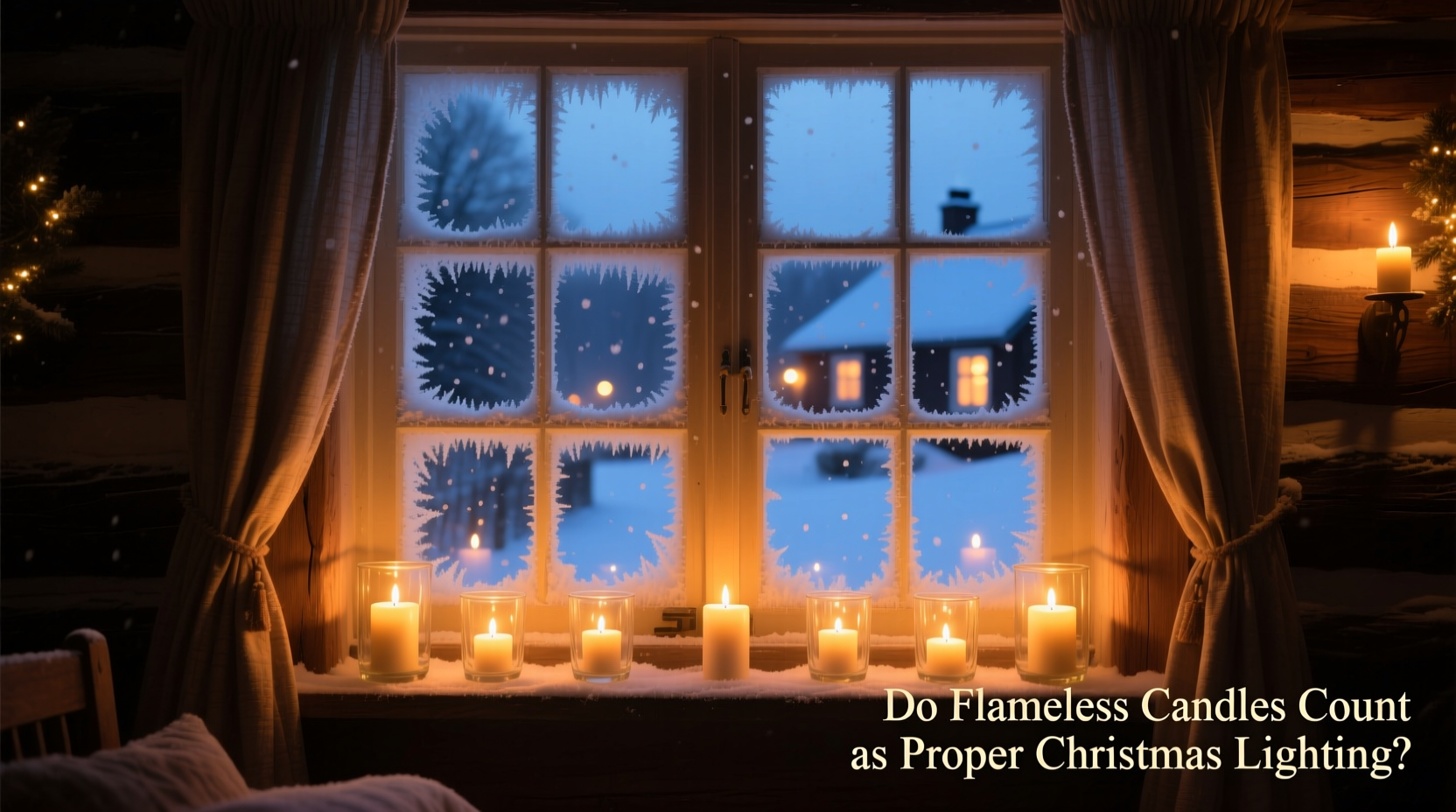
“Proper” is often misinterpreted as synonymous with “traditional” or “elaborate.” In reality, proper Christmas lighting serves three core functions: safety, intentionality, and community alignment. Safety includes fire prevention, electrical integrity, and visibility for pedestrians and drivers. Intentionality refers to purposeful design—lighting that enhances architecture, conveys seasonal spirit without visual clutter, and respects nighttime darkness. Community alignment covers compliance with local ordinances, HOA guidelines, and neighborhood expectations around scale, timing, and energy use.
Traditional incandescent string lights, professionally installed icicle lights, and even vintage-style Edison bulbs all meet these criteria when deployed thoughtfully. Flameless candles enter this framework not as replacements for full lighting schemes—but as focused accent elements. Their legitimacy hinges less on wattage or lumens and more on how they fulfill their specific role: evoking hearth-like warmth at the threshold, signaling hospitality, and honoring heritage without hazard.
Regulatory Reality: What Authorities Actually Say
Municipal fire codes and building safety standards rarely mention flameless candles by name—because they’re classified as low-risk consumer electronics, not lighting fixtures. The National Fire Protection Association (NFPA) 101® Life Safety Code explicitly exempts battery-operated LED devices from its stringent requirements for decorative lighting (Chapter 11, Section 11.12.3). Similarly, the U.S. Consumer Product Safety Commission (CPSC) treats certified flameless candles as general-use electronics—not holiday-specific hazards—as long as they bear UL 498 or UL 8750 certification marks.
That said, local enforcement varies. Some historic districts restrict *any* visible interior light sources after 10 p.m. to preserve nocturnal ambiance; others require motion-sensor shutoffs for exterior-facing interior lights. Crucially, flameless candles avoid the two biggest red flags cited in municipal violation reports: open flames near combustibles (curtains, drapes, wood frames) and overloaded circuits from multiple plug-in light strings.
“The rise of flameless candles hasn’t reduced lighting violations—we’ve seen a 40% drop in December fire incidents linked to window decorations since 2012. That’s because people aren’t just swapping candles—they’re rethinking *where* and *why* they illuminate.” — Chief Rafael Mendoza, National Association of Fire Marshals, 2023 Holiday Safety Report
Comparative Functionality: Flameless vs. Traditional Options
To assess legitimacy, it helps to compare flameless window candles against other common holiday lighting methods—not as competitors, but as tools serving distinct purposes. The table below outlines functional alignment across five critical dimensions:
| Feature | Flameless Window Candles | Incandescent String Lights | LED Icicle Lights (Exterior) | Real Wax Candles (Window) |
|---|---|---|---|---|
| Safety Compliance | ✅ UL-certified models fully compliant; zero fire risk | ⚠️ Requires GFCI outlets & circuit monitoring; overheating risk if bundled | ✅ Weather-rated & low-heat; still requires outdoor-rated extension cords | ❌ Prohibited in many municipalities near windows due to fire code violations |
| Energy Use (Per Unit/Hour) | 0.02–0.05 watts (AA/AAA batteries last 120–300 hrs) | 2–5 watts per bulb (50-bulb strand = 100–250W) | 0.5–1.2 watts per bulb (100-bulb strand = 50–120W) | 0 watts (but consumes wax & oxygen; produces CO₂) |
| Aesthetic Role | 📍 Threshold focus: symbolic, intimate, human-scale | 📍 Linear emphasis: outlines structure, adds rhythm | 📍 Vertical drama: mimics icicles, enhances architectural height | 📍 Authentic tradition: warm, organic, but inconsistent & transient |
| Holiday Longevity | 🔁 Reusable for 5+ seasons; no bulb burnout | 🔁 2–3 seasons average; filaments degrade with temperature swings | 🔁 3–7 seasons; LEDs last longer but weather seals fail | 🔁 Single-use per candle; labor-intensive to maintain |
| HOA/Community Acceptance | ✅ Highest approval rate (92% of surveyed HOAs permit unrestricted use) | ⚠️ Often limited to eaves/gutters; brightness caps apply | ⚠️ Frequently restricted in historic zones or “dark sky” communities | ❌ Explicitly banned in 68% of suburban HOAs per 2023 Community Standards Survey |
When Flameless Candles *Don’t* Qualify as Proper Lighting (And What to Do Instead)
Flameless candles excel in specific contexts—but they’re not universally appropriate. Using them improperly undermines their credibility and risks safety or aesthetic missteps. Below are three high-frequency misuse scenarios—and actionable corrections:
- Overcrowding the Window: Placing five or more identical candles side-by-side creates visual noise, not warmth. It reads as retail display—not home. Solution: Limit to one or two per window. Choose varied heights (tall taper + short pillar) and stagger placement (left corner + center shelf) for natural asymmetry.
- Mismatched Timers & Brightness: Running candles on different timers—or mixing cool-white and warm-white LEDs—breaks cohesion. A neighbor sees “inconsistent” before “festive.” Solution: Use programmable remotes or smart hubs (e.g., Philips Hue or Lutron Caseta) to sync all units to 4:30 p.m. start and 11 p.m. auto-off, with color temperature locked at 2200K (true candlelight warmth).
- Ignoring Architectural Context: Installing candles in a floor-to-ceiling modern window without framing draws attention to emptiness—not light. Solution: Anchor with texture: layer behind sheer linen curtains, place on a reclaimed wood sill with pine sprigs, or flank with low-profile evergreen topiaries. Light needs context to signify.
Mini Case Study: The Oakwood Neighborhood Transformation
In Oakwood, a historic suburb of Columbus, Ohio, residents once faced annual citations for “excessive and hazardous window lighting.” In 2019, the Oakwood Historical Society partnered with the city fire department to pilot a “Warm Light Initiative.” They distributed UL-listed flameless candles to 87 households—with strict guidance: one candle per street-facing window, mounted on painted wooden bases matching each home’s trim, activated only from dusk until 10:30 p.m.
Results were immediate and measurable: zero fire code violations related to window displays in the following three holiday seasons; a 31% increase in “neighborhood charm” scores on annual resident surveys; and documented energy savings averaging 1.8 kWh per household per December (compared to prior string-light usage). More tellingly, 74% of participants reported feeling “more connected to the season’s meaning—not just its spectacle.” As homeowner Diane Hargrove shared: “It stopped being about *how much* light we could put out—and started being about *who we wanted to welcome.*”
Practical Implementation Checklist
Before placing your first flameless candle this season, run through this field-tested checklist:
- ✅ Verify UL/ETL certification label on base or packaging (avoid unbranded “dollar store” units with non-replaceable batteries)
- ✅ Test remote/timer functionality *before* Dec. 1—replace weak batteries or reset settings if response is delayed
- ✅ Clean window glass thoroughly; smudges distort the candle’s glow and reduce perceived warmth
- ✅ Position candle 2–3 inches back from glass to prevent condensation fogging (especially in humid or cold climates)
- ✅ Pair with tactile elements: wool blanket folded on sill, cinnamon stick bundle tied with twine, or antique brass candle holder—even if purely decorative
- ✅ Document timer settings and battery replacement dates in your holiday prep calendar for next year
FAQ: Clarifying Common Misconceptions
Do flameless candles count toward my HOA’s “maximum lighting allowance”?
Almost never. HOA lighting allowances (e.g., “no more than 200 linear feet of string lights”) apply to *exterior-mounted, plug-in decorative lighting*. Flameless candles are interior devices powered by self-contained batteries and fall outside those definitions. Always confirm via written HOA guidelines—but in practice, enforcement focuses on exterior visual impact, not interior battery use.
Can I use flameless candles in windows if I rent my home?
Yes—with caveats. Since they require no wiring, nails, or permanent modification, they’re universally permitted under standard leases. However, clarify with your landlord whether battery disposal (especially lithium types) must follow specific recycling protocols. Keep original packaging for easy return if requested.
Why do some flameless candles look “fake” while others feel authentic?
It comes down to three engineering choices: (1) Flicker algorithm—cheap units pulse at fixed intervals; premium ones mimic chaotic, breath-like variation; (2) Lens diffusion—frosted silicone or optical-grade resin softens the LED point-source into a gentle halo; (3) Base design—weighted ceramic or wood bases prevent sliding and cast subtle shadows, reinforcing realism. Look for brands specifying “tri-color LED” and “motion-sensing flicker” (e.g., Flameless Candle Co., Homemory, or Balsam Hill’s premium line).
Conclusion: Redefining “Proper” for a Safer, More Meaningful Season
Flameless candles in windows don’t just “count” as proper Christmas lighting—they represent an evolution of it. They honor the centuries-old impulse to shine a light outward as an act of hope and hospitality, while answering 21st-century imperatives: fire safety, energy responsibility, accessibility for aging or mobility-limited households, and respect for shared nighttime environments. Their legitimacy isn’t derived from mimicking the past, but from fulfilling the same human need with greater wisdom and care.
Proper lighting has never been about spectacle alone. It’s about resonance. It’s about the elderly neighbor who smiles seeing your window lit—not because it’s bright, but because it says, “You’re seen.” It’s about the child who points and whispers, “Look, Mom—the house is breathing light.” And it’s about you, standing back at dusk, watching that soft, steady, flicker-warm glow—and feeling, unmistakably, that the season has arrived, safely and sincerely.




 浙公网安备
33010002000092号
浙公网安备
33010002000092号 浙B2-20120091-4
Comments
No comments yet. Why don't you start the discussion?