
Metallic painted ornaments—those shimmering baubles on holiday trees, vintage-style wall hangings, and modern tabletop accents—are prized for their reflective depth and dimensional warmth. Yet many owners notice fine white lines, dulled patches, or flaking edges after just a season of handling or storage. This isn’t poor craftsmanship alone; it’s physics meeting aesthetics. Metallic paint isn’t metal—it’s pigment suspended in resin, layered over substrate. Its vulnerability stems from material hierarchy: the topmost layer is often thinner, softer, and less abrasion-resistant than what lies beneath. Understanding this distinction transforms how we handle, store, clean, and preserve these decorative objects—not as disposable decor, but as delicate surface art.
Why metallic paint scratches more readily than solid metal or enamel
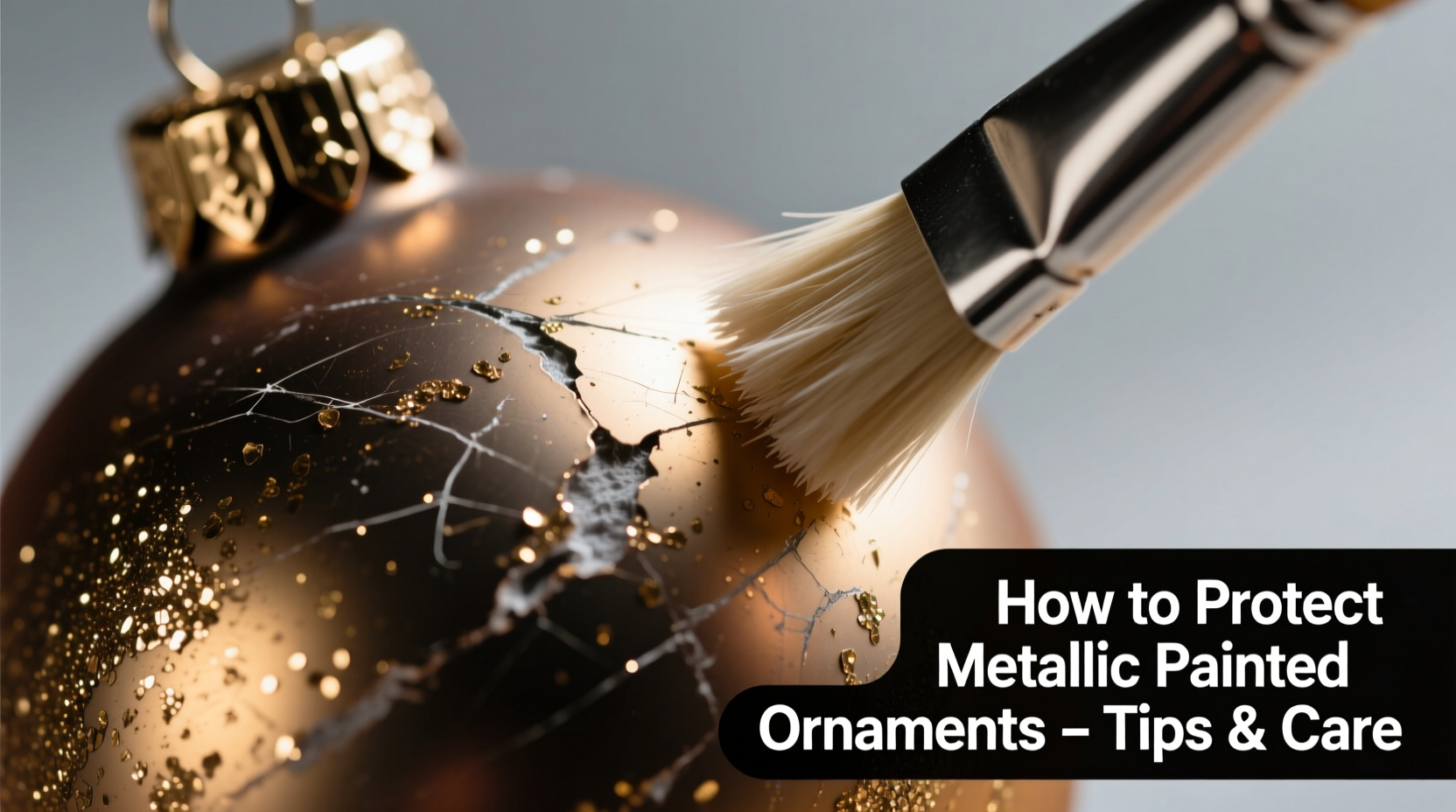
Metallic paint achieves its luster through microscopic flakes of aluminum, copper, or bronze suspended in acrylic, polyurethane, or nitrocellulose binders. Unlike electroplated or anodized metal, where the reflective layer is molecularly bonded to the base, painted metallics rely on adhesion strength and film integrity. A 2022 study published in the Journal of Coating Technology and Research measured pencil hardness (a standard ASTM D3363 test) across common decorative finishes: solid brass scored 4H, powder-coated steel scored 3H, while high-gloss metallic acrylic paint averaged only HB–B. That gap explains why fingernails, velvet-lined boxes with stray threads, or even microfiber cloths used too vigorously can compromise the surface.
The issue compounds during curing. Most mass-produced ornaments use air-dry or low-bake processes (under 60°C), resulting in incomplete cross-linking of polymer chains. Incomplete curing leaves the film softer and more prone to plastic deformation—what appears as a “scratch” is often a groove where binder has been displaced, not pigment removed. Under magnification, true scratches reveal lifted edges and exposed substrate; lighter marks are compression zones where metallic flakes have tilted away from optimal light reflection, creating localized dullness.
How to assess scratch risk before purchase or display
Not all metallic finishes carry equal risk. Before adding an ornament to your collection—or gifting one—evaluate these four physical indicators:
- Substrate rigidity: Tap the ornament lightly. A hollow, tinny ring suggests thin stamped metal or plastic core—more likely to flex under pressure and shear the paint layer. A deeper, muted thud signals thicker metal or dense resin, offering better support.
- Cure verification: Look for manufacturer markings like “oven-cured,” “UV-cured,” or “post-baked.” These indicate higher cross-link density. Avoid items labeled “air-dried” or “fast-dry” unless explicitly rated for interior decorative use.
- Topcoat presence: Hold the ornament at a 45° angle under daylight. Does the shine appear uniform and glassy, or does it look “flat-shiny”—like pigment sitting on top? The former suggests a clear protective overcoat (polyurethane or acrylic); the latter means the metallic layer is exposed.
- Edge definition: Examine where paint meets unpainted areas (e.g., hanging loops or base rims). Sharp, clean transitions indicate precision spraying and controlled drying. Fuzzy, feathered, or slightly runny edges suggest rushed application and weaker interlayer adhesion.
Conservators at the Museum of Decorative Arts confirm this assessment protocol. As senior conservator Dr. Lena Petrova notes: “We’ve treated 17th-century gilded wood and 1950s metallic ceramic figurines side by side. The consistent predictor of surface loss isn’t age—it’s whether the metallic layer was isolated by a barrier coat. Without it, humidity cycling, thermal expansion, and incidental contact all accelerate failure.”
Proven protection strategies: from daily handling to long-term storage
Protection isn’t about eliminating contact—it’s about managing energy transfer. Every interaction imparts kinetic force. Reduce force, distribute pressure, and eliminate abrasive agents.
Handling protocol
- Always hold ornaments by non-painted structural elements: hooks, loops, or reinforced bases—not by the body or protruding details.
- Wash and dry hands thoroughly before touching. Skin oils accelerate oxidation in copper-based metallics and soften acrylic binders over time.
- Never stack ornaments directly—even “soft” ones like felt or velvet can embed micro-abrasives into painted surfaces during vibration or shifting.
Cleaning methodology
Never use water, alcohol, or all-purpose cleaners. Moisture wicks under compromised edges; solvents swell binders. Instead:
- Dust weekly with a clean, dry, ultra-soft brush (e.g., makeup brush with natural goat hair).
- For light smudges: use a lint-free cotton pad lightly dampened with distilled water—not tap water—and dab (never rub) for 2 seconds. Immediately follow with a dry pad.
- For stubborn residue: mix 1 part isopropyl alcohol (99%) with 9 parts distilled water. Apply to cotton pad, squeeze until barely damp, and press—not swipe—over affected area. Test first on reverse side.
Storage systems that prevent micro-scratching
| Method | Why It Works | Risk If Done Poorly |
|---|---|---|
| Individual acid-free tissue paper wraps + rigid cardboard dividers | Tissue cushions impact; dividers prevent lateral movement and pressure points | Using newsprint or dyed tissue—ink transfers and reacts with metallic pigments |
| Hanging storage in ventilated wooden cabinet with padded hooks | Eliminates surface contact entirely; wood buffers humidity swings | Overcrowding hooks causes ornaments to swing and collide |
| Vacuum-sealed bags with silica gel packets | Removes oxygen and moisture—critical for copper/bronze metallics prone to verdigris | Excessive vacuum pressure deforms thin substrates and stresses paint adhesion |
Mini case study: Restoring a family heirloom set
In 2023, Sarah M., a textile historian in Portland, inherited her grandmother’s 1962 Christmas ornament collection—24 hand-blown glass balls coated in copper- and gold-toned metallic paint. After decades in a cedar chest with wool blankets, 11 showed fine radial scratches radiating from hanging points, and three had oxidized green halos around the metal caps. She consulted a decorative arts conservator who diagnosed two root causes: wool fibers abrading paint during storage shifts, and cedar oil vapor reacting with copper pigment.
The restoration wasn’t repainting—it was stabilization. Each ornament was cleaned with the distilled water/isopropyl method, then given a single, ultrathin mist coat of Paraloid B-72 (an archival acrylic resin used by museums for reversible surface consolidation). Finally, they were rehoused in custom-cut foam trays lined with Tyvek®—a synthetic, non-linting, pH-neutral material that cradles without gripping. Five years later, Sarah reports zero new scratches and stable color retention—even through seasonal humidity changes. Her key insight: “I stopped treating them as ‘just decorations’ and started treating them as what they are—fragile, chemistry-dependent artifacts.”
Step-by-step: Applying a protective topcoat (for DIY-safe applications)
Only attempt this on ornaments confirmed to have fully cured paint (no solvent smell after 72 hours) and no existing flaking. Never coat antique or valuable pieces without professional consultation.
- Prepare the environment: Work in a dust-free room (close windows, turn off HVAC) at 20–24°C and 45–55% relative humidity. High humidity causes blushing; low humidity accelerates solvent evaporation and orange-peel texture.
- Clean meticulously: Use compressed air to remove dust, then wipe with a lint-free cloth dampened with mineral spirits (test first). Let dry 30 minutes.
- Select coating: Choose a non-yellowing, UV-stabilized acrylic clear coat (e.g., Krylon Crystal Clear Acrylic Spray, matte or satin finish). Avoid lacquers—they’re too aggressive for aged paint.
- Apply technique: Shake can 2 minutes. Hold 12 inches from surface. Use 3–4 light, overlapping passes—never one heavy coat. Allow 15 minutes drying between passes. Total film thickness should remain under 25 microns.
- Cure patiently: Let sit undisturbed for 72 hours before handling. Full chemical cure takes 14 days—avoid polishing or cleaning during this period.
“Surface protection isn’t about making something indestructible—it’s about extending the window between inevitable wear and visible degradation. A proper topcoat adds 3–5 years to functional life for most modern metallic paints.” — Rafael Chen, Industrial Coatings Engineer, Sherwin-Williams Decorative Division
FAQ
Can I use car wax or furniture polish on metallic ornaments?
No. Automotive waxes contain silicones and abrasives designed for thick automotive clear coats—not delicate decorative films. Furniture polishes often include petroleum distillates that swell acrylic binders and attract dust. Both leave residues that accelerate yellowing and create sticky zones where lint adheres permanently.
Does humidity cause scratching—or just tarnishing?
Humidity doesn’t directly cause scratches, but it enables them. At >60% RH, microscopic water layers form on surfaces, turning dust particles into mild abrasives during contact. More critically, moisture ingress at paint edges causes substrate swelling, lifting the film and exposing vulnerable cut edges to mechanical damage. For copper-based metallics, high humidity also triggers oxidation—green corrosion that undermines adhesion and creates pitting that mimics deep scratching.
Are “scratch-resistant” metallic ornaments truly different—or just marketing?
They are materially distinct—but with caveats. True scratch resistance comes from either ceramic-infused binders (e.g., nano-silica hybrids) or dual-layer systems: a base metallic coat followed by a hardened clear topcoat (≥3H pencil hardness). However, “scratch-resistant” claims aren’t standardized. Always verify third-party testing data—if unavailable, assume standard vulnerability applies. Many budget ornaments labeled “scratch-resistant” merely use thicker paint films, which crack rather than scratch, creating different but equally damaging failure modes.
Conclusion
Metallic painted ornaments occupy a compelling middle ground between craft and chemistry. Their beauty lies precisely in their delicacy—the way light fractures across imperfectly aligned flakes, the warmth of pigment that breathes with ambient temperature, the quiet patina that develops with respectful age. Scratching isn’t inevitable; it’s the result of mismatched expectations and unexamined habits. When you choose to hold an ornament by its hook instead of its face, wrap it in archival tissue instead of tissue paper from the grocery store, or pause before reaching for that all-purpose cleaner—you’re not just preserving finish. You’re honoring the material intelligence behind its making. These objects carry memory, intention, and aesthetic labor. Protecting them isn’t maintenance—it’s continuity.




 浙公网安备
33010002000092号
浙公网安备
33010002000092号 浙B2-20120091-4
Comments
No comments yet. Why don't you start the discussion?