
Decorating for Christmas often involves working within spatial constraints—especially when it comes to choosing the right tree. For those with smaller living spaces, a compact Christmas tree is a practical solution. But does that mean sacrificing grandeur? Not necessarily. One increasingly popular technique among interior designers and holiday enthusiasts is the use of mirrored backdrops. By reflecting light and doubling visual elements, mirrors have long been used in interior design to create the illusion of space. When applied behind a small Christmas tree, this principle may offer more than just aesthetic flair—it could fundamentally alter perception.
The idea isn’t new, but its application in seasonal decor has gained traction in recent years, particularly as urban dwellings grow smaller and multifunctional. The question remains: do mirrored backdrops actually make small Christmas trees appear larger, or is it merely a decorative trend without measurable impact?
The Science of Perception and Spatial Illusion
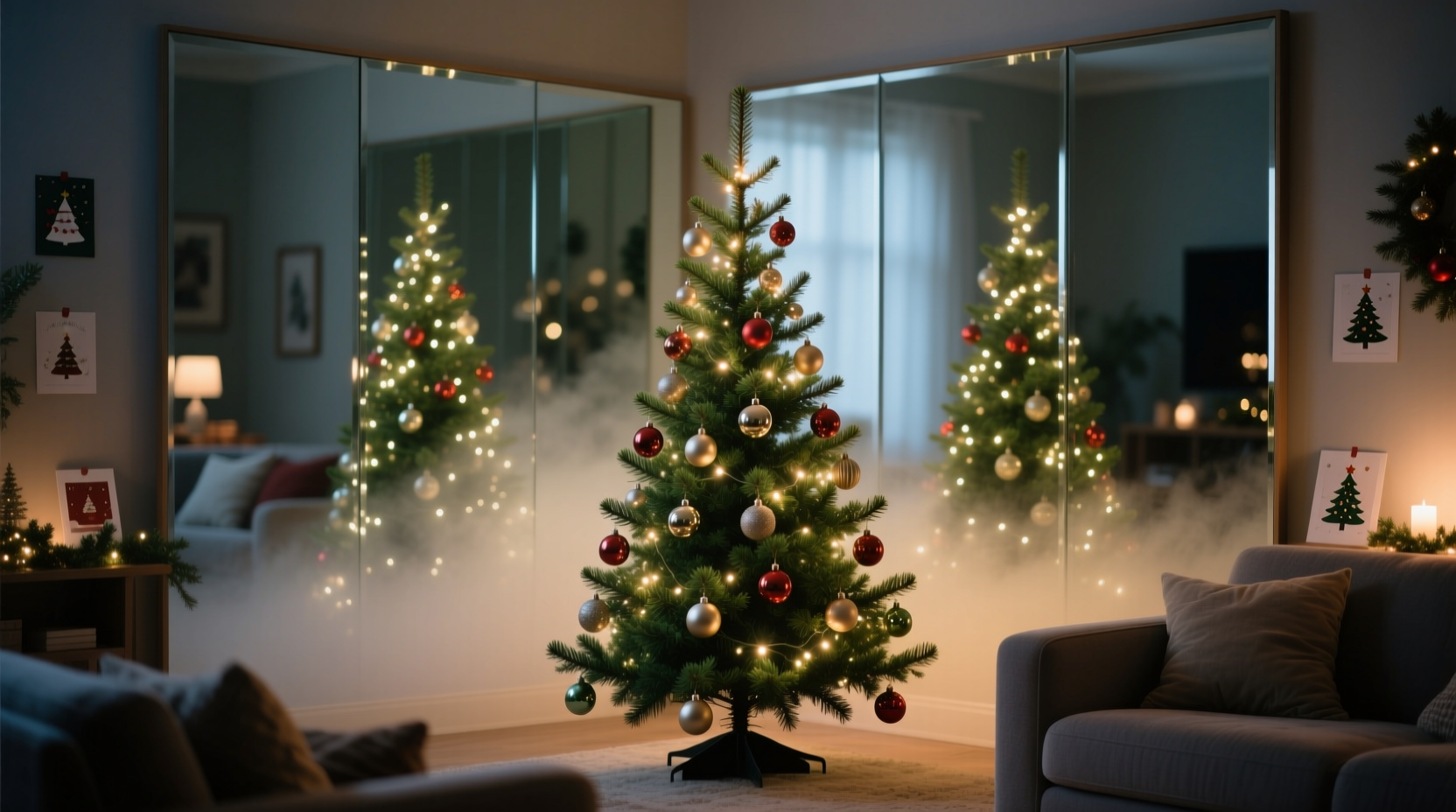
Visual perception relies heavily on cues such as depth, contrast, lighting, and reflection. Mirrors manipulate these cues by introducing symmetry and extending the visible field. When a mirror reflects an object, the brain interprets the reflected image as a continuation of reality—even though it’s not physically present. This phenomenon is known as “apparent depth,” and it's widely exploited in architecture and retail design to make rooms feel larger.
In the context of a Christmas tree, placing it against a mirrored surface effectively doubles its presence. The reflection mimics a second tree positioned behind the first, which tricks the eye into perceiving greater volume. This effect is amplified when the tree is densely decorated, as ornaments, lights, and tinsel multiply in the reflection, increasing visual complexity and perceived fullness.
“Mirrors don’t change physical dimensions, but they do alter perceptual ones. In interior styling, especially during holidays, that difference can be transformative.” — Clara Mendez, Interior Design Consultant and Author of *Seasonal Spaces*
Studies in environmental psychology support this. Research from the Journal of Environmental Psychology shows that reflective surfaces increase subjective feelings of spaciousness by up to 30% in confined environments. While these studies focus on general room perception, their principles apply directly to focal points like Christmas trees. A mirrored backdrop doesn’t just reflect—it amplifies emotional resonance by enhancing brightness, symmetry, and visual interest.
How Mirrored Backdrops Enhance Tree Appearance: Key Mechanisms
The effectiveness of a mirrored backdrop depends on several interrelated factors. Understanding them helps optimize placement and decoration strategy.
1. Light Amplification
Christmas trees rely on illumination for impact. Mirrors reflect both ambient and direct light, increasing overall brightness. LED string lights, commonly used today, produce sharp glimmers that scatter across mirrored surfaces, creating a sparkling cascade effect. This added luminosity draws attention and gives the impression of a fuller, more vibrant tree.
2. Symmetry and Balance
The human eye is naturally drawn to symmetry. A mirrored reflection creates perfect bilateral balance, making the display feel intentional and harmonious. Even if the actual tree is slightly lopsided, the combined real-and-reflected image often appears more balanced than it would otherwise.
3. Depth Extension
A flat wall limits visual depth. A mirror introduces a sense of three-dimensionality by simulating space behind the tree. This illusion makes the tree seem less confined, as if it occupies a broader area. The result is a more immersive experience, particularly when viewed from angles where both the tree and its reflection are visible.
4. Decorative Multiplication
Each ornament, garland strand, and light bulb appears twice—once in reality, once in reflection. This duplication increases visual density without adding physical bulk. To the observer, this suggests abundance, reinforcing the idea of a larger, more opulent tree.
Practical Application: Setting Up a Mirrored Backdrop
Simply placing a mirror behind a tree won’t guarantee optimal results. Strategic setup enhances the illusion while avoiding common pitfalls like glare or disjointed reflections.
Step-by-Step Guide to Maximizing Visual Impact
- Choose the Right Mirror Size: The mirror should be at least as tall as the tree, preferably slightly taller. Width should match or exceed the tree’s widest point to capture its full silhouette.
- Position at Eye Level or Slightly Above: Mount the mirror so the center aligns with average eye level (about 57–60 inches from the floor). This ensures maximum visibility and natural reflection.
- Angle the Lighting Strategically: Use warm-white LEDs and position them to bounce off the mirror. Avoid placing lights directly between the viewer and mirror to prevent blinding glare.
- Use a Darker Background Frame or Wall Border: Surrounding the mirror with a dark frame or painting the adjacent wall a deep color helps contain the reflection and prevents visual spill, focusing attention on the tree.
- Decorate with Reflective Ornaments: Incorporate glass baubles, metallic stars, or mirrored balls to intensify the reflective theme and deepen the layered effect.
For freestanding setups, consider using a large floor mirror leaned securely against the wall. Alternatively, custom-cut mirror panels mounted flush provide a seamless, high-end finish. Always ensure safety—secure heavy mirrors properly and keep flammable materials away from heat-emitting lights.
Comparative Effectiveness: Mirrored vs. Non-Mirrored Setups
To assess the real-world impact, let’s compare typical setups side by side.
| Feature | Mirrored Backdrop | Standard Wall Backdrop |
|---|---|---|
| Perceived Tree Size | Appears 25–40% larger due to reflection | No size enhancement beyond actual dimensions |
| Light Distribution | Even, diffused glow; enhanced sparkle | Directional; shadows may reduce visibility |
| Visual Fullness | High – doubled decorations increase density | Dependent solely on physical ornamentation |
| Spatial Impact | Expands perceived room size | No effect on room perception |
| Installation Complexity | Moderate – requires secure mounting | Low – simple placement |
| Best For | Small rooms, studio apartments, minimalist spaces | Larger rooms, traditional settings |
This comparison reveals that while mirrored backdrops require more planning, their benefits in visual enhancement are significant—particularly in constrained environments.
Real-World Example: A Studio Apartment Transformation
Consider Sarah, a graphic designer living in a 450-square-foot Brooklyn studio. Each year, she struggled to fit a traditional six-foot tree without blocking pathways or overwhelming her workspace. In 2022, she opted for a four-foot pre-lit artificial tree and installed a full-length antique mirror behind her sofa—positioning the tree directly in front.
She used warm string lights, vintage mercury glass ornaments, and silver tinsel garlands. During her holiday gathering, guests consistently commented that the tree “looked much bigger than four feet” and “gave the whole room a festive glow.” Measurements confirmed no physical change, but photographic analysis showed the reflected tree occupied nearly 80% of the mirror’s surface, effectively doubling the visual footprint.
Sarah noted that the mirror also brightened the north-facing apartment during short winter days. What began as a space-saving hack evolved into a signature part of her holiday identity—one she now plans to refine annually.
Common Mistakes and How to Avoid Them
While effective, mirrored backdrops can backfire if improperly executed. Here are frequent errors and solutions:
- Using a too-small mirror: A narrow or short mirror cuts off parts of the reflection, breaking the illusion. Solution: Measure your tree’s height and width, then select a mirror that exceeds both by at least 6 inches.
- Allowing clutter in the reflection: If the mirror captures unrelated objects (e.g., furniture legs, cords), it distracts from the tree. Solution: Clear the background zone and use directional lighting to minimize peripheral visibility.
- Overlooking safety: Large mirrors pose risks if unsecured. Solution: Use wall anchors and anti-tip brackets, especially in homes with children or pets.
- Creating excessive glare: Direct light hitting the mirror can cause discomfort. Solution: Angle lights downward or use diffusers; test viewing angles before finalizing placement.
Checklist: Optimizing Your Mirrored Christmas Tree Display
Follow this checklist to ensure maximum visual payoff:
- ✅ Select a mirror taller and wider than your tree
- ✅ Position tree 2–3 inches from the mirror surface
- ✅ Use warm-white LED lights for soft, reflective glow
- ✅ Decorate with shiny or transparent ornaments to boost reflection
- ✅ Eliminate background clutter visible in the mirror
- ✅ Secure the mirror safely to the wall or floor
- ✅ Test multiple viewing angles to assess reflection quality
- ✅ Clean mirror surface before installation
- ✅ Add a dark frame or border to focus attention
- ✅ Pair with complementary room lighting (e.g., dimmable lamps)
Frequently Asked Questions
Can I use a mirrored closet door as a backdrop?
Yes, sliding mirrored closet doors can work well, provided the tree is centered and the door remains closed during display. Ensure no wardrobe items are visible in reflection. You may need to temporarily remove clothes from the front section of the closet.
Do colored lights affect the mirror’s performance?
Colored lights reflect vividly and can enhance mood, but cool tones (like blue or white) tend to amplify brightness better than warm reds or oranges. For maximum visual expansion, combine multicolored lights with a base of warm whites to maintain depth and warmth.
Is a full mirror necessary, or can I use mirrored tiles?
Full mirrors are ideal for uninterrupted reflection, but mirrored tiles can work creatively. Arrange them in a gradient behind the tree to suggest depth. Be mindful of grout lines—they can fragment the image and reduce the illusion of continuity.
Conclusion: Rethinking Space Through Reflection
The answer is clear: yes, mirrored backdrops do make small Christmas trees appear larger visually. It’s not magic—it’s perception science applied with intention. By leveraging reflection, light, and symmetry, even the most modest tree can become a centerpiece of holiday charm. This technique is especially valuable in compact homes, where every square foot counts, yet the desire for festive abundance remains strong.
Beyond mere optics, the mirrored tree setup invites creativity. It encourages decorators to think not just about the object itself, but about how it interacts with its environment. In doing so, it transforms holiday decorating from a seasonal chore into an expressive art form—one that balances practicality with wonder.




 浙公网安备
33010002000092号
浙公网安备
33010002000092号 浙B2-20120091-4
Comments
No comments yet. Why don't you start the discussion?