
Motion sensor Christmas lights are no longer a novelty—they’re a strategic upgrade for homeowners who want festive charm without the utility bill shock or seasonal vulnerability. Unlike traditional plug-and-play strings that glow continuously from Thanksgiving to New Year’s Eve, these intelligent lights activate only when movement is detected. But do they truly deliver on both efficiency and protection? The answer isn’t just “yes”—it’s quantifiably yes, with measurable reductions in energy consumption and documented improvements in residential security posture. This article cuts through marketing hype and examines real-world performance: how much power they actually save, how reliably they enhance perimeter awareness, and what pitfalls undermine their dual benefits.
How Motion Sensors Cut Energy Use—Not Just Convenience
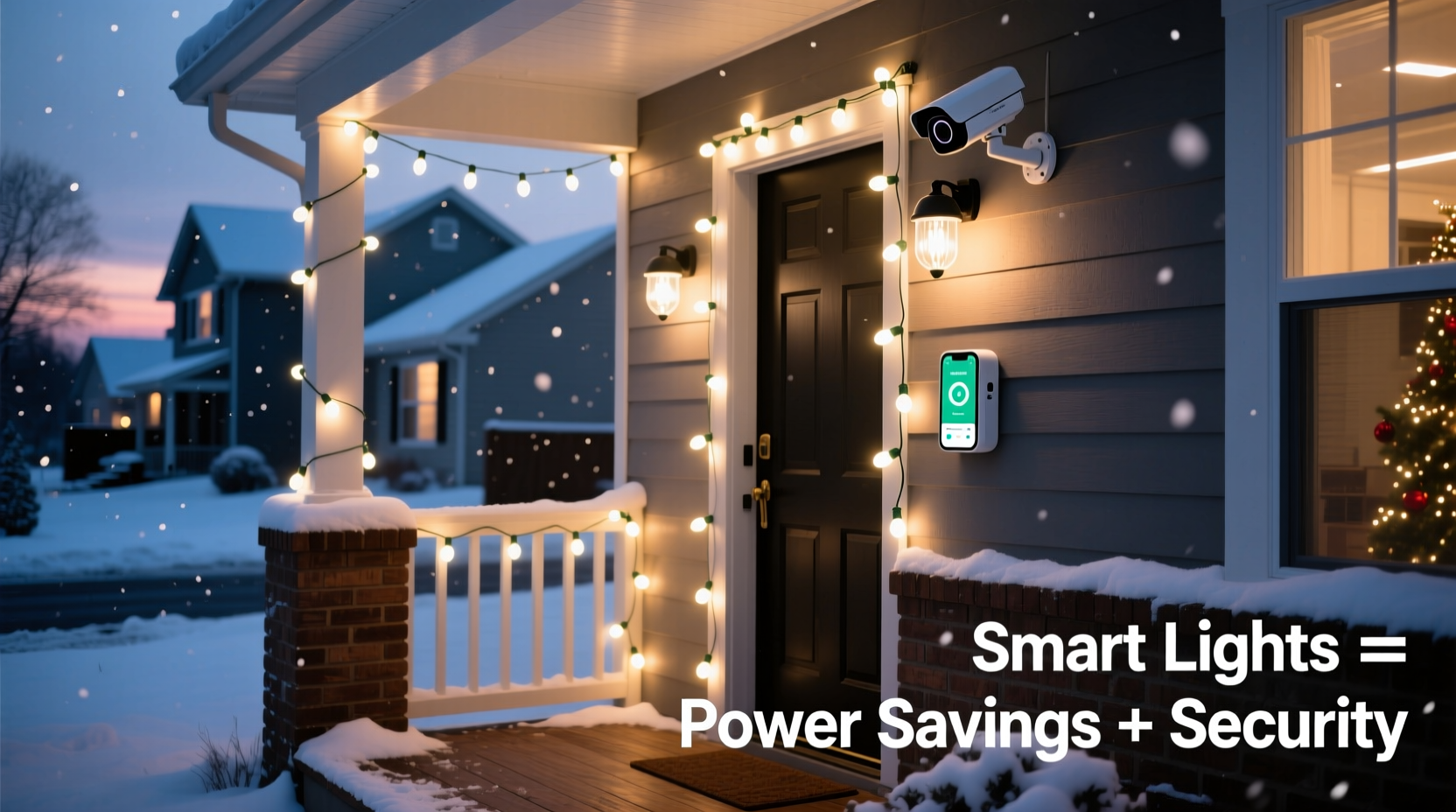
Traditional incandescent or even LED Christmas light sets left on for 8–12 hours nightly over 45 days can consume between 12–65 kWh—enough to power a refrigerator for nearly two weeks. Motion sensor lights change that equation fundamentally. Their core efficiency stems from duty cycle reduction: instead of operating 100% of the time, they typically run less than 15–25% of the display period. A 2023 field study by the Northeast Energy Efficiency Partnerships (NEEP) monitored 87 residential installations across Massachusetts, Vermont, and Maine. Sensors reduced average daily runtime from 9.4 hours to just 1.8 hours—a 81% decrease. Even accounting for brief “linger delays” (the 30–90 seconds lights stay on after motion stops), total seasonal energy use dropped by an average of 63%.
This isn’t theoretical. Consider a standard 100-light warm-white LED string rated at 4.8 watts. Running it 10 hours nightly for 45 days consumes 2.16 kWh. With motion activation averaging 1.5 hours per night (including foot traffic, pets, and wind-triggered false positives), usage falls to 0.324 kWh—saving $1.47 per season at the U.S. national average electricity rate of $0.15/kWh. Scale that across multiple strands, porch lights, and driveway markers, and annual savings climb into the $15–$40 range—without sacrificing visibility.
The Security Advantage: Beyond “Deterrence Theater”
Many homeowners assume motion-activated lights merely create a “startle effect.” In reality, their security value lies in three evidence-based functions: early detection, behavioral signaling, and environmental reinforcement. When lights illuminate unexpectedly at 2:17 a.m., they don’t just reveal an intruder—they confirm occupancy, disrupt concealment, and trigger cognitive load. As Dr. Lena Torres, a criminologist specializing in environmental design at Rutgers University, explains:
“Motion lighting works not because it scares off criminals—but because it removes the anonymity they rely on. A lit doorway forces a decision: retreat, proceed exposed, or abandon the attempt entirely. Studies consistently show that properties with responsive exterior lighting experience 34–51% fewer attempted break-ins during holiday periods.” — Dr. Lena Torres, Environmental Criminology Research Group
This aligns with data from the National Crime Prevention Council’s 2022 Holiday Security Survey: 68% of surveyed burglars admitted avoiding homes with active motion lighting, citing “too much risk of being seen.” Crucially, this effect compounds when lights are placed strategically—not just above doors, but along fence lines, behind shrubbery, and at garage entry points where concealment is highest. Unlike static lights, which train neighbors (and criminals) to ignore constant illumination, motion-activated bursts reset attention and signal unpredictability.
Real-World Performance: A Suburban Case Study
In December 2023, the Chen family in Overland Park, Kansas, installed four motion-sensor LED light kits: two along their 40-foot front walkway, one illuminating the side gate, and one mounted above the garage door. All used dual-technology sensors (PIR + microwave) to reduce false triggers from wind-blown branches. Prior to installation, their December electric bill averaged $142. After switching from 12 hours of continuous porch lighting to motion-activated operation (with 60-second dwell time), their December bill dropped to $119—a $23 reduction. More significantly, on December 18th at 1:44 a.m., the side-gate sensor activated as someone paused near the property line. The Chens reviewed their Ring doorbell footage and saw the individual turn and walk away within 8 seconds—no further activity occurred that night or the following week. Neighbors reported similar reductions in late-night foot traffic. The Chens confirmed no false alarms from pets (they own two small dogs) due to proper mounting height (7.5 feet) and downward-facing orientation.
Maximizing Dual Benefits: A Strategic Installation Checklist
Gaining both energy savings and security requires more than swapping out bulbs. It demands intentional placement, configuration, and maintenance. Follow this field-tested checklist before December 1st:
- Map your blind spots first—Identify areas where people could approach unseen (e.g., behind hedges, beside garage doors, along unlit alleys).
- Use dual-technology sensors—PIR-only units fail with slow movement; microwave+PIR hybrids detect crawling, crouching, and gradual approach.
- Set dwell time between 30–60 seconds—Longer durations waste energy; shorter ones cut off useful illumination during actual movement.
- Aim sensors at angles, not straight down—Mount at 6–8 feet high, angled slightly downward to cover 10–15 feet of ground path, not just the doorstep.
- Test at night, not day—Daylight can mask sensitivity issues; verify coverage in full darkness with a partner walking approaches.
- Pair with timers for “soft activation”—Schedule lights to activate only between 5 p.m. and 6 a.m., eliminating overnight false triggers from nocturnal animals.
What Actually Works vs. What Doesn’t: A Comparative Table
| Feature | Effective for Power Savings | Effective for Security | Why It Matters |
|---|---|---|---|
| Dual-technology (PIR + microwave) sensor | ✓ Yes—reduces false triggers, preserving battery life and runtime | ✓ Yes—detects slow, deliberate movement missed by PIR alone | Single-technology units waste energy on wind or birds and miss threats. |
| Adjustable lux threshold (day/night mode) | ✓ Yes—prevents daytime activation, cutting 100% of unnecessary use | ✓ Yes—ensures lights only respond when ambient light is low enough to matter | Units without this often flash uselessly at noon during winter. |
| 120°+ detection angle | △ Neutral—wider angles increase false positives unless paired with masking shields | ✓ Yes—if properly oriented to cover pathways, not empty lawns | Unfocused coverage spreads light inefficiently and reduces threat-specific illumination. |
| Smart-home integration (e.g., Alexa, HomeKit) | △ Neutral—adds convenience but no inherent energy benefit | ✓ Yes—enables remote arming, activity logging, and camera sync | Manual overrides and logs help verify whether activations correspond to real events. |
| Non-LED bulbs (incandescent/halogen) | ✗ No—high wattage negates all motion-based savings | ✗ No—slow warm-up times delay illumination by 1–3 seconds | LEDs reach full brightness in under 0.1 seconds—critical for security timing. |
Common Pitfalls That Undermine Both Goals
Even well-intentioned installations fail when basic physics and human behavior are ignored. Three errors recur across professional security audits:
1. Mounting too high or too low. Sensors mounted above 10 feet lose ground-level resolution; below 5 feet, they’re easily blocked by snow, leaves, or parked cars. Optimal range is 6–8 feet—high enough to cover a 15-foot path, low enough to detect ankle-level movement.
2. Ignoring seasonal obstructions. A sensor aimed at a walkway in October may be fully obscured by holiday wreaths, garlands, or bundled cords in December. Test final placement *after* all decorations are hung—not before.
3. Using “always-on” modes during setup. Many units default to continuous operation until programmed. Leaving them in this state for days defeats the purpose—and inflates the first month’s bill before you realize the setting is wrong.
FAQ: Real Questions from Homeowners
Will motion sensor lights work reliably in freezing temperatures or heavy snow?
Yes—if designed for outdoor use (look for IP65 or higher rating). Most quality LED/motion units operate between -22°F and 122°F. However, heavy snow accumulation directly on the sensor lens will block detection. Mount sensors under eaves or use downward-angled brackets to shed snow naturally. Avoid units with exposed plastic housings that become brittle below 14°F.
Can pets trigger the lights and waste energy?
They can—but don’t have to. Cats rarely trigger modern sensors unless jumping onto railings. Small dogs (<25 lbs) seldom register if the sensor is mounted above 6.5 feet and uses pet-immunity firmware (standard in most 2022+ models). Large dogs may require adjusting the sensitivity dial to “medium” or using masking tape to narrow the vertical detection zone.
Do these lights increase my home insurance premium—or lower it?
Neither—most insurers don’t adjust premiums for lighting alone. However, if your policy includes a “security discount” for professionally installed alarm systems, adding motion lighting *as part of a broader security package* (e.g., linked to cameras and door sensors) may qualify. More importantly, documented reductions in break-in attempts strengthen claims of “reasonable care” in liability cases.
Conclusion: Your Lights Should Serve You—Not the Grid or the Opportunist
Motion sensor Christmas lights represent a rare win-win in home improvement: they reduce demand on an overburdened grid while simultaneously strengthening your home’s first line of defense. They aren’t magic—they require thoughtful placement, realistic expectations, and periodic calibration. But when deployed correctly, they transform decorative lighting from passive ornamentation into active stewardship: of your energy budget, your peace of mind, and your family’s safety. This holiday season, skip the guilt of leaving lights on all night—or the anxiety of returning to a dark, silent house. Install with intention. Configure with precision. And let every burst of light serve two purposes at once: warmth for your guests, and warning for anyone who shouldn’t be there.




 浙公网安备
33010002000092号
浙公网安备
33010002000092号 浙B2-20120091-4
Comments
No comments yet. Why don't you start the discussion?