
Walk into any online dating forum or couples’ workshop, and you’re likely to hear someone ask: “What’s your MBTI type?” From INFJ to ESTP, millions swear by the Myers-Briggs Type Indicator as a roadmap to romantic compatibility. But behind the viral quizzes and Instagram infographics lies a more complex question: Do these personality assessments actually predict whether two people will thrive—or crash—in a relationship?
The short answer is nuanced. While personality types can offer valuable self-awareness and spark meaningful conversations, they are not reliable predictors of long-term relationship success on their own. Science suggests that deeper psychological factors—like emotional intelligence, attachment styles, communication patterns, and shared values—play far more decisive roles.
The Allure of Personality Typing in Relationships
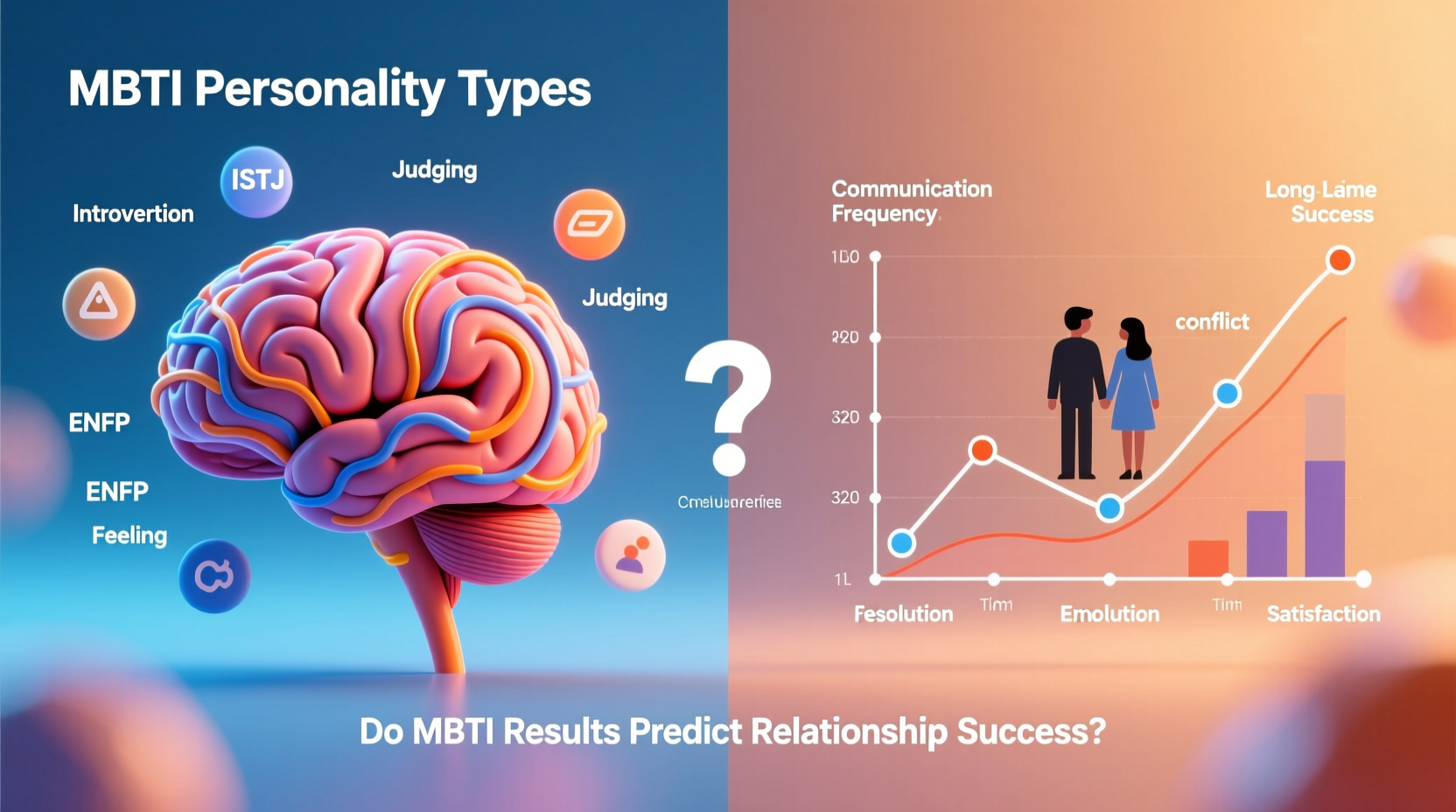
The appeal of using tools like the MBTI in romance is understandable. Human beings crave simplicity in the messy world of love. Reducing complex personalities to 16 types offers a comforting illusion of predictability. It's easier to believe that an \"INTJ\" and an \"ENFP\" are destined to balance each other than to confront the hard work of building trust, resolving conflict, and growing together over time.
Developed in the 1940s by Katharine Briggs and Isabel Briggs Myers, the MBTI categorizes individuals along four dichotomies:
- Introversion (I) vs. Extraversion (E) – Where you draw energy from
- Sensing (S) vs. Intuition (N) – How you gather information
- Thinking (T) vs. Feeling (F) – How you make decisions
- Judging (J) vs. Perceiving (P) – How you approach the outside world
The resulting 16 types promise insight into behavior, preferences, and interpersonal dynamics. In relationships, enthusiasts often cite \"complementary types\" — such as an analytical ISTJ paired with a warm ESFP — as ideal matches.
What Does the Research Say?
Despite its popularity, the MBTI has faced consistent criticism from academic psychologists. A major issue is its lack of scientific validity and reliability. Studies show that up to 50% of people receive different results when retaking the test just five weeks later, undermining its consistency.
More robust models, like the Big Five Personality Traits (Openness, Conscientiousness, Extraversion, Agreeableness, Neuroticism), have stronger empirical support. Research consistently links high agreeableness and low neuroticism with greater relationship satisfaction. These traits are predictive because they reflect emotional stability and cooperative tendencies—key ingredients for partnership resilience.
“Personality matters in relationships, but not in the way pop psychology suggests. It’s not about type matching—it’s about how individuals manage emotions, resolve conflict, and adapt over time.” — Dr. John Gottman, Relationship Researcher & Author of *The Seven Principles for Making Marriage Work*
A 2017 meta-analysis published in the Journal of Research in Personality found no significant correlation between MBTI types and marital satisfaction. Meanwhile, studies on the Big Five show that partners high in emotional stability and conscientiousness report higher intimacy and lower divorce rates.
Where Personality Tests Fall Short
The fundamental flaw in using MBTI for relationship forecasting is reductionism. Love isn’t governed by cognitive preferences alone. Real-world relationship success depends on:
- How securely attached each partner is
- Their ability to communicate during conflict
- Shared life goals and values
- Willingness to grow and compromise
- External stressors like finances, health, and family dynamics
No personality quiz captures these dimensions. For example, two INFJs may both value deep connection, but if one has an anxious attachment style and the other avoids vulnerability, their relationship may struggle regardless of “type compatibility.”
Moreover, the MBTI presents personality as fixed. Yet modern psychology emphasizes that people evolve. Relying on static labels can create self-fulfilling prophecies—e.g., “I’m an introvert, so I can’t be social for my partner”—when growth and adaptation are possible.
Common Misconceptions About MBTI and Love
| Misconception | Reality |
|---|---|
| \"Opposites attract\" means contrasting types are ideal. | Differences can complement, but core value alignment is more important than cognitive style. |
| If our types 'match,' we’ll have a successful relationship. | Type similarity doesn't protect against poor communication or unresolved trauma. |
| My partner should naturally understand me based on my type. | Understanding requires active listening, not assumptions based on labels. |
| MBTI explains why we fight. | Fights stem from unmet needs, not whether one is a 'Thinker' or 'Feeler.' |
Beyond the Test: What Actually Predicts Relationship Success
If not MBTI, then what? Decades of longitudinal research point to evidence-based predictors of lasting love.
1. Emotional Intelligence (EQ)
Couples who regulate their emotions, empathize with each other, and express feelings constructively handle stress better. High EQ enables repair after arguments—a critical skill given that all couples argue.
2. Attachment Security
Rooted in early childhood experiences, attachment styles (secure, anxious, avoidant) shape how people relate. Securely attached individuals tend to trust, communicate openly, and seek closeness without fear of engulfment or abandonment.
3. The Gottman Institute’s “Four Horsemen”
Psychologist John Gottman identified four behaviors that predict divorce with over 90% accuracy:
- Criticism – Attacking character instead of addressing behavior
- Contempt – Sarcasm, mockery, eye-rolling
- Defensiveness – Refusing accountability
- Stonewalling – Withdrawing emotionally
These behaviors matter far more than whether someone prefers planning (Judging) over spontaneity (Perceiving).
4. Shared Values and Life Vision
Agreement on key issues—children, finances, religion, lifestyle—reduces chronic conflict. Two ENFPs may bond over excitement and creativity, but if one wants children and the other doesn’t, friction becomes inevitable.
5. Effort and Intentionality
Successful relationships aren’t found—they’re built. Regular check-ins, date nights, therapy, and gratitude practices strengthen bonds over time.
Mini Case Study: When MBTI Led Them Astray
Lena and Mark met on a dating app where both listed their MBTI types—she was an INFP, he an ENTJ. Excited by the “ideal match” narrative around intuitive feelers and thinkers, they assumed synergy was guaranteed. Early dates were electric—deep conversations, mutual admiration.
But within months, tension grew. Lena felt criticized when Mark offered efficiency tips on her freelance work. Mark felt frustrated when Lena needed days to process decisions. They blamed their differences on “type mismatch,” citing the classic INFP sensitivity versus ENTJ directness.
Only in couples counseling did they uncover deeper issues: Lena had an anxious attachment style rooted in parental unpredictability; Mark avoided emotional discussions due to a dismissive upbringing. Their struggles weren’t about MBTI—they were about unhealed wounds and communication gaps.
With therapy, they learned to recognize triggers, express needs without blame, and appreciate differences as strengths. Today, they credit their growth not to personality typing, but to intentional effort and professional support.
Using Personality Tools Wisely: A Practical Checklist
That said, personality frameworks aren’t useless. When used responsibly, they can enhance self-awareness and dialogue. Here’s how to use them constructively:
- Use them as starting points, not endpoints. Discuss what the types suggest, but verify with real-life observation.
- Focus on behaviors, not labels. Instead of saying “You’re being so ISTJ right now,” say “I notice you’re focused on structure—can we talk about what’s driving that?”
- Combine with validated tools. Explore the Big Five or attachment style quizzes backed by research.
- Discuss preferences, not predictions. Talk about how you recharge, make decisions, or handle deadlines—not whether you’re “destined” to succeed.
- Revisit over time. People change. Reassess periodically with curiosity, not rigidity.
FAQ
Can two of the same MBTI types have a successful relationship?
Yes. Same-type couples often share communication styles and values, which can foster understanding. However, they may also amplify each other’s blind spots—e.g., two INFJs might avoid confrontation, leading to unresolved issues. Success depends on awareness and balance, not type alone.
Are there any personality tests that *do* predict relationship outcomes?
The Big Five model shows moderate predictive power, particularly regarding emotional stability and agreeableness. Tools like the Enneagram, when used thoughtfully, can also prompt introspection. However, no single test replaces observing how partners handle real-world challenges.
Should I break up if my MBTI type ‘doesn’t match’ my partner’s?
No. Ending a relationship based solely on personality typing ignores the complexity of human connection. Focus instead on how you treat each other, resolve conflict, and support growth. If serious issues exist, address them directly—with or without a personality label.
Conclusion: Look Beyond the Label
Personality tests like the MBTI offer a fun, accessible way to explore individual differences. They can spark reflection and open doors to meaningful conversations about needs, fears, and dreams. But they are not crystal balls.
Real relationship success emerges not from type compatibility, but from mutual respect, emotional maturity, and sustained effort. The healthiest partnerships aren’t between two people whose MBTI codes align perfectly—they’re between those willing to listen deeply, apologize sincerely, and grow together through life’s uncertainties.
Rather than searching for a “perfect match,” focus on becoming a better partner. Invest in self-awareness, practice empathy, and don’t hesitate to seek help when needed. Love isn’t about finding the right puzzle piece. It’s about learning how to build something enduring—together.




 浙公网安备
33010002000092号
浙公网安备
33010002000092号 浙B2-20120091-4
Comments
No comments yet. Why don't you start the discussion?