
Every December, millions of households unpack cardboard boxes filled with glitter, glass, wood, and handwritten names. A ceramic snowman from kindergarten. A photo bauble from a first Christmas as parents. A brass initial from a grandparent’s estate. These aren’t just decorations—they’re tiny time capsules. Yet as collections grow—often spanning decades and generations—many people pause mid-hang, ornament in hand, and ask: Is this meaningful—or just taking up space? The tension isn’t trivial. It reflects deeper questions about memory, intentionality, and how we curate meaning in an age of abundance. This isn’t about aesthetics alone; it’s about emotional economy—the balance between what we keep and what we carry.
The Psychology of Personalized Ornaments: Why We Keep Them
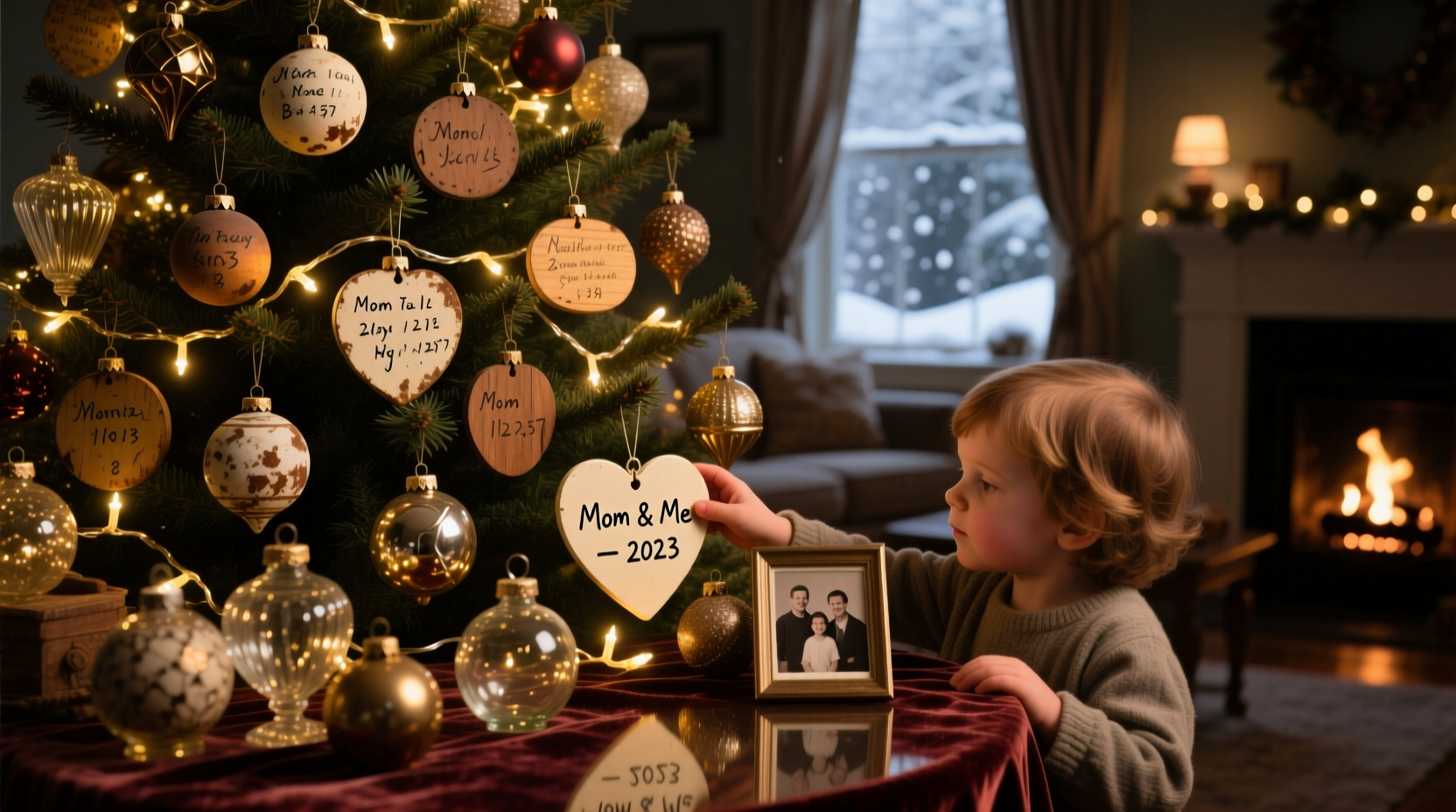
Personalized ornaments function as what psychologists call “material anchors for autobiographical memory.” Unlike generic decorations, they’re encoded with specific context: a year, a person, a milestone. Research from the University of California, Santa Cruz shows that tactile, visually distinct objects tied to emotionally significant events activate the hippocampus and ventromedial prefrontal cortex more robustly than photographs alone—making them potent memory triggers during repeated seasonal exposure.
This effect intensifies when ornaments are co-created (e.g., handprint clay stars made with toddlers) or gifted intentionally (a “Baby’s First Christmas” ornament presented at a newborn’s naming ceremony). The ritual of hanging them each year reinforces neural pathways associated with belonging, continuity, and intergenerational identity. In families with geographic dispersion, these ornaments become portable heirlooms—small, transportable pieces of shared history that require no explanation.
Yet this psychological benefit isn’t automatic. It depends on three conditions: intentional acquisition, consistent display, and shared narrative. An ornament purchased on impulse at a mall kiosk—without story, without ceremony, without annual reconnection—rarely accrues meaning over time. It sits in the box, waiting for significance that never arrives.
The Clutter Threshold: When Meaning Turns to Mass
There is a measurable point at which personalization shifts from resonance to redundancy. Behavioral economists refer to this as the “diminishing returns of symbolic density.” In practical terms: once a tree holds more than 12–15 ornaments with unique personal narratives, cognitive load increases. Viewers—and even the decorators themselves—struggle to distinguish individual stories amid visual noise. What was meant to honor each moment begins to blur into a monolithic “memory fog.”
A 2023 survey by the National Holiday Living Institute found that 68% of respondents owned 30+ personalized ornaments—but only 22% could verbally recount the story behind more than half of them. Worse, 41% admitted keeping ornaments they disliked aesthetically but felt “obligated” to hang due to perceived sentimental duty. This reveals a quiet crisis: not of excess, but of unexamined inheritance.
Clutter, in this context, isn’t merely physical. It’s emotional clutter—the weight of unresolved expectations, guilt-laden gifting, or nostalgia performed rather than felt. An ornament that evokes discomfort (“Aunt Carol’s overly critical comment written on the back”), obligation (“My sister’s third ‘World’s Best Aunt’ ornament”), or dissonance (“This ‘Family Unity’ ball from the year we filed for divorce”) doesn’t enrich—it burdens.
A Real Household Experiment: The Anderson Family’s 5-Year Ornament Audit
In 2019, the Andersons—a dual-income family with two children in Portland, Oregon—faced a turning point. Their ornament collection had swelled to 87 pieces. The attic box overflowed. Their 7-foot Fraser fir groaned under layers of mismatched glass, wood, and fabric. More troubling: their youngest, then 6, asked, “Why do we have so many ‘firsts’? Is there a ‘second’ one?”
That winter, they launched a gentle audit—not as decluttering, but as curation. Over five years, they implemented three practices:
- Annual Story Circle: On Christmas Eve, each family member selects one ornament to hold while sharing its origin. No pressure to choose “important” ones—just what feels resonant that year.
- The 5-Year Rule: Any ornament not selected for display in three consecutive years is respectfully retired: photographed, its story documented digitally, then gifted to a community center or donated to a hospice program’s holiday craft initiative.
- One-In, One-Out Policy: For every new personalized ornament acquired, one older piece is intentionally released—unless it meets a “legacy threshold”: displayed annually for 10+ years AND consistently referenced in family storytelling.
By 2024, their active collection stood at 32 ornaments. Their tree looked lighter—but their conversations richer. “We stopped counting ornaments,” says Maya Anderson, “and started listening to what each one wanted us to remember.”
Do’s and Don’ts of Meaningful Personalization
Intention transforms ornamentation from decoration into devotion. The difference lies not in the object, but in how it’s integrated into family practice. Below is a distilled comparison of approaches that build sentiment versus those that accumulate clutter.
| Action | Builds Sentiment | Creates Clutter |
|---|---|---|
| Acquisition | Chosen after a milestone (graduation, adoption, recovery), with time set aside to write its story together | Bought as a “must-have” during holiday shopping, with no reflection on relevance or narrative |
| Display | Hung deliberately—e.g., child-made ornaments at eye level for kids; legacy pieces near the trunk where light catches them | Stacked haphazardly, buried under tinsel or oversized bows, making identification difficult |
| Narrative Practice | Shared aloud each year during trimming; recorded in a dedicated “Ornament Journal” kept beside the tree | Assumed to be “self-explanatory”; stories forgotten or misattributed across generations |
| Storage | Organized by year or theme in labeled, acid-free boxes; fragile items individually wrapped | Tossed loosely into plastic bins; glass cracked, ribbons frayed, paint chipped from friction |
| Release | Retired with ceremony—e.g., a small “story farewell” before donating to a cause aligned with its origin | Discarded silently, hidden in storage, or left to deteriorate in damp basements |
Expert Insight: Beyond Decoration, Into Legacy
Dr. Lena Torres, cultural anthropologist and author of Ritual Objects: How Everyday Things Carry Memory, emphasizes that ornaments gain power not through permanence, but through *practice*:
“An ornament becomes sacred not because it’s irreplaceable, but because it’s repeatedly chosen. Every time you reach past the shiny new bauble to hang your mother’s chipped ceramic dove—that’s where meaning lives. Sentiment isn’t stored in the object; it’s rehearsed in the gesture. Clutter happens when the gesture stops, but the object stays.” — Dr. Lena Torres, Cultural Anthropologist
Torres’ fieldwork across 42 U.S. households revealed a consistent pattern: families reporting high holiday satisfaction didn’t own the most ornaments—they engaged in the most consistent, low-pressure storytelling rituals around them. In one Appalachian family, for example, ornaments weren’t hung until after dinner, when grandparents told “one story per ornament” while grandchildren placed them on the tree. The ritual took 47 minutes. The tree held 19 ornaments. No one counted them. Everyone remembered them.
Building Your Own Ornament Intentionality Plan
Creating meaning—not just managing inventory—requires structure. Here’s a realistic, adaptable 4-step plan designed for busy households:
- Inventory & Identify (Late November): Unpack all ornaments. Sort into three piles: Core Narrative (3–5 pieces tied to foundational family moments), Active Rotation (10–15 pieces with clear, recent stories), and Archive Candidates (everything else). Do not discard yet—just observe.
- Story Mapping (First Weekend in December): With household members, assign each Core and Active piece a 1-sentence story (“This is the ornament we hung the day Dad came home from chemo”). Write them on index cards. Place cards beside corresponding ornaments.
- Tree-Zone Design (Trimming Day): Divide your tree visually: Trunk Zone (legacy/core pieces), Middle Ring (active rotation), Outer Branches (non-personalized accents like pinecones or ribbon). Limit Core pieces to visible, touchable spots—no hiding meaning in the foliage.
- Release Ritual (January 2nd): Review Archive Candidates. For each, ask: “Has anyone spoken its name aloud in the last 12 months?” If no, photograph it, record its story digitally, and release it—donating, gifting, or repurposing. Keep a “Legacy Log” noting what left, why, and where it went.
FAQ: Practical Questions About Personalized Ornaments
What if I love an ornament but hate its aesthetic?
Reframe it as a story container—not a decor object. Mount it inside a shadow box on the wall near your tree instead of hanging it. Or place it on a side table with its story card. Beauty serves meaning; it needn’t dominate it.
How do I handle ornaments from estranged or deceased relatives without causing pain?
Designate a “Quiet Branch”—a single, lower section of the tree reserved for pieces carrying complex emotion. Hang them there without commentary. Their presence acknowledges reality; their placement honors boundaries. You may add a small, neutral tag: “Held with care.”
Is it okay to stop collecting personalized ornaments entirely?
Absolutely—and increasingly common. Many families now mark milestones with non-ornamental traditions: planting a tree, writing letters to future selves, or contributing to a “family impact fund.” Personalization isn’t exclusive to objects. The healthiest collections aren’t the largest—they’re the most honestly curated.
Conclusion: Choose Presence Over Possession
Personalized ornaments don’t inherently increase sentimental value—or create clutter. They reflect the values, rhythms, and honesty of the people who hang them. A single handmade paper star, displayed with full attention and told with tenderness, carries more emotional weight than fifty mass-produced baubles gathering dust in a box. The tree isn’t a museum. It’s a living archive—one that breathes, changes, and makes space for what matters this year.
You don’t need permission to simplify. You don’t need to preserve every token of every season. What endures isn’t the glass or the wood—it’s the warmth in the voice telling the story, the pause before hanging, the shared glance that says, We remember. We choose. We are here.




 浙公网安备
33010002000092号
浙公网安备
33010002000092号 浙B2-20120091-4
Comments
No comments yet. Why don't you start the discussion?