
Leaving home for the holidays is a joyful occasion—but it also introduces real vulnerability. According to the FBI’s 2023 Crime Data Explorer, residential burglaries spike 12% between Thanksgiving and New Year’s, with nearly 60% occurring during daylight hours when homes appear unoccupied. Many homeowners assume that stringing up programmable Christmas lights—especially those with motion triggers, random timers, or smartphone-controlled scenes—will make their property look “lived in” and therefore safer. But does that assumption hold up under scrutiny? The answer isn’t yes or no—it’s conditional. Programmable lights *can* support home security, but only when integrated into a broader, intentional strategy. This article cuts through marketing hype and examines what works, what doesn’t, and exactly how to deploy lighting as a credible layer of deterrence—not just decoration.
How Intruders Actually Assess Risk (and Why Lights Alone Aren’t Enough)
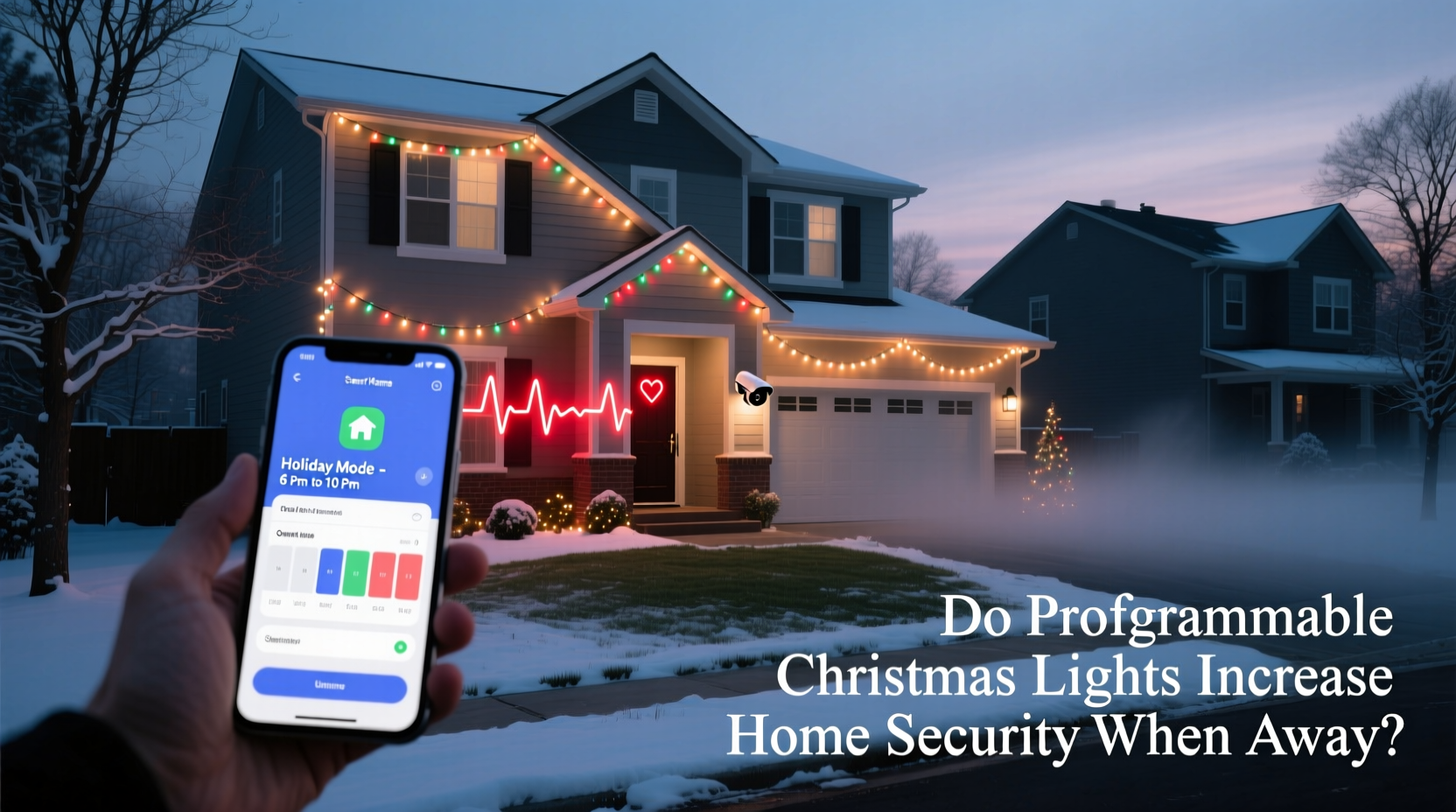
Research from the University of North Carolina’s 2022 Burglary Study surveyed 422 incarcerated residential burglars and found that 83% relied on observable cues to determine whether a home was occupied: mail piling up, newspapers on the driveway, overgrown lawns, dark windows at night, and—critically—inconsistent or implausible lighting patterns. Notably, 71% said they’d abandon a target if they saw signs of activity *at unpredictable times*, such as lights turning on mid-evening, flickering briefly in a bedroom, or illuminating the porch at 10:47 p.m. on a Tuesday. That’s where programmable lights gain traction: not because they’re festive, but because they introduce temporal unpredictability—a psychological signal of presence.
However, the same study revealed a critical caveat: 94% of respondents could distinguish between “real” human behavior and “automation tells.” For example, lights that turn on every night at precisely 5:00 p.m., remain static for four hours, then shut off at 9:00 p.m. were rated as “low risk” by 88% of participants. Likewise, synchronized whole-house light shows—while impressive—signal “vacation mode” more than “someone’s home.” Authenticity matters more than brightness.
What Programmable Lights Can—and Cannot—Do for Security
Programmable Christmas lights are not security devices. They lack sensors, alarms, recording capability, or integration with law enforcement systems. Their value lies solely in perception management: shaping how your home appears to passersby, delivery personnel, and opportunistic offenders. When deployed thoughtfully, they complement proven security measures—not replace them.
| Capability | Real-World Security Benefit | Limits & Risks |
|---|---|---|
| Randomized timing | Simulates natural human movement; disrupts pattern recognition used by offenders. | Requires careful calibration—too frequent or too long creates suspicion (“Why is the tree lit at 3 a.m.?”). |
| Zoned control (e.g., porch vs. backyard vs. upstairs) | Enables targeted activation mimicking room-specific use (e.g., kitchen light at 7:15 p.m., then hallway at 8:03 p.m.). | Most consumer-grade light strings lack true independent zone control without multiple hubs or smart plugs. |
| Remote triggering (via app or voice) | Allows real-time response—e.g., turning on front lights when a neighbor texts “I saw someone near your fence.” | Dependent on Wi-Fi reliability and app responsiveness; no fallback if internet drops. |
| Motion-activated scenes | Can startle or expose loiterers; useful for driveways or side yards. | Outdoor motion sensors often trigger falsely (pets, wind), eroding credibility over time. |
| Color/scene variety | Subtle warm-white-only modes blend with interior lighting; avoids “holiday display = empty house” bias. | Bright multicolor sequences draw attention and may signal absence—especially in neighborhoods where few others decorate. |
A Real-World Example: The Portland Vacation Test
In December 2023, Sarah M., a cybersecurity analyst in Portland, Oregon, scheduled a 10-day trip to visit family. She installed a $129 programmable LED string with app-based scheduling and zoned outlets. Her setup included three distinct behaviors: (1) porch light + front window string activated randomly between 4:45–6:15 p.m.; (2) a single warm-white bulb in her upstairs office turned on for 47 seconds at irregular intervals between 8–11 p.m.; and (3) the backyard string triggered only when her Ring doorbell detected motion after dusk.
On Day 4, her neighbor noticed a man “testing door handles” on two adjacent homes—including Sarah’s. He didn’t attempt entry at hers. When police reviewed Ring footage, they saw the backyard lights flash as the man stepped onto the patio—startling him enough to retreat immediately. Later, the officer told Sarah: “He didn’t know if someone was watching—or if the light meant someone had just walked into the yard. That hesitation gave us time to respond.” Crucially, Sarah’s system avoided common pitfalls: no all-night displays, no holiday music synced to lights, and no visible hub or router blinking in the window. Her lights worked not because they were bright, but because they introduced ambiguity—the most powerful deterrent in residential security.
How to Set Up Programmable Lights for Genuine Deterrence: A 5-Step Protocol
Effectiveness hinges on execution. Follow this field-tested sequence—not as a one-time setup, but as an ongoing practice before every extended absence.
- Conduct a “Vulnerability Walkaround” — Stand at street level at dusk. Note which exterior areas are naturally dark (side gate, garage entry, basement egress). Prioritize lighting these zones—not the roofline or front tree. Intruders avoid well-lit access points.
- Select Warm-White-Only Strings — Use 2700K–3000K color temperature LEDs. Cool white (5000K+) looks artificial at night; colored lights scream “decoration,” not “occupancy.” Reserve RGB modes for daytime viewing only.
- Layer Lighting Types — Combine one programmable string (e.g., porch + window) with one non-programmable but timed device (e.g., a simple plug-in timer for interior lamps) and one motion-activated fixture (e.g., solar path light near the back door). Diversity prevents pattern detection.
- Introduce “Human Glitches” — Program one light to activate for 23 seconds at 10:17 p.m. on Night 3, then skip Night 4 entirely, then run for 82 seconds at 11:02 p.m. on Night 5. Humans forget, adjust, and behave erratically—your lights should reflect that.
- Test & Refine for 72 Hours Pre-Departure — Observe your home from the sidewalk at different times. Ask a trusted neighbor to walk by and report what they infer. If they say, “Looks like you’re gone but trying hard,” revise your schedule.
Expert Insight: What Law Enforcement Really Sees
Captain Lena Torres of the Austin Police Department’s Neighborhood Crime Prevention Unit has overseen residential security outreach for 17 years. Her team analyzed 214 burglary reports filed during the 2022–2023 holiday season and cross-referenced them with visible security indicators:
“Lights alone don’t stop crime—but inconsistent, low-intensity, human-scale lighting does change behavior. We’ve seen repeat offenders bypass homes where a single light came on in the kitchen at 9:38 p.m. on three separate nights, then stayed on for just 90 seconds. Why? Because it suggests routine *with variation*. That’s harder to game than a motion light that blazes for five minutes every time a leaf blows past. The goal isn’t visibility—it’s cognitive friction.”
— Capt. Lena Torres, APD Neighborhood Crime Prevention Unit
Torres emphasizes that programmable lights become significantly more effective when paired with other occupancy signals: a parked car (even if borrowed), a visible holiday card on the front door, or a timed mailbox alert. “It’s about stacking small cues until the perceived risk outweighs the potential reward. One light won’t do it. Three coordinated, imperfect signals might.”
FAQ: Practical Questions Answered
Do smart lights work if my Wi-Fi goes down?
Most programmable Christmas lights rely on cloud-based apps and will default to last-saved settings—or go dark—if Wi-Fi fails. Choose models with local scheduling (e.g., LIFX Mini, Nanoleaf Shapes) or pair strings with smart plugs that retain schedules offline. Always test offline functionality before departure.
Is it safer to leave lights off entirely when away?
No—dark homes are statistically higher-risk targets. The U.S. Department of Justice’s 2021 Home Security Survey found that 68% of attempted break-ins occurred at residences with zero exterior lighting after dusk. The key isn’t light volume; it’s intelligent, variable illumination that avoids signaling vacancy.
Can I use indoor programmable lights instead of outdoor ones?
Yes—and often more effectively. Interior lights visible through windows (especially in living rooms, kitchens, and home offices) carry stronger occupancy weight than exterior displays. Use warm-white smart bulbs on randomized timers, and ensure curtains are partially open (not fully drawn) to allow subtle spill. Avoid bright, static ceiling lights—opt for table or floor lamps with soft diffusion.
Conclusion: Light Strategically, Not Just Brightly
Programmable Christmas lights don’t increase home security by default. They increase it only when treated as behavioral tools—not decorative accessories. Their power lies in introducing doubt: doubt about whether someone is home, doubt about whether movement has been observed, doubt about whether the next light flash might coincide with a neighbor stepping onto their porch or a patrol car slowing to glance. That doubt buys time—the most valuable currency in residential security. You don’t need the most expensive system or the brightest display. You need intentionality: choosing warm tones over flashy colors, prioritizing functional zones over festive spectacle, embracing randomness over routine, and always anchoring your lighting in the broader context of your home’s real-world security posture. Start small this season. Pick one vulnerable entry point. Program one string with three unpredictable 45-second activations across five evenings. Watch how it changes the way your home feels from the sidewalk—and how it shifts your own sense of confidence when the suitcase wheels click toward the door.




 浙公网安备
33010002000092号
浙公网安备
33010002000092号 浙B2-20120091-4
Comments
No comments yet. Why don't you start the discussion?