
The holiday season brings with it an unmistakable desire to transform homes into festive showcases. For decades, stringing traditional Christmas lights has been a cornerstone of seasonal decoration. But in recent years, projection Christmas lights have surged in popularity—offering dazzling visuals with minimal setup. This shift raises a key question: Are projection lights replacing traditional ones, or are they better used as complementary tools? The answer isn’t binary. It depends on goals, aesthetics, practicality, and personal preference.
Projection lights use high-lumen projectors to cast animated or static light patterns onto walls, roofs, or lawns. Traditional lights involve physical strings of LEDs or incandescent bulbs draped across eaves, trees, and railings. Each approach offers distinct advantages and limitations. Understanding how they function—and where they shine—can help homeowners make informed decisions about their holiday lighting strategy.
The Rise of Projection Christmas Lights
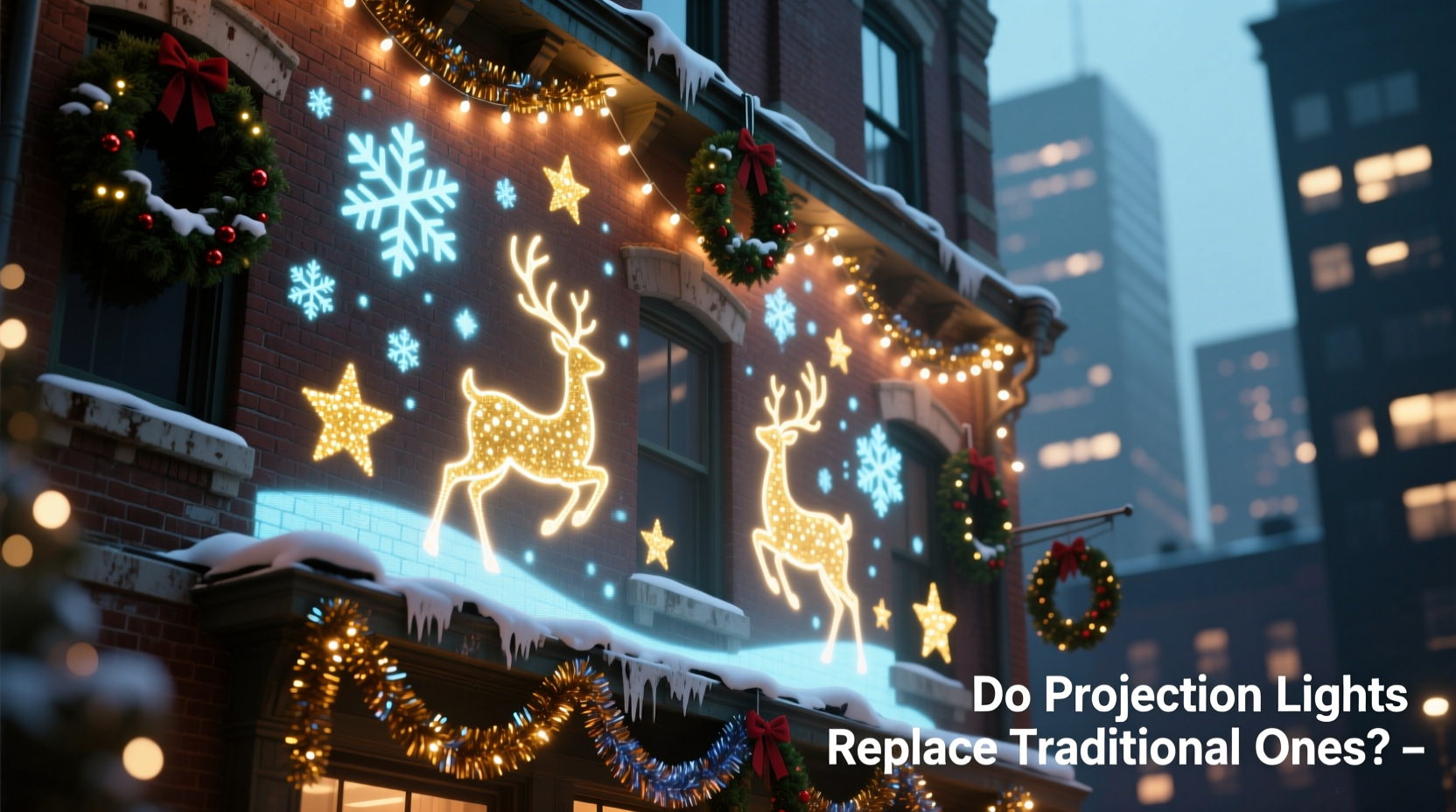
Projection lights entered the mainstream in the late 2010s, driven by improvements in LED projector technology and consumer demand for easier decorating solutions. Unlike traditional setups that require ladders, extension cords, timers, and hours of labor, projection systems can be installed in minutes. Most units plug into an outdoor outlet, are aimed at a surface, and instantly deliver vibrant light displays.
Modern projectors offer features like remote controls, multiple animation modes (snowfall, twinkling stars, color shifts), timer settings, and even Bluetooth connectivity. Some models include interchangeable lenses or digital apps that allow users to customize patterns. These innovations have made projections especially appealing to busy families, older adults, and renters who want festive flair without permanent installations.
Still, projection lights are not a one-size-fits-all solution. Their effectiveness is highly dependent on environmental factors such as wall color, surface texture, ambient light, and distance from the projector. A white stucco wall may reflect colors vividly, while a dark brick façade can absorb much of the glow, diminishing impact.
Where Traditional Lights Still Shine
Despite the convenience of projections, traditional Christmas lights retain a strong presence—and for good reason. They provide tactile depth, three-dimensional sparkle, and a classic charm that many associate with nostalgia and craftsmanship. When wrapped around trees, railings, or windows, traditional lights create immersive experiences that projections alone cannot replicate.
Advancements in LED technology have also improved the appeal of traditional lights. Today’s strands are energy-efficient, long-lasting, and available in a wide range of colors, bulb sizes, and effects (e.g., warm white, cool white, multicolor, icicle, net lights). Many are now designed for easy storage and reuse, with features like end-to-end connectors and weather-resistant casings.
Moreover, traditional lights offer greater control over design precision. Homeowners can outline architectural details, highlight specific landscaping features, or create intricate patterns that follow rooflines and gutters. This level of customization allows for personalized, unique displays that stand out in neighborhoods where uniformity is common.
“While projections offer speed and novelty, nothing replaces the warmth and dimensionality of real lights strung by hand.” — Daniel Reeves, Holiday Lighting Designer & Founder of Luminary Displays Co.
Comparing Key Factors: Projections vs. Traditionals
| Factor | Projection Lights | Traditional Lights |
|---|---|---|
| Installation Time | 5–10 minutes | 1–6+ hours |
| Setup Complexity | Low (plug and aim) | High (climbing, wiring, securing) |
| Visual Depth | Flat, two-dimensional | Three-dimensional, layered |
| Customization | Limited to preset patterns | High (shape, density, layout) |
| Durability | Moderate (sensitive to weather/misalignment) | High (if properly stored) |
| Energy Use | Low to moderate (5–30W per unit) | Moderate (depends on strand count) |
| Cost (Initial) | $30–$100 per projector | $50–$300+ for full home coverage |
This comparison reveals that neither option universally outperforms the other. Instead, each excels in different contexts. Projections win in speed and simplicity; traditionals dominate in visual richness and flexibility.
When Projections Complement Rather Than Replace
In most cases, projection lights work best as complements to traditional setups rather than full replacements. Consider a scenario where a homeowner uses string lights to outline windows and wrap porch columns, then adds a snowflake projection on the front wall. The result is a layered effect: physical lights add sparkle up close, while the projection creates a dynamic backdrop visible from the street.
This hybrid approach leverages the strengths of both technologies. Projections can fill large blank surfaces (like garage doors) that would otherwise require dozens of light strands to cover. They can also introduce motion—such as falling snow or rotating stars—that static lights cannot achieve. Meanwhile, traditional lights maintain their role in defining shapes and adding texture.
A growing number of professional decorators now recommend combining both. “We use projections for big impact zones and reserve traditional lights for detail work,” says Maria Lin, a seasonal display consultant based in Colorado. “It reduces labor without sacrificing beauty.”
Real-World Example: The Johnson Family’s Hybrid Display
The Johnsons live in a suburban neighborhood known for its elaborate holiday decorations. In past years, setting up their display took two full weekends: untangling hundreds of light strands, climbing ladders in cold weather, and running multiple extension cords. Last year, they decided to try something new.
They kept their favorite traditional lights for the front porch railing and two evergreen trees. Then, they purchased two projection units—one for the garage door (projecting animated reindeer) and one for the gable (twinkling starfield). Setup took under an hour. Neighbors noticed the display immediately, commenting on the “cinematic” quality of the moving images.
Most importantly, the family reported spending less time maintaining the display. No blown bulbs to replace, no sagging strands after windstorms. Yet, they preserved the warmth of real lights in key areas. “It felt magical without being exhausting,” said Sarah Johnson. “We’ll never go back to all-traditional.”
Step-by-Step Guide to Integrating Both Systems
For those considering a blended approach, here’s a practical sequence to follow:
- Assess your property’s architecture. Identify large flat surfaces (walls, garage doors) ideal for projections, and structural features (trees, porches, fences) suitable for traditional lights.
- Determine power access. Ensure outdoor outlets are available near planned projector locations. Use GFCI-protected outlets for safety.
- Select projector types. Choose models with adjustable focus, multiple patterns, and weather resistance. Look for units with swivel bases for precise aiming.
- Plan traditional light placement. Focus on outlining key features or creating focal points. Avoid overcrowding—less is often more.
- Test both systems at night. Install everything temporarily before finalizing positions. Adjust projector angles and brightness to avoid overspill or glare.
- Sync timers or smart controls. Program both systems to turn on and off simultaneously for a cohesive look.
- Add finishing touches. Incorporate lawn ornaments, wreaths, or sound elements (like holiday music) to enhance the overall experience.
Checklist: Evaluating Your Lighting Strategy
- ☐ Do I have large, flat exterior surfaces suitable for projections?
- ☐ Am I willing to invest time in installing traditional lights for depth and realism?
- ☐ Is my home’s exterior color compatible with projected images?
- ☐ Do I need motion or animation in my display?
- ☐ Can I access outdoor power sources safely?
- ☐ Will neighbors or passersby view my display from a distance?
- ☐ Am I looking to reduce annual setup time?
Frequently Asked Questions
Can projection lights work in snowy climates?
Yes, but with caveats. Snow accumulation on the projector lens can block the image. Units should be angled slightly downward or placed under eaves for protection. Regular clearing may be necessary during heavy snowfall.
Do projection lights use less electricity than traditional ones?
Generally, yes. A single projector consumes between 5 and 30 watts, while a full home setup with traditional lights can use 100–500 watts depending on length and bulb type. However, using multiple projectors or leaving them on all night can offset savings.
Can I mix colors and patterns from different brands?
You can, but synchronization may be limited. For coordinated effects (e.g., color-matching animations), consider purchasing multi-projector kits designed to work together or use smart-enabled models with app control.
Conclusion: Harmony Over Replacement
Projection Christmas lights are not replacing traditional ones—they’re redefining how we think about holiday lighting. Rather than viewing them as competitors, the most effective approach treats both as tools in a decorator’s toolkit. Projections excel in speed, scalability, and motion-based effects. Traditional lights deliver authenticity, dimension, and emotional resonance.
The future of holiday displays lies in thoughtful integration. By combining the efficiency of projections with the craftsmanship of hand-strung lights, homeowners can create displays that are both impressive and sustainable. Whether you're a minimalist seeking simplicity or a maximalist chasing spectacle, there’s room for both in your seasonal celebration.




 浙公网安备
33010002000092号
浙公网安备
33010002000092号 浙B2-20120091-4
Comments
No comments yet. Why don't you start the discussion?