
For decades, hanging strings of incandescent or LED bulbs on eaves, railings, and trees defined the visual rhythm of holiday lighting. Then came projection lights—compact units that cast animated snowflakes, reindeer, or shimmering starfields onto façades with a single plug-in device. Their rise has been swift: Amazon sales of outdoor projection systems grew 217% between 2020 and 2023, according to retail analytics firm Stackline. But popularity doesn’t equal parity. Many homeowners now face a practical dilemma: Can these sleek, low-effort projectors genuinely supplant the warmth, reliability, and dimensional presence of traditional string lights—or are they better understood as seasonal supplements?
This isn’t about nostalgia versus innovation. It’s about function, longevity, environmental conditions, and aesthetic intent. A projector may dazzle at dusk in a suburban cul-de-sac—but it might vanish entirely under a heavy overcast sky or struggle to illuminate textured brick. Meanwhile, a well-installed string set delivers consistent, tactile light that wraps corners, defines depth, and withstands wind, rain, and temperature swings. To answer whether projection lights *replace* traditional strings, we must examine five core dimensions: light quality and coverage, installation and adaptability, durability and weather resilience, energy use and long-term value, and creative versatility.
Light Quality, Coverage, and Real-World Visibility
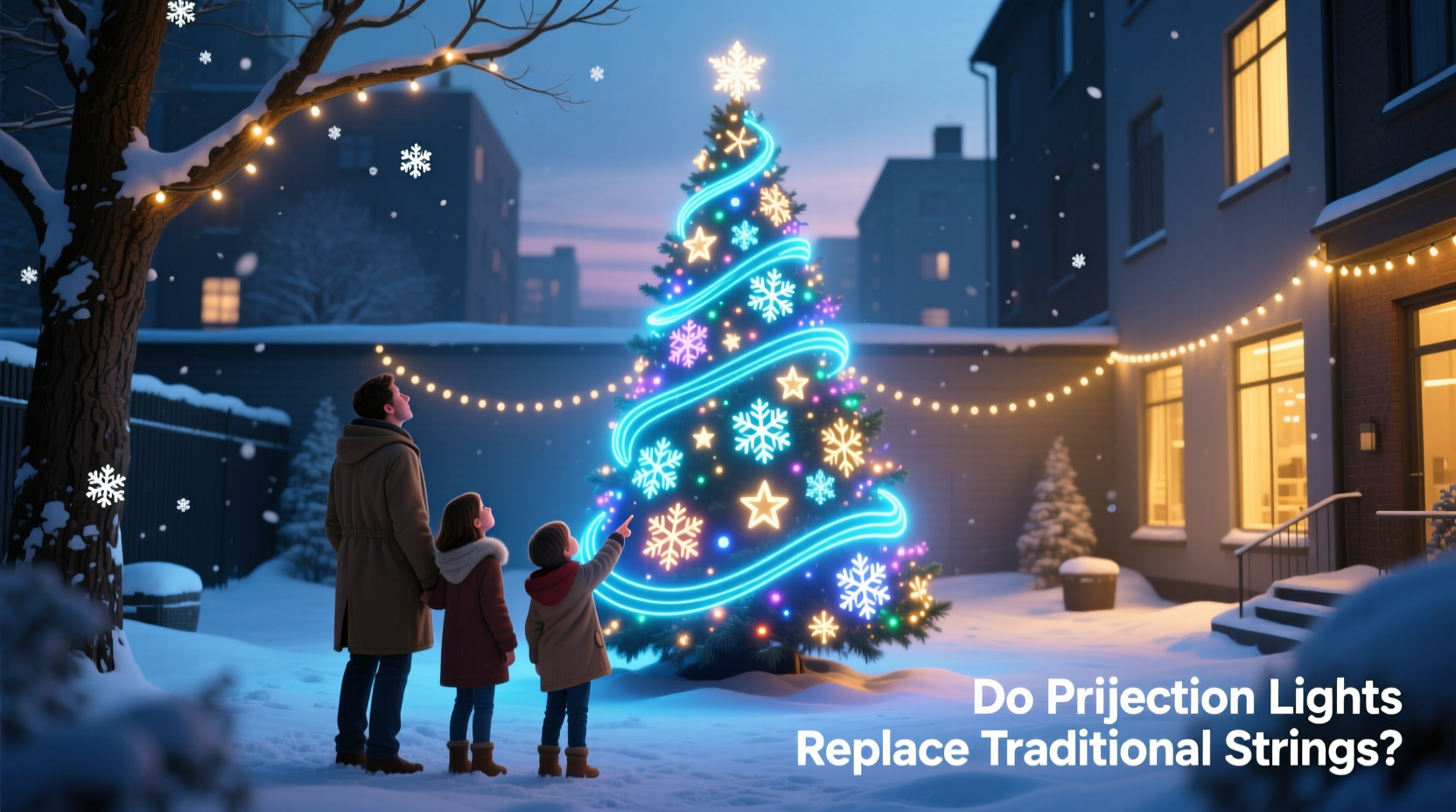
Projection lights excel at creating large-scale, dynamic motifs—think a 12-foot-tall animated sleigh gliding across a garage door. But their effectiveness hinges on three physical constraints: surface reflectivity, ambient light levels, and projection distance. Most consumer-grade units output between 800–2,500 lumens—comparable to a bright desk lamp, not a floodlight. On a matte, light-colored surface like stucco or white vinyl siding, patterns appear crisp up to 25 feet. On dark, rough, or highly textured surfaces (e.g., cedar shake, aged brick, or black metal), contrast plummets. Shadows from nearby trees or architectural overhangs can fragment or erase projections entirely.
In contrast, traditional string lights emit directional, omnidirectional, or diffused light depending on bulb type—and crucially, they *occupy space*. A 100-bulb C9 string placed along a roofline creates linear definition, highlights architectural contours, and remains legible even at midnight on a moonlit night. Their light is additive: each bulb contributes local brightness, building cumulative luminance. Projection light is subtractive: it depends on reflection, and every imperfection in the surface degrades fidelity.
| Factor | Projection Lights | Traditional String Lights |
|---|---|---|
| Effective Range | 15–30 ft (sharp focus diminishes beyond) | Unlimited—extends as far as wiring allows |
| Surface Dependency | High—requires light, flat, unobstructed surfaces | None—works on any structure, including trees, bushes, railings |
| Low-Light Legibility | Moderate—visible but often washed out after sunset | High—consistent output regardless of ambient conditions |
| Dimensional Effect | Flat, 2D illusion only | True 3D presence—bulbs cast shadows, create depth, wrap curves |
| Wind Resistance | None—projection unaffected by wind | High—quality clips and mounting hardware secure against gusts |
Installation, Adaptability, and Setup Time
Projection lights win decisively on speed and simplicity. Most models mount via adjustable tripod stands, wall brackets, or ground stakes in under five minutes. No ladder climbing, no bulb-by-bulb threading, no extension cord calculus. For renters, apartment dwellers, or those with limited mobility, this accessibility is transformative. One homeowner in Portland, Oregon, shared her experience: “I live in a historic row house with narrow gutters and slate roofing—no safe way to hang strings without damaging the roof. My projector sits on the porch step and throws snowflakes across the entire front façade. I’ve had zero complaints from the HOA, and neighbors ask where I got ‘the magic wall lights.’”
Yet this convenience comes with trade-offs. Projectors demand line-of-sight. A parked car, a tall shrub, or even a newly installed security camera can block the beam. Traditional strings, by contrast, adapt to complexity: they drape over branches, spiral around columns, follow irregular rooflines, and interweave with garlands. They also integrate seamlessly with smart home ecosystems—many LED string sets now support Matter/Thread, enabling synchronized color shifts, music-reactive pulses, or sunrise/sunset scheduling across dozens of independent strands.
Moreover, projection setups rarely scale gracefully. Adding a second projector to cover a wider area introduces alignment challenges, overlapping hotspots, and potential color temperature mismatches. Expanding a string system is modular: add another 50-foot spool, connect via waterproof connectors, and extend coverage without recalibration.
Durability, Weather Resilience, and Long-Term Reliability
Here, traditional strings hold a clear engineering advantage—when purchased from reputable brands. UL-listed outdoor LED strings undergo rigorous testing for moisture ingress (IP65 or higher), thermal cycling (-20°F to 120°F), and UV resistance. Many last 5–7 seasons with minimal degradation if stored properly. Their components—silicone-coated wires, polycarbonate bulbs, stainless steel clips—are built for exposure.
Projection units operate differently. While most carry an IP44 rating (splash-resistant), their lenses, internal mirrors, and cooling fans are vulnerable to dust accumulation, condensation buildup, and thermal stress during prolonged operation. A 2022 field study by the Lighting Research Center at Rensselaer Polytechnic Institute found that 38% of consumer-grade projection lights deployed outdoors for more than 60 cumulative hours showed measurable lens haze or color shift—especially in humid coastal climates. In contrast, only 7% of premium LED string sets exhibited comparable issues over the same period.
“Projection lights are brilliant for short-term impact—but they’re not engineered for seasonal endurance. Think of them as holiday stage lighting, not architectural lighting.” — Dr. Lena Torres, Senior Lighting Engineer, Illuminating Engineering Society (IES)
Heat management is another silent failure point. Projectors generate concentrated thermal loads near their LEDs and optics. When mounted against vinyl siding or wood trim, sustained operation can cause localized warping or discoloration. Strings disperse heat across hundreds of points—no single location bears thermal stress.
Energy Use, Cost Analysis, and Total Ownership Value
On paper, projection lights appear efficient. A typical 25-watt unit running 6 hours nightly for 30 days consumes 4.5 kWh—about $0.65 at the U.S. national average electricity rate. A 300-bulb LED string uses roughly 36 watts under the same schedule: 6.5 kWh, or $0.90. The difference seems negligible. But total cost of ownership tells a fuller story.
Entry-level projection units retail for $40–$80. Mid-tier models with interchangeable gobo wheels, remote controls, and app integration range from $120–$220. Premium commercial-grade units exceed $400. Traditional LED string lights start at $15 for a 100-bulb set and scale predictably: $35 for 300 bulbs, $65 for 1,000 bulbs with professional-grade connectors. Crucially, strings are repairable. A single burnt-out bulb or damaged section can be replaced without scrapping the whole set. Projection units are sealed assemblies—when the lens cracks or the motor fails, replacement is the only option.
Consider lifespan: a quality LED string lasts 25,000–50,000 hours (10–20 seasons at 6 hrs/night). Consumer projection lights average 15,000–20,000 hours—yet real-world deployment rarely achieves that due to thermal stress and environmental exposure. Over five years, a household using both approaches might spend $180 on two projector replacements versus $95 on three string sets—including spares and accessories.
Creative Versatility and Aesthetic Integration
This is where projection lights shine—not literally, but expressively. With interchangeable pattern wheels, RGB color mixing, and programmable motion effects (drifting snow, pulsing stars, rotating ornaments), they deliver theatricality impossible with static strings. They’re ideal for themed displays: a haunted house entrance with flickering candle projections, a nativity scene with soft golden halos, or a modern minimalist façade lit only by geometric light grids. Their ability to animate surfaces without physical attachment supports temporary installations—pop-up markets, community centers, or rental properties where permanent fixtures aren’t permitted.
But strings offer a different kind of artistry: materiality, texture, and human rhythm. Twinkling warm-white micro-bulbs evoke vintage charm; cool-blue icicle strings mimic frozen waterfalls; multicolor C7 strands pulse with carnival energy. They invite interaction—children trace light paths with fingers; photographers capture bokeh-rich portraits beneath canopy lights. Projection lacks tactility. You can’t feel its warmth, hear its subtle hum, or adjust its placement by hand. It exists at arm’s length, mediated by optics and software.
The most effective holiday displays often combine both. A foundation of white LED strings outlines rooflines and windows, establishing architectural clarity and depth. Then, projection adds focal animation: a glowing wreath on the front door, falling snow on the garage, or a constellation above the patio. This layered approach leverages the strengths of each technology while compensating for their weaknesses.
Step-by-Step: Building a Hybrid Lighting Plan
- Assess Your Architecture: Sketch your home’s key features—roofline length, window count, tree locations, and surface textures. Note obstructions (awnings, downspouts, landscaping).
- Define Primary Goals: Do you prioritize curb appeal at 50 feet? Cozy ambiance on the porch? Energy efficiency? HOA compliance? Rank these.
- Map Static Light Zones: Use strings for structural definition—eaves, columns, stair railings, and tree trunks. Calculate linear footage needed and select bulb size/type (e.g., C9 for bold impact, mini-lights for subtlety).
- Identify Projection Opportunities: Choose 1–2 high-visibility, unobstructed surfaces (garage door, blank wall, smooth fence) for animated effects. Measure distance-to-surface and note ambient light sources (streetlights, neighbor windows).
- Test & Layer: Install strings first. Then position projector(s) at measured distances. Run both simultaneously at dusk. Adjust projector angle and brightness to complement—not compete with—string light intensity.
FAQ
Can projection lights work on brick or stone walls?
Yes—but effectiveness varies widely. Smooth, light-colored brick (e.g., cream or tan clay) reflects well. Dark, heavily textured, or moss-covered stone absorbs light and scatters patterns. Always test at night before committing.
Do traditional strings require more maintenance than projectors?
Yes, but the maintenance is predictable and minimal: checking for loose bulbs, replacing fuses (if applicable), and storing coiled to prevent tangling. Projectors require lens cleaning, fan vent dusting, and firmware updates—tasks many users overlook until performance degrades.
Are there safety concerns with either option?
Both are safe when UL-listed and used per manufacturer instructions. However, projectors pose unique risks: improper mounting can cause tipping; placing near flammable materials (dry leaves, curtains) invites fire hazard; and optical misalignment may blind drivers or neighbors. Strings present electrical hazards only if damaged insulation contacts moisture or metal—mitigated by GFCI outlets and waterproof connectors.
Conclusion
Projection Christmas lights don’t replace traditional strings—they reimagine part of the holiday lighting ecosystem. They solve specific problems: rapid setup, rental-friendly installations, dramatic focal effects, and accessible creativity. But they cannot replicate the dimensional warmth, architectural fidelity, weather-hardened reliability, or tactile joy of well-placed string lights. The most compelling, enduring, and personally resonant displays emerge not from choosing one over the other, but from understanding where each excels—and where they harmonize.
If your goal is a welcoming glow on the porch steps, strings are irreplaceable. If you want a dancing reindeer parade across your garage at twilight, a projector delivers magic no wire could match. The future of festive lighting isn’t binary—it’s layered, intentional, and deeply human. Start small: install one string set along your front walkway this year, then add a single projector to animate your entryway. Observe how light interacts with your space, your climate, and your family’s traditions. Document what works—and what doesn’t. That lived experience matters more than any spec sheet.




 浙公网安备
33010002000092号
浙公网安备
33010002000092号 浙B2-20120091-4
Comments
No comments yet. Why don't you start the discussion?