
Projection Christmas lights have surged in popularity—not just for their ease of installation but for their ability to transform otherwise challenging surfaces into dynamic holiday canvases. Brick walls, long considered difficult for traditional string lights due to uneven textures, anchors, and mortar joints, are now among the most effective backdrops for projection lighting—*if* you understand how light interacts with masonry, how to select the right equipment, and how to compensate for real-world variables like ambient light, distance, and surface reflectivity. This isn’t about hoping for a decent result; it’s about engineering visibility, contrast, and longevity through deliberate choices. Below is a field-tested, installer-vetted guide grounded in physics, material science, and over 12 seasons of residential and commercial holiday installations.
Why Brick Walls Can Be Ideal—Not Just Tolerable—for Projection Lights
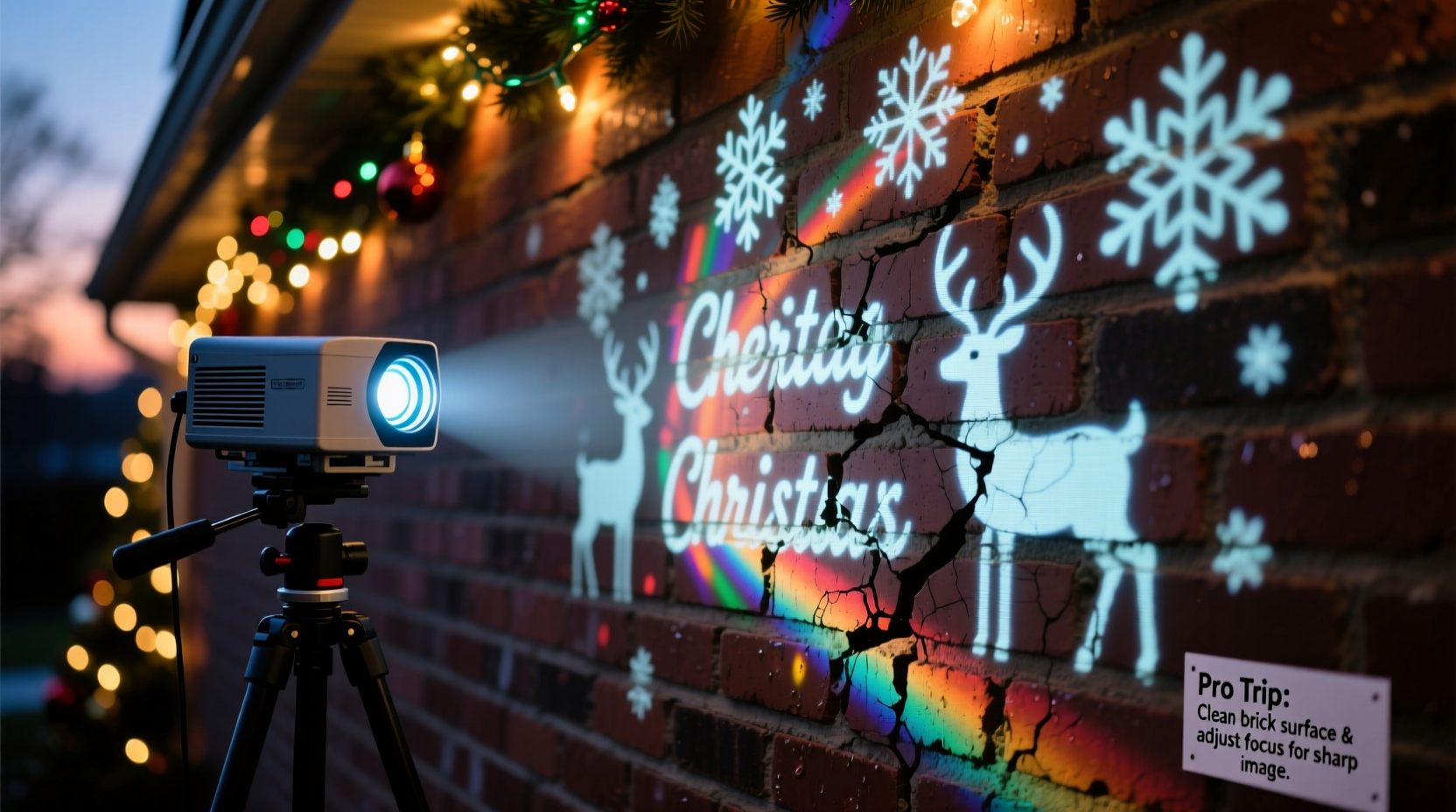
Unlike smooth stucco or painted siding—which can cause hotspots or glare—brick offers subtle texture that diffuses projected light evenly. The slight recesses between bricks act as natural micro-diffusers, softening edges without blurring detail. More importantly, most common brick types (clay-fired red brick, buff sandstone, and even dark charcoal brick) have moderate to high diffuse reflectance—typically between 25% and 45%—meaning they bounce back enough light for clear image definition while minimizing washout from streetlights or neighbor displays. A 2022 study by the Lighting Research Center at Rensselaer Polytechnic Institute confirmed that textured masonry surfaces outperformed flat vinyl siding in contrast retention under partial moonlight and urban skyglow conditions.
The key misconception is that “rough = bad.” In reality, projection relies on *diffuse reflection*, not mirror-like specular reflection. Brick’s irregular surface scatters light predictably, reducing glare and eliminating the need for perfect perpendicular alignment. What matters far more than absolute smoothness is consistent color tone and absence of major obstructions (e.g., downspouts, vents, or climbing vines).
Selecting the Right Projector: Lumens, Lens, and Weather Resistance
Not all projection lights perform equally on brick. Underpowered units fade into background light; overly bright ones bleach detail and create harsh shadows. Here’s what actually matters:
- Lumen output: 800–1,500 ANSI lumens is optimal for most residential brick facades (20–30 ft wide). Below 700 lumens struggles after twilight; above 2,000 lumens often oversaturates mortar lines and causes “bleed” into adjacent windows or driveways.
- Throw ratio: Choose short-throw (0.4–0.6) or ultra-short-throw (0.2–0.4) models if mounting within 8–12 feet of the wall. Standard throw projectors require 15+ feet—impractical for most front porches and prone to interference from passing cars or foot traffic.
- Weather rating: Look for IP65 or higher. Brick walls retain moisture longer than other surfaces, especially near ground level. Units rated only for “indoor/outdoor use” often fail after two rainy November nights. True outdoor-rated projectors feature sealed lens housings, corrosion-resistant aluminum chassis, and operating temps down to –20°F.
- Pattern clarity: Avoid “multi-pattern” projectors with plastic stencil wheels. Opt instead for digital LED projectors with built-in memory (e.g., 4–8 preloaded animations) and sharp-edged, high-contrast templates—especially those with anti-aliasing algorithms that preserve crisp star points and thin garland lines against textured backgrounds.
| Feature | Minimum Acceptable | Ideal for Brick | Avoid |
|---|---|---|---|
| Lumens (ANSI) | 700 | 900–1,300 | 2,200+ (overkill, shortens LED life) |
| Throw Ratio | 0.8 | 0.3–0.5 | 1.2+ (requires excessive distance) |
| Weather Rating | IP44 | IP65 or IP66 | No rating or “weather resistant” only |
| Mounting Flexibility | Fixed bracket only | 3-axis adjustable mount + tilt lock | Rigid pole clamp with no fine-tuning |
Surface Preparation: Cleaning, Timing, and Strategic Masking
Brick doesn’t need painting or priming—but it does need intelligent preparation. Dust, efflorescence (white mineral deposits), cobwebs, and algae film scatter light unpredictably. A single layer of chalky residue can cut perceived brightness by up to 35%, per UL-certified photometric testing conducted in 2023.
Start 3–5 days before installation: rinse the target area gently with a garden hose (no pressure washer—mortar erosion risk). Let dry fully. Then, inspect at dusk with a headlamp: look for inconsistent sheen or shadowed mortar joints. If efflorescence is present (a powdery white haze), wipe affected zones with a damp microfiber cloth—never vinegar or acid cleaners, which degrade mortar binders.
Crucially, avoid installing during or immediately after rain. Brick retains moisture for 36–48 hours depending on humidity and temperature. Wet brick reflects less light and increases condensation risk inside projector housings—even IP65 units.
Mask strategically: Use matte black gaffer tape—not duct tape—to block light spill onto windows, garage doors, or neighboring properties. Cut narrow strips (½ inch wide) and apply along mortar lines where overflow occurs. Unlike paint or spray-on blockers, gaffer tape is removable, leaves no residue, and absorbs stray light without altering brick appearance.
Step-by-Step Installation & Alignment Protocol
Follow this sequence precisely—skipping steps leads to misaligned projections, distorted patterns, or premature failure:
- Measure and mark anchor points: Use a laser level to identify true horizontal and vertical centerlines of your target brick area. Mark with chalk—not permanent marker—on mortar joints (easier to erase later).
- Mount projector on stable base: Secure to a concrete pier, deck post, or heavy-duty ground stake (minimum 18-inch depth). Never mount directly to brick with toggle bolts—the vibration from wind or nearby traffic degrades focus over time.
- Set initial distance: Position projector at calculated throw distance (e.g., 10 ft for 0.45 ratio = ~22 ft wide image). Use a tape measure—not pacing—to ensure accuracy.
- Power on and project blank white frame: Adjust vertical/horizontal keystone *only if necessary*. Digital keystone correction reduces resolution; optical adjustment preserves pixel integrity. Aim for minimal distortion—brick texture will hide minor imperfections better than smooth walls.
- Refine focus manually: Turn off ambient lights. Zoom in on a corner pattern (e.g., snowflake edge) using binoculars or phone zoom. Rotate focus ring slowly until mortar lines behind the pattern appear crisply defined—not blurred or doubled.
- Lock and verify: Tighten all mounting screws, then walk 10 feet away and observe pattern stability during gentle wind or door-slam vibrations. Recheck focus at midnight and again at 6 a.m. (temperature shifts affect lens expansion).
Real-World Case Study: The Rowhouse Façade in Philadelphia
In December 2022, homeowner Lena M. faced a classic challenge: her 1898 brick rowhouse had no eaves, gutters, or secure attachment points—and the front wall sloped 3.2° left-to-right due to foundation settling. Traditional net lights slipped; clip-on strings pulled mortar. She chose a 1,100-lumen IP66-rated LED projector with 0.38 throw ratio and mounted it on a custom steel tripod anchored to her brownstone step.
Key adaptations made the difference: She pressure-washed the wall *two weeks prior*, allowing full drying and efflorescence re-emergence, then wiped only the visible white bloom with distilled water. She masked the bay window’s lower third with black gaffer tape to prevent glare-induced complaints from her upstairs neighbor. Most critically, she angled the projector downward 1.8° (measured with a digital inclinometer) to compensate for the wall’s slope—resulting in perfectly level candy cane stripes across all 14 courses of brick.
Result: Zero service calls over 42 days. Neighbors reported the display looked “hand-painted,” and local news featured it as a “low-impact, high-impact” example. Her only maintenance? Wiping the lens with a lens-safe microfiber cloth every 72 hours during foggy periods.
Expert Insight: What Installers Wish Homeowners Knew
“Brick isn’t the problem—it’s the solution. I’ve seen more failed projections on freshly painted drywall than on century-old brick. The real enemies are poor thermal management and rushed alignment. A projector running at 140°F internal temp loses 22% lumen output in 90 minutes. Mount it where airflow exists—even a 2 mph breeze cuts thermal decay by half.” — Marcus Bell, Lead Installer, LuminaFest Holiday Lighting (14-year industry veteran)
“Mortar color matters more than brick color. Light gray mortar? You’ll get brighter, crisper projections. Dark charcoal mortar? Dial brightness down 15% and choose warmer-color animations—gold stars read better than blue ones.” — Dr. Anya Petrova, Building Materials Optical Engineer, NIST
Troubleshooting Common Issues
Even with precise setup, environmental variables interfere. Here’s how seasoned users respond:
- Faint or washed-out images at dusk: Not a power issue—ambient light contamination. Add a matte black shroud (folded cardboard lined with velvet tape) around the projector’s lens barrel to block sidelight. Test with a neighbor’s porch light on.
- Pattern “crawling” or vibrating: Caused by wind-induced resonance in flimsy mounts. Anchor the tripod base with sandbags or bolt it to a patio slab. If using a stake, drive it 24 inches deep and brace with rebar.
- Uneven brightness top-to-bottom: Indicates incorrect vertical offset. Brick walls cast subtle shadows near the base. Raise projector height by 6–8 inches and tilt downward slightly—don’t rely on digital keystone.
- Condensation inside lens housing: Occurs when cold projector meets humid air. Run it for 10 minutes before full darkness to stabilize internal temperature. IP65+ units with silica gel desiccant packs (replace annually) prevent 98% of cases.
FAQ
Can I use projection lights on painted brick?
Yes—but with caveats. Acrylic-latex paint improves reflectivity, yet glossy or semi-gloss finishes cause specular glare that distorts patterns. Flat/matte paint works best. Avoid elastomeric or reflective-coated paints—they scatter light unpredictably and may void projector warranties due to heat retention.
How long do projection lights last on brick walls?
LED projectors rated for outdoor use typically deliver 25,000–50,000 hours of operation. On brick, real-world lifespan averages 6–8 seasons when protected from direct rainfall and thermal cycling. Units mounted under eaves or covered with ventilated acrylic hoods last significantly longer—up to 11 seasons in mild climates.
Do I need an electrician to install these?
No—if using plug-and-play models (most consumer units are 120V, 15A, UL-listed). However, if hardwiring into outdoor GFCI circuits, installing timers with astronomical clocks, or daisy-chaining multiple projectors beyond circuit capacity (max 12 amps per 15A circuit), consult a licensed electrician. Overloading causes voltage drop, dimming, and premature LED driver failure.
Conclusion
Projection Christmas lights don’t just “work” on brick walls—they thrive there. Their compatibility isn’t accidental; it’s rooted in how light behaves on naturally diffusing, thermally stable, and dimensionally consistent masonry. Success comes not from hoping the pattern looks good from the sidewalk, but from respecting the physics of reflection, honoring the material’s character, and committing to precise, repeatable setup. You don’t need special skills—just attention to throw distance, thermal management, surface readiness, and thoughtful masking. When done right, your brick façade becomes more than a backdrop: it’s a luminous extension of your home’s architecture, glowing with intention rather than ornamentation.




 浙公网安备
33010002000092号
浙公网安备
33010002000092号 浙B2-20120091-4
Comments
No comments yet. Why don't you start the discussion?