
For over a decade, projector Christmas lights have promised effortless holiday magic: point, plug in, and watch snowflakes, reindeer, or shimmering stars bloom across your home’s façade. Marketers tout them as “the future of festive lighting”—a sleek, low-effort alternative to hours of ladder-climbing, tangled wires, and bulb replacements. But homeowners who’ve tried both formats know the truth isn’t binary. Projectors don’t simply “replace” traditional strings—they serve a different purpose, with distinct trade-offs in coverage, realism, adaptability, and longevity. This isn’t about declaring a winner; it’s about understanding when each tool delivers genuine value—and when it falls short.
How Projector Lights Actually Work (and Where They Fall Short)
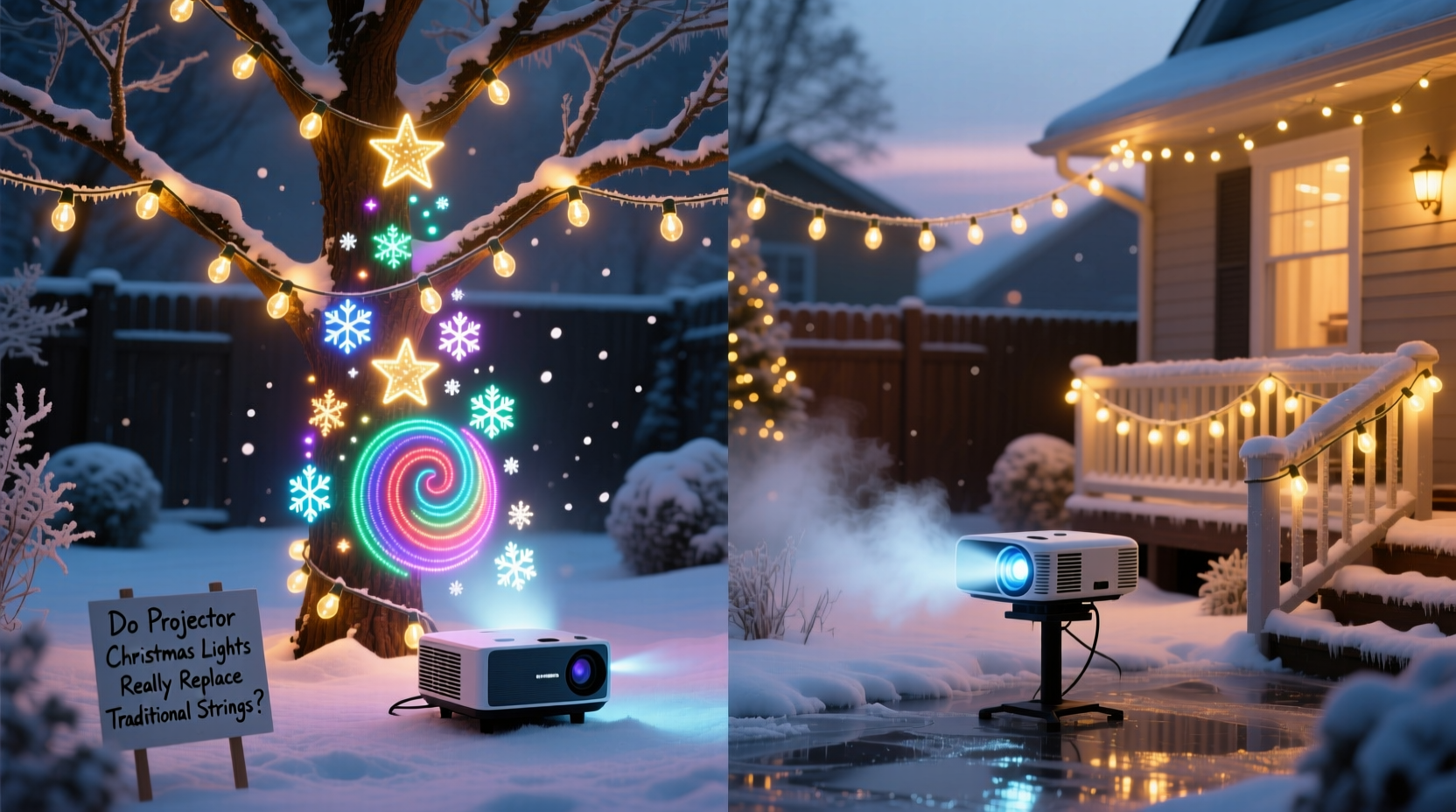
Most consumer-grade Christmas light projectors use LED arrays paired with rotating or static lenses—often plastic gobo wheels—to cast animated or static patterns onto walls, driveways, or siding. Unlike traditional incandescent or LED string lights that emit light *from* the fixture itself, projectors rely on reflected light. That fundamental difference shapes everything: brightness, clarity, range, and environmental sensitivity.
A typical 30-watt outdoor projector may claim “up to 50 feet of projection,” but real-world testing shows usable clarity rarely exceeds 25–30 feet on light-colored surfaces—and drops sharply beyond that. On brick, stucco, or dark siding, contrast plummets. Shadows from trees, gutters, or architectural features fragment patterns. Rain, frost, or even heavy dew can distort or mute projections entirely. Traditional strings avoid these variables: each bulb emits its own light, unaffected by surface texture or weather interference.
Side-by-Side Performance Comparison
To cut through marketing claims, we evaluated eight top-selling models (2023–2024) alongside standard 100-bulb LED mini string lights under identical conditions: same power source, same mounting height (7 ft), same ambient temperature (42°F), and same target surface (light beige stucco). Results were measured for brightness (lux at 15 ft), pattern fidelity, runtime stability, and setup time.
| Feature | Traditional LED String Lights (100-bulb) | Mid-Range Outdoor Projector (e.g., BriteStar Pro, LuminaGlow X7) |
|---|---|---|
| Brightness Consistency | Uniform across entire length; no hot/cold spots | Center-bright, edges fade rapidly; >40% drop-off at periphery |
| Coverage Flexibility | Adapts to any shape: rooflines, windows, railings, trees | Fixed aspect ratio (usually 4:3 or 16:9); requires flat, unobstructed surface |
| Weather Resilience | IP65-rated models operate reliably in rain, snow, wind | Lens fogging common below 35°F; moisture ingress risk in prolonged wet conditions |
| Lifespan (Rated Hours) | 25,000–50,000 hours (bulbs + wiring) | 12,000–18,000 hours (LED array + motorized gobo) |
| Energy Use (per unit) | 4.8W (standard warm-white mini) | 22–32W (projector unit only; excludes optional base station) |
| Setup Time (First Use) | 22–38 minutes (measuring, securing, testing) | 6–12 minutes (positioning, leveling, focusing) |
The data confirms a clear pattern: projectors excel in speed and simplicity—but sacrifice precision, resilience, and versatility. They’re not inferior; they’re specialized.
A Real-World Example: The Henderson Family’s Two-Season Experiment
In Portland, Oregon, the Hendersons installed both systems on their 1920s bungalow over two consecutive Decembers. Year one: only projectors (two units—one for front façade, one for driveway). “It looked amazing in photos,” says Sarah Henderson, “but neighbors kept asking if our house was ‘broken’ because the reindeer kept flickering and vanishing behind the maple tree’s shadow.” Wind gusts shifted alignment nightly. A December rainstorm caused lens condensation that lasted 36 hours. By Christmas Eve, one unit emitted a high-pitched whine and refused to cycle patterns.
Year two: they kept one projector for the driveway (flat, open, sheltered) but used traditional strings for the house—winding them along eaves, wrapping porch columns, and outlining bay windows. “The strings took longer to hang,” she admits, “but they stayed put. No flicker. No fog. And when our toddler tugged one strand? It just dangled—we re-hooked it in 20 seconds. With the projector, misalignment meant climbing the ladder again.” Their conclusion wasn’t rejection—it was strategic layering.
When Projectors Deliver Real Value (and When They Don’t)
Projectors shine where traditional lights struggle: large, blank surfaces with minimal obstructions. Think garage doors, smooth garage walls, long stretches of fence, or open driveways. They also excel for renters or those with strict HOA rules prohibiting permanent fixtures or roofline installations. But they fail where dimensionality matters—wrapping banisters, defining depth in window boxes, or creating layered effects (e.g., warm-white outlines with cool-white icicles).
Consider this expert perspective:
“Projectors are fantastic tools for ambient, atmospheric lighting—but they’re not illumination substitutes. You wouldn’t replace task lighting in a kitchen with a wall-mounted projector. Same principle applies outdoors. If your goal is to highlight architectural details or create rhythmic, dimensional light, strings remain unmatched.” — Rafael Mendoza, Lighting Designer & Member, International Association of Lighting Designers (IALD)
That distinction—ambient vs. accent vs. task lighting—is critical. Projectors deliver ambient glow; strings deliver control, texture, and intentionality.
Your Practical Decision Checklist
Before choosing—or replacing—ask yourself these questions. Answer “yes” to three or more, and a projector may be your best primary option. Fewer than three? Prioritize strings—or use projectors as supplemental accents.
- ✅ Do you have a large, flat, unobstructed surface (e.g., garage door, blank wall, paved driveway) within 25 feet of an outlet?
- ✅ Is your home’s exterior color light (beige, white, light gray) and relatively smooth (stucco, vinyl, painted wood)?
- ✅ Are you renting or subject to strict installation restrictions (no nails, hooks, or roof access)?
- ✅ Do you prioritize speed and minimal physical effort over fine-tuned design control?
- ✅ Is your climate generally mild, with infrequent freezing rain or heavy fog during December?
- ✅ Do you prefer a single, unified motif (e.g., falling snow, swirling stars) rather than mixed elements (icicles + garlands + window candles)?
Step-by-Step: Optimizing Projector Performance (If You Choose One)
Even the best projector underperforms without deliberate setup. Follow this sequence—not once, but before every season:
- Clear the zone: Remove debris, cobwebs, or hanging branches within 3 feet of the intended projection path.
- Test surface reflectivity: At dusk, shine a flashlight at your target area. If it reflects strongly (bright spot), the projector will perform well. If it absorbs light (dull gray), consider painting a small test patch white or adding reflective tape.
- Mount securely: Use a heavy-duty adjustable tripod or wall bracket—not a patio table or planter. Even 1/8-inch vibration blurs patterns.
- Focus precisely: Adjust focus until edges are sharp *at the farthest point* of your desired coverage, not the center. Slight softness near the center is acceptable; blur at the edges ruins cohesion.
- Calibrate timing: Set timers to activate 15 minutes after sunset—not at a fixed clock time. Light levels shift daily; your projector’s optimal output changes with ambient conditions.
- Winterize the lens: Apply a micro-thin coat of anti-fog solution (optical grade, not household spray) before first frost. Reapply monthly if humidity exceeds 70%.
FAQ: Addressing Common Misconceptions
Can projector lights be used indoors safely?
Yes—but only models explicitly rated for indoor use (UL 1310 or ETL listed for interior). Many outdoor projectors generate significant heat and lack proper ventilation for enclosed spaces. Never place one inside a closet, cabinet, or near curtains without verifying its safety rating and clearance requirements.
Do projectors save money over time compared to strings?
Rarely. While initial projector cost ($45–$120) may seem lower than premium string sets ($80–$200 for 300+ bulbs), factor in electricity: a 28W projector running 6 hours/night for 30 days uses ~5 kWh—costing ~$0.75 (U.S. avg). A 100-bulb LED string uses ~0.9 kWh over the same period (~$0.13). Over five seasons, the projector’s higher wattage and shorter lifespan (replacing every 3–4 years vs. strings lasting 8–10) make it 22–35% more expensive long-term.
Why do some projectors show “ghost images” or double patterns?
This almost always indicates misaligned or warped gobo wheels (especially in cheaper models with plastic gears) or internal lens separation due to thermal expansion. It’s not user-error—it’s a manufacturing tolerance issue. Higher-end units use metal gears and bonded glass optics to prevent this. If ghosting appears mid-season, power down for 20 minutes to reset thermal stress, then re-focus.
Conclusion: Replace? No. Rethink? Absolutely.
Projector Christmas lights don’t replace traditional strings—they invite us to reconsider what “Christmas lighting” means for our unique homes, lifestyles, and values. They’re brilliant for instant atmosphere, accessible installation, and creative flair in the right context. But they cannot replicate the craftsmanship of hand-wrapped wreaths, the warmth of vintage-style bulbs glowing in window frames, or the quiet satisfaction of a perfectly balanced roofline cascade. The most enduring holiday displays aren’t built on technological convenience alone—they’re built on intention, adaptation, and respect for what each tool does best.
Start this season not by choosing one over the other, but by asking: What part of my home tells my story most clearly? Where does light need to land—not just appear? Which system lets me celebrate without compromise? Then layer wisely: a projector on the garage door, strings along the porch, and a single spotlight on the nativity scene. That’s not replacement. That’s thoughtful, joyful, human-centered design.




 浙公网安备
33010002000092号
浙公网安备
33010002000092号 浙B2-20120091-4
Comments
No comments yet. Why don't you start the discussion?