
As holiday seasons roll around, homeowners face a familiar challenge: decorating their homes with festive lights. For decades, this has meant hours spent untangling wires, climbing ladders, and securing individual strands across roofs, gutters, and trees. But in recent years, projector Christmas lights have emerged as a promising alternative—offering dazzling displays with minimal physical setup. The central question many now ask is not just about brightness or style, but efficiency: do projector Christmas lights actually save time compared to installing traditional string lights by hand?
The answer isn't a simple yes or no—it depends on your goals, home layout, and expectations for your display. However, when evaluating setup speed, maintenance, versatility, and long-term use, projector lights often come out ahead in terms of time saved. Let’s break down the realities behind both methods and see where each excels.
How Traditional String Light Installation Works
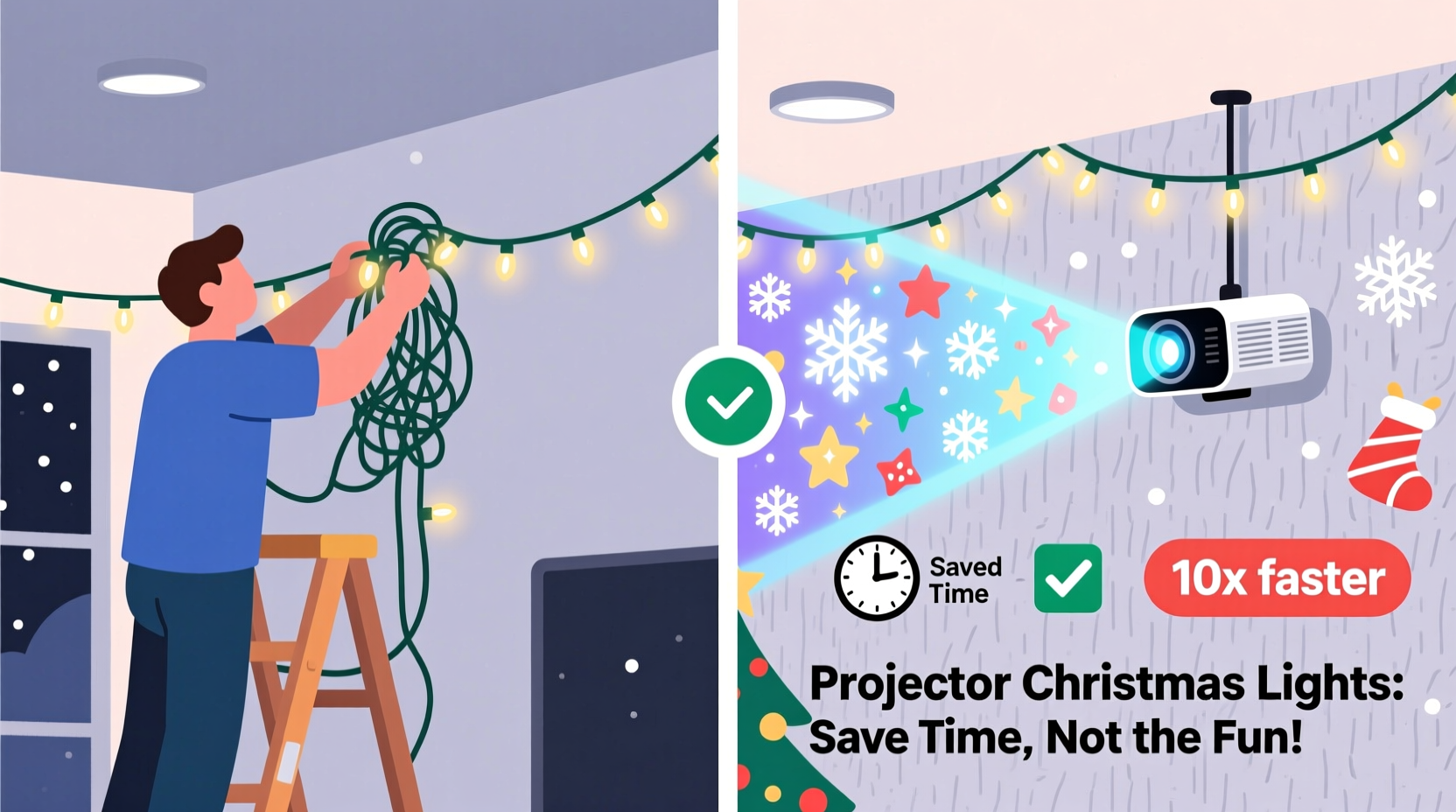
Stringing Christmas lights the conventional way involves several labor-intensive steps:
- Inventory check: Untangling stored lights, testing bulbs, replacing broken strands.
- Planning layout: Deciding which areas to illuminate—roofline, windows, bushes, eaves.
- Gathering tools: Ladders, extension cords, clips, timers, voltage testers.
- Physical installation: Climbing, stretching, clipping each strand securely while avoiding electrical hazards.
- Testing and adjusting: Ensuring all sections work, hiding cords, fine-tuning spacing.
- Maintenance during season: Replacing fallen bulbs, fixing outages after storms.
- Removal and storage: Carefully taking down each section, coiling neatly, labeling for next year.
For an average two-story house with full exterior coverage, this process can take anywhere from 6 to 15 hours spread over multiple days—even longer if done solo. A study conducted by the National Association of Home Builders found that nearly 40% of homeowners spend more than half a weekend just setting up their holiday lighting displays.
How Projector Christmas Lights Work
Projector Christmas lights operate on a completely different principle. Instead of illuminating physical surfaces with wired bulbs, they project patterns of light onto walls, snow-covered lawns, or building facades using high-lumen LED projectors. These units are typically mounted on stands, stakes, or attached to existing fixtures at ground level.
A single projector can cover up to 30 feet vertically and 20 feet horizontally, depending on model and darkness conditions. Many offer rotating effects like falling snow, twinkling stars, or animated reindeer—all activated with the flip of a switch.
Setup usually involves only three steps:
- Place the projector on a stable surface (often staked into the ground).
- Angle it toward the desired surface (wall, garage, tree).
- Plug it in and select the pattern via remote or manual controls.
No ladders. No wiring across eaves. No bulb-by-bulb troubleshooting. Some models even allow smartphone control or scheduling through apps.
Time Comparison: Projector vs. Strings
To determine which method saves more time, we need to compare total time investment across key phases: setup, operation, maintenance, and takedown.
| Phase | String Lights (Avg. Time) | Projector Lights (Avg. Time) | Notes |
|---|---|---|---|
| Initial Setup | 4–10 hours | 10–30 minutes | Projectors eliminate ladder work and complex routing. |
| Bulb Testing & Repair | 1–3 hours | 0 minutes | LED projectors rarely fail mid-season; no individual bulbs. |
| Mid-Season Maintenance | 1–2 hours | 0–10 minutes | Strings may require rewiring after wind/rain; projectors just reboot. |
| Takedown & Storage | 3–6 hours | 15–20 minutes | Untangling and coiling strings takes significant effort. |
| Total Seasonal Commitment | 9–21 hours | 30–70 minutes | Projectors save 8–20+ hours per season. |
This data shows a stark contrast. While string lights offer a classic, three-dimensional glow, they demand a substantial time commitment. In contrast, projector systems deliver instant visual impact with almost negligible labor.
“Time is one of the most underappreciated costs of holiday decorating. For busy families, retirees, or anyone with mobility concerns, projector lights aren’t just convenient—they’re empowering.” — Laura Mendez, Residential Lighting Consultant, Holiday Illumination Group
Real-World Example: The Thompson Family's Switch
The Thompsons, a family of four in suburban Minnesota, used to dedicate two full weekends every December to hanging over 1,200 feet of string lights across their home and yard. John Thompson, a software engineer, described the process as “equal parts tradition and torture.”
In 2022, after John developed mild vertigo, climbing ladders became risky. They tried a single red-and-green projector light aimed at their garage. Neighbors mistook it for part of a larger display. Encouraged, they expanded to three projectors in 2023—covering front walls, driveway trees, and creating a snowfall effect on their shed.
Setup took less than 40 minutes. Their total decoration time dropped from 18 hours to under an hour. More importantly, the kids could help safely from the ground, and the display remained consistent throughout the season without repairs.
“We didn’t lose charm—we gained peace of mind,” said Sarah Thompson. “And we finally had time to enjoy other traditions, like baking cookies and watching holiday movies together.”
When Projector Lights Save the Most Time
Not all situations are equal. Projector lights offer maximum time savings in specific scenarios:
- Multistory homes: Eliminates dangerous ladder work on second-floor eaves and roof peaks.
- Large flat surfaces: Walls, garages, and fences are ideal canvases for projection.
- Cold or wet climates: Avoid prolonged outdoor exposure during setup and takedown.
- Physical limitations: Seniors, people with joint pain, or those recovering from injury benefit greatly.
- Renters or temporary setups: No need to drill holes or attach permanent fixtures.
Limitations and Trade-offs
Despite their speed advantages, projector lights aren’t perfect replacements for strings in every context.
Visibility issues: Projections depend heavily on ambient light and surface texture. Bright urban environments or highly reflective siding can wash out effects. Dark brick or stucco works best.
Lack of depth: Unlike string lights, which wrap around objects and create dimension, projections are flat. Trees lit with projectors appear painted rather than wrapped.
Power and placement: Each projector needs access to an outdoor outlet. Without proper positioning, shadows or distortion occur. Some models require leveling for optimal focus.
Weather sensitivity: While most are weather-resistant, heavy snow accumulation on the lens can block output. Occasional wiping may be needed.
Additionally, purists argue that projector lights lack the warmth and craftsmanship associated with hand-strung displays. There’s emotional value in the ritual of decorating—a factor beyond mere efficiency.
Step-by-Step: Setting Up Projector Lights in Under 30 Minutes
If you're considering switching, here’s how to get started quickly and effectively:
- Assess your target surfaces: Identify large, dark, vertical areas like garage doors, house walls, or fences.
- Check power sources: Ensure outdoor outlets are accessible within 25 feet (use GFCI-protected circuits).
- Choose projector type: Static (fixed pattern) vs. rotating (animated). Match to your aesthetic preference.
- Stake or mount the unit: Insert ground stake firmly or place on a level platform. Avoid wobbly surfaces.
- Aim carefully: Tilt and rotate until the image fills the desired area without cutting off edges.
- Test and adjust: Turn on at dusk to evaluate brightness and clarity. Reposition if needed.
- Set timer or schedule: Program on/off times to conserve energy and maintain consistency.
- Secure cords: Use cord covers or lawn staples to prevent tripping hazards.
Repeat for additional projectors, staggering patterns for variety. Done correctly, the entire process rarely exceeds 30–45 minutes—even for multi-projector setups.
Checklist: Making the Switch with Confidence
- ☐ Measure distance from outlet to intended projector location
- ☐ Confirm surface suitability (dark, flat, unobstructed)
- ☐ Purchase weather-rated projector with desired pattern
- ☐ Test indoors first to understand beam angle and clarity
- ☐ Plan layout to avoid overlapping projections
- ☐ Include surge protector in outdoor setup
- ☐ Label each projector for easy storage next year
Frequently Asked Questions
Can I combine projector lights with traditional strings?
Absolutely. Many homeowners use projectors for large wall areas and pair them with string lights on railings, trees, or porches. This hybrid approach balances speed and dimensionality, offering both coverage and depth.
Do projector lights work in snowy conditions?
Yes, but with caveats. The projector itself can operate in cold weather if rated for outdoor use. However, snow covering the lens will block the image. Choose elevated mounting spots or check periodically during storms.
Are projector lights brighter than LED strings?
Not necessarily. Projectors concentrate light over a wide area, so individual points aren’t as bright as LEDs. But collectively, they create a vivid impression from a distance. Up close, string lights still appear more intense.
Final Verdict: Yes, They Save Time—But With Conditions
Projector Christmas lights undeniably save time compared to manually installing string lights. From initial setup to seasonal takedown, they reduce a multi-day chore into a single evening’s work. For those short on time, dealing with physical constraints, or managing large properties, the efficiency gains are transformative.
However, time savings come with trade-offs in realism, texture, and personal touch. If your goal is a warm, immersive, three-dimensional glow wrapping every railing and branch, traditional strings still hold an edge. But if your priority is speed, safety, and simplicity—especially across expansive or hard-to-reach areas—projector lights are a modern upgrade worth embracing.
The future of holiday lighting likely lies in integration: using projectors for broad coverage and animations, while reserving strings for accent features. This balanced strategy maximizes visual appeal without sacrificing precious time.
Take Action This Season
This holiday season, consider reevaluating your lighting routine. Whether you're tired of tangled wires, concerned about safety, or simply want more time with family, projector Christmas lights offer a compelling alternative. Start small—one projector on your garage or front wall—and see how much time you reclaim. You might find that convenience doesn’t mean compromise, but liberation.




 浙公网安备
33010002000092号
浙公网安备
33010002000092号 浙B2-20120091-4
Comments
No comments yet. Why don't you start the discussion?